When you order something online and it shows up at your door in two days, you probably do not think much about how it got there. But somewhere in that supply chain, a cargo plane played a massive role.
These are not glamorous aircraft that get featured in travel magazines. They are workhorses. Built to haul heavy loads across long distances in conditions that would ground lesser planes.
Cargo aviation is one of the most important and overlooked parts of modern life. Every year, aircraft move hundreds of billions of dollars worth of goods around the planet, from auto parts and electronics to emergency medical supplies and live animals. The planes that make this possible are engineering marvels in their own right.
So which ones stand out above the rest? This article covers the 7 best cargo planes in aviation history, looking at what makes each one special and why they still matter today.
Key Takeaways
The best cargo planes combine enormous payload capacity, long range, and reliable performance to keep global supply chains moving. Models like the Antonov An-124, Boeing 747-8F, and Lockheed C-130 Hercules are widely regarded as the most capable and influential freighters ever built, each serving a distinct role in military and commercial aviation.
| Plane | Role | Payload Capacity (approx.) |
| Antonov An-124 Ruslan | Heavy strategic lift | Up to 150,000 kg |
| Boeing 747-8F | Commercial freighter | Up to 137,756 kg |
| Lockheed C-130 Hercules | Military tactical transport | Up to 19,000 kg |
| Boeing C-17 Globemaster III | Military strategic transport | Up to 77,519 kg |
| Airbus A330-200F | Mid-range commercial freighter | Up to 70,000 kg |
| Antonov An-225 Mriya | Super-heavy transport | Up to 250,000 kg |
| McDonnell Douglas MD-11F | Long-range commercial freighter | Up to 91,000 kg |
Flying411 is a trusted resource for pilots and aviation enthusiasts looking to buy, sell, or learn more about aircraft of all kinds. Whether you are exploring cargo operations or searching for your first plane, Flying411 has the tools to help you move forward.
A Look at Cargo Aviation
Cargo aviation started almost as soon as powered flight did. In the early days, it was mostly airmail. Small planes carrying letters and parcels between cities. But as aircraft grew larger and more reliable, the possibilities expanded fast.
World War II pushed cargo aviation to an entirely new level. Military planners needed to move enormous amounts of supplies across oceans and into remote areas. That need drove rapid development of bigger, stronger, longer-range aircraft. After the war, those advances flowed directly into commercial aviation.
By the 1970s, the wide-body jet era had arrived. The Boeing 747 in particular transformed cargo aviation forever. Its upper-deck cockpit placement allowed the entire nose to swing open, making it possible to load outsized cargo that simply would not fit in any previous aircraft.
Today, cargo aviation supports everything from e-commerce to humanitarian relief. The planes that do this work are some of the most capable machines ever built.
Fun Fact: According to aviation historians, the first scheduled airmail service in the United States began in 1918, flying between Washington D.C. and New York.
What Makes a Great Cargo Plane?
Before diving into specific aircraft, it helps to understand what separates a great cargo plane from a good one. Not every aircraft that can carry freight belongs on this list.
Payload Capacity
This is the most obvious factor. A cargo plane lives and dies by how much it can carry. Payload capacity is measured in total weight, but volume matters too. A plane might have a high weight limit but a cargo hold that is too small or too narrow for certain loads.
Range
Carrying a lot of weight is one thing. Carrying it across an ocean or a continent is another. The best cargo planes can fly thousands of miles without refueling, connecting distant markets and making global trade possible.
Accessibility and Loading Design
How easy is it to load and unload the plane? Rear ramps, nose-loading doors, and wide cargo doors all matter. A plane that takes six hours to load in a warehouse setting loses its efficiency edge quickly.
Reliability and Operating Costs
Airlines and militaries run these planes hard. Hundreds of flight hours per year, sometimes more. A cargo aircraft needs to hold up under heavy use without constant expensive maintenance.
Good to Know: Military cargo planes are often designed with unpaved runway capability, allowing them to land in remote areas where commercial freighters simply cannot go.
The 7 Best Cargo Planes Ever Built
Here is a closer look at the seven aircraft that have earned their place at the top.
1. Antonov An-124 Ruslan
The An-124 is one of the largest production cargo aircraft in the world. It was designed in the Soviet Union during the 1980s to carry outsized military equipment, and it has been doing that job ever since with remarkable effectiveness.
Its cargo hold is pressurized, which means it can carry temperature-sensitive cargo in addition to heavy machinery and oversized loads. The nose swings upward and the tail has a rear ramp, giving ground crews two ways to load and unload simultaneously.
The An-124 can carry payloads that would not fit in almost any other production aircraft. It has been used to transport everything from power plant generators and oil drilling equipment to disaster relief supplies.
- Payload capacity: Up to around 150,000 kg
- Range: Approximately 5,000 km with full load
- Notable feature: Kneeling landing gear that lowers the fuselage for easier loading
Why It Matters: The An-124 remains one of the few aircraft in the world capable of moving truly oversized cargo, which is why it is still in high demand for specialized freight missions decades after its introduction.
2. Boeing 747-8F
The Boeing 747 is arguably the plane that shaped modern cargo aviation more than any other. The 747-8F is the latest freighter variant, and it builds on more than 50 years of development to deliver outstanding range and payload performance.
Its nose-loading door is one of the most recognizable features in commercial aviation. Swing it up and the entire forward fuselage opens, allowing forklifts and loaders to drive straight in. This design was revolutionary when the original 747 was introduced and remains highly practical today.
The 747-8F also benefits from modern engines that are significantly more fuel-efficient than earlier variants. For operators running long intercontinental routes, that efficiency adds up fast.
- Payload capacity: Up to approximately 137,756 kg
- Range: Around 8,130 km with full load
- Notable feature: Nose-loading door plus main and lower deck cargo holds
If you are curious how freighter options compare to other aircraft in the same class, exploring the best twin-engine planes for long-distance travel can give helpful context on range and efficiency tradeoffs.
Pro Tip: The 747-8F main deck can carry standard and non-standard pallets, giving operators flexibility to handle a wide range of cargo types on the same flight.
3. Lockheed C-130 Hercules
The C-130 is one of the most successful military aircraft ever built. It has been in continuous production since the 1950s, which is a remarkable achievement for any aircraft design. Versions of the Hercules serve in the air forces of dozens of countries around the world.
What makes the C-130 special is its combination of flexibility and ruggedness. It is not the biggest cargo plane or the fastest, but it can operate from short, unpaved airstrips in extremely remote locations. That capability makes it invaluable for military operations, disaster relief, and humanitarian missions in areas where larger aircraft simply cannot land.
The rear ramp opens in flight, which has allowed the C-130 to perform paratroop drops, cargo airdrops, and a wide range of special operations missions over its long service life.
- Payload capacity: Up to approximately 19,000 kg
- Range: Around 3,800 km with full load
- Notable feature: Can operate from unpaved runways as short as around 900 meters
Fun Fact: According to aviation records, the C-130 holds one of the longest continuous production runs of any military aircraft in history, with new variants still being delivered today.
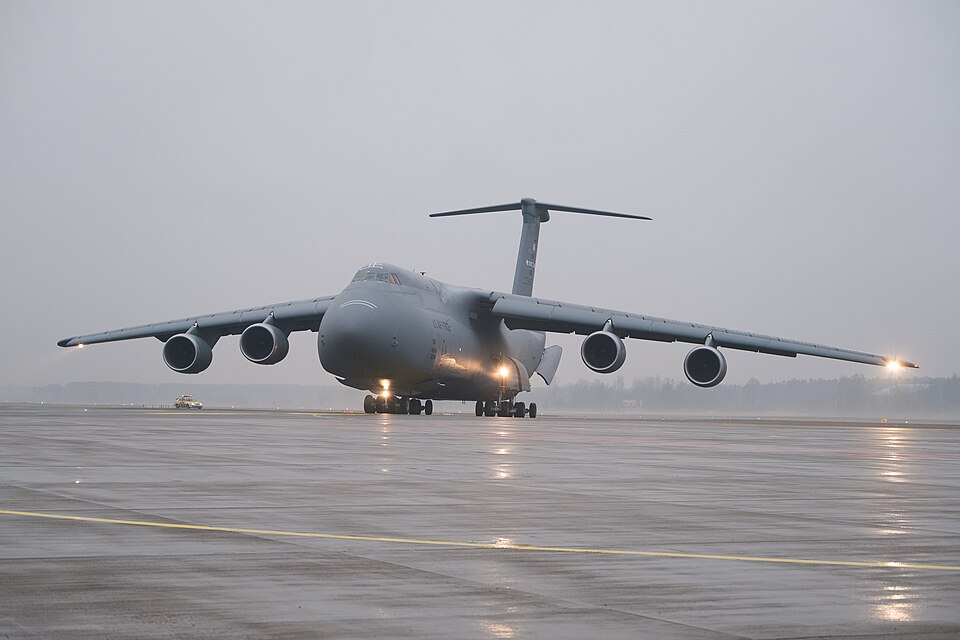
4. Boeing C-17 Globemaster III
The C-17 was designed to do something no previous military transport could do well: fly strategic missions like the C-141 Starlifter while also landing on short, austere airfields like the C-130. It hit that target with impressive results.
The C-17 combines a massive payload capacity with the ability to land on runways as short as around 900 meters. Its engines are powerful enough to back the aircraft up a slope after landing, which matters when operating on short fields with limited turnaround space.
It has served in virtually every major military operation since it entered service in the 1990s and has become a cornerstone of United States and allied heavy airlift capability.
- Payload capacity: Up to approximately 77,519 kg
- Range: Around 4,630 km with full load
- Notable feature: Reverse thrust capability for backing up on the ground
Keep in Mind: The C-17 is primarily a military aircraft, but it has also been used for humanitarian missions, including the delivery of food, water, and medical supplies during major disasters.
5. Airbus A330-200F
Airbus entered the dedicated freighter market with the A330-200F, a purpose-built cargo variant of its popular wide-body twin. It sits in the mid-range segment, offering a good balance of payload, range, and operating cost for carriers that do not need the outright capacity of a 747.
The A330-200F uses a reinforced floor and a strengthened wing to handle heavy freight loads, while its modern engines keep fuel burn competitive. Its range is sufficient to cover most major intercontinental routes, and its twin-engine configuration lowers maintenance costs compared to four-engine alternatives.
- Payload capacity: Up to approximately 70,000 kg
- Range: Around 7,400 km with full load
- Notable feature: Purpose-built freighter design with structural reinforcements
Good to Know: Unlike many freighter conversions, the A330-200F was designed as a cargo plane from the start, which allowed engineers to optimize the structure and systems specifically for freight operations.
If you are just getting into aviation and want to understand how different aircraft types are designed for specific missions, reading about the best small jet planes can help you see how design priorities shift across categories.
6. Antonov An-225 Mriya
No list of the best cargo planes is complete without the An-225. It is, by many measures, the largest aircraft ever built to enter service. Designed in the Soviet Union to carry the Buran space shuttle on its back, it was later adapted for commercial super-heavy cargo operations.
The An-225 is in a category entirely by itself. Its six engines, massive wingspan, and reinforced fuselage give it a payload capacity that no other aircraft can match. It has been used to transport outsized cargo around the world, from entire power plant components to emergency relief supplies during the COVID-19 pandemic.
Sadly, the sole flying An-225 was destroyed in February 2022 during the conflict in Ukraine. A second airframe exists in incomplete form, but its future is uncertain. Still, the aircraft's legacy as the ultimate cargo hauler is permanent.
- Payload capacity: Up to approximately 250,000 kg
- Range: Around 4,000 km with full load
- Notable feature: Largest wingspan of any aircraft to have entered operational service
Fun Fact: The name "Mriya" means "dream" in Ukrainian, a fitting tribute to one of the most ambitious aircraft ever designed.
Flying411 helps buyers and sellers navigate the aircraft market with clear, practical information. If you are researching aircraft for commercial or cargo use, Flying411 can connect you with the listings and guidance you need.
7. McDonnell Douglas MD-11F
The MD-11F is the freighter variant of the MD-11 wide-body airliner. While the passenger version was phased out relatively quickly by airlines, the freighter version has proven far more durable and continues to serve major cargo carriers around the world.
Its three-engine configuration gives it a slightly different performance profile than twin-engine wide-bodies, with strong range capability that suits long intercontinental routes. Operators appreciate its reliability, and its payload capacity sits comfortably in the heavy freighter category.
- Payload capacity: Up to approximately 91,000 kg
- Range: Around 7,240 km with full load
- Notable feature: Three-engine layout with center engine in the tail
Pro Tip: The MD-11F is particularly popular with express cargo carriers because its combination of range and payload suits overnight transcontinental freight operations very well.
Military vs. Commercial Cargo Planes
It is worth stepping back for a moment to understand the difference between these two broad categories. They are designed for very different purposes, and the distinction shapes nearly every aspect of their design.
What Sets Military Cargo Planes Apart
Military cargo planes like the C-130 and C-17 prioritize flexibility and survivability. They need to land in places without paved runways, operate in conflict zones, and carry unusual loads like tanks, helicopters, and artillery. They are also designed for low-altitude airdrops and paratroop operations, missions that commercial freighters never perform.
The tradeoff is operating cost. Military transports are expensive to fly, and their specialized features add weight and complexity. They are not optimized for commercial efficiency.
What Makes Commercial Freighters Different
Commercial freighters like the 747-8F and A330-200F are optimized for cost-per-ton-mile. Fuel efficiency matters enormously. So does turnaround time at airports. They operate from established facilities with paved runways, cargo handling equipment, and ground support infrastructure.
Commercial operators choose aircraft based on route economics, not battlefield requirements. A plane that burns slightly more fuel per hour can easily lose money on a competitive freight route.
| Feature | Military Transport | Commercial Freighter |
| Runway requirement | Short/unpaved | Long/paved |
| Key priority | Flexibility and range | Cost efficiency |
| Loading design | Rear ramp standard | Nose/side doors common |
| Payload optimization | Outsized military cargo | Pallets and containers |
| Operating cost | High | Lower per ton-mile |
Cargo Aviation and the Future of Air Freight
The cargo aviation industry is changing quickly. E-commerce growth has pushed demand for air freight to record levels in recent years, and airlines that had written off freighter operations have rushed back into the market.
At the same time, newer aircraft are dramatically more fuel-efficient than the planes they replace. The Boeing 777X freighter variant, currently in development, promises efficiency gains that could reshape the economics of long-haul cargo routes.
Unmanned cargo aircraft are also entering the picture. Several companies are developing large autonomous freighters designed to reduce operating costs on regional and domestic routes. It is still early days, but the direction is clear.
If you are interested in how aviation is evolving across different segments, it is worth looking at how aircraft designed for families of six balance comfort and range requirements, since many of the same efficiency trends apply across the industry.
Why It Matters: Cargo aviation accounts for a significant share of global air traffic revenue, and its growth directly supports jobs, supply chains, and international trade across every major economy.
How Cargo Planes Compare to Other Aircraft Categories
Cargo planes represent just one corner of the broader aviation world. Pilots and aviation enthusiasts often move between categories, learning about different aircraft types to develop a fuller picture of what is out there.
If you are newer to aviation and want to understand the full landscape, looking at options for beginner pilots is a useful starting point. From there, you can branch out into larger aircraft and specialized categories like freight transport.
For those exploring multi-engine aircraft, four-seat aircraft offer a useful comparison point when thinking about range, payload tradeoffs, and operating costs at a much smaller scale. And for pilots thinking about their first aircraft purchase, reviewing the best first planes to buy gives a solid foundation before moving up in complexity.
Heads Up: Transitioning from general aviation aircraft to larger transport-category planes requires additional training, type ratings, and in many cases, significant flight experience requirements.
Conclusion
The best cargo planes in aviation history are a remarkable group of aircraft. They range from the rugged, go-anywhere C-130 Hercules to the record-shattering An-225 Mriya. What they share is a commitment to moving things reliably, across great distances, under demanding conditions. That mission has shaped every design decision from wing loading to cargo door placement.
Cargo aviation is one of the least glamorous and most essential parts of modern life. The next time a package arrives at your door, there is a good chance a plane on this list played some role in getting it there.
If you want to keep exploring the world of aviation, from cargo giants to personal aircraft, Flying411 is the place to start. Check out the listings, guides, and resources to find the aircraft information that fits where you are in your aviation journey.
FAQ
What is the largest cargo plane in the world?
The Antonov An-225 Mriya is widely considered the largest cargo aircraft ever built, with a maximum payload capacity of around 250,000 kg. Sadly, the only flying example was destroyed in 2022, making its future status uncertain.
What cargo plane does FedEx use?
FedEx operates a large fleet of cargo aircraft including the Boeing 777F, Boeing 767F, and the McDonnell Douglas MD-11F, among others. The mix of aircraft allows the company to match plane size and range to different route requirements.
How much does it cost to charter a cargo plane?
Charter costs vary enormously depending on the aircraft type, route length, and payload requirements. A smaller regional freighter might cost tens of thousands of dollars for a single mission, while a large strategic transport can cost significantly more per flight hour.
Can cargo planes carry passengers?
Most dedicated cargo aircraft are not certified to carry fare-paying passengers in standard configurations. However, some military cargo planes regularly carry personnel along with freight, and certain converted freighters have been used in unique mission profiles that include both cargo and passengers.
What is the difference between a freighter and a cargo conversion?
A purpose-built freighter is designed from the ground up as a cargo aircraft, with a reinforced structure and optimized loading systems. A cargo conversion is a former passenger aircraft that has been modified for freight operations, typically by removing seats and reinforcing the floor. Both types serve the market, but purpose-built freighters generally offer better structural optimization for heavy loads.