When you board a commercial flight today, there is a good chance you are sitting in an Airbus. Since the company launched its first aircraft in 1972, Airbus has grown into one of the most influential aerospace manufacturers in the world. It now holds a top position globally in commercial airliner deliveries, competing directly with Boeing on nearly every route and market segment.
But not every Airbus model carries the same legacy. Some changed the way airlines operate. Others redefined passenger comfort. A few pushed the boundaries of what was thought possible in commercial aviation. The best Airbus planes are more than just flying machines. They are engineering milestones that reshaped how the world travels.
Whether you are an aviation enthusiast, a frequent flyer curious about the planes you board, or someone exploring the world of aircraft ownership, understanding these models gives you a deeper appreciation for how far aviation has come. Here is a close look at the seven best Airbus planes ever built, and why each one earned its place on this list.
Key Takeaways
The best Airbus planes include the A320 family, A380, A350, A330, A220, A300, and A321XLR, each excelling in different areas of commercial aviation from short-haul efficiency to ultra-long-haul range. Together, these aircraft have helped Airbus become one of the most trusted names in the industry, offering airlines options for nearly every route, passenger load, and budget.
| Aircraft | Best Known For | Typical Seating | Range |
| Airbus A320neo | Fuel-efficient narrow-body workhorse | 150 to 194 | Up to 3,500 nm |
| Airbus A380 | World's largest passenger jet | 525 (typical 3-class) | Up to 8,000 nm |
| Airbus A350 | Long-haul composite widebody | 300 to 410 | Up to 8,700 nm |
| Airbus A330neo | Versatile mid-range widebody | 260 to 300 | Up to 7,200 nm |
| Airbus A220 | Regional comfort redefined | 100 to 150 | Up to 3,450 nm |
| Airbus A300 | The aircraft that started it all | 220 to 266 | Up to 4,000 nm |
| Airbus A321XLR | Longest-range single-aisle ever | 180 to 220 | Up to 4,700 nm |
If you are curious about aircraft beyond the commercial world, Flying411 is a trusted resource for buyers and enthusiasts navigating the general aviation market.
A Brief History of Airbus
Before diving into the best models, it helps to understand where Airbus came from. The company began as a European consortium in 1970, formed through cooperation among France, Germany, Spain, and the United Kingdom. The goal was straightforward: compete with the dominant American aircraft manufacturers that controlled the market at the time.
The first Airbus aircraft, the A300B1, took flight on October 28, 1972. It was the world's first twin-engine wide-body airliner. Early sales were slow, but the aircraft eventually proved its value, and Airbus found its footing.
Fun Fact: Airbus did not land its first American customer until 1978, when Eastern Airlines signed on. It took six years of persistence to crack the U.S. market.
By the 1980s, Airbus had launched the A320, which went on to become one of the most successful commercial aircraft programs in aviation history. By 2019, Airbus had emerged as the world's largest manufacturer of commercial airliners by deliveries, a title it has held in many years since.
The story of Airbus is one of collaboration, competition, and relentless innovation. And that story is best told through its aircraft.
What Makes an Airbus Plane Stand Out?
Not every aircraft earns a place in aviation history. The models on this list stand out for specific reasons, and it is worth understanding the key traits that separate a good plane from a great one.
Fuel efficiency is at the top of the list for airlines. Fuel represents one of the largest operating costs, so any aircraft that burns less per seat-mile gets serious attention from fleet planners.
Range determines which routes an airline can serve. A plane with longer legs opens up more possibilities, especially for connecting cities that are far apart.
Passenger comfort matters more than ever. Cabin pressure, seat width, noise levels, and air quality all affect the flying experience.
Common type ratings across aircraft families reduce pilot training costs. Airbus has long invested in cockpit commonality across its models, which means pilots who fly one Airbus type can often transition to another with less retraining.
Technological innovation drives the industry forward. Whether it is fly-by-wire controls, composite materials, or advanced avionics, the best aircraft push the boundaries of what is possible.
Pro Tip: When comparing aircraft models, look beyond seat counts. Range, fuel burn per seat, and maintenance costs often matter more to operators than raw passenger capacity.
7 Best Airbus Planes of All Time
Airbus has produced a wide range of aircraft over the decades, but a handful of models stand above the rest. The seven planes below were chosen based on their commercial impact, technological innovation, and lasting influence on how airlines and passengers experience air travel.
Each one tells a different part of the Airbus story, and together they cover the full spectrum of what modern commercial aviation looks like.
1. Airbus A320neo: The Best-Selling Narrow-Body in History
If there is one Airbus plane that defines commercial aviation today, it is the A320 family. And within that family, the A320neo, which stands for New Engine Option, represents its finest evolution.
The original A320 made its debut in 1988 and immediately changed the game. It was the first commercial aircraft to feature full digital fly-by-wire flight controls, replacing traditional manual systems with electronic signals that improved both safety and handling. That innovation alone would have secured its place in history.
The A320neo followed decades later with a significant upgrade. New-generation engines from either CFM International or Pratt and Whitney, combined with Sharklet wingtip devices, cut fuel burn by up to 20 percent compared to the previous generation. Noise emissions dropped by roughly half.
Key highlights of the A320neo:
- Seats approximately 150 to 194 passengers depending on configuration
- Range of up to around 3,500 nautical miles
- Up to 20 percent lower fuel consumption per seat versus the older A320ceo
- Cockpit commonality with the A319, A321, and A318, reducing training costs
- Sharklets reduce drag and improve lift efficiency
The A320 family has been called the most successful commercial aircraft program in history, with tens of thousands delivered or on order. Airlines like United, Delta, JetBlue, Air France, and dozens more rely on these aircraft for their short-to-medium-haul routes.
In September 2025, the A320 family reportedly surpassed Boeing's 737 as the most-delivered airliner in history, a milestone that underscores just how dominant this program has become.
If you are researching the broader world of aircraft ownership for general aviation, resources on choosing your first plane to buy can give you a useful starting point.
Good to Know: The A320neo family now includes the A319neo, A320neo, A321neo, and the A321XLR. Each serves a slightly different market, giving airlines a scalable platform for routes of various lengths and densities.
2. Airbus A380: The Sky Palace That Rewrote the Record Books
Few aircraft in history have generated the kind of awe that the A380 does. It is, simply put, the largest passenger airliner ever built. And flying on one feels nothing like any other airplane.
The A380 features two full passenger decks running the entire length of the fuselage. In a typical three-class configuration, it seats around 525 passengers. In an all-economy layout, that number can climb to a certified maximum of 853. Emirates, the A380's biggest operator, famously configured some aircraft to carry 615 passengers across just two classes.
The numbers surrounding this plane are staggering. Its wingspan stretches nearly 80 meters. The two passenger decks together cover an area roughly equal to three singles tennis courts. The range of approximately 8,000 nautical miles means it can fly nonstop for around 17 hours, connecting distant city pairs without a fuel stop.
What makes the A380 remarkable:
- The only commercial aircraft certified to carry more than 500 passengers
- Two full-length passenger decks connected by fore and aft staircases
- Range of roughly 8,000 nautical miles
- Cabin noise is significantly lower compared to older large jets, reducing passenger fatigue
- Fly-by-wire controls and advanced avionics set a new standard for large aircraft
- Fuel burn of approximately 3.1 liters per 100 passenger-kilometers
Fun Fact: The A380 holds more than 380 patents, covering everything from acoustic paneling to hydraulic systems. Many of those technologies later became standard across the broader aviation industry.
The A380 entered service with Singapore Airlines in 2007 and quickly became a status symbol for the routes it flew. Emirates, Qantas, British Airways, Lufthansa, Korean Air, and others operated it on their flagship long-haul routes.
Production ended in 2021, but many A380s remain in service today. Airlines like Emirates continue to fly it extensively, and passengers consistently rate A380 flights among their best experiences in the air.
The A380 was ultimately a commercial challenge for Airbus. Development costs were enormous, and the industry's shift from hub-and-spoke routing toward point-to-point travel made filling 500-plus seat aircraft difficult. But as a piece of engineering and a passenger experience, it has few rivals in history.
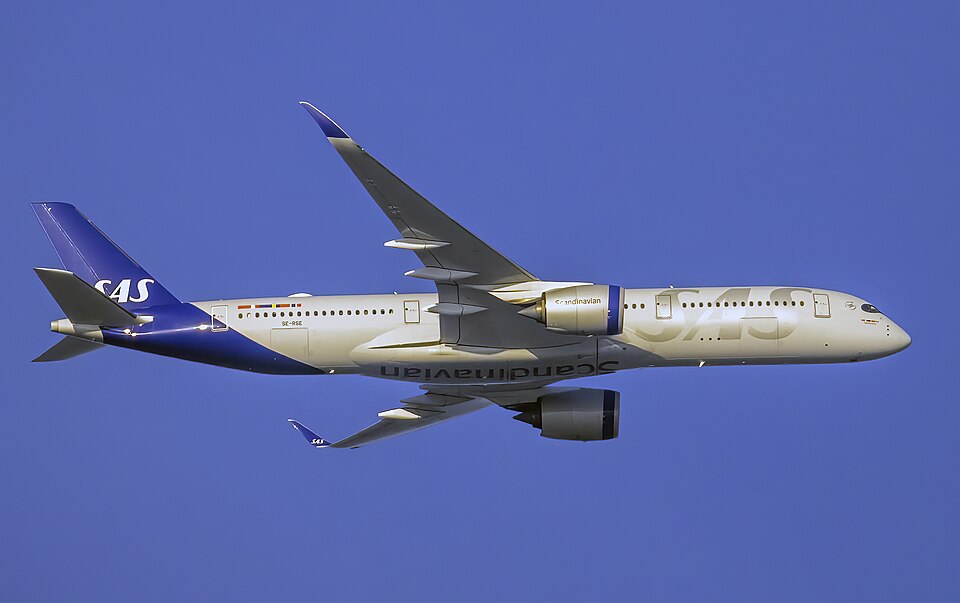
3. Airbus A350: The Composite-Wing Long-Haul Champion
The A350 is the aircraft Airbus built to take on Boeing's 787 Dreamliner head-on, and it succeeded impressively. Constructed largely from carbon-fiber-reinforced polymer composites, it is lighter, more efficient, and more comfortable than nearly anything that came before it.
There are two primary variants currently in service. The A350-900 seats roughly 300 to 350 passengers in a three-class layout with a range of approximately 8,500 nautical miles. The larger A350-1000 carries around 350 to 410 passengers out to about 8,700 nautical miles. Qatar Airways operates the A350-1000 on some of its longest routes.
Why airlines love the A350:
- Carbon-fiber composite structure reduces weight significantly
- Rolls-Royce Trent XWB engines deliver strong efficiency and low noise
- Advanced cabin air systems recycle and filter air more frequently than older widebody jets
- Larger windows than typical widebody aircraft improve cabin ambiance
- Lower operating costs per seat compared to older long-haul aircraft
The A350 replaced the older A340 program and now competes directly with Boeing's 787-9, 787-10, and 777 families. Qantas has ordered A350s for its ambitious Project Sunrise initiative, which aims to operate nonstop flights between Sydney and London, one of the longest possible commercial routes on the globe.
Why It Matters: The composite construction of the A350 is not just about weight. It also allows for higher cabin humidity and lower cabin altitude pressure, which reduces passenger fatigue on long flights. That is a genuine improvement in the flying experience for everyone on board.
For travelers comparing widebody aircraft options across different trip types, understanding aircraft range is critical. Those interested in twin-engine long-distance performance can also explore what makes twin-engine planes ideal for long-distance travel.
4. Airbus A330neo: The Proven Widebody That Got Even Better
The A330 has been one of Airbus's most reliable and commercially successful widebody aircraft for decades. The A330neo, which stands for New Engine Option, took that trusted airframe and gave it a significant boost in efficiency.
The A330neo uses Rolls-Royce Trent 7000 engines, which cut fuel burn by around 14 percent per seat compared to the older A330ceo. Sharklet wingtip devices borrowed from the A350 program squeeze out additional aerodynamic efficiency. The result is a widebody aircraft that delivers strong performance without requiring airlines to invest in an entirely new platform.
A330neo variants and their strengths:
- A330-800: Smaller variant, seats around 220 to 260 passengers, suited for thinner long-haul routes
- A330-900: Larger variant, seats roughly 260 to 300 passengers, the more popular option with airlines
The A330neo offers airlines a compelling value proposition. It provides widebody capability at a lower acquisition cost than the A350, making it attractive for carriers that need range and capacity without the premium price tag of an entirely new-generation widebody.
Operators like Delta have built meaningful A330neo fleets, and the aircraft continues to earn orders from airlines looking for a reliable, efficient workhorse for medium-to-long-haul operations.
Keep in Mind: The A330neo uses an updated version of a fuselage cross-section that dates back to the A300. That decades-long refinement means airlines benefit from one of the most operationally proven airframe designs in commercial aviation.
5. Airbus A220: Regional Flying Reimagined
The A220 has an unusual backstory. It was not originally an Airbus aircraft at all. Bombardier, the Canadian aerospace manufacturer, developed it as the CSeries. Financial difficulties led Airbus to acquire a majority stake in the program in 2018, and the aircraft was rebranded as the A220.
What Airbus inherited was a genuinely impressive regional jet. The A220 uses Pratt and Whitney Geared Turbofan engines, which feature a gear mechanism that allows the fan to spin at a different speed from the turbine. This design reduces noise, lowers emissions, and improves fuel efficiency meaningfully.
What sets the A220 apart:
- Seats between roughly 100 and 150 passengers depending on variant
- Range of up to approximately 3,450 nautical miles
- Four-abreast seating in economy gives passengers noticeably more room than typical regional jets
- One of the widest seat widths in its class
- Geared Turbofan engines reduce noise and fuel burn compared to older regional aircraft
The A220-100 seats around 100 to 135 passengers, while the A220-300 accommodates closer to 130 to 160 passengers. Airlines including Delta Air Lines, Air Canada, and Swiss International Air Lines have built significant A220 fleets.
Passengers who fly the A220 frequently comment on how spacious it feels for a regional aircraft. The wider fuselage, larger windows, and quieter cabin create an experience that feels closer to a widebody than a narrow-body regional jet.
Good to Know: Airbus has final assembly lines for the A220 in both Mirabel, Canada and Mobile, Alabama. The Mobile facility marks a meaningful American manufacturing presence for Airbus in the U.S. market.
For those thinking about aircraft in the four-seat category for personal or business use, there are great options worth exploring in the world of four-seat aircraft.
If you are thinking about adding an aircraft to your personal fleet or looking for guidance on what fits your flying needs, Flying411 connects aviation enthusiasts with the resources and listings that matter.
6. Airbus A300: The Plane That Started It All
No list of the best Airbus planes would be complete without the aircraft that launched the entire company. The A300 was the world's first twin-engine wide-body commercial airliner, entering service with Air France in 1974.
Before the A300, wide-body aircraft used three or four engines. The idea that two engines could power a large commercial jet was genuinely radical at the time. The A300 proved it could be done safely and economically.
Early sales were difficult. Airbus struggled to attract customers beyond its European base until 1978, when Eastern Airlines became the first American operator. After that, orders picked up steadily.
Why the A300 matters:
- Launched the Airbus program and established the company as a serious competitor
- Introduced the wide-body twin-engine concept to commercial aviation
- Laid the groundwork for every Airbus widebody that followed
- Served both passenger and cargo roles across its long production run
- The A300-600, a later variant, offered improved performance and modern avionics
The A300 also gave birth to the A310, a shorter derivative with greater range that found success on thinner transatlantic routes. Together, the A300 and A310 established Airbus as a credible alternative to Boeing and McDonnell Douglas.
Production of the A300 ended in 2007, but the aircraft's legacy lives on in every Airbus product line that followed. The fuselage cross-section Airbus developed for the A300 became the basis for the A310, A330, and A340, a design lineage that spans decades.
Fun Fact: The A300's first flight on October 28, 1972 is now celebrated as the official birthday of Airbus as a commercial aircraft manufacturer.
7. Airbus A321XLR: The Future of Single-Aisle Flying
The A321XLR, where XLR stands for Xtra Long Range, represents the most ambitious extension of the A320 family yet. Certified for passenger service in 2024, it is the longest-range single-aisle commercial aircraft ever built, with a range of up to approximately 4,700 nautical miles.
That range number matters a great deal. It means the A321XLR can connect city pairs that previously required widebody aircraft, but at a lower cost and with greater frequency. Routes like New York to Warsaw, or Boston to Madrid, become viable with a single-aisle aircraft for the first time.
What makes the A321XLR a game-changer:
- Range of up to roughly 4,700 nautical miles, a record for single-aisle jets
- Seats approximately 180 to 220 passengers depending on configuration
- Lower operating costs than widebody aircraft on medium-range international routes
- Rear center fuel tank extends range while preserving the standard A320 family cockpit commonality
- Certified on a 50 percent sustainable aviation fuel blend, with a path toward 100 percent capability by 2030
Airlines including Iberia, American Airlines, and Aer Lingus have placed orders for the A321XLR, intending to open or deepen transatlantic routes that widebody economics could not support profitably.
Pro Tip: The A321XLR is particularly interesting for airlines serving smaller city-pair markets across the Atlantic. Rather than waiting for a widebody to fill up before operating a flight, they can run the A321XLR more frequently on thinner routes and still turn a profit.
For those exploring the range of small jet aircraft available in general aviation, a review of small jet plane options offers useful context on what single-engine and light jets can do.
How Airbus Planes Compare Across Categories
Here is a quick side-by-side overview to help you understand which aircraft fits which role.
| Aircraft | Category | Seating Range | Max Range | Best For |
| A220 | Narrow-body regional | 100 to 160 | ~3,450 nm | Short to medium regional routes |
| A320neo | Narrow-body mainline | 150 to 194 | ~3,500 nm | High-frequency short-haul |
| A321XLR | Narrow-body long-range | 180 to 220 | ~4,700 nm | Thinner transatlantic routes |
| A330neo | Widebody medium-haul | 220 to 300 | ~7,200 nm | Mid-range international |
| A350-900 | Widebody long-haul | 300 to 350 | ~8,500 nm | Major long-haul routes |
| A350-1000 | Widebody ultra-long | 350 to 410 | ~8,700 nm | Ultra-long-haul flagship routes |
| A380 | Very large aircraft | 400 to 615+ | ~8,000 nm | High-density hub routes |
Airbus and Sustainability: What Is Changing
Airbus has been vocal about its goals to reduce the environmental impact of aviation. All current Airbus commercial aircraft are certified to fly on a 50 percent sustainable aviation fuel blend. The A320 family is engineered to reach 100 percent SAF capability by 2030.
Beyond fuel, Airbus is investing in hydrogen propulsion research, hybrid-electric demonstrators, and advanced aerodynamics. The company has set an aspirational goal of contributing to net-zero carbon emissions in aviation by 2050.
Why It Matters: Sustainable aviation fuel reduces lifecycle carbon emissions compared to conventional jet fuel. As SAF production scales up globally, the environmental profile of commercial aviation could improve significantly over the next two decades.
For families considering personal aircraft for longer trips, understanding aircraft capability across passenger loads is valuable. You can find helpful guidance on planes suited for groups of six if you are thinking about family aviation.
Airbus in the United States: More American Than You Think
Many Americans assume Airbus is purely a European company. The reality is more nuanced. Airbus has final assembly lines in Mobile, Alabama, producing both A220 and A320 family aircraft for airlines around the world.
The Mobile facility has been operational since 2015 and has expanded significantly since then. New assembly capacity was added in October 2025 to meet growing demand for A320 family aircraft. Airbus employs tens of thousands of workers across its U.S. supply chain and supports a significant network of American suppliers and partners.
Major U.S. carriers including American Airlines, Delta Air Lines, JetBlue, and United Airlines operate large fleets of Airbus aircraft, making Airbus a daily part of the American flying experience even if the brand does not always get prominent recognition.
For pilots or buyers just getting started in aviation, Flying411 is a great place to find resources, listings, and expert guidance tailored to the U.S. general aviation market.
Tips for Aviation Enthusiasts Following the Airbus Story
If you are fascinated by these aircraft and want to follow Airbus developments closely, here are a few things worth paying attention to:
- Production rates: Airbus has targeted a production rate of 75 A320 family aircraft per month by 2027, a pace that would be the highest in commercial aviation history.
- New programs: The next-generation single-aisle replacement for the A320 family is expected to become a major announcement in the coming years.
- Sustainability milestones: Watch for updates on SAF adoption rates and Airbus's hydrogen demonstrator program.
- Fleet transitions: Airlines retiring older narrow-body fleets are likely to choose between the A320neo family and Boeing's competing 737 MAX program, making each order announcement a significant industry event.
For those curious about the broader world of aviation and aircraft selection, resources on beginner aircraft options offer a grounded starting point for anyone thinking about getting into general aviation.
Quick Tip: Aviation tracking websites and apps let you identify the specific aircraft type on any commercial flight before you board. Knowing you are on an A350 versus an A330 can meaningfully shape your expectations for the flight experience.
Conclusion
The best Airbus planes represent more than half a century of engineering ambition, commercial competition, and genuine innovation in the way the world moves through the air. From the A300 that proved the twin-engine widebody concept, to the A320neo that now dominates short-haul flying, to the A380 that reimagined what a passenger jet could be, Airbus has consistently pushed aviation forward.
Each of the seven aircraft on this list earned its place through a combination of technical achievement, commercial success, and lasting impact on how airlines and passengers think about flying. Whether you are a casual traveler, a dedicated aviation enthusiast, or someone exploring the world of aircraft ownership, these planes tell a story worth knowing.
If you are ready to explore aviation further, Flying411 is your go-to resource for aircraft listings, buying guides, and expert insights across every corner of the aviation world.
FAQs
What is the most popular Airbus plane ever made?
The A320 family is the most popular Airbus program by a wide margin, with tens of thousands of aircraft delivered or on order. Within the family, the A320ceo and A320neo variants have the highest production numbers.
Is Airbus or Boeing considered safer?
Both Airbus and Boeing maintain strong safety records and are subject to rigorous regulatory oversight. Modern commercial aviation is extremely safe regardless of manufacturer, and both companies' aircraft meet the same international certification standards.
What Airbus planes does American Airlines fly?
American Airlines operates several Airbus types, including the A319, A320, A321, and has placed orders for the A321XLR. The airline is one of the largest operators of Airbus narrow-body aircraft in the United States.
Why did Airbus stop making the A380?
Airbus ended A380 production in 2021 primarily because demand fell short of what was needed to sustain the program economically. The aviation industry's shift toward point-to-point routes reduced the need for very large hub aircraft, and orders from airlines other than Emirates never reached the volumes Airbus had projected.
What is the difference between the A320ceo and A320neo?
The A320ceo, which stands for Current Engine Option, refers to the original generation of A320 aircraft using first-generation engines. The A320neo uses newer, more fuel-efficient engines and features Sharklet wingtip devices, delivering up to 20 percent lower fuel consumption per seat compared to the ceo generation.