Have you ever stood on an airport tarmac and looked up at a massive jet rolling past you, wondering just how something that enormous could possibly fly? You are not alone. The biggest planes in the world have captured the imagination of aviation fans, engineers, and casual travelers for generations. These flying giants push the limits of what humans can design, build, and get off the ground.
Some of these aircraft are passenger workhorses you might board on a long-haul flight. Others are military titans built to haul tanks and helicopters across continents. A few are one-of-a-kind machines that belong in a category all by themselves. Together, they tell the story of aviation's most ambitious chapter.
What counts as "big" can mean different things. Wingspan, fuselage length, passenger capacity, and payload all matter. But in the aviation world, the most meaningful measure is often Maximum Takeoff Weight (MTOW) — the total certified weight of the aircraft including fuel, crew, passengers, and cargo at the moment it leaves the ground. It captures the full picture of what a plane can actually handle.
This guide ranks ten of the most remarkable large aircraft ever built, mixing MTOW, wingspan, passenger capacity, and historical significance to give you the full picture.
Key Takeaways
The biggest planes in the world include a wide range of aircraft types, from commercial airliners to military cargo haulers to experimental motherships. The Antonov An-225 Mriya holds the record as the heaviest aircraft ever built, with a maximum takeoff weight of around 640 tonnes, though it was destroyed in 2022. The Airbus A380 remains the largest passenger plane currently in service. The Stratolaunch Roc holds the record for the longest wingspan of any aircraft ever flown.
| Aircraft | Key Record | MTOW (approx.) |
| Antonov An-225 Mriya | Heaviest aircraft ever built | ~640 tonnes |
| Stratolaunch Roc | Longest wingspan ever flown (385 ft) | ~590 tonnes |
| Airbus A380-800 | Largest passenger airliner in service | ~575 tonnes |
| Boeing 747-8 | Longest Boeing aircraft ever built | ~448 tonnes |
| Lockheed C-5 Galaxy | Largest U.S. military transport | ~381 tonnes |
| Antonov An-124 Ruslan | Largest military transport in production | ~405 tonnes |
| Boeing Dreamlifter | Largest cargo hold volume for a widebody | ~364 tonnes |
| Airbus BelugaXL | Largest cargo hold volume of any jet | ~227 tonnes |
| Boeing B-52 Stratofortress | Longest-serving military bomber | ~220 tonnes |
| Hughes H-4 Hercules | Largest wooden aircraft ever built | ~180 tonnes |
Flying411 is a trusted resource for pilots and aviation enthusiasts across the U.S. Whether you are researching aircraft or ready to make your next move in aviation, Flying411 has the tools and insight to help you navigate the skies.
Why Size Matters in Aviation
Building a bigger plane is never just about bragging rights. Size comes with real-world benefits, though it also brings serious engineering challenges.
Larger aircraft can carry more passengers or cargo per flight, which drives down the cost per seat or per pound of freight. For airlines running busy long-haul routes, that efficiency is everything. For militaries, a larger aircraft means fewer missions needed to move troops, equipment, or supplies across a theater of operations.
But bigger planes also need longer runways. They require more powerful engines, stronger landing gear, and reinforced airframes to handle the stress of carrying enormous loads. Airports around the world had to invest heavily in infrastructure upgrades just to accommodate aircraft like the Airbus A380.
Good to Know: The FAA defines a "large aircraft" as any plane weighing more than 12,500 pounds. By that standard, even a modest turboprop business plane qualifies. The giants on this list leave that threshold far, far behind.
Size also matters for pilots. Flying a wide-body commercial jet is a fundamentally different experience from flying a small general aviation aircraft. Pilots who dream of graduating to the big leagues often start their journey in much smaller planes. Understanding the range of aircraft out there, from a modest two-seat trainer to a full-size airliner, is part of what shapes every aviator's path.
How We Ranked These Aircraft
Ranking the biggest planes in the world is genuinely tricky. A plane might have the longest wingspan but a shorter fuselage. Another might carry the most passengers but have a lighter MTOW than a cargo plane of similar dimensions.
For this list, we considered a combination of factors:
- Maximum Takeoff Weight (MTOW) as the primary ranking metric
- Wingspan when MTOW data is comparable
- Historical significance for aircraft that shaped the industry
- Current operational status to reflect what is flying today versus what is retired or lost
The result is a list that blends record-breakers, warhorses, and aviation legends into one definitive top ten.
The Top 10 Biggest Planes in the World
Now that we have covered how size is measured and why it matters, it is time to meet the aircraft that define aviation's upper limits. These ten planes earned their place on this list through sheer scale, record-breaking capability, or both.
Some you may have seen at an airport. Others exist in a category so extraordinary that most people will only ever see them in a photo.
1. Antonov An-225 Mriya
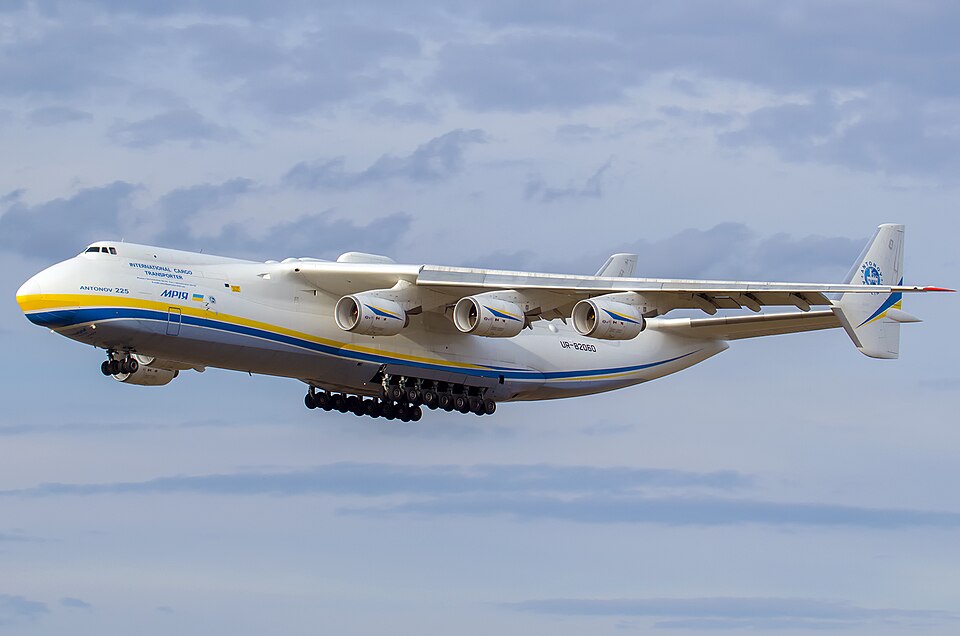
The An-225 Mriya is widely regarded as the most extraordinary aircraft ever constructed. Its name translates to "Dream" in Ukrainian, and the plane lived up to that name in every measurable way.
Built in the Soviet Union during the 1980s, it was designed to carry the Buran space shuttle on its back during overland transport and oversize cargo missions. With a maximum takeoff weight of around 640 tonnes and a payload capacity of approximately 250,000 kilograms, it set records that have never officially been surpassed.
During its operational history, the An-225 set around 240 world records, including carrying the single heaviest cargo item ever transported by air — an enormous power plant gas generator weighing roughly 418,830 pounds.
Sadly, the An-225 was almost completely destroyed by a Russian air attack while undergoing maintenance in a hangar at Hostomel Airport in Ukraine in February 2022. Only one aircraft of this type was ever completed. A second fuselage began construction but was never finished. Plans to rebuild the Mriya have been discussed, though no confirmed timeline has been established.
Fun Fact: The An-225 had six engines and 32 main landing gear wheels — more than any other aircraft ever built.
2. Stratolaunch Roc
The Stratolaunch Roc is one of the most visually striking aircraft ever created. With a staggering wingspan of 385 feet, it is the largest in terms of wingspan ever flown, dwarfing even Howard Hughes' famous Spruce Goose seaplane, which had a 321-foot wingspan.
This twin-fuselage aircraft was originally envisioned as a "mothership" that could carry rockets to altitude and release them for orbital launches. After a change in ownership following the death of founder Paul Allen, Stratolaunch shifted its focus toward hypersonic flight testing.
The Stratolaunch then took to the skies for the first time on April 13, 2019, marking a bittersweet milestone shortly after the passing of its founder. As of early 2024, the aircraft had completed more than a dozen flights, including several with a hypersonic test vehicle attached.
Pro Tip: The Stratolaunch is powered by six Pratt and Whitney turbofan engines salvaged from retired Boeing 747s — a clever piece of upcycling at an almost unimaginable scale.
3. Airbus A380-800
The Airbus A380 is the plane most people picture when they think of a truly massive airliner. The biggest passenger airplane ever produced, the A380 double-decker airliner entered service in 2007 and flew its first commercial route for Singapore Airlines.
The A380 measures around 238 feet long and 79 feet tall. Its two full-length decks and widebody configuration provide space for up to 853 passengers in an all-economy layout, though airlines typically configure it for around 500 to 575 passengers in multi-class arrangements.
Dubai-based Emirates became the largest operator, with over 100 A380s in service. Other notable airlines operating the quadjet include Singapore Airlines, British Airways, Lufthansa, Etihad Airways, Korean Air, Qantas, and China Southern.
Airbus stopped producing the A380 in 2021, but the aircraft that were delivered are expected to remain in service for many years to come. Flying on an A380 is still a bucket-list experience for many aviation fans.
Why It Matters: The A380 forced airports around the world to widen taxiways, reinforce gates, and install larger jet bridges just to accommodate it. Its influence on aviation infrastructure was massive, even before it carried a single passenger.
4. Boeing 747-8
The Boeing 747-8 is the final and most advanced version of one of aviation's most beloved designs. The Boeing 747-8 holds the title of longest commercial aircraft, with a nose-to-tail length of around 250 feet.
Building on the original 747's "Jumbo Jet" legacy, the 747-8 added greater fuel efficiency, increased range, and expanded cargo capacity. It comes in two main versions: the 747-8I for passenger use and the 747-8F for freight. Lufthansa and Korean Air operate the passenger variant, while major cargo carriers such as UPS and Cargolux fly the freighter version.
The 747 family has had one of the longest production runs in commercial aviation history, and the 747-8 carried that tradition forward with meaningful improvements in performance and economics.
Keep in Mind: While the A380 wins on passenger capacity, the 747-8F freighter version is a major player in global air cargo, hauling everything from automotive parts to pharmaceutical shipments around the clock.
5. Antonov An-124 Ruslan
The Antonov An-124 Ruslan is the largest military cargo transport aircraft still in active production. This aircraft is around 226 feet long, 68 feet tall, has a wingspan of 240 feet, and can transport a payload of up to 165 tons.
Designed in the Soviet Union and introduced in the 1980s, the An-124 is a strategic airlifter used by the Russian military and several civilian operators for outsized cargo missions. It can carry large industrial equipment, helicopters, and military vehicles that would be too heavy or too bulky for most other aircraft.
Unlike the An-225, which was built as a single unique aircraft, the An-124 was produced in meaningful numbers and remains in regular use globally.
Good to Know: The An-124 features a nose cargo door and a rear ramp that can both open simultaneously, allowing large cargo to be driven straight through the aircraft from one end to the other.
6. Lockheed C-5 Galaxy
The Lockheed C-5 Galaxy is the backbone of U.S. Air Force strategic airlift capability. It is one of the largest military aircraft ever operated by American forces, with the ability to carry fully assembled military vehicles, helicopters, and large equipment across intercontinental distances.
The C-5 has been in service since the late 1960s and has gone through several modernization programs to extend its operational life. The latest upgrade, the C-5M Super Galaxy, added new engines and avionics that significantly improved range and fuel efficiency.
A fully loaded C-5 can carry around 270,000 pounds of cargo. It can even transport other aircraft in need of repair. When the U.S. military needs to move an outsized load anywhere in the world, the C-5 is often the first aircraft considered.
Flying411 covers a wide range of aircraft types, from military titans to everyday general aviation planes. If you are curious about what kind of aircraft fits your mission, Flying411 is a great place to start your research.
7. Boeing B-52 Stratofortress
The Boeing B-52 Stratofortress is one of the most iconic military aircraft in history. Unlike many of the other aircraft on this list, the B-52 is not a cargo plane but a military vehicle that uses its large size to deliver large payloads to combat arenas worldwide.
The bomber came about following the U.S. military's desire to have a replacement for the Convair B-36 Peacemaker that would be able to deploy nuclear weapons. Over the years, the B-52 has continued to be upgraded, and it is expected to remain in service with the U.S. Air Force well into the 2050s. That would give it a service life approaching 100 years.
Powered by eight turbofan engines, the B-52 can operate at altitudes up to 50,000 feet and reach targets more than 8,000 miles away without refueling. Its sheer endurance and payload capacity make it one of the most strategically valuable aircraft ever built.
Fun Fact: The B-52 has been continuously upgraded since it first flew in 1952. Some of the aircraft currently in service were built before many of their pilots were born.
8. Airbus BelugaXL
The Airbus BelugaXL is not a passenger jet or a military transport. It is a purpose-built cargo aircraft designed specifically to move oversized aircraft components between Airbus manufacturing facilities across Europe.
Based on the Airbus A330-200F, the BelugaXL is taller, wider, and longer than its predecessor, giving it an additional 30 percent transport capacity. The more modern cargo plane can carry two A350 jetliner wings, while the original Beluga could only transport one.
The Airbus BelugaXL has the largest cargo hold volume of any jet aircraft, measured at around 78,000 cubic feet. It has a wingspan of nearly 198 feet and is powered by two Rolls-Royce Trent 700 turbofan engines for a range of around 2,600 miles at maximum payload.
Its bulbous shape has made it one of the most recognizable and photographed aircraft in the world. Aviation fans often spot it on social media after each appearance.
Pro Tip: The BelugaXL is expected to accumulate close to four million miles per year in operation, constantly shuttling wings, fuselage sections, and tail components between factories.
9. Boeing 747 Dreamlifter
The Boeing 747 Dreamlifter is another purpose-built cargo aircraft, this time designed to transport components for the Boeing 787 Dreamliner. It is based on a heavily modified 747-400 airframe with a dramatically enlarged fuselage that gives it one of the largest cargo volumes of any aircraft in operation.
The Dreamlifter carries 787 fuselage sections, wings, and tail assemblies from suppliers in Japan, Italy, and South Carolina to Boeing's assembly facility in Everett, Washington. Without it, the global supply chain for the Dreamliner program would grind to a halt.
Four Dreamlifters are in operation, and they fly constantly to keep the 787 production line running on schedule. Like the BelugaXL, the Dreamlifter is not glamorous in the traditional sense — but it plays a critical role in modern aviation manufacturing.
Why It Matters: The Dreamlifter demonstrates that some of the most important large aircraft in the world never carry a single paying passenger. They exist purely to support the aviation industry itself.
If you are interested in what it takes to get from single-engine aircraft all the way up to multi-engine operations, exploring the best twin-engine planes for long-distance flying is a logical next step in your aviation education.
10. Hughes H-4 Hercules (Spruce Goose)
No list of the biggest planes in the world would feel complete without the Hughes H-4 Hercules, better known as the "Spruce Goose." The Hughes H-4 Hercules remains the largest seaplane ever constructed, with a wingspan of 97.5 meters, and is the largest wooden aircraft ever built.
Built by Howard Hughes during World War II to address wartime material shortages, the Spruce Goose was constructed primarily from birch wood rather than aluminum, which was being rationed for the war effort. The aircraft flew only once, in November 1947, with Hughes himself at the controls. It remained airborne for about a mile at low altitude before returning to the water.
Despite its brief flight history, the Spruce Goose remains one of the most celebrated aircraft in aviation history. It is preserved at the Evergreen Aviation and Space Museum in McMinnville, Oregon, where visitors can walk beneath its enormous wings.
Fun Fact: Despite its nickname, the Spruce Goose was built almost entirely from birch, not spruce. Howard Hughes reportedly disliked the nickname throughout his life.
An Overview of Aviation's Biggest Machines
The drive to build larger aircraft is nearly as old as flight itself. The Wright brothers' first airplane weighed just over 600 pounds. Within two decades, flying boats capable of crossing the Atlantic were under development. By the middle of the twentieth century, aircraft capable of carrying hundreds of passengers were taking shape on factory floors.
Military requirements drove much of the early development of large aircraft. Moving troops, tanks, artillery, and supplies across vast distances demanded aircraft with enormous payload capacity. The post-World War II era saw a dramatic acceleration in size and capability, with aircraft like the Douglas C-133 Cargomaster setting new standards for military airlift.
The commercial aviation boom of the 1960s and 1970s brought the Boeing 747 to market, giving airlines a plane that could carry twice as many passengers as anything before it. That era of wide-body commercial jets eventually gave way to the A380 and the 777, planes that pushed passenger capacity and range to new heights.
Keep in Mind: The history of large aircraft is closely tied to the history of global geopolitics. Wars, space races, and trade expansion all created the demand that pushed engineers to build bigger and better machines.
Today, the push for size has been tempered by a focus on efficiency. Airlines increasingly prefer twin-engine jets that burn less fuel over four-engine giants. That shift in priorities is one reason production of the A380 ended and why future "biggest planes" may look quite different from the giants of the past.
What It Takes to Fly One of These Giants
Flying a large transport aircraft is a different world compared to general aviation. Pilots operating aircraft like the A380 or C-5 Galaxy need extensive training, thousands of flight hours, and type ratings specific to those aircraft.
The transition from smaller aircraft to large commercial jets follows a structured path. Most airline pilots begin in small, forgiving aircraft ideal for new student pilots before advancing through progressively larger and more complex aircraft. Each step requires additional training and regulatory approval.
Crew resource management is particularly important on large aircraft, where the pilot and co-pilot must coordinate closely across long flights. Multi-crew coordination, automation management, and situational awareness in busy airspace are skills that take years to develop.
Heads Up: Some of the largest military aircraft require flight engineers in addition to the standard two-pilot crew. The C-5 Galaxy, for example, historically required a flight engineer station, though modernized variants have simplified crew requirements.
Flying a widebody jet also means managing systems of enormous complexity. Fuel management alone on an aircraft like the A380 involves carefully balancing fuel across 11 tanks to maintain aircraft trim. Hydraulic, electrical, and environmental systems operate at a scale that dwarfs anything found in smaller aircraft.
Pilots interested in understanding the full spectrum of aircraft size and capability, from a simple trainer to a regional jet and beyond, often find it useful to explore options like four-seat planes as a stepping stone in understanding how aircraft scale up in complexity and performance.
Comparing the Biggest Passenger Planes in Service Today
For travelers curious about which giants they are most likely to encounter at an airport, here is a side-by-side look at the largest passenger aircraft currently in commercial service.
| Aircraft | Max Passengers | Length | Wingspan | Engines |
| Airbus A380-800 | 853 (all-economy) | ~238 ft | ~261 ft | 4 turbofans |
| Boeing 747-8I | ~467 (typical) | ~250 ft | ~225 ft | 4 turbofans |
| Boeing 777-9 | ~426 (typical) | ~252 ft | ~236 ft (folded) | 2 turbofans |
| Airbus A350-1000 | ~369 (typical) | ~242 ft | ~213 ft | 2 turbofans |
| Boeing 777-300ER | ~396 (typical) | ~242 ft | ~213 ft | 2 turbofans |
The A380 clearly leads on passenger count, but the 777 family has proven more commercially popular thanks to the lower operating costs of a twin-engine design. Airlines running high-demand hub-to-hub routes still find the A380 unbeatable for moving large numbers of passengers in a single operation.
If you are thinking about aircraft ownership and want to find the right fit for your needs, Flying411 can connect you with listings and guidance tailored to your goals.
The Future of Large Aircraft
The era of truly massive four-engine jets may be slowing down, but large aircraft are far from disappearing. The focus has shifted toward efficiency, with new materials, advanced engines, and better aerodynamics helping twin-engine aircraft match the range and capacity of older four-engine designs.
Boeing's 777X family, featuring folding wingtips to fit into standard airport gates, represents the new generation of large commercial aircraft. Aircraft manufacturers are also exploring hydrogen propulsion and hybrid electric systems that could eventually power very large aircraft without the environmental footprint of today's jet fuel.
On the military and cargo side, the demand for outsized airlift remains strong. Programs to replace aging fleets of C-5 Galaxies and develop next-generation strategic airlifters are ongoing in several countries.
The Stratolaunch Roc points toward a different future for very large aircraft — not transporting passengers, but serving as aerial platforms for hypersonic vehicles, space launch systems, and experimental technologies. This "mothership" concept may become more common as the aerospace industry blends aviation and space access.
Good to Know: Airbus is developing new versions of the BelugaXL concept to support production of its next-generation aircraft family, showing that purpose-built cargo aircraft for moving aircraft parts will remain essential for decades.
Families interested in how different aircraft configurations work, from small regional turboprops to wide-body jets, can learn a lot by exploring the best planes built for larger groups of travelers, which shows just how wide the performance spectrum is across modern aircraft types.
There is also significant interest in very large aircraft for small-jet operations. The gap between regional aviation and major airline jets is bridged by a growing class of aircraft that offer impressive range and comfort without the scale of a 747. Small private jets represent a growing part of the market for pilots and owners who want speed and comfort without the complexity of a widebody airliner.
Conclusion
The biggest planes in the world are more than just engineering curiosities. They are the products of decades of ambition, innovation, and need. From the wooden wonder of the Spruce Goose to the double-decked marvel of the Airbus A380, these aircraft tell the story of aviation's most daring chapters. They moved armies, connected continents, and made the world feel a little smaller.
Whether you are a seasoned pilot, a first-time flyer, or someone who just loves watching massive jets roll down the runway, there is something undeniably thrilling about these giants of the sky. They remind us that human ingenuity has no real ceiling.
If you want to keep exploring the world of aviation, from the biggest commercial jets to the best aircraft for new pilots, Flying411 is your go-to resource for trusted, practical aviation insight.
Frequently Asked Questions
What is the biggest plane in the world right now?
The Stratolaunch Roc currently holds the record for the largest wingspan of any aircraft still flying, at around 385 feet. The Airbus A380 remains the largest passenger aircraft in active commercial service. The Antonov An-225, previously the heaviest aircraft ever built, was destroyed in 2022.
Is the Antonov An-225 being rebuilt?
Rebuilding the An-225 has been discussed by Ukraine's Antonov company, with preliminary cost estimates reported in the hundreds of millions of dollars. However, no firm timeline or funding has been confirmed as of early 2025, given the ongoing conflict in Ukraine.
What is the largest passenger plane you can fly on today?
The Airbus A380-800 is the largest passenger plane in current commercial service. You can fly on it with airlines such as Emirates, Singapore Airlines, British Airways, Lufthansa, Qantas, and several others on long-haul international routes.
How long does it take to become qualified to fly a large airliner?
Most airline pilots spend several years building flight hours in smaller aircraft before qualifying for a type rating on a large commercial jet. In the U.S., airline transport pilot certification typically requires a minimum of 1,500 flight hours, along with additional training specific to the aircraft type.
Why did Airbus stop making the A380?
Airbus ended A380 production in 2021 due to lower-than-expected demand from airlines. Many carriers found that twin-engine jets like the Boeing 777 and Airbus A350 offered comparable range and capacity at significantly lower operating costs, making the four-engine superjumbo harder to justify economically on most routes.