Choosing the right trainer can be the difference between a student who solos in 20 hours and one who struggles for 60. The aircraft you learn in shapes how fast you build confidence, how cleanly you pick up new skills, and how much you actually enjoy your time in the cockpit.
The best planes for new pilots are not random picks. They are the trainers that certified flight instructors keep putting students in, year after year, because they simply work.
Some are high-wing classics. Some are sporty low-wings. One even comes with a parachute built into the airframe. Each has earned its place because it helps brand-new pilots focus on flying instead of fighting the airplane.
This post goes through what makes a great trainer, why the wrong one can stall your progress, and which seven aircraft instructors recommend most.
Key Takeaways
The best planes for new pilots are stable, forgiving, simple to operate, and affordable enough to fly often. The Cessna 172 leads the pack because it does everything well and almost nothing poorly. Other strong picks include the Piper Cherokee, Diamond DA20, Beechcraft Musketeer, Cessna 152, Piper Tomahawk, and the more advanced Cirrus SR20. Each one has helped real students earn real certificates at flight schools around the country.
| Aircraft | Seats | Wing Style | Best Suited For |
| Cessna 172 Skyhawk | 4 | High-wing | All-around primary training |
| Piper Cherokee PA-28 | 4 | Low-wing | Cross-country and precision |
| Diamond DA20 | 2 | Low-wing | Modern, efficient training |
| Beechcraft Musketeer | 4 | Low-wing | Solid, budget-friendly option |
| Cessna 152 | 2 | High-wing | Lowest-cost basic training |
| Piper Tomahawk | 2 | Low-wing | Building precise control feel |
| Cirrus SR20 | 4 | Low-wing | Modern avionics, premium track |
Flying411 covers the full spectrum of aviation, from primary trainers to advanced cross-country machines. Bookmark the site and keep coming back as your flying journey grows.
What New Pilots Actually Need in a Trainer Aircraft
Not every airplane is built for learning. A great trainer has specific qualities that help a student build skills without getting overwhelmed. Understanding what those qualities are makes it much easier to evaluate any aircraft you might step into.
The most important trait is stability. A training airplane should want to fly straight and level on its own, without constant input from the controls. When a student is busy reading instruments, talking on the radio, and managing checklists, a stable aircraft gives them one less thing to fight. High-wing designs like the Cessna tend to offer this naturally because the wing sits above the center of gravity and acts like a pendulum that resists rolling.
Excellent visibility is another quality instructors look for. Students need to see other traffic, identify landmarks during navigation lessons, and stay aware of where they are in the pattern. A design that blocks the student's view out the side or over the nose creates unnecessary difficulty.
Must-Have Qualities in a Good Trainer
Here is what else belongs on the list of must-haves for a training aircraft:
- Forgiving stall behavior. The airplane should give clear warning before a stall and recover easily when the student releases back pressure. Abrupt or unpredictable stalls are dangerous in training.
- Simple systems. A basic cockpit with straightforward avionics lets students focus on flying. Complex aircraft with retractable gear and constant-speed propellers are not appropriate for early lessons.
- Low operating cost. Students need to fly often to build skills. If the aircraft costs too much per hour, training gets stretched out and progress slows.
- Parts and maintenance availability. A plane that sits grounded for weeks waiting on rare parts is not useful to a flight school or a student on a timeline.
The Cessna 172, often called the Skyhawk, checks every one of these boxes. That is a big reason why it has long been considered the most popular trainer in aviation. But it is not the only option, and some students are better served by something different depending on their learning style and goals.
Pro Tip: Before committing to a flight school, ask which aircraft you will be flying on day one. The right trainer should feel like a partner in learning, not an obstacle to push through.
Why the Wrong Plane Makes Learning Harder
Putting a new student in the wrong aircraft does not just slow progress. It can shake confidence in ways that are hard to recover from. Flight training is already mentally demanding. Add an aircraft that punishes small mistakes harshly or requires advanced skill to handle basic maneuvers, and the student spends mental energy surviving the flight instead of learning from it.
The Piper Cherokee is a good example of a well-matched trainer. It is predictable. When a student makes a small control input, the aircraft responds in a predictable way. There are no surprises. That consistency is what lets a student start to build instincts. An aircraft that responds differently each time teaches nothing useful about aircraft control.
Common Mismatches to Avoid
Some aircraft that look attractive on paper are simply too much for a new student. Consider a few common mismatches:
- A complex retractable-gear aircraft adds a gear checklist, a constant-speed propeller, and higher landing speeds. None of those things help a student who is still learning to hold altitude in a turn.
- A high-performance aircraft with sensitive controls can feel like too much in turbulence, making basic maneuvers stressful instead of educational.
- An older aircraft with outdated instruments and weak radios makes communication and navigation harder than they need to be.
The Cub and similar tailwheel designs are wonderful airplanes, but they require additional skill that beginners simply have not developed yet. Learning on a tailwheel airframe adds the challenge of ground handling to an already full plate. Most instructors save those aircraft for students who already have their license and want to expand their skills. If old-school aviation calls to you, the world of classic airframes worth saving is a great place to look once you have your certificate.
Heads Up: A student who trains on a well-matched aircraft builds a foundation that transfers cleanly to more advanced types later. Starting with the wrong plane can mean unlearning bad habits for years.
How Flight Schools Choose Their Training Fleets
A flight school does not pick its fleet based on what looks good in a brochure. The decision comes down to practicality, economics, and what actually produces competent graduates. Understanding how schools make that call helps explain why certain aircraft show up on the ramp at almost every training facility in the country.
Maintenance cost and parts availability top the list of concerns. A Lycoming engine, for example, has been in production for decades. Mechanics know them well, parts are easy to find, and overhaul costs are predictable. That reliability matters enormously when a school has students flying six days a week. The Cessna 172 and Cessna 182, both powered by Lycoming engines in most configurations, benefit directly from this.
Schools also consider how well a trainer transitions to more advanced ratings. A student who learns the basics in a 172 Skyhawk will find the step up to a multi-engine aircraft or a commercial rating much smoother because the fundamental systems are familiar. Cockpit layout, engine management, and handling all carry forward in recognizable ways.
What Drives Fleet Decisions
Here is how fleet decisions typically get made:
- Insurance cost. Some aircraft are cheaper to insure for student use than others. Lower insurance means lower hourly rates for students.
- Resale value. Schools eventually sell their fleet aircraft. A Cessna or Piper holds its value well, which matters when budgeting for replacements.
- Student feedback. Instructors pay close attention to which aircraft their students learn fastest in and which ones produce the most frustration.
- Regulatory fit. Some schools offer sport pilot training, which requires aircraft certified for that purpose. Others focus on private and commercial tracks, which open up a wider range of options.
Why It Matters: The result is a training fleet that looks remarkably similar from one school to the next. Cessnas and Pipers dominate because they have earned that position through decades of producing good pilots efficiently and affordably.
Top 7 Best Planes for New Pilots Recommended by Instructors
These seven aircraft are not just popular. They are the planes that experienced instructors point to when a student asks where to start. Each one has earned its spot through real-world performance in the training environment.
1. Cessna 172 Skyhawk: The Gold Standard for New Pilots
The Cessna 172 Skyhawk is the quintessential choice for flight training. It has long been considered one of the most widely used trainers in the world, and that is not an accident. The 172 has been in continuous production since the mid-1950s, and its design has been refined over countless hours of real-world student use.
The Skyhawk does everything adequately and nothing dangerously. It stalls with clear warning. It climbs steadily. It handles crosswinds without drama. The high-wing design gives students excellent visibility of the ground during pattern work and cross-country navigation, which is genuinely helpful when you are still building your visual reference skills.
Key reasons instructors love the 172:
- Predictable flight characteristics in all phases of flight
- Spacious four-seat cabin that comfortably holds an instructor and student
- Simple cockpit layout that does not overwhelm a beginner
- Wide availability at flight schools across the country
- Strong resale value if you ever decide to buy one personally
For aspiring pilots trying to decide where to start, the 172 is the answer most instructors give without hesitation.
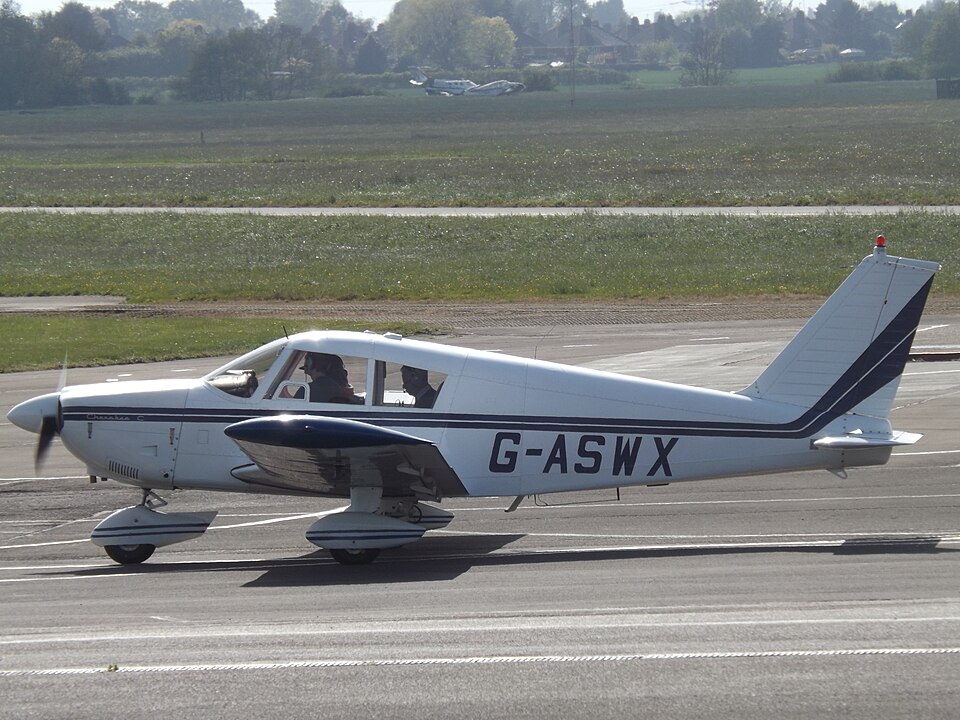
2. Piper Cherokee PA-28: A Predictable Low-Wing Favorite
The PA-28 Cherokee is the top choice after the 172 for many flight training programs. Where the 172 has a high wing, the Cherokee sits low, which changes the flying experience in meaningful ways. The low-wing design requires more active roll correction in crosswinds, which actually teaches students to use the ailerons more precisely. That is an important skill for pilots moving on to faster aircraft later.
The Cherokee holds its own because of how honest it flies. The controls are smooth and connected. The aircraft responds the way the textbooks say it should, which makes it a great teaching tool. The cabin is wide and comfortable, making long lessons less fatiguing. The Lycoming O-320 engine is simple and dependable. And because so many Cherokees are out there, maintenance is straightforward and affordable.
Good to Know: The Cherokee is also a strong cross-country trainer because the low-wing layout gives students good upward visibility of weather and other traffic on long legs.
3. Diamond DA20: Modern Build, Precision Handling
The DA20 is a two-seat composite aircraft that brings a different feel to early training. It is lighter and more responsive than a 172 or Cherokee, which means students have to be more deliberate with their inputs. That precision pays off later.
The aircraft is designed with excellent ergonomics. Side-by-side seating, a large bubble canopy, and modern avionics options give students a clear view of everything they need to monitor. The composite airframe is light, which keeps the DA20 efficient on fuel and affordable to operate per hour.
Responsive controls and a clean aerodynamic profile make this aircraft feel sporty without being intimidating. New pilots tend to come away from DA20 training with a sharper, more connected feel for the airplane.
4. Beechcraft Musketeer: The Underrated Workhorse
The Beechcraft Musketeer is a low-wing single-engine aircraft that does not get nearly the attention it deserves. It is built to Beechcraft's high standards of quality, which means the airframe is solid and the systems are straightforward. Pilots looking for a more affordable entry into the Beechcraft lineup often find the Musketeer to be the right fit.
It is a forgiving aircraft that handles gently and predictably. Visibility from the cockpit is good, the cabin is comfortable, and the systems are simple enough for early students while still being satisfying as skills develop. For students who eventually want to build hours in something dependable without high operating costs, the Musketeer deserves a close look.
5. Cessna 152: The Budget-Friendly Classic
The Cessna 150 evolved into the Cessna 152, and together they represent some of the most affordable flight training in general aviation. The 152 is a two-seat, high-wing aircraft powered by a modest Lycoming O-235 engine. It burns less fuel than a 172, which keeps the hourly operating cost lower.
The trade-off is performance. The 152 is slower and carries less useful load than its bigger sibling. On hot days at high elevations, it can feel underpowered. But for primary flight training in normal conditions, it is perfectly capable and widely available at schools that want to keep prices accessible.
Quick Tip: If you are flying purely to earn your private certificate at the lowest possible cost, asking about 152 availability at local schools is a smart first move.
6. Piper Tomahawk: A Trainer That Rewards Precision
The Piper Tomahawk is a two-seat trainer that Piper built specifically for the flight training market in the late 1970s. It has a reputation for being a bit more sensitive than the 152 or Cherokee, which some instructors use intentionally to sharpen a student's control inputs early.
The handling makes it an interesting aircraft to train in. Students who fly the Tomahawk tend to develop a light touch because the aircraft rewards precision. It is not a complex airplane, but it does not hide sloppy flying as easily as some other trainers. For students who want to fly solo with real confidence, the discipline the Tomahawk builds is valuable.
It is worth noting that the Tomahawk has been out of production for decades, so availability varies by location. But where it is available, it provides excellent training value at a reasonable hourly rate.
7. Cirrus SR20: A Premium Path for Students With Resources
The Cirrus SR20 sits in a different category from the other aircraft on this list, but it earns its place because it is increasingly becoming a first airplane for students at higher-end schools or programs that emphasize modern avionics from day one.
The SR20 is easy to fly in most respects. The controls are well-harmonized, the advanced avionics suite gives students early exposure to glass cockpit navigation, and the aircraft's parachute system adds a layer of safety that gives some students and parents genuine peace of mind. It is a genuinely capable airplane that does not require extraordinary skill to handle.
The downsides are cost and complexity. The SR20 costs significantly more per hour to operate than a 152 or Cherokee, and the avionics suite can be distracting for students who are not yet comfortable with the basics. For those with the budget and a clear path toward a serious aviation career, the SR20 is a legitimate and rewarding option.
Keep in Mind: The transition from an SR20 to more advanced types is also smooth, because the avionics are similar to what commercial programs and many regional operators use.
Comparing the Seven Best Planes for New Pilots
A side-by-side view often makes the choice clearer. Here is a quick comparison of all seven aircraft across the factors that matter most in training. Hourly costs are general estimates and can vary widely by region and school.
| Aircraft | Estimated Cost Per Hour | Best For | Skill Level |
| Cessna 172 | $150–$180 | All-around training | True beginner |
| Piper Cherokee | $130–$160 | Cross-country and precision | Beginner |
| Diamond DA20 | $120–$150 | Precision and efficiency | Beginner |
| Beechcraft Musketeer | $100–$130 | Budget-conscious students | Beginner |
| Cessna 152 | $100–$130 | Lowest-cost basic training | True beginner |
| Piper Tomahawk | $100–$130 | Developing control feel | Beginner |
| Cirrus SR20 | $200–$250 | Modern avionics exposure | Beginner with resources |
If you are curious about where general aviation training leads, exploring short-haul commercial airliners gives a sense of the regional jets many career pilots eventually fly.
How to Pick the Right First Plane for You
With so many strong options, the choice often comes down to fit. Three quick questions can guide most students toward the right answer.
What Is Your Budget?
If keeping costs low is the priority, the Cessna 152, Beechcraft Musketeer, and Piper Tomahawk usually offer the lowest hourly rates. If you have more flexibility and want a comfortable four-seat cabin, the Cessna 172 or Piper Cherokee is the natural pick.
What Are Your Long-Term Goals?
If you plan to stop at a private pilot certificate and fly recreationally, almost any aircraft on this list will serve you well. If you are aiming for a commercial career, exposure to modern avionics in something like the Cirrus SR20 or a glass-cockpit 172 can shorten the learning curve later. Pilots dreaming of flying the largest commercial airliners will follow a longer path, but it always starts in a basic single-engine trainer.
What Does Your School Have on the Ramp?
Practical access matters. The best trainer is the one you can actually fly twice a week. If your local school operates a fleet of Cherokees, that is the airplane to fall in love with. Consistency beats theory every time.
Fun Fact: Many career pilots who later fly heavy iron, sub-hunters, or even fast jets started their first lesson in something as humble as a Cessna 152 or a worn-out Cherokee.
Beyond the Trainer: Where Training Leads
Primary training is only the beginning. Once you have your private certificate, the door opens to instrument ratings, complex aircraft, and eventually the type of flying that drew you to aviation in the first place. Some pilots set their sights on long ocean patrols and spend years admiring the world of long-range patrol planes. Others dream about military aviation and follow the news on today's top American fighters or the high-G world of premier dogfighting jets.
Whatever your destination, the foundation you build in your first 40 to 60 hours shapes everything that comes after. Choosing the right trainer is your first real decision as a pilot. Make it carefully, but do not overthink it. The truth is, any airplane on this list will get you where you want to go.
Conclusion
The best planes for new pilots all share one thing in common. They let students focus on learning instead of struggling to keep up with the aircraft. From the dependable Cessna 172 to the modern Cirrus SR20, each airplane on this list has helped real students earn real certificates at flight schools across the country. Instructors recommend these aircraft because they work, plain and simple.
Start with the trainer that fits your budget, your school's fleet, and your long-term goals. Build a strong foundation, fly often, and trust the process. Before long, the airplane that felt so big on day one will feel like an old friend.
For more in-depth guides on training aircraft, ownership, and everything in between, head over to Flying411 and find the content that matches where you are in your aviation journey.
Frequently Asked Questions
How many hours does it typically take to solo in a trainer aircraft?
Most students reach their first solo flight somewhere between 15 and 30 hours, depending on how often they fly and which aircraft they train in. Students who fly two or three times per week tend to progress faster because the skills stay fresh. Aircraft like the Cessna 172 are often noted for helping students reach solo milestones efficiently.
Can a student pilot train in more than one aircraft type during primary training?
Yes, and many instructors actually encourage it when circumstances allow. Training in two different aircraft builds adaptability and helps students understand that good flying habits transfer across different types. That said, consistency in the early stages is usually better, so students can build a solid foundation before adding new variables.
Is it better to train at a Part 141 flight school or a Part 61 school?
Part 141 schools follow a structured FAA-approved curriculum and can lead to a private pilot certificate in fewer minimum hours. Part 61 schools offer more flexibility in scheduling and lesson structure. Neither is universally better. The right choice depends on how you learn, your schedule, and the quality of the specific school you are considering.
What should a new pilot look for when renting a training aircraft for the first time?
Check that the aircraft has a current annual inspection and that all required documents are on board, including airworthiness certificate, registration, operating handbook, and weight and balance data. Review the aircraft logbooks if possible, and ask the school about any recent maintenance issues. A walk-around with your instructor before the first flight is standard practice.
At what point should a new pilot consider buying their own aircraft instead of renting?
Most instructors suggest waiting until after you have earned your private pilot certificate before purchasing an aircraft. By that point, you have enough experience to evaluate different types realistically and understand what you actually need versus what just looks appealing in a listing. Students who buy too early sometimes end up with an airplane that does not match their training goals and slows their progress.
Are high-wing or low-wing trainers better for new pilots?
Neither is universally better. High-wing aircraft like the Cessna 172 offer better downward visibility and natural roll stability, which many beginners find comforting. Low-wing aircraft like the Piper Cherokee tend to teach more active aileron use and feel more like the higher-performance airplanes most pilots eventually move on to. Pick the wing that matches your school's fleet and your comfort level.
Do I need to learn on a glass cockpit aircraft?
Not at all, but it can help. Many new pilots start in aircraft with traditional analog gauges and transition to glass cockpit systems later. Others train from day one in something like a modern 172 or a Cirrus SR20 with full digital avionics. Either path produces capable pilots, though glass cockpit experience is increasingly valuable for those pursuing a professional career.