The United States has long been home to some of the most advanced and capable military aircraft the world has ever seen. From early Cold War jets that redefined aerial combat to modern stealth fighters packed with artificial intelligence and sensor fusion, American engineers have consistently pushed the boundaries of what is possible in the sky.
Whether you are a military aviation fan, a student of history, or simply someone who just watched a Top Gun movie and wants to know more, understanding the best US fighter jets tells you a lot about how air power has shaped modern warfare. These machines are not just fast metal tubes with guns. They are flying computers, strategic tools, and symbols of national capability all rolled into one.
This article covers 13 of the most impressive and important fighter jets in US military history, including some that are still flying today and a few that made history before being retired. Along the way, you will find performance specs, real-world combat records, and the stories that make each aircraft unique.
Key Takeaways
The best US fighter jets span several generations of technology, from powerful Cold War workhorses to fifth-generation stealth aircraft that can evade radar and share battlefield data in real time. At the top of the list sit the F-22 Raptor and F-35 Lightning II, both of which represent the current peak of American air power. The F-15 Eagle stands out for its unmatched air-to-air combat record, while jets like the F-16 Fighting Falcon and F/A-18 Super Hornet have proven their value through decades of global service.
| Fighter Jet | Role | Generation | Status |
| F-22 Raptor | Air Superiority | 5th | Active |
| F-35 Lightning II | Multirole | 5th | Active |
| F-15EX Eagle II | Air Superiority / Strike | 4.5th | Active |
| F-15E Strike Eagle | Strike Fighter | 4th | Active |
| F/A-18E/F Super Hornet | Multirole (Navy) | 4.5th | Active |
| F-16 Fighting Falcon | Multirole | 4th | Active |
| F-15C/D Eagle | Air Superiority | 4th | Phasing Out |
| A-10 Thunderbolt II | Close Air Support | 4th | Active (Limited) |
| F-14 Tomcat | Fleet Defense | 3rd/4th | Retired |
| F/A-18 Hornet | Multirole (Navy) | 4th | Phasing Out |
| F-117 Nighthawk | Stealth Strike | 4th | Retired (some reserve) |
| F-4 Phantom II | Multirole | 3rd | Retired |
| F-86 Sabre | Air Superiority | 1st Jet Gen | Retired |
If you are passionate about aviation and want to explore the world of aircraft ownership, buying, or selling, Flying411 is a trusted resource that connects aviation enthusiasts with the knowledge and listings they need.
What Makes a Fighter Jet "The Best"?
Before jumping into the list, it helps to understand what separates a great fighter jet from a good one. Speed alone does not tell the full story. Modern military aviation experts evaluate fighters based on a combination of factors.
Key performance factors include:
- Stealth capability — how well the jet avoids radar detection
- Speed and maneuverability — raw performance in the air
- Weapons payload — how much and what kinds of weapons it can carry
- Avionics and sensor fusion — the ability to gather, process, and share battlefield information
- Combat record — real-world performance in actual conflicts
- Versatility — ability to perform multiple mission types
- Operational cost — how expensive it is to fly and maintain
With those factors in mind, here is a look at 13 of the greatest fighter jets ever produced by the United States.
Fun Fact: The term "fifth-generation fighter" refers to jets that combine stealth, advanced avionics, sensor fusion, and network-centric warfare capabilities all in one airframe. Only a handful of countries have successfully fielded true fifth-generation aircraft.
The 13 Best US Fighter Jets: A Complete Ranking
America has produced fighter jets for nearly every kind of mission imaginable, from pure dogfighters built to dominate the skies to stealthy strike platforms that can slip past enemy defenses undetected. The 13 aircraft below cover that full range. Some are still flying today. Others have been retired but left a legacy that shaped everything that came after.
Each one earns its place on this list for a different reason, and together they tell the story of how American air power evolved from the dawn of the jet age to the stealth era of today.
1. F-22 Raptor — The King of Air Superiority
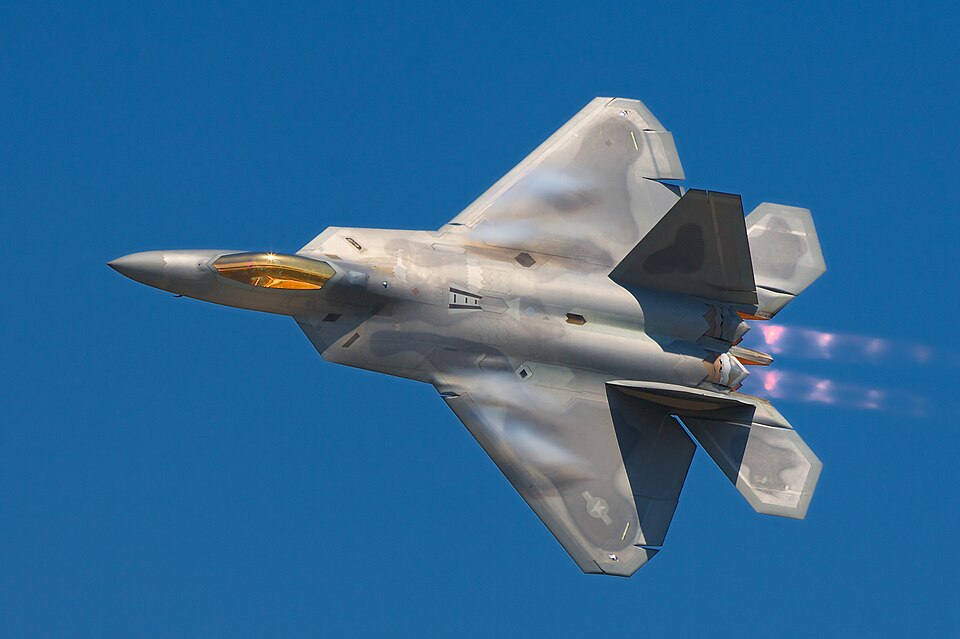
The Lockheed Martin F-22 Raptor is widely regarded as the most capable pure air superiority fighter in the world today. Built by Lockheed Martin and Boeing, the Raptor first flew in 1997 and entered service with the US Air Force in 2005. It was the world's first operational fifth-generation fighter.
What sets the F-22 apart is its combination of extreme stealth and extreme performance. Its radar cross-section is reportedly comparable to that of a small metal marble, making it nearly invisible to conventional radar systems. At the same time, its twin Pratt and Whitney F119 turbofan engines with thrust vectoring allow it to reach speeds of around Mach 2.25 and perform maneuvers no other operational jet can match.
The F-22 can carry six AIM-120 AMRAAM radar-guided missiles and two AIM-9 Sidewinder heat-seeking missiles internally, keeping its stealth signature intact. When stealth is not a priority, it can also carry weapons on external hardpoints.
Production was capped at 187 operational aircraft, a decision that has been debated by military analysts ever since. The high per-unit cost, which has been estimated at well over $140 million per aircraft (with total program costs pushing figures considerably higher), contributed to that decision. Despite limited numbers, the F-22 has been deployed in operations across the Middle East and beyond.
Why It Matters: The F-22 defined what a fifth-generation fighter could be. Its influence shaped the design and development philosophy of every stealth fighter that followed, both in the US and abroad.
Key specs (approximate):
- Top speed: ~Mach 2.25
- Range: ~1,800 miles (combat radius varies by configuration)
- Stealth: Extremely low radar cross-section
- Primary role: Air superiority
2. F-35 Lightning II — The Swiss Army Knife of the Skies
The Lockheed Martin F-35 Lightning II is the most widely produced and deployed fifth-generation fighter jet in history. Designed to replace a wide range of older aircraft across all three US military branches, the F-35 comes in three variants:
- F-35A — conventional takeoff and landing (USAF)
- F-35B — short takeoff and vertical landing (USMC)
- F-35C — carrier-based variant (USN)
What makes the F-35 special is not raw speed. With a top speed of around Mach 1.6, it is slower than the F-22 and even the F-15. Its power comes from its extraordinary sensor suite, advanced stealth, and the ability to act as a flying data hub. The jet fuses information from its radar, infrared sensors, satellites, and allied aircraft into a single coherent picture for the pilot.
The F-35 can carry a broad range of weapons, including air-to-air missiles, precision guided bombs, cruise missiles, and even the B61-12 nuclear gravity bomb. In "beast mode," it can carry close to 22,000 pounds of weaponry by using external mounts, sacrificing some stealth for maximum firepower.
Lockheed Martin delivered around 191 F-35s in 2025 alone, bringing the global fleet to roughly 1,300 aircraft across dozens of allied nations. The F-35 has seen real combat use by the US and partners including Israel and the United Kingdom.
Pro Tip: The F-35B's short takeoff and vertical landing capability makes it especially useful for operating from smaller amphibious assault ships, not just traditional aircraft carriers. This gives the Marine Corps significant flexibility in how and where it deploys air power.
As you explore other remarkable aircraft that push the limits of performance, you might also find it interesting to read about the best small aircraft in general aviation, where innovative design plays an equally important role.
Key specs (approximate):
- Top speed: ~Mach 1.6
- Stealth: Advanced low-observable design
- Variants: A (Air Force), B (Marines), C (Navy)
- Primary role: Multirole strike, stealth operations
3. F-15EX Eagle II — The New Eagle Soars
The Boeing F-15EX Eagle II is the newest and most advanced version of the legendary F-15 family. The first example was delivered to the US Air Force in 2021, representing a significant upgrade over the original F-15 design from the 1970s. It is not a retired platform — it is a brand-new aircraft built on a proven airframe.
The F-15EX is reportedly the fastest operational fighter in the US Air Force inventory, capable of reaching speeds around Mach 2.5. It can carry an extraordinary weapons load of up to 29,500 pounds, which is among the highest of any fighter in the world.
The new Eagle II features a digital fly-by-wire flight control system, an advanced electronic warfare suite, a new cockpit with modern displays, and the capacity to carry hypersonic missiles in the future. Unlike the stealthy F-22, the F-15EX is not a low-observable aircraft. Instead, it relies on speed, payload, and advanced sensors to dominate in combat.
The Air Force sees the F-15EX as a complement to the F-35 rather than a replacement. It can carry the weapons that are too large to fit inside the F-35's internal bays.
Good to Know: The F-15EX uses an open mission systems architecture, meaning its software can be updated more quickly and at lower cost than previous generations of aircraft. This is designed to help it stay relevant as threats evolve.
4. F-15E Strike Eagle — The Precision Strike Legend
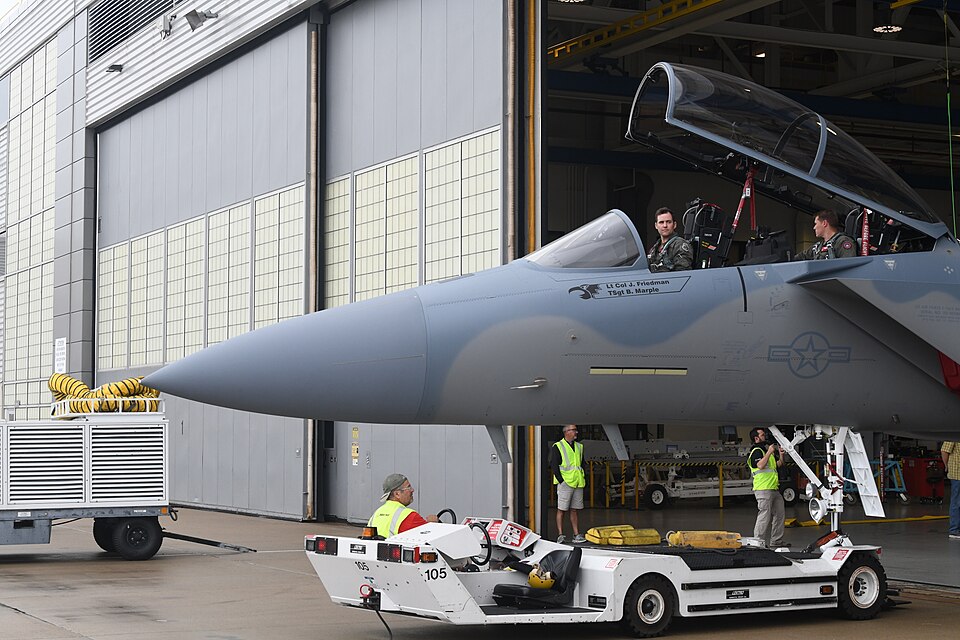
The F-15E Strike Eagle is the two-seat, all-weather strike variant of the original F-15 Eagle. It entered service in the late 1980s and has been one of the most combat-proven aircraft in the US military inventory ever since.
While the original F-15 was a dedicated air superiority fighter, the Strike Eagle added a rear-seat weapons systems officer and a range of precision ground-attack capabilities. It can carry laser-guided bombs, JDAM satellite-guided munitions, air-launched cruise missiles, and anti-ship weapons, all while still being capable of defending itself in air-to-air combat.
The Strike Eagle's combat record is extensive. During Operation Desert Storm, F-15Es flew night precision bombing missions against Iraqi targets with remarkable effectiveness. They have since served in operations across Afghanistan, Libya, Syria, and beyond.
One of the more remarkable facts about the F-15 family is its air-to-air combat record. Across all variants and operators, the F-15 has compiled an impressive string of victories in aerial combat with no losses in air-to-air engagements, a record that few aircraft in history can match.
Fun Fact: During the Gulf War, F-15E Strike Eagles were credited by some accounts with destroying a significant portion of one Iraqi armored division's total equipment, making them one of the most effective ground attack platforms of that conflict.
5. F/A-18E/F Super Hornet — The Navy's Workhorse
The Boeing F/A-18E/F Super Hornet is the primary strike fighter of the United States Navy and is widely used from aircraft carriers around the world. It is a substantially larger and more capable aircraft than the original F/A-18 Hornet it evolved from, with longer range, greater payload, and significantly improved avionics.
The Super Hornet comes in two versions: the single-seat F/A-18E and the two-seat F/A-18F. Both can carry a wide range of air-to-air and air-to-ground weapons, making them true multirole platforms. The EA-18G Growler, a specialized electronic warfare variant, also shares the Super Hornet airframe.
Top speed is around Mach 1.8, and the aircraft can carry more than 17,000 pounds of weapons across its multiple hardpoints. The Super Hornet is not a stealth aircraft, but it has been equipped with features designed to reduce its radar signature compared to older fighters.
The Super Hornet has served in combat operations across the Middle East and is operated by Australia in addition to the US Navy. The Navy has been transitioning toward the F-35C for carrier operations, but the Super Hornet is expected to remain in service for many years to come.
For those curious about aircraft designed for demanding and specialized conditions, the best VTOL aircraft represent another category of engineering excellence worth exploring.
Keep in Mind: The EA-18G Growler variant of the Super Hornet is one of the most important electronic warfare aircraft in the world. It can suppress and jam enemy radar and communication systems, creating safer conditions for strike packages to operate.
6. F-16 Fighting Falcon — The World's Fighter Jet
The General Dynamics F-16 Fighting Falcon is arguably the most important fighter jet in the history of American aviation in terms of sheer global impact. First flying in 1974 and entering service in 1978, the F-16 has been produced in numbers exceeding 4,500 aircraft and is operated by air forces across more than two dozen countries.
The F-16 was designed from the start to be a lightweight, highly maneuverable day fighter. Its single engine keeps costs down, while its fly-by-wire flight control system and reclined ejection seat allow pilots to sustain high g-forces without blacking out. The airframe has since been upgraded repeatedly and now serves in an impressive multirole capacity.
With a top speed over Mach 2, the F-16 is fast, nimble, and difficult to defeat in a close-in dogfight. It has seen extensive combat in the Gulf War, the Balkans, Afghanistan, Iraq, and many other theaters. Its combat record in air-to-air engagements is excellent.
The latest production variants, known as Block 70 and Block 72, feature active electronically scanned array (AESA) radar and significantly upgraded electronic warfare systems, keeping the design competitive well into the 21st century. Ukraine received F-16s from allied nations beginning in 2024, demonstrating that this aircraft remains highly relevant in modern combat.
Why It Matters: The F-16's combination of affordability, performance, and adaptability made it the backbone of US air power during the Cold War and helped dozens of allied nations build credible air forces. Its influence on modern fighter design is difficult to overstate.
7. F-15C/D Eagle — The Original Air Dominance Champion
The original F-15C and F-15D variants were the definitive air superiority fighters of the Cold War era. The F-15C is the single-seat combat version while the F-15D is the two-seat trainer. Both entered service in the late 1970s and have flown with the US Air Force for decades.
The F-15 Eagle was designed with one mission in mind: defeating any air threat. Its twin engines give it a top speed of around Mach 2.5, a rapid climb rate, and outstanding energy management in combat. Its powerful radar, advanced avionics, and ability to carry both short and long-range air-to-air missiles made it essentially unstoppable in its prime.
The F-15C and D are now gradually being phased out of US service as the F-35 takes over many missions and the newer F-15EX takes over the high-end strike role. Many Air National Guard units still fly the older Eagles, keeping the platform active even as retirement approaches.
8. A-10 Thunderbolt II — The Ground Troops' Best Friend
The Fairchild Republic A-10 Thunderbolt II is not a classic fighter jet in the air-to-air sense. It was built specifically for close air support, meaning its job is to fly low and slow over a battlefield and provide direct support to ground troops by destroying enemy armor, artillery, and personnel.
The A-10 is built around its legendary GAU-8 Avenger rotary cannon, a 30-millimeter weapon capable of firing around 4,000 rounds per minute and designed specifically to punch through the armor of tanks and other vehicles. The airframe itself is built to survive punishment, with a titanium "bathtub" surrounding the cockpit and dual engines mounted high on the rear fuselage to protect them from ground fire.
Despite repeated attempts by the Air Force to retire the A-10, the aircraft has continued to earn its place due to its unique effectiveness in close air support missions. It remains active today in a limited capacity.
The unique role that dedicated ground attack aircraft like the A-10 play in integrated combat operations shares some conceptual overlap with how specialized aircraft serve critical infrastructure missions. For an interesting comparison, see how the best firefighting aircraft also operate in demanding low-altitude environments.
Pro Tip: Pilots and ground troops who have worked with the A-10 often speak very highly of its effectiveness. The sound of the GAU-8 cannon has a distinctive quality that ground forces have called reassuring when it is on their side.
9. F-14 Tomcat — The Icon of a Generation
The Grumman F-14 Tomcat is one of the most iconic aircraft in American aviation history, largely due to its starring role in the 1986 film Top Gun. But beyond pop culture, the Tomcat was a genuinely extraordinary aircraft that served the US Navy from 1974 until its retirement in 2006.
The F-14 was designed as a fleet defense interceptor. Its most distinctive feature was its variable-sweep wing, which could change angle in flight to optimize performance at different speeds. At low speed, the wings spread wide for maximum lift. At high speed, they swept back to reduce drag. This gave the Tomcat impressive versatility across a wide range of mission profiles.
The F-14 was armed with the AIM-54 Phoenix, a very long-range radar-guided missile capable of engaging targets at distances said to reach 100 miles or more. This made it the ideal platform for defending carrier battle groups from enemy aircraft and missiles at extreme range.
The Tomcat compiled an air-to-air combat record during its service life, with kills credited in operations over Libya and the Persian Gulf. It was ultimately retired as the Navy transitioned to the more versatile and less expensive F/A-18 Super Hornet.
Fun Fact: After the US Navy retired its F-14 fleet, all surviving airframes were carefully shredded to prevent spare parts from falling into the hands of Iran, which had purchased F-14s during the era of the Shah.
10. F/A-18 Hornet — The Original Naval Multirole Fighter
The original McDonnell Douglas F/A-18 Hornet entered service with the US Navy and Marine Corps in the early 1980s and became the backbone of US naval aviation for two decades. The "F/A" designation reflects its dual role as both a fighter and an attack aircraft, which was unusual at the time.
The Hornet has a top speed of around Mach 1.8 and features a twin-engine design for reliability during carrier operations. Its avionics were considered advanced for their era, and the aircraft proved extremely capable in combat during Desert Storm, Bosnia, and Afghanistan.
The original Hornet has been largely replaced in Navy service by the larger and more capable Super Hornet. However, the Marine Corps continued operating the platform longer, and many allied nations flew the Hornet for extended periods.
Exploring how different aircraft serve different strategic environments is a fascinating part of understanding military aviation. For a look at aircraft built for a very different but equally demanding role, the best maritime patrol aircraft offer an interesting comparison.
11. F-117 Nighthawk — The Stealth Pioneer
The Lockheed F-117 Nighthawk holds a unique place in aviation history as the world's first operational stealth combat aircraft. Developed under extreme secrecy in the 1970s and 1980s, the F-117 entered service in 1983, but its existence was not publicly acknowledged until 1988.
The Nighthawk's angular, faceted design was unlike any other aircraft at the time. Rather than optimizing the shape for aerodynamic performance, the designers optimized it to reflect radar signals away from their source, drastically reducing the aircraft's radar signature. The result was an aircraft that could operate in heavily defended airspace with a dramatically reduced chance of detection.
The F-117 was used to spectacular effect during Operation Desert Storm in 1991, where it struck high-value targets in downtown Baghdad with precision-guided munitions while other aircraft could not safely operate in the same airspace.
The Nighthawk was officially retired in 2008, though a small number are said to be kept in flyable reserve condition. Its legacy lives on in every stealth aircraft that followed.
Good to Know: The F-117 was technically classified as an attack aircraft, not a fighter, since it carried no air-to-air weapons. The "F" designation was reportedly used partly for security purposes during its classified development years.
12. F-4 Phantom II — The Cold War Workhorse
The McDonnell Douglas F-4 Phantom II is one of the most significant American military aircraft of the 20th century. It served across the US Air Force, Navy, and Marine Corps, and was exported to many allied nations. The Phantom flew its first flight in 1958 and remained in some US service roles into the 1990s.
The F-4 was fast and powerful for its era, with a top speed exceeding Mach 2. It served in the Korean War's aftermath, became the dominant fighter of the Vietnam War era, and later served in operations around the world. It was also one of the first US fighters to rely heavily on radar-guided missiles rather than guns, a decision that caused problems in Vietnam when close-range engagements demanded a cannon that many early models lacked.
The lessons learned from the F-4's combat performance in Vietnam directly shaped the design philosophy of the F-15 and F-16, making the Phantom's influence felt in every American fighter that followed.
Keep in Mind: After early Vietnam combat experience revealed problems with gun-free air combat, the US military significantly reformed its air combat training doctrine. The famous Navy Fighter Weapons School, better known as TOPGUN, was established in 1969 partly as a result of these lessons.
13. F-86 Sabre — Where Modern Jet Combat Began
The North American F-86 Sabre holds a special place in American aviation history as the fighter that defined the jet age of aerial combat. First flying in 1947 and entering service in 1949, the Sabre was the first swept-wing jet fighter to see widespread US service.
The Sabre became famous during the Korean War, where it tangled regularly with the Soviet-built MiG-15 in dogfights over "MiG Alley," a stretch of airspace near the Yalu River. American and United Nations pilots flying the F-86 compiled what was by many accounts a favorable kill ratio against the MiG-15, though exact figures have been debated by historians.
The Sabre was not as fast or as powerful as fighters that came later, but it represented a crucial step in the evolution of American air power. Its swept-wing design, powered by a centrifugal-flow jet engine, set the template for the supersonic fighters that followed.
More than 9,000 F-86 Sabres were produced, making it one of the most widely built jet fighters in history. Many allies flew the Sabre for decades after the Korean War, and it remained in frontline service with some air forces into the 1990s.
Fun Fact: The F-86 Sabre was so important to early jet combat that it contributed directly to the training philosophy and tactics that American fighter pilots used for decades. Many of the maneuvers and doctrines taught in advanced combat schools today trace their roots back to lessons learned in the Sabre's cockpit.
How US Fighter Jet Generations Compare
Understanding fighter jet generations helps put each aircraft in context. The United States has fielded aircraft across several distinct technological generations.
| Generation | Key Feature | Example Aircraft |
| 1st Jet Gen | Basic jet propulsion | F-86 Sabre |
| 2nd Generation | Supersonic capable, early missiles | F-4 Phantom II |
| 3rd Generation | Mach 2+, improved radar, air-to-air missiles | F-14, F-15 (early) |
| 4th Generation | Fly-by-wire, advanced radar, multirole | F-15, F-16, F/A-18 |
| 4.5th Generation | AESA radar, partial stealth features | F-15EX, Super Hornet |
| 5th Generation | Full stealth, sensor fusion, network warfare | F-22, F-35 |
The jump from fourth to fifth generation was not just about speed or weapons. It was about information dominance. Fifth-generation jets can see more, share data faster, and survive in defended airspace where previous generations would not last long.
Why It Matters: Military planners often say that in modern air combat, the winner is the pilot who sees the enemy first and shoots first. Fifth-generation aircraft are designed specifically to win that race.
The Future of US Fighter Jets: What Comes Next
The US military is not standing still. Even as the F-35 continues full production and the F-22 serves in the active fleet, the next chapter of American air power is already being written.
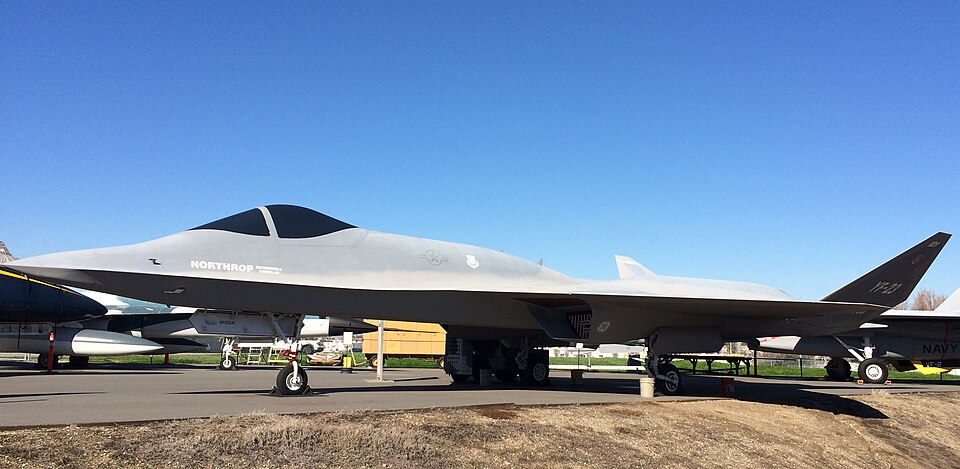
The Next Generation Air Dominance (NGAD) program is the US Air Force's effort to develop a sixth-generation fighter to eventually replace the F-22 Raptor. Details remain largely classified, but the program is expected to incorporate advanced artificial intelligence, improved stealth, directed energy weapons, and the ability to work alongside unmanned loyal wingman drones.
The Navy has its own parallel effort under the F/A-XX program to develop a sixth-generation replacement for the Super Hornet and older F/A-18s. Both programs aim to maintain US air superiority well into the second half of the 21st century.
Just as fighter jets represent the cutting edge of military aviation, other aircraft categories continue to evolve with impressive new designs. For a fascinating look at how modern engineering is reshaping air travel, the story of the biggest passenger planes in the world offers a compelling parallel in the commercial sector.
Heads Up: Sixth-generation fighter development is extremely expensive and technically challenging. Some defense analysts suggest that the future of air power may involve networks of cheaper unmanned aircraft working alongside a smaller number of crewed platforms rather than purely crewed supersonic jets.
What Sets American Fighter Jets Apart
The United States has maintained air superiority in virtually every conflict since World War II. Several factors contribute to this consistent advantage.
Investment in research and development. The US defense budget has historically included substantial funding for advanced aviation research. Programs like the Defense Advanced Research Projects Agency (DARPA) have helped produce breakthrough technologies that later found their way into production aircraft.
Pilot training. American fighter pilots go through some of the most rigorous and realistic training programs in the world. Schools like the Navy Fighter Weapons School (TOPGUN) and the Air Force's Weapons School produce tactically elite aviators who know how to get the most from their aircraft.
Industrial capability. Companies like Lockheed Martin, Boeing, and Northrop Grumman have maintained the engineering talent and manufacturing infrastructure to develop and build some of the most complex machines ever produced.
Allied cooperation. The F-35 program, for example, involved partner nations from Europe, Asia, and elsewhere. This collaboration spread development costs and helped build a global ecosystem of operators, spare parts networks, and shared tactical knowledge.
For a broader view of how specialized military aviation extends beyond fighters into other critical roles, the best regional aircraft section covers how aviation supports strategic transport and connectivity missions.
Conclusion
The best US fighter jets represent more than just machines. They reflect decades of technological ambition, strategic thinking, and the extraordinary skill of the pilots who fly them. From the F-86 Sabre's role in defining jet combat during the Korean War to the F-22 Raptor's unmatched stealth and agility, each aircraft on this list has contributed something lasting to American air power.
The transition from fourth-generation workhorses like the F-16 and F-15 to fifth-generation platforms like the F-22 and F-35 marks a fundamental shift in how air combat is conducted. Today, the battle begins long before aircraft are within visual range, with information and sensor dominance playing a larger role than raw speed or turning ability.
As the US moves toward sixth-generation designs, the aircraft on this list will be remembered as the foundation on which the next era of air superiority is built. These are not just fighters. They are milestones in the ongoing story of American aviation excellence.
If you want to stay connected with the aviation world, from military history to the latest in general aviation news and listings, Flying411 is your go-to resource for everything aviation.
Frequently Asked Questions
What is the most advanced US fighter jet currently in service?
The F-22 Raptor is generally considered the most advanced US fighter jet in service today, particularly for air superiority missions. The F-35 Lightning II is the most versatile and widely deployed fifth-generation fighter, excelling in multirole operations.
How many F-22 Raptors does the US military operate?
The US Air Force operates around 187 production F-22 Raptors. Production was capped at this number due to budget considerations, a decision that has been a subject of ongoing debate among defense analysts.
Is the F-35 faster than the F-22?
No. The F-22 Raptor has a higher top speed, reaching approximately Mach 2.25, compared to the F-35's top speed of around Mach 1.6. However, the F-35 compensates with superior sensor fusion, versatility, and multirole capability.
What happened to the F-14 Tomcat after it was retired?
The US Navy retired the F-14 Tomcat in 2006. To prevent spare parts from being acquired by foreign adversaries, most surviving airframes were destroyed rather than put into storage or sold. A small number are preserved in museums.
What is the difference between fourth-generation and fifth-generation fighter jets?
Fourth-generation jets like the F-15 and F-16 feature advanced radar, fly-by-wire flight controls, and multirole capability. Fifth-generation jets like the F-22 and F-35 add true stealth, advanced sensor fusion that combines data from multiple sources into one picture, and network-centric warfare capabilities that allow them to share battlefield information with other aircraft and ground forces in real time.