Just picture an aircraft that can rise straight up from a city street, hover like a hummingbird, and then tear across the sky at airplane speeds. That is exactly what vertical takeoff and landing (VTOL) aircraft do. No runway needed. No long taxiing. Just straight up, then go.
For decades, engineers have chased this dream. Some designs crashed and burned. Others became icons. A small handful changed warfare, transportation, and aviation forever. Today, the world of VTOL aircraft spans military jets, civilian tiltrotors, and a fast-growing wave of electric air vehicles.
Whether you are an aviation enthusiast, a pilot, or someone simply curious about how flight keeps reinventing itself, this guide breaks down the nine best VTOL aircraft ever built. These machines range from Cold War legends to cutting-edge flying machines still earning their wings.
Key Takeaways
The best VTOL aircraft include both fixed-wing military jets and tiltrotor designs that can take off vertically without a runway. The F-35B Lightning II is widely considered the most capable VTOL combat aircraft in operation today, while the Bell Boeing V-22 Osprey stands as the most proven tiltrotor in military service. The AgustaWestland AW609 leads the civilian tiltrotor market. VTOL technology is now branching into electric designs aimed at urban air mobility.
| Aircraft | Type | Primary Role | Status |
| Lockheed Martin F-35B | Supersonic STOVL jet | Combat/strike | Active service |
| Bell Boeing V-22 Osprey | Tiltrotor | Military transport | Active service |
| Harrier Jump Jet (AV-8B) | Vectored thrust jet | Close air support | Mostly retired |
| AgustaWestland AW609 | Civilian tiltrotor | Commercial transport | Certification phase |
| Yakovlev Yak-38 | Carrier-based VTOL jet | Naval combat | Retired |
| Bell V-280 Valor | Next-gen tiltrotor | Military transport | Development/testing |
| Joby Aviation S4 | eVTOL | Urban air taxi | Certification phase |
| Lilium Jet | eVTOL (electric ducted fan) | Urban air taxi | Development |
| Opener BlackFly | Ultralight electric VTOL | Personal aviation | Available |
At Flying411, aviation professionals and enthusiasts find reliable, up-to-date information on aircraft of all types, from powerful military jets to exciting new eVTOL designs entering the market.
What Is a VTOL Aircraft, Exactly?
Before diving into the list, it helps to clear up a common point of confusion. VTOL stands for Vertical Takeoff and Landing. It describes any aircraft that can lift off straight up, hover in place, and land vertically, without needing a runway.
Helicopters are the most familiar example. But the VTOL category in aviation typically refers to fixed-wing aircraft that achieve this feat, since helicopters are assumed to have this capability by design. The real engineering challenge is building an airplane-style aircraft that can still take off and land like a helicopter.
How VTOL Aircraft Generate Vertical Lift
There are several ways engineers have solved this problem:
- Vectored thrust: Rotating jet nozzles redirect engine exhaust downward for lift, then back for forward flight. The Harrier uses this approach.
- Tiltrotor: Large rotors tilt from vertical to horizontal as the aircraft transitions from hover to cruise. The V-22 Osprey is the best-known example.
- Lift fan systems: A separate fan generates downward thrust for vertical lift. The F-35B uses this alongside its main engine.
- Electric multirotor: Multiple electric motors power rotors that provide lift. This is the approach most eVTOL air taxis use.
Good to Know: Most VTOL fixed-wing aircraft actually prefer a short rolling takeoff when conditions allow. Taking off vertically burns far more fuel and limits how much payload the aircraft can carry. The term STOVL, or Short Takeoff and Vertical Landing, describes this common real-world compromise.
A Look at VTOL Flight
The idea of vertical flight goes back centuries. Leonardo da Vinci reportedly sketched early rotor concepts long before powered flight was possible. But practical VTOL aircraft only became a serious project after World War II, when military planners wanted jets that could operate without vulnerable runways.
Through the 1950s and 1960s, dozens of experimental VTOL designs were tested. Most failed. The engineering problems were brutal: how do you control an aircraft that is hovering on its own jet exhaust? How do you prevent the hot gas from being sucked back into the engine? How do you transition smoothly from hover to forward flight?
Only one fixed-wing VTOL design from that era truly succeeded in regular operational service: the Hawker Siddeley Harrier. It became the blueprint every later VTOL designer studied. Since then, only a handful of designs have reached full operational status.
Fun Fact: The U.S. Federal Aviation Administration created an entirely new aircraft category called "powered lift" specifically to classify the Bell Boeing V-22 Osprey, since no existing category quite fit its unique abilities.
The 9 Best VTOL Aircraft Ever Built
Each aircraft on this list earned its spot in a different way. Some changed how militaries fight. Others pushed the boundaries of civilian aviation. A few are still proving what they can do.
What they all share is a working answer to one of aviation's hardest questions: how do you build something that flies like a plane but lands like a helicopter?
1. Lockheed Martin F-35B Lightning II
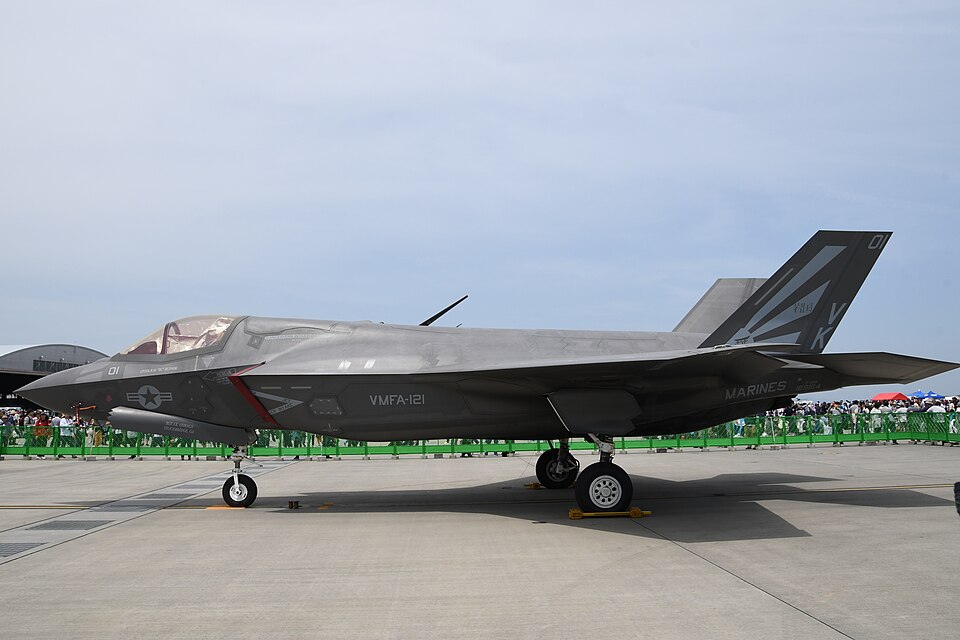
The F-35B is the crown jewel of operational VTOL aircraft. It is the world's first supersonic stealth aircraft with short takeoff and vertical landing capability, a combination no other jet had achieved before entering service with the U.S. Marine Corps in 2015.
What makes the F-35B remarkable is its lift system. A shaft-driven lift fan sits just behind the cockpit, spinning to generate downward thrust during vertical landings. The main engine's rear nozzle also swivels to direct thrust downward. Together, these systems let the aircraft land vertically even with its substantial weight.
Key specs (approximate):
- Max speed: Supersonic (Mach 1.6+)
- VTOL system: Lift fan plus vectored thrust nozzle
- Role: Stealth strike fighter
- Operators: U.S. Marine Corps, Royal Air Force, Royal Navy, and allies
The F-35B can operate from small amphibious assault ships, forward airstrips, and even improvised surfaces close to the front line. That operational flexibility is what sets it apart from every other supersonic fighter on the planet.
Flying411 covers military and commercial aircraft for readers who want to go deeper than the headlines. Browse the site for detailed breakdowns of the world's most capable aircraft.
Why It Matters: The F-35B is the only aircraft in history that combines supersonic speed, stealth technology, and vertical landing capability in a single operational package.
2. Bell Boeing V-22 Osprey
The V-22 Osprey is the world's most proven tiltrotor aircraft, and it changed how the U.S. military thinks about air assault, special operations, and logistics. It flies like an airplane in cruise but takes off and lands like a helicopter.
Its two large rotors tilt from vertical for hover and takeoff to horizontal for forward flight. This gives it a top speed roughly twice that of a conventional military helicopter, along with far greater range. A fleet of more than 400 aircraft has logged well over 600,000 flight hours across U.S. Marine Corps, Air Force, and Navy service.
Key specs (approximate):
- Top speed: Around 275 knots (roughly 315 mph)
- Range: Over 900 nautical miles
- Capacity: Up to 32 troops or significant cargo
- Role: Troop transport, special operations, search and rescue
The path to service was not easy. The Osprey program struggled through engineering setbacks and crashes during its long development period before finally entering service in 2007. Today it is a proven and valued platform. For those curious about how freighters and large transports handle logistical challenges, the role of aircraft like the V-22 connects to how cargo aircraft support global operations.
Pro Tip: The V-22's tiltrotor design gives it a cruise speed advantage over conventional helicopters, but it cannot hover as efficiently. Pilots must carefully manage power and airspeed during the critical transition between helicopter and airplane modes.
3. Hawker Siddeley / McDonnell Douglas AV-8B Harrier II
The Harrier jump jet is the grandfather of all VTOL fixed-wing aircraft. Originally developed by British manufacturer Hawker Siddeley in the 1960s, it became the first truly successful VTOL attack aircraft to reach operational service. The second-generation AV-8B Harrier II, built for the U.S. Marine Corps, refined the formula significantly.
The Harrier's trick is vectored thrust. Four rotating nozzles on the Rolls-Royce Pegasus engine can swivel from pointing backward for forward flight to pointing straight down for hovering. The pilot controls this with a small lever alongside the throttle.
Key specs (approximate):
- Max speed: Around 575 knots (subsonic)
- VTOL system: Four vectored thrust nozzles
- Role: Close air support and reconnaissance
- First flight: 1967 (GR.1), AV-8B first flight 1981
The Harrier served with the RAF, Royal Navy, U.S. Marine Corps, Italian Navy, Spanish Navy, and Indian Navy. It famously played a critical role in the Falklands War of 1982. Most variants have now been retired or are being replaced by the F-35B, but the Harrier's legacy as a VTOL pioneer is permanent.
Fun Fact: In 1983, a Royal Navy Harrier pilot who was running critically low on fuel is said to have landed safely on the deck of a Spanish container ship that happened to be nearby, making it one of the more unusual emergency landings in aviation history.
4. AgustaWestland AW609 (Leonardo AW609)
The AW609 is the world's first civilian tiltrotor aircraft to approach commercial certification, and it has been a long time coming. Developed by AgustaWestland (now Leonardo), it takes the same tiltrotor concept as the V-22 Osprey and packages it for private and corporate transport.
The AW609 is designed to cruise at around 275 knots and reach altitudes above 25,000 feet. It can carry up to nine passengers and access helipads, offshore platforms, and remote locations that a fixed-wing turboprop simply cannot reach.
Key specs (approximate):
- Cruise speed: Around 275 knots
- Range: Approximately 700+ nautical miles
- Capacity: Up to 9 passengers
- Role: Executive transport, offshore, emergency services
Certification has taken far longer than originally hoped, largely because powered lift aircraft require new regulatory frameworks. The FAA is still working on a Special Federal Aviation Regulation to govern aircraft like the AW609. When it does enter service, it will open a new category of point-to-point travel for private and corporate aviation. Readers interested in business aviation options can explore some of the best business aircraft available today for comparison.
Keep in Mind: The AW609 is not yet commercially certified. Potential operators have been waiting years for the FAA to finalize its powered-lift regulations, which are also being shaped by the broader eVTOL certification push.
5. Yakovlev Yak-38 Forger
The Yak-38 was the Soviet Union's answer to the Harrier, and it holds the distinction of being the only other carrier-based VTOL jet to reach operational service during the Cold War. It flew from Kiev-class aircraft carriers of the Soviet Navy starting in the late 1970s.
The Yak-38 used a combination of one vectored-thrust main engine and two dedicated lift jets mounted vertically behind the cockpit. This approach gave it reliable vertical lift but left little room for fuel or weapons once airborne, significantly limiting its combat usefulness.
Key specs (approximate):
- Max speed: Around Mach 1 (with afterburner, limited use)
- VTOL system: Main engine thrust vectoring plus two lift jets
- Role: Carrier-based strike
- Service: Soviet Navy, 1976 to early 1990s
The Yak-38 was retired following the fall of the Soviet Union and was never considered a full combat success. Its limited range and payload meant it was more of a proof of concept than a war-winning machine. Still, it earns a place on this list as one of only a handful of VTOL jets to actually serve aboard aircraft carriers.
Good to Know: The Soviet Navy's experience with the Yak-38 showed that a VTOL carrier aircraft with two separate propulsion systems for hover and cruise creates serious weight and reliability challenges. This lesson directly influenced later VTOL jet designs.
6. Bell V-280 Valor
The Bell V-280 Valor is a next-generation tiltrotor that represents a significant leap forward from the V-22 Osprey. It was developed as part of the U.S. Army's Future Long-Range Assault Aircraft (FLRAA) competition, which Bell won in late 2022.
Unlike the V-22, the V-280 tilts only its rotors, not the entire engine nacelle. This simplifies the mechanical system and reduces maintenance demands. The aircraft is designed to fly faster and farther than the Black Hawk helicopter it is intended to eventually replace.
Key specs (approximate):
- Cruise speed: Around 280 knots (hence the name)
- Range: Significantly greater than current assault helicopters
- Capacity: 14 troops or equivalent cargo
- Role: Long-range assault transport
The V-280 completed a successful test flight program and demonstrated impressive performance figures. Full production and service entry are still years away, but the Valor is shaping up to be one of the most capable military tiltrotors ever designed. It is worth watching closely as the U.S. Army modernizes its rotary wing fleet.
Pro Tip: The V-280's rotor-only tilt system is mechanically simpler than the V-22's full nacelle tilt. Fewer moving parts generally means lower maintenance costs over time, which is a major factor in military procurement decisions.
7. Joby Aviation S4
The Joby S4 is one of the leading eVTOL aircraft in the race to bring electric air taxis to American cities. It is a piloted, five-seat aircraft powered by six electric motors with tilting rotors. In hover mode, all six rotors provide lift. In cruise mode, five rotors fold flat while one large rear propeller drives the aircraft forward.
Joby has logged thousands of flight hours on its prototype fleet and is working through FAA certification. The company has a manufacturing partnership with Toyota and has announced plans to launch commercial air taxi service in select U.S. cities.
Key specs (approximate):
- Max speed: Around 200 mph
- Range: Approximately 150 miles per charge
- Capacity: 1 pilot plus 4 passengers
- Noise: Significantly quieter than a helicopter
The Joby S4 is not a military aircraft or a business jet. It is designed for short urban and regional trips, offering a faster alternative to ground traffic. For pilots and aviation fans curious about where general aviation is heading, the S4 offers a glimpse of what personal air travel could look like within the next decade. Aviation enthusiasts can also check out a broader roundup of general aviation aircraft to understand how eVTOLs fit into the wider landscape.
Fun Fact: Joby's S4 is said to be more than 100 times quieter than a conventional helicopter at takeoff, which is a key factor in gaining community acceptance for urban air mobility operations.
8. Lilium Jet
The Lilium Jet takes a different technical approach from most eVTOLs. Instead of exposed spinning rotors, it uses electric ducted fans embedded in the edges of its wings and canards. In hover, the fans tilt to point downward. During cruise, they tilt back for forward thrust while the wings provide aerodynamic lift.
The company behind the Lilium Jet, Lilium GmbH, has faced financial difficulties and restructured more than once, but the underlying aircraft technology has shown genuine promise in testing. The design aims for speeds and ranges closer to a small regional aircraft than a typical air taxi.
Key specs (approximate):
- Target cruise speed: Around 186 mph
- Target range: Around 186 miles
- Capacity: Up to 6 passengers
- Propulsion: All-electric ducted fans
The Lilium approach offers a quieter, more aerodynamically clean alternative to exposed rotor designs. The trade-off is that ducted fan systems are mechanically complex and the aircraft depends entirely on battery technology that is still maturing. The future of the Lilium Jet remains an open story, but the technology is genuinely innovative.
Heads Up: Lilium's business has gone through significant restructuring. The program continues under new ownership, but potential customers and investors should monitor certification progress closely before drawing conclusions about timelines.
9. Opener BlackFly
The Opener BlackFly is a different kind of VTOL aircraft entirely. It is a single-seat, all-electric ultralight aircraft that the manufacturer classifies as an ultralight vehicle in the U.S., meaning it falls outside many standard FAA certification requirements. It has a fixed-wing design with eight electric motors powering eight rotors arranged in two rows.
The BlackFly is designed to be simple enough for a non-pilot to fly. The flight control system handles stability, and the pilot uses intuitive joystick controls to navigate. It can operate over water and is built to float if it lands on a lake or river.
Key specs (approximate):
- Max speed: Around 62 mph
- Range: Around 25 miles per charge
- Capacity: 1 person
- Role: Personal recreation and transport
The BlackFly is not competing with the military jets on this list. It occupies a completely different niche: personal VTOL transport for everyday people. Think of it as the ultralight aircraft concept updated for the electric age. For comparison, those interested in piston-powered personal aviation may enjoy reading about the best twin-engine piston aircraft available for private pilots today.
Quick Tip: Because the BlackFly falls into the ultralight category in the U.S., pilots do not need a traditional pilot's license to fly it. However, training is strongly recommended, and local regulations vary. Always check airspace rules before flying.
How VTOL Aircraft Compare: A Quick Reference
| Aircraft | Max Speed (approx.) | Vertical Lift Method | Category | Status |
| F-35B Lightning II | Supersonic (Mach 1.6+) | Lift fan + vectored thrust | Military jet | In service |
| V-22 Osprey | ~275 knots | Tiltrotor | Military transport | In service |
| AV-8B Harrier II | ~575 knots | Vectored thrust | Military jet | Mostly retired |
| AW609 | ~275 knots | Tiltrotor | Civil transport | Certification |
| Yak-38 Forger | ~Mach 1 | Vectored thrust + lift jets | Military jet | Retired |
| Bell V-280 Valor | ~280 knots | Tiltrotor | Military transport | Development |
| Joby S4 | ~200 mph | Tilting electric rotors | eVTOL air taxi | Certification |
| Lilium Jet | ~186 mph | Electric ducted fans | eVTOL air taxi | Development |
| Opener BlackFly | ~62 mph | Fixed-wing multirotor | Personal eVTOL | Available |
The Rise of Electric VTOL: What's Coming Next
The eVTOL revolution is arguably the most significant shift in aviation since the jet age. Dozens of companies around the world are developing electric vertical takeoff and landing aircraft, most of them aimed at the urban air mobility market.
What drives this interest? Several factors line up at once. Battery technology has improved dramatically. Electric motors are simpler and more reliable than combustion engines. Urban traffic congestion creates demand for faster point-to-point travel. And noise regulations in cities make quiet electric aircraft far more politically viable than conventional helicopters.
The FAA has been working to build a certification framework for these aircraft, a task complicated by the wide variety of designs entering the market. Some, like the Joby S4, use tilting rotors. Others, like the Lilium Jet, use ducted fans. Still others use fixed rotors like a large multicopter.
Why It Matters: The eVTOL industry has attracted billions in investment from aerospace companies, automakers, and venture capital firms. The aircraft that successfully navigate FAA certification will define how short-distance urban travel works for decades to come.
The military is also investing heavily in next-generation VTOL concepts beyond the Bell V-280. Programs funded by DARPA and AFWERX have explored designs that could cruise at speeds well above 400 mph while still taking off and landing vertically. The gap between military and civilian VTOL technology, historically wide, is beginning to narrow.
Those who follow large-scale aviation developments closely may also find it useful to explore where VTOL designs fit alongside some of the biggest aircraft in the world, which represent the other extreme of aviation engineering.
VTOL vs. Helicopter: Key Differences
People often ask why VTOL fixed-wing aircraft matter if helicopters already provide vertical flight. The answer comes down to speed and efficiency.
Helicopters are excellent at hovering and slow-speed maneuvering. But they have a fundamental aerodynamic limit: as forward speed increases, the rotor blade retreating from the direction of travel generates less and less lift, until eventually the rotor stalls. This limits most helicopters to cruise speeds well below 200 knots.
VTOL fixed-wing aircraft sidestep this problem. Once they transition to forward flight, they rely on wings rather than rotors for lift. Wings are far more efficient at high speeds. The result is an aircraft that can hover like a helicopter when needed but cruise at speeds closer to a turboprop or even a jet.
The trade-off is complexity. Tiltrotors, vectored thrust systems, and lift fans are mechanically demanding. They require more maintenance, more pilot training, and more sophisticated flight control computers than a simple helicopter. That complexity is exactly why so few VTOL fixed-wing designs have ever reached operational service.
Good to Know: Fixed-wing VTOL aircraft generally burn significantly more fuel during vertical takeoff and landing compared to a rolling takeoff. This is why most pilots and operators use STOVL operations whenever a short runway or deck space is available.
Who Uses VTOL Aircraft Today?
Military operators remain the primary users of fixed-wing VTOL aircraft. The U.S. Marine Corps operates the F-35B and previously operated the AV-8B Harrier. The V-22 Osprey serves across the Marine Corps, Air Force, and Navy. Allied militaries in the UK, Italy, Japan, and other countries also operate VTOL-capable platforms.
Civilian operators are largely limited to helicopters for now. The AW609 tiltrotor is nearing certification but has not yet entered commercial service. The eVTOL market is growing rapidly but has not yet achieved FAA certification for passenger operations in the U.S.
Emergency services have long relied on helicopters for medical evacuation, search and rescue, and disaster response. VTOL fixed-wing aircraft and advanced eVTOLs could eventually expand the capabilities of these missions by covering more ground in less time.
Pro Tip: For anyone following the civilian VTOL market, FAA certification milestones are the most important indicators of real commercial progress. Press releases and prototype flights are exciting, but certification determines when passengers can actually board.
Aircraft that combine the reach of a jet with the flexibility of helicopter operations are also reshaping thinking about the best Airbus aircraft and other commercial platforms, as airlines watch VTOL technology develop for potential short-haul applications.
Conclusion
The world of VTOL aircraft covers an astonishing range, from the thundering supersonic F-35B to the whisper-quiet electric air taxis preparing for city rooftops. What ties them all together is the same core ambition that engineers have chased since the earliest days of powered flight: an aircraft that goes straight up, flies fast, and lands exactly where you need it.
The best VTOL aircraft on this list are defined by their ability to solve that challenge in different ways, for different missions, and for different eras of aviation. Some are legendary. Some are still proving themselves. And some are just getting started.
When you are ready to go deeper into the aircraft that shape modern aviation, Flying411 is your go-to source for authoritative, enthusiast-friendly coverage of the planes that matter most.
Frequently Asked Questions
What does VTOL stand for?
VTOL stands for Vertical Takeoff and Landing. It describes any aircraft capable of lifting off vertically, hovering, and landing vertically without a runway.
Is a helicopter considered a VTOL aircraft?
Helicopters are inherently VTOL capable, but in aviation terminology, the VTOL classification for fixed-wing aircraft is distinct. Helicopters are generally excluded from lists of VTOL aircraft because vertical capability is assumed for all rotorcraft.
What is the difference between VTOL and STOVL?
VTOL means the aircraft takes off and lands purely vertically. STOVL stands for Short Takeoff and Vertical Landing, meaning the aircraft uses a short rolling takeoff (which allows more payload and fuel) but lands vertically. Many VTOL aircraft, including the F-35B and Harrier, are operationally STOVL in practice.
Are there any civilian VTOL aircraft available right now?
Conventional helicopters are the primary civilian VTOL aircraft. The Opener BlackFly is available as an ultralight personal eVTOL. Several eVTOL air taxis, including the Joby S4, are working through FAA certification and are expected to enter commercial service in the coming years.
Why is the Harrier jump jet still considered important even though it is mostly retired?
The Harrier was the first fixed-wing VTOL aircraft to reach widespread operational success and is said to have defined the entire category of vectored thrust aircraft. Its lessons in aerodynamics, pilot training, and operational flexibility directly influenced the design of the F-35B and every other modern VTOL jet.