The ocean is a big place. It covers more than 70 percent of the Earth's surface, and a huge amount of the world's trade, energy infrastructure, and national security depends on what happens out there. Keeping an eye on all of it is no small task. That's exactly why the best maritime patrol aircraft exist.
These specialized planes are built for one purpose above all others: staying airborne over open water for long stretches of time, watching for threats below and on the surface. They hunt submarines, track surface ships, conduct search and rescue missions, and gather intelligence in the most remote corners of the globe. They are, in many ways, the unblinking eyes of a nation's naval defense.
Whether you are a military aviation enthusiast, a defense researcher, or simply curious about what protects the seas, this guide breaks down seven of the most capable and widely respected maritime patrol aircraft flying today.
Key Takeaways
The best maritime patrol aircraft combine long endurance, advanced sensors, and weapons capability to protect vast ocean areas. The Boeing P-8 Poseidon is widely regarded as the most capable in active service, but older platforms like the P-3 Orion still play important roles worldwide, and newer designs from Japan, France, and Europe are giving the field serious competition.
| Aircraft | Country of Origin | Primary Role | Key Feature |
| Boeing P-8 Poseidon | USA | ASW, ISR, ASuW | Jet speed with long endurance |
| Lockheed P-3 Orion | USA | ASW, maritime patrol | Proven 60-year track record |
| Kawasaki P-1 | Japan | ASW, maritime patrol | Purpose-built, no civilian counterpart |
| Dassault Atlantique 2 | France | ASW, anti-ship | Rolls-Royce Tyne turboprop engines |
| Airbus C295 MPA | Spain/Europe | Multi-role patrol | Compact, versatile, cost-effective |
| Saab Swordfish | Sweden | ASW, ISR, ASuW | High cruise speed, multi-role |
| Embraer EMB 145 MP | Brazil | Maritime patrol, ISR | Jet-based, AESA radar |
Flying411 connects aviation enthusiasts and buyers with the resources and listings they need to better understand the world of aircraft. Whether you are researching military platforms or exploring general aviation options, Flying411 is a great place to start.
What Makes a Great Maritime Patrol Aircraft?
Not every aircraft can do this job well. Maritime patrol is a demanding role that requires a very specific combination of qualities. A good understanding of these traits helps explain why the aircraft on this list stand out from the rest.
Endurance: The Most Important Factor
The ocean does not care how fast your plane is. What matters is how long it can stay airborne. Most maritime patrol missions last anywhere from six to twelve hours, sometimes longer. Aircraft built for this role are optimized to loiter at relatively low altitudes, conserving fuel while sensors sweep wide areas below.
Turboprop engines are common because they burn fuel more efficiently at low speeds than jet engines. That said, newer jet-powered designs like the P-8 Poseidon have found ways to balance speed with endurance, making them competitive with their turboprop counterparts.
Sensor Suites: The Eyes and Ears
A maritime patrol aircraft (MPA) is only as good as what it can detect. These planes carry sophisticated packages of sensors, including:
- Radar systems capable of detecting small surface targets and submarine periscopes
- Electro-optical and infrared (EO/IR) cameras for day and night visual identification
- Acoustic systems including sonobuoys dropped into the water to listen for submarines
- Magnetic anomaly detectors (MAD) that sense the disturbance a submarine's metal hull creates in Earth's magnetic field
- Automatic Identification System (AIS) receivers that track ships broadcasting their positions
- Electronic support measures (ESM) to detect and analyze radar and radio emissions from other vessels
Weapons Capability
Detecting a threat is only half the job. Many MPAs can carry torpedoes, depth charges, anti-ship missiles, and mines. The ability to strike a submarine or surface vessel after locating it is what transforms a patrol plane into a true combat asset.
Good to Know: Modern MPAs are not just military tools. They regularly participate in search and rescue operations, counter-narcotics missions, and humanitarian disaster response. Their long range and advanced sensors make them uniquely valuable for non-combat work as well.
A Quick Look at Maritime Patrol Aviation
The concept of patrolling the seas from the air is older than most people realize. The first aircraft used in something resembling a maritime patrol role flew during World War I. Both the Royal Naval Air Service and the French Aéronautique Maritime deployed aircraft on anti-submarine patrols as early as 1914 and 1915, primarily using flying boats and blimps.
During World War II, the role expanded dramatically. Aircraft like the Consolidated PBY Catalina and the Short Sunderland flying boat became iconic symbols of oceanic vigilance. The U.S. Navy used blimps extensively in the Atlantic and Caribbean to escort convoys and hunt submarines.
After the war, the mission evolved again. Jet-age bombers lacked the low-speed endurance needed for long patrols, so navies turned to aircraft derived from civilian airliners. The turboprop era brought platforms like the Lockheed P-3 Orion, which became the gold standard for decades.
Today, the field continues to evolve. Jet-powered platforms are becoming more common, unmanned systems are beginning to supplement crewed aircraft, and the sensor technology carried by modern MPAs would have seemed like science fiction to earlier generations of naval aviators.
Fun Fact: The Consolidated PBY Catalina, one of the most famous maritime patrol aircraft of World War II, is said to have been the first Allied aircraft to spot the German battleship Bismarck during the famous chase that led to her sinking in May 1941.
The 7 Best Maritime Patrol Aircraft in the World Today
Here is a look at seven of the most capable and well-regarded maritime patrol aircraft in active service or recent operation around the world.
1. Boeing P-8 Poseidon (USA)
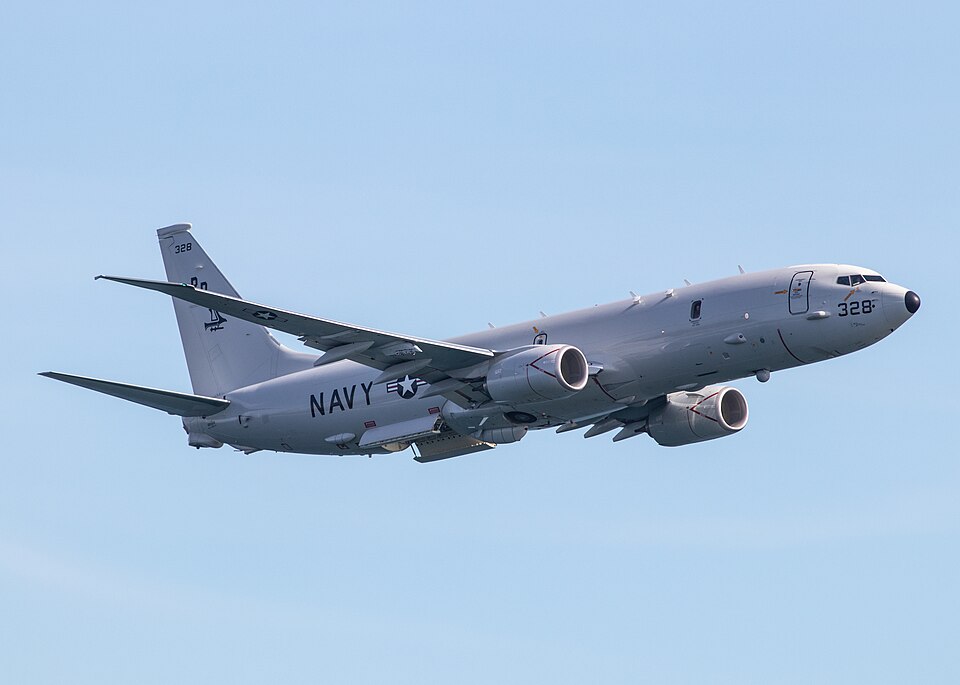
The P-8 Poseidon is widely considered the premier maritime patrol aircraft in the world right now. It is a military derivative of the Boeing 737-800 Next Generation commercial airliner, and it entered U.S. Navy service in 2013.
The P-8 was designed to replace the aging P-3 Orion fleet and it does so with a significant leap in technology. It flies at speeds up to around 490 knots and can reach altitudes of up to 41,000 feet. Its endurance allows it to conduct extended patrols far from shore, and it is equipped with an in-flight refueling system to stretch that range even further.
Its sensor suite includes Raytheon's AN/APY-10 radar, an advanced acoustics system for sonobuoy processing, electronic support measures, and an electro-optical/infrared camera. It can carry the MK 54 lightweight torpedo, anti-ship missiles, and other weapons.
What sets the P-8 apart is the combination of jet-speed transit to the patrol area with comprehensive sensor and weapons integration. More than 170 P-8s have been delivered to operators including the U.S. Navy, Royal Australian Air Force, Royal Air Force, Royal Norwegian Air Force, Indian Navy, and several others.
Pro Tip: The P-8's commercial 737 airframe means logistics and maintenance benefit from one of the most widely supported aircraft platforms in the world. That matters enormously for long-term operational costs.
Key Specs:
- Engines: Two CFM56-7B turbofans
- Speed: Up to approximately 490 knots
- Range: Over 7,200 km without refueling
- Primary missions: ASW, ISR, anti-surface warfare, search and rescue
2. Lockheed P-3 Orion (USA)
The P-3 Orion is one of the most storied patrol aircraft ever built. It first flew in the early 1960s and entered U.S. Navy service as a replacement for the earlier P2V Neptune. Decades later, it is still flying with numerous air arms around the world.
The P-3 is a four-engine turboprop derived from the Lockheed L-188 Electra commercial airliner. Its four Allison T56-A-14 engines provide reliable, fuel-efficient power for long patrols. It cruises at around 350 knots at altitude and can stay airborne for extended periods carrying a full sensor and weapons load.
Over its long service life, the P-3 has been continuously upgraded. The internal weapons bay and ten external hardpoints give it flexibility for a wide range of weapons, including torpedoes, mines, depth charges, and anti-ship missiles. Its sensor suite has been updated many times to keep it relevant against modern threats.
Lockheed Martin has offered P-3 Mid-Life Upgrade programs to extend the aircraft's service life significantly, and many operators have taken advantage of these programs. Countries including Japan, Germany, Australia, Norway, and others have operated or continue to operate the P-3.
For anyone interested in the broader category of proven long-endurance aircraft, the design DNA behind the P-3 connects to a wider tradition of robust aviation platforms that have shaped both military and general aviation aircraft development over the decades.
Why It Matters: The P-3 Orion spent much of the Cold War tracking Soviet submarines in the Atlantic, Pacific, and Arctic. It played a central role in one of the most important strategic standoffs in modern history.
Key Specs:
- Engines: Four Allison T56-A-14 turboprops
- Speed: Approximately 350 knots cruise
- Endurance: Over 12 hours
- Primary missions: ASW, maritime patrol, surveillance, ISR
3. Kawasaki P-1 (Japan)
The Kawasaki P-1 is something genuinely rare in the world of maritime patrol aviation: a purpose-built aircraft with no civilian counterpart. It was designed from the ground up to serve as a maritime patrol aircraft for the Japan Maritime Self-Defense Force (JMSDF), replacing the P-3C fleet.
The P-1 is powered by four IHI F7-10 turbofan engines and uses a fly-by-optics flight control system. That last detail is notable. A conventional fly-by-wire system uses electrical signals, which can be disrupted by the electromagnetic emissions of the aircraft's own sensors and weapons. Fly-by-optics uses light signals through fiber optic cables instead, which are immune to that interference. For an aircraft loaded with sophisticated electronics, this is a meaningful tactical advantage.
The P-1 carries eight hardpoints and can be armed with Harpoon anti-ship missiles, Maverick missiles, mines, depth charges, and torpedoes. Its sensor suite is comprehensive and optimized for the Western Pacific operating environment, where the JMSDF faces demanding requirements.
The P-1 entered service around 2013 and has been steadily expanding its role within the JMSDF. Japan's geographic situation, surrounded by sea and adjacent to some of the world's busiest and most strategically sensitive waterways, makes a capable MPA fleet essential.
Keep in Mind: Japan's investment in a completely indigenous MPA reflects both its strategic needs and its commitment to building domestic defense aerospace capability. The P-1 program has helped develop significant national expertise that will benefit future Japanese aviation programs.
Key Specs:
- Engines: Four IHI F7-10 turbofans
- Speed: Approximately 870 km/h maximum
- Range: Over 8,000 km
- Primary missions: ASW, maritime patrol, anti-surface warfare
4. Dassault Atlantique 2 (France)
France's answer to maritime patrol is the Dassault Atlantique 2, known as the ATL2. This twin-turboprop aircraft serves the French Navy and has been a workhorse for decades. It is powered by two Rolls-Royce Tyne engines and has a maximum speed of around 600 km/h with a range exceeding 7,300 km.
The ATL2 can carry up to around 3.5 tonnes of armament, including depth charges, mines, torpedoes, and the AM-39 Exocet anti-ship missile. The Exocet is one of the most recognized and proven anti-ship weapons in the world, giving the ATL2 a potent strike capability against surface targets.
The French Navy has deployed the Atlantique 2 in several real-world conflicts and peacekeeping missions, including operations over Kosovo, Libya, and other theaters. This operational experience has shaped the aircraft's ongoing upgrades and capability development.
A modernization program has kept the ATL2 relevant with updated mission systems, new radar, and improved sensor fusion. France intends to keep the platform in service for the foreseeable future while exploring future replacement options.
Fun Fact: The name "Atlantique" refers to the Atlantic Ocean, reflecting the aircraft's primary intended patrol area when it was first designed. French naval doctrine has long prioritized Atlantic patrol as a core mission.
Key Specs:
- Engines: Two Rolls-Royce Tyne turboprops
- Speed: Up to approximately 600 km/h
- Range: Over 7,300 km
- Primary missions: ASW, anti-ship warfare, maritime patrol
5. Airbus C295 MPA (Spain / Europe)
The Airbus C295 Maritime Patrol Aircraft is one of the more versatile and widely deployed platforms on this list. It was developed by EADS CASA, now part of Airbus Military, and builds on the highly successful C295 tactical transport airframe.
Its size makes it smaller and more affordable than the P-8 or P-3, but its fully integrated tactical system (FITS) is genuinely sophisticated. FITS integrates the aircraft's navigation and communications systems with radar, EO/IR turret, acoustic system, magnetic anomaly detector, AIS, IFF interrogator, electronic support measures, a weapon system, and even a sea pollution detection system. That last capability reflects the C295 MPA's dual-use potential for environmental monitoring alongside traditional defense roles.
Two Pratt and Whitney Canada PW127G turboprop engines power the aircraft, and it can patrol a radius of around 1,800 nautical miles while staying airborne for more than eight hours depending on configuration. Its underwing stations can carry anti-ship missiles and torpedoes.
The C295 MPA serves with the Chilean Navy, Portuguese Air Force, Royal Air Force of Oman, and other operators. Its relatively lower acquisition and operating cost compared to larger platforms makes it attractive for nations that need capable maritime patrol without a top-tier budget.
If you are exploring how different aircraft designs solve specific operational problems, the best small aircraft in general aviation offer an interesting parallel: smaller airframes often find clever ways to punch above their weight class.
Good to Know: The C295 platform family is one of the most commercially successful medium tactical aircraft programs in Europe, with operators across more than 30 countries using various versions for transport, surveillance, and patrol roles.
Key Specs:
- Engines: Two Pratt and Whitney Canada PW127G turboprops
- Endurance: More than eight hours
- Range: Approximately 1,800 nautical miles patrol radius
- Primary missions: Maritime patrol, EEZ surveillance, ASW, SAR
6. Saab Swordfish (Sweden)
The Saab Swordfish represents a different approach to maritime patrol. Rather than a purpose-built airframe or a military conversion, it is based on a commercial jet platform adapted for multi-mission patrol duties. Saab has configured it with impressive multi-role capabilities spanning anti-submarine warfare, anti-surface warfare, and intelligence, surveillance, and reconnaissance.
What makes the Swordfish stand out is the breadth of what it can do in a single mission. Saab markets it as capable of conducting all these roles simultaneously, enabled by its C4I packages, Automatic Identification Systems, electronic warfare and self-protection systems, and the ability to drop and operate sonobuoys.
The aircraft has a maximum cruise speed of around 902 km/h and a range of approximately 11,000 km, making it one of the longer-legged options on this list. It can stay airborne without refueling for roughly eight hours. That combination of speed and range allows rapid transit to distant patrol areas followed by extended loitering once on station.
The Swordfish competes in the export market against established players and represents Saab's ambition to carve out a meaningful share of the growing global MPA market.
Why It Matters: Nations looking to replace aging P-3 fleets or expand maritime patrol coverage without the cost of a large dedicated fleet find business-jet-based platforms like the Swordfish increasingly attractive. The trend toward jet-based MPAs is reshaping the market.
Key Specs:
- Platform: Commercial jet derivative
- Speed: Up to approximately 902 km/h cruise
- Range: Approximately 11,000 km
- Primary missions: ASW, ISR, anti-surface warfare, area denial support
7. Embraer EMB 145 MP (Brazil)
The Embraer EMB 145 Maritime Patrol variant is built on the framework of the Embraer R-99 and the broader EMB 145 regional jet family. This twin-turbofan platform brings jet performance to the maritime patrol mission, and its Active Electronically Scanned Array (AESA) radar is among its most important capabilities.
The 145 MP is utilized by Mexico, while other variants in the EMB 145 family serve Brazil, Greece, and other nations in various configurations. Four underwing hardpoints allow it to carry weapons for anti-submarine and anti-ship warfare. Its avionics include C3I capabilities and Signal Intelligence (SIGINT) collection in the form of Electronic Intelligence (ELINT) gathering.
AESA radar represents a significant advantage in maritime patrol. Unlike older mechanically scanned radars, an AESA can rapidly switch between modes, track multiple targets simultaneously, and resist jamming more effectively. For an aircraft tasked with finding small targets in cluttered sea environments, this matters.
Brazil's Embraer has established itself as a serious player in the defense aviation market, and the 145 MP is an example of how a regional jet manufacturer can adapt its core product for demanding military roles. Nations with limited budgets looking for a jet-speed MPA with modern sensors find the 145 MP a competitive option.
If you are looking for the best business aircraft options that share design DNA with military platforms like the EMB 145, business aircraft comparisons can offer useful context for understanding how commercial and defense aviation converge.
Pro Tip: The EMB 145 family's widespread use in commercial aviation means spare parts, maintenance expertise, and pilot training resources are available across a broad global network. For smaller air forces, that logistical footprint can be a decisive advantage.
Key Specs:
- Engines: Two Rolls-Royce AE 3007 turbofans
- Radar: Active Electronically Scanned Array (AESA)
- Primary missions: Maritime patrol, ISR, ASW, anti-surface warfare
- Operators: Mexico, Brazil, Greece (various variants)
How Do These Aircraft Compare?
Choosing the right maritime patrol aircraft depends heavily on what a nation needs. Here is a straightforward comparison to help put the options in perspective.
| Aircraft | Speed | Range | Engine Type | Notable Strength |
| P-8 Poseidon | Very high (jet) | Very long | Twin turbofan | Best-in-class sensor suite |
| P-3 Orion | Medium | Very long | Four turboprops | Proven, widely supported |
| Kawasaki P-1 | High (jet) | Very long | Four turbofans | Fly-by-optics, purpose-built |
| Atlantique 2 | Medium | Long | Twin turboprops | Exocet missile capability |
| C295 MPA | Medium | Medium | Twin turboprops | Cost-effective, versatile |
| Saab Swordfish | High (jet) | Very long | Jet platform | Longest range on this list |
| EMB 145 MP | High (jet) | Medium-long | Twin turbofans | AESA radar, jet speed |
Heads Up: Range and endurance figures vary significantly depending on payload, altitude, and mission configuration. Always treat published figures as approximate guidance rather than hard performance guarantees.
The Role of Maritime Patrol Aircraft Beyond Military Missions
It would be easy to think of maritime patrol aircraft purely in terms of military power. But these platforms do a remarkable amount of work that has nothing to do with conflict.
Search and rescue is one of the most visible non-military roles. When a vessel goes missing at sea, an MPA is often the first asset dispatched to search a large area quickly. The same sensors that find submarines can locate life rafts, flares, and survivors in the water.
Counter-narcotics operations rely heavily on maritime patrol aircraft. Drug trafficking by sea is a significant challenge in many regions, and aircraft with long endurance, radar, and EO/IR cameras can monitor large maritime areas that would be impossible to cover with ships alone.
Environmental monitoring is a growing role. Aircraft like the C295 MPA carry sea pollution detection systems that can identify and map oil spills and other contamination from altitude. This dual-use capability makes them valuable tools for coast guards and environmental agencies as well as navies.
Illegal fishing detection and enforcement is another application. Many nations' exclusive economic zones (EEZs) are vast, and MPAs can cover these areas efficiently, identifying vessels fishing without authorization and directing coast guard enforcement assets.
For those curious about how aviation platforms serve specialized roles beyond traditional flight, the best firefighting aircraft represent another fascinating category where aircraft adapt to demanding, specialized missions that protect lives and property.
Fun Fact: Some maritime patrol aircraft have been credited with locating shipwreck survivors days after vessels went missing, demonstrating the life-saving potential of long-endurance aerial surveillance beyond any military application.
The Future of Maritime Patrol Aviation
The field of maritime patrol is evolving quickly. Several trends are shaping what the next generation of MPAs will look like.
Unmanned systems are beginning to supplement crewed MPAs. Long-endurance drones can handle some routine surveillance tasks, freeing crewed aircraft for more complex missions. The U.S. Navy has explored MQ-4C Triton unmanned aircraft as a complement to the P-8 fleet, for example.
Artificial intelligence and automation are being integrated into sensor processing. Modern MPAs generate enormous amounts of data from multiple sensors simultaneously. AI systems that can filter, fuse, and prioritize that data automatically help crews make faster, better decisions.
Hyperspectral imaging and other advanced sensor types are beginning to appear in maritime patrol payloads, offering new ways to detect submarines, pollution, and other targets.
Business-jet-based platforms continue to grow in popularity. Countries that cannot afford or do not need a full dedicated MPA fleet are finding that converted business jets offer a cost-effective way to field a capable maritime surveillance capability.
The best VTOL aircraft represent another frontier in aviation flexibility, and some of that technology may eventually find its way into maritime patrol applications as hover capability becomes more practical in larger platforms.
Keep in Mind: The growing strategic importance of the maritime domain, from undersea communications cables to offshore energy infrastructure, means demand for effective maritime patrol capability is likely to increase rather than decrease in the coming decades.
What to Look for When Evaluating a Maritime Patrol Aircraft
Whether you are a defense analyst, a student of aviation, or someone working in the field, evaluating MPAs comes down to a handful of key questions.
Mission requirements: What specific tasks does the aircraft need to perform? An aircraft optimized for anti-submarine warfare in the deep ocean has different needs than one designed for coastal surveillance in shallow, cluttered waters.
Operating environment: Arctic patrol demands different capabilities than tropical patrol. Rough weather performance, de-icing systems, and crew comfort on long missions all matter.
Logistics and support: The best aircraft in the world is useless without spare parts and trained maintenance crews. Platforms built on commercially available airframes often have significant logistical advantages.
Budget: Acquisition cost is only part of the picture. Operating costs over a 20 to 30-year service life can dwarf the purchase price. Fuel efficiency, maintenance intervals, and crew training costs all factor into the true cost of ownership.
Upgrade path: Sensors and mission systems evolve rapidly. An aircraft with a well-defined upgrade path and a manufacturer committed to long-term support will remain relevant far longer than one that is difficult to modernize.
The best twin-engine piston aircraft serve as an interesting point of comparison for thinking about how multi-engine reliability and efficiency apply across different aviation categories.
Conclusion
The best maritime patrol aircraft share a set of qualities that make them extraordinary tools: long endurance, sophisticated sensors, weapons capability, and the flexibility to serve both military and humanitarian missions. From the globally deployed P-8 Poseidon to the purpose-built Kawasaki P-1 and the cost-effective C295 MPA, each aircraft on this list represents a thoughtful answer to the challenge of watching the world's oceans.
Maritime patrol aviation has come a long way since the flying boats of the First World War, and the technology keeps advancing. Whether the mission is hunting submarines, tracking pirates, or rescuing survivors at sea, these aircraft are some of the most capable tools ever built for the job.
If you want to learn more about extraordinary aircraft across every category, from military patrol planes to general aviation gems, Flying411 is your destination. Head over to explore listings, guides, and everything the aviation world has to offer.
Frequently Asked Questions
What is a maritime patrol aircraft used for?
A maritime patrol aircraft is a fixed-wing aircraft designed to operate over water for extended periods. Its primary roles include anti-submarine warfare, anti-surface warfare, search and rescue, intelligence gathering, and surveillance of exclusive economic zones.
Is the P-8 Poseidon replacing the P-3 Orion?
Yes. The Boeing P-8 Poseidon was developed specifically to replace the aging Lockheed P-3 Orion in U.S. Navy service. The transition has been ongoing for over a decade, though many other nations still operate P-3 variants.
What sensors do maritime patrol aircraft typically carry?
Most modern maritime patrol aircraft carry a combination of radar, electro-optical and infrared cameras, acoustic processing systems for sonobuoys, magnetic anomaly detectors, electronic support measures, and Automatic Identification System receivers for tracking ships.
How long can a maritime patrol aircraft stay airborne?
Endurance varies by aircraft and mission configuration, but most modern MPAs are designed to stay airborne for roughly eight to twelve hours. Some missions are extended further through in-flight refueling.
What is the difference between a maritime patrol aircraft and a reconnaissance aircraft?
Maritime patrol aircraft are optimized for long-duration operations over water and typically carry weapons in addition to sensors. Reconnaissance aircraft focus primarily on intelligence gathering and may not carry weapons. In practice, many modern MPAs combine both roles.
Can maritime patrol aircraft operate in bad weather?
Most dedicated MPAs are designed for all-weather operations and carry weather radar along with other systems that allow them to function in poor visibility, rain, and rough conditions. Operating in the maritime environment requires robust weather tolerance by design.
What makes anti-submarine warfare so challenging for patrol aircraft?
Submarines are designed to be as difficult to detect as possible. They operate underwater, emit minimal noise, and use a variety of countermeasures. Finding them requires multiple sensor types working together, including acoustic sensors, magnetic anomaly detectors, and radar, all while the aircraft covers vast ocean areas in limited time.