Every wildfire season, the stakes get higher. Fires burn hotter, spread faster, and cover more ground than ever before. The people on the front lines need every tool they can get, and some of the most powerful tools in their arsenal fly at hundreds of miles an hour.
Firefighting aircraft are the unsung heroes of wildfire suppression. They swoop in low over the burning hillsides, dropping thousands of gallons of water or retardant in a matter of seconds. Some refill from lakes mid-mission. Others haul enough chemical retardant to soak a mile-long stretch of forest. Each one plays a specific role in a coordinated air-and-ground attack on one of nature's most destructive forces.
The best firefighting aircraft are not just big. They are fast, precise, reliable, and built to handle the violent air currents, intense heat, and tight terrain that wildfires create. This article takes a close look at seven of the most effective and widely respected aerial firefighters working in the skies today — what they carry, how they operate, and why they matter.
Key Takeaways
The best firefighting aircraft include purpose-built water scoopers like the Canadair CL-415 SuperScooper, large tankers like the McDonnell Douglas DC-10, and versatile military platforms like the C-130 Hercules equipped with MAFFS systems. Each aircraft serves a distinct role — from initial attack in rough terrain to extended coverage of massive wildfire fronts — and crews typically combine multiple aircraft types on the same fire for the best results.
| Aircraft | Type | Retardant/Water Capacity | Key Strength |
| Canadair CL-415 SuperScooper | Amphibious water scooper | ~1,621 US gal (scooped) | Rapid refill from lakes, purpose-built |
| McDonnell Douglas DC-10 Tanker | Very Large Airtanker (VLAT) | Up to 12,000 US gal | Massive single-drop coverage |
| Boeing 747 Supertanker | Very Large Airtanker (VLAT) | Up to 19,600 US gal | Largest capacity ever used in firefighting |
| C-130 Hercules (MAFFS) | Large Airtanker (LAT) | Up to ~3,000 US gal | Military availability and flexibility |
| Air Tractor AT-802 Fire Boss | Single Engine Airtanker (SEAT) | ~800 US gal | Agility in tight terrain, fast turnaround |
| BAe 146 / Avro RJ | Large Airtanker (LAT) | Up to 3,000 US gal | Jet speed and steep approach capability |
| Sikorsky S-70 Firehawk | Firefighting helicopter | ~1,000 US gal (bucket/tank) | Precision drops, urban and remote areas |
If you are curious about the broader world of aviation, Flying411 is a great resource for exploring different aircraft types, buying guides, and general aviation news all in one place.
How Aerial Firefighting Actually Works
Before getting into specific aircraft, it helps to understand how aerial firefighting fits into the bigger picture. Ground crews cannot always get close enough to a fire on foot. Roads burn, terrain gets too steep, and fire moves faster than trucks. That is where aircraft come in.
Firefighting planes and helicopters do several key jobs:
- Drop water or fire retardant directly on active flames or just ahead of the fire to slow its spread
- Scout and coordinate by flying over the fire to help ground teams know where to go
- Deliver smokejumpers to remote areas where ground crews cannot reach by road
- Provide aerial supervision to direct other aircraft safely and efficiently
Aircraft are classified based on how much retardant or water they carry. Single Engine Airtankers (SEATs) carry up to 800 gallons. Large Airtankers (LATs) carry between 2,000 and 4,000 gallons. Very Large Airtankers (VLATs) carry more than 8,000 gallons. Water scoopers are a separate category — they refill by skimming the surface of lakes or rivers, which makes them incredibly efficient in areas where water sources are nearby.
Good to Know: The U.S. Forest Service (USFS) often combines military aircraft with contracted civilian tankers during major fire emergencies, using a program called the Modular Airborne Fire Fighting System (MAFFS) to quickly expand capacity.
No single aircraft type wins every fire. Different terrain, fuel types, and fire behavior call for different tools. A fast-moving grass fire in flat country needs something different than a crown fire in rugged mountain forest.
A Look at Firefighting Aircraft
Aerial firefighting has a longer history than most people realize. Experimentation with dropping water from aircraft on wildfires dates back to the late 1940s. Early efforts used military surplus planes left over from World War II — converted bombers that were repurposed into rough-and-ready tankers.
Through the 1950s and 1960s, the fleet grew to include aircraft like the Grumman TBF Avenger, Douglas DC-6, and Lockheed P-2 Neptune. These were dependable, if aging, warbirds that served for decades before more modern replacements arrived.
The 2002 fire season was a turning point in the United States. Two air tankers suffered structural failures during firefighting operations, which led the U.S. Department of the Interior to push hard for newer, safer aircraft. This spurred the development of jet-powered tankers and improved the safety standards across the fleet.
Fun Fact: According to historical records, the Grumman TBF Avenger — a World War II torpedo bomber — became one of the most widely used air tankers of its era, with peak usage reportedly reaching more than 40 aircraft fighting fires simultaneously in the early 1970s.
Today, the aerial firefighting fleet is far more capable, diverse, and safety-conscious than its predecessors. Purpose-built aircraft share the skies with converted airliners and military transports, all working together toward the same goal.
The 7 Best Firefighting Aircraft in Use Today
These seven aircraft represent some of the most effective and widely used platforms in aerial firefighting today. They range from nimble single-engine tankers built for tight terrain to massive jet-powered giants capable of dropping retardant across a mile of fire line in seconds. Some are purpose-built for this exact mission.
Others started life as military transports or passenger jets before finding a second calling over burning hillsides. Together, they cover nearly every firefighting scenario imaginable.
1. Canadair CL-415 SuperScooper
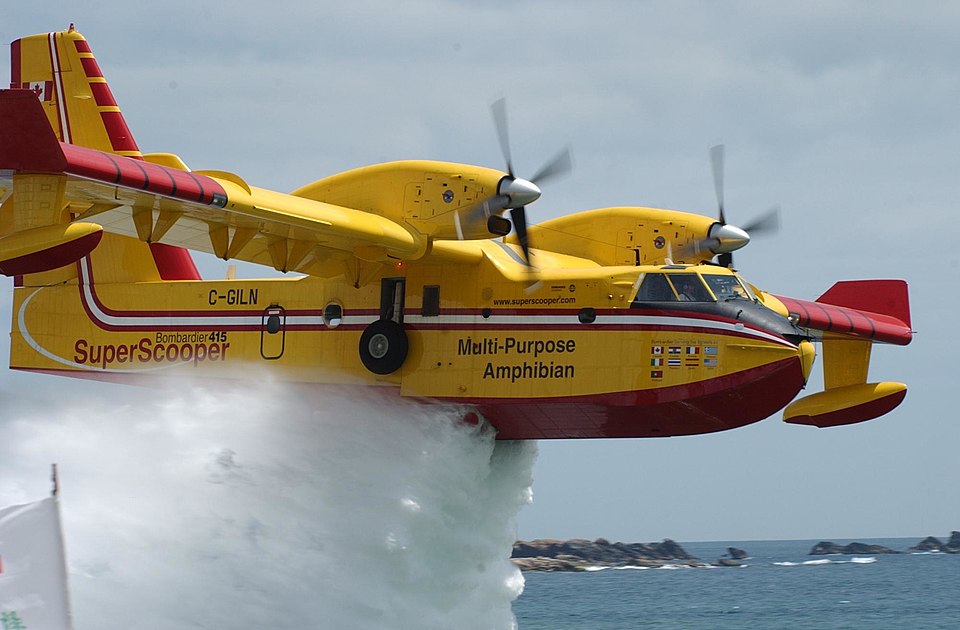
The Canadair CL-415 SuperScooper is widely considered the gold standard of purpose-built firefighting aircraft. Developed in the early 1990s as an evolution of the earlier piston-powered CL-215, it entered service in 1994 and has been a staple of aerial firefighting fleets around the world ever since.
What makes the CL-415 special is its ability to scoop water directly from a lake, river, or ocean while in flight — no need to land or return to a tanker base for a refill. The aircraft skims the water's surface at low speed, filling its tanks with roughly 1,600 U.S. gallons of water in about 12 seconds. It then climbs, flies to the fire, drops its load, and heads back for another scoop. This cycle can repeat many times in a single hour, making the CL-415 one of the most productive firefighters in the fleet.
Powered by two Pratt and Whitney Canada turboprop engines, the aircraft is amphibious — meaning it can operate from both land runways and water. Its foam injection system allows it to mix foam concentrate with the water for improved fire suppression.
Key specs at a glance:
- Water capacity: approximately 1,621 U.S. gallons per scoop
- Scoop time: roughly 12 seconds on the water
- Engines: 2x Pratt and Whitney Canada PW123AF turboprops
- Special ability: Water scooping from open water sources
The CL-415 has been used in firefighting operations across Europe, North America, and beyond. When the Los Angeles wildfires raged in early 2025, Canada sent CL-415 SuperScoopers to help the Los Angeles Fire Department — a testament to the aircraft's respected status.
Why It Matters: The CL-415's water-scooping ability means it can keep working even when ground-based retardant supplies run low. As long as there is accessible open water within range, it stays in the fight.
A newer evolution of this design, the De Havilland Canadair DHC-515, is now in development and is expected to carry on the SuperScooper legacy with modern avionics and the ability to operate at night.
2. McDonnell Douglas DC-10 Air Tanker
The DC-10, long known as a wide-body passenger airliner, has found a second life as one of the most capable air tankers ever put to work over a wildfire. Operated by 10 Tanker Air Carrier, the DC-10 air tanker is classified as a Very Large Airtanker (VLAT) and is one of the few wide-body jet platforms used regularly in firefighting.
The aircraft carries up to 12,000 U.S. gallons of fire retardant in an external belly-mounted tank system. That retardant can be released in about eight seconds, laying down a line of suppressant that is reportedly around 300 feet wide and up to a mile long. One drop from the DC-10 is said to be roughly equivalent to a dozen drops from a smaller S-2T tanker.
Because of its jet speed, the DC-10 can cover large distances quickly. This makes it useful for extended attack operations on major fires — situations where a fire has grown too large for initial-attack resources and needs a bigger response.
The DC-10 does have limitations. It needs a well-equipped airbase for refueling and retardant loading, and it is not suited for tight terrain or initial-attack operations on small fires. But when a fire is large and a massive retardant line is needed fast, the DC-10 delivers.
Pro Tip: The DC-10 and similar VLATs are generally not the first aircraft to arrive at a fire. They work best as part of a larger strategy, laying down retardant lines that guide the fire into areas ground crews can manage.
3. Boeing 747 Supertanker
Few aircraft in the world match the sheer scale of the Boeing 747 Supertanker. Derived from various 747 airframes, the Supertanker became the largest firefighting airtanker ever flown, with a capacity reportedly reaching up to 19,600 U.S. gallons of fire retardant or water.
The Global SuperTanker version — a Boeing 747-400 dubbed the Spirit of John Muir — was certified for firefighting by the U.S. Federal Aviation Administration in 2016. It then went on to fight fires in Chile, Israel, and California before eventually being retired from firefighting service and converted back to a cargo configuration in 2021.
The 747 Supertanker used a pressurized liquid drop system that allowed it to release retardant at a controlled rate, either in one massive dump or in segmented drops along the fire line. It could lay down a retardant swath reportedly around three miles long and 150 feet wide. Its jet speed meant it could be practically anywhere in the continental United States in roughly five hours.
The aircraft needed an 8,000-foot runway, which limited its operational flexibility. But for massive, fast-moving wildfires where a single enormous retardant drop could make the difference, nothing compared to the 747 Supertanker.
Fun Fact: The 747 Supertanker fought some of its most dramatic early missions in Chile in January 2017, helping to suppress a series of wildfires that had burned through hundreds of thousands of acres and destroyed numerous homes.
While this specific aircraft is no longer in firefighting service, the story of the 747 Supertanker illustrates how aviation innovation can push the boundaries of what is possible in wildfire response. Discussions about next-generation VLATs continue in the industry.
4. Lockheed C-130 Hercules with MAFFS
The C-130 Hercules is one of the most versatile military transport aircraft ever built, and it has also proven to be a valuable player in aerial firefighting. Rather than being converted permanently into an airtanker, military C-130s can be outfitted with a Modular Airborne Fire Fighting System (MAFFS) — a self-contained retardant tank system that loads into the aircraft's cargo hold.
The MAFFS program was created by the U.S. Congress in the early 1970s as a partnership between the U.S. Forest Service (USFS) and the Department of Defense (DoD). When fire conditions are severe and the civilian tanker fleet is stretched thin, the military can deploy C-130s from the Air National Guard or Air Force Reserve to augment the response.
A MAFFS-equipped C-130 can carry up to around 3,000 U.S. gallons of fire retardant. It is not the largest tanker in the sky, but the C-130 is tough, reliable, and can operate from shorter, less-prepared airstrips than many of the larger tankers.
The C-130's military availability is one of its biggest advantages. During extreme fire emergencies, the government can activate these assets quickly without waiting for civilian contract aircraft to mobilize.
Good to Know: The MAFFS system is not just for C-130s. Efforts to fit MAFFS II into other military transport aircraft, including the smaller C-27J Spartan, have shown promising results for nations that need flexible firefighting options using existing military fleets.
If you want to read about other remarkable heavy-lift aircraft that serve important roles beyond firefighting, this breakdown of the world's biggest planes offers a fascinating look at large aircraft capability.
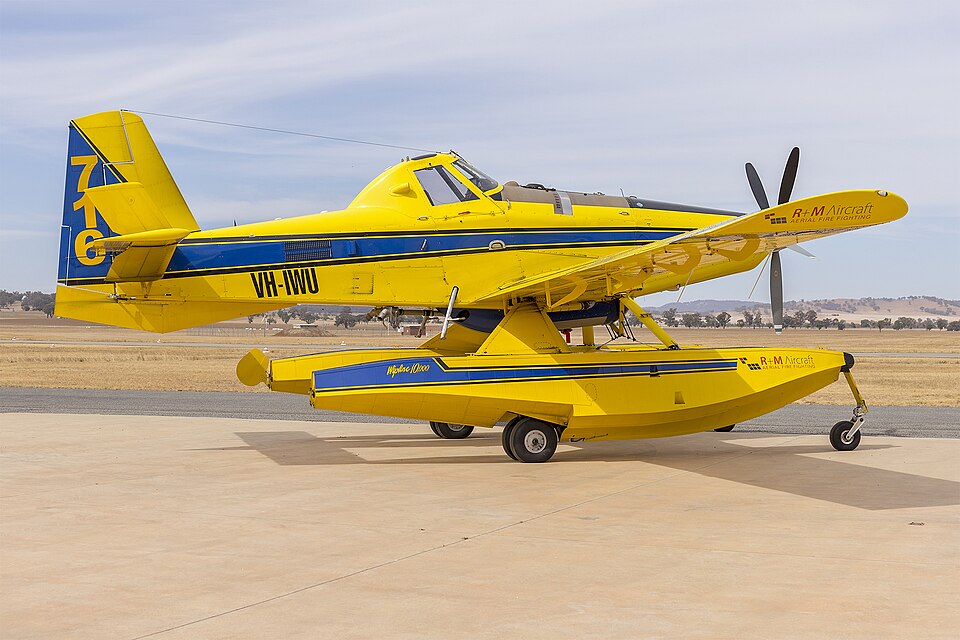
5. Air Tractor AT-802 Fire Boss
Not every firefighting challenge calls for a jumbo jet or a massive amphibian. Sometimes what you need is a nimble, fast-turning, easy-to-refill aircraft that can get into tight terrain and keep making drops all day long. That is exactly what the Air Tractor AT-802 Fire Boss delivers.
The AT-802 is a single-engine agricultural aircraft that has been adapted for aerial firefighting in two key configurations. The standard AT-802 operates as a conventional Single Engine Airtanker (SEAT), loading retardant from a ground base and making repeated drops. The Fire Boss variant is fitted with floats, transforming it into an amphibious aircraft that can scoop water from lakes and rivers much like the larger CL-415.
Each drop carries up to about 800 U.S. gallons of water or retardant — not massive by VLAT standards, but the AT-802 makes up for it with frequency. It can reload fast and keep cycling back to the fire. Because of its small size, it can operate in rugged terrain where larger aircraft simply cannot safely fly.
The AT-802 Fire Boss is particularly well suited for initial attack — catching a fire early while it is still small, before it has a chance to grow into something that requires a full VLAT response. Speed of response can mean the difference between a 10-acre fire and a 10,000-acre fire.
Why operators love the AT-802:
- Low operating costs compared to larger tankers
- Ability to use short, unpaved airstrips
- Water-scooping option for the Fire Boss variant
- Proven track record in North America, Europe, and beyond
Quick Tip: If you are comparing firefighting aircraft by cost-effectiveness, the AT-802 Fire Boss consistently ranks as one of the most economical options for initial-attack and moderate-intensity fire suppression.
6. BAe 146 / Avro RJ Air Tanker
The British Aerospace 146 — also known in updated form as the Avro RJ — started its career as a regional passenger jet. With room for 70 to 110 passengers, quiet engines, and excellent slow-speed handling, it served airlines across the world for decades. Then, after a series of tragic airtanker accidents in 2002 led the USFS to seek safer, more modern aircraft, the 146 found a new purpose.
Flight tests conducted in 2004 showed that the 146's slow-speed characteristics and ability to fly steep approaches made it an excellent fit for the water-bomber role. Operators including Neptune Aviation and Air Spray USA converted their aircraft to carry up to 3,000 U.S. gallons of fire retardant in belly-mounted tank systems.
As a jet-powered large airtanker, the BAe 146 brings speed and reliability to the flight line. It can cover long distances quickly to reach a fire, then slow down to make precise drops. Its four engines — often jokingly called "four hairdryers" — give it redundancy that single or twin-engine aircraft cannot match.
The BAe 146 is not as flashy as the DC-10 or as purpose-built as the CL-415, but it is a proven, cost-effective workhorse that has played an important role in modernizing the U.S. firefighting fleet.
Keep in Mind: The BAe 146 platform is aging, and the future of this aircraft in firefighting will depend on ongoing maintenance investment and the availability of replacement airframes. Newer purpose-built tankers are gradually entering service.
Fans of unique aircraft types used in specialized roles might also enjoy learning about the best cargo planes that have shaped aviation history, including several that have been adapted for unusual missions.
7. Sikorsky S-70 Firehawk
Helicopters play an absolutely critical role in aerial firefighting, and among the many rotorcraft in service, the Sikorsky S-70 Firehawk stands out as one of the most capable. Based on the famous Black Hawk military helicopter, the Firehawk is operated by agencies including the Los Angeles County Fire Department and CAL FIRE, among others.
Unlike fixed-wing tankers that need a runway and a straight-line drop path, the Firehawk can hover. This gives it a level of precision that no fixed-wing aircraft can match. It can position its water drop with pinpoint accuracy — critical when fires threaten homes, power lines, or other infrastructure that you cannot afford to flood with retardant.
The Firehawk uses either a belly-mounted internal tank or an external water bucket. With tank configurations, it can carry around 1,000 U.S. gallons of water or retardant per load. Like the CL-415, it can refill from a lake or reservoir by hovering low and dipping a snorkel into the water.
Helicopters like the Firehawk are also used to transport firefighters, deliver supplies, support rescue operations, and provide aerial reconnaissance. Their versatility makes them indispensable on complex fires where a single type of aircraft cannot do everything that needs to be done.
Fun Fact: During the 2025 Los Angeles wildfires, more than fifty helicopters and other aircraft were reported to have been deployed in aerial operations, with the Firehawk among the most visible responders working in tight urban and semi-urban terrain.
If you are considering the versatile world of twin-engine aircraft that serve many demanding missions, check out this guide to the best twin-engine piston aircraft for more perspective on how smaller platforms punch above their weight.
How Firefighting Aircraft Work Together
No single aircraft can fight a major wildfire alone. In a well-coordinated aerial attack, different aircraft play different roles at the same time.
A typical large-fire air operation might look something like this:
- Lead planes and air attack aircraft arrive first. Flying in a Twin Commander or Beechcraft King Air, the Air Tactical Group Supervisor (ATGS) assesses the fire from above, identifies where drops should be made, and coordinates all the aircraft in the airspace.
- SEATs and initial-attack resources arrive quickly to hit the fire while it is still manageable.
- Large and very large airtankers are called in to lay down retardant lines that slow the fire's spread or protect high-value areas.
- Water scoopers work near available water sources, cycling continuously to deliver repeated loads.
- Helicopters provide precision drops near structures, conduct rescues, and support ground crews.
The coordination between all of these different aircraft — many of them flying in a relatively small airspace over an active fire — is genuinely impressive. Unauthorized drone flights over wildfires create life-threatening hazards by forcing all aircraft to ground for safety. This is why firefighting agencies take unauthorized airspace intrusions so seriously.
Heads Up: If you ever see a wildfire from a distance, do not fly any recreational drone near the area. Even a brief unauthorized drone flight can shut down aerial firefighting operations for an entire fire, allowing the fire to grow unchecked.
Fixed-Wing vs. Helicopter: Which Is Better for Firefighting?
This is a question that comes up often, and the honest answer is that both types are essential. Fixed-wing aircraft and helicopters bring different strengths to the fight.
| Feature | Fixed-Wing Tankers | Firefighting Helicopters |
| Water/retardant capacity | Generally higher (800 to 19,600+ gal) | Generally lower (up to ~1,000 gal) |
| Drop precision | Lower (linear drop path) | Higher (hover in place) |
| Speed | Faster | Slower |
| Terrain flexibility | Need suitable airstrip | Can land almost anywhere |
| Refill method | Tanker base or water scoop | Snorkel from water source |
| Best for | Large fire fronts, long lines | Urban interface, precision, rescue |
Neither type replaces the other. Effective aerial firefighting uses both in combination, with each aircraft doing what it does best.
What Makes a Firefighting Aircraft Effective?
When evaluating the best firefighting aircraft, several key factors determine how useful a platform really is in operational conditions.
Payload capacity matters, but it is not the only thing that matters. An aircraft that carries 19,000 gallons but takes hours to reload may deliver less total retardant in a day than one that carries 1,600 gallons and refills every few minutes.
Terrain compatibility is critical. A fire burning in a narrow mountain canyon may be inaccessible to a large jet tanker but perfectly suited to a nimble SEAT or a hovering helicopter.
Refill flexibility — whether an aircraft can scoop from open water or needs a dedicated tanker base — determines how continuously it can work when ground infrastructure is limited.
Safety record has been a driving factor in fleet evolution, particularly after the 2002 accidents that pushed the industry toward newer, structurally sound aircraft.
Availability and cost determine how many aircraft can actually be put to work. The most capable plane in the world is useless if it is too expensive to contract or too rare to mobilize quickly.
If aviation in general sparks your interest, exploring the landscape of the best general aviation aircraft is a great way to see how the broader world of flying continues to evolve.
The Future of Firefighting Aircraft
Wildfire seasons are getting longer and more intense in many parts of the world. The demand for aerial firefighting capacity is growing, and the industry is responding with innovation.
The De Havilland Canadair DHC-515 is the next evolution of the SuperScooper lineage. It is designed to incorporate modern avionics and the ability to fight fires at night — a capability that current CL-415s lack. Night operations could dramatically extend the effective working hours of firefighting aircraft.
Unmanned Aircraft Systems (UAS), or drones, are being explored for wildfire reconnaissance and monitoring. While they are not yet used to drop significant amounts of retardant, advances in drone technology could eventually make them useful for small fire suppression or real-time fire mapping.
MAFFS integration with additional aircraft types, including the C-27J Spartan, shows that military transport aircraft around the world are being evaluated as backup firefighting platforms. This could expand aerial firefighting capacity for nations that cannot afford a dedicated fleet.
The future fleet will likely be a mix of purpose-built aircraft like the DHC-515, modernized conversions of proven platforms, and emerging technologies that expand what is operationally possible.
Why It Matters: As wildfire risk grows due to shifting climate patterns and expanding human development into fire-prone areas, investing in capable firefighting aircraft is no longer just a forestry issue. It is a public safety priority.
If you enjoy learning about how different aircraft categories are pushing boundaries, you might also be interested in the best business aircraft currently in use, including platforms that balance performance, range, and capability in ways that parallel the demands of specialized aviation.
Conclusion
The best firefighting aircraft are not chosen for glamour. They are chosen because they work — under extreme conditions, in difficult terrain, with lives and land on the line. From the nimble Air Tractor AT-802 Fire Boss skimming a mountain lake to the massive DC-10 laying down a mile of retardant in eight seconds, each of these aircraft fills a critical role in protecting communities and forests from wildfire.
No single aircraft does it all. The most effective aerial firefighting operations use a combination of platforms, each doing what it does best, coordinated by skilled pilots and supervisors who know the terrain and the fire. That coordination — between people and machines, between aircraft types, between military and civilian resources — is what makes aerial firefighting so remarkable.
If you want to keep exploring the world of aviation and aircraft, Flying411 is your go-to source for guides, aircraft breakdowns, and aviation news written for anyone who loves flight.
Frequently Asked Questions
What is the most common firefighting aircraft used in the United States?
The Air Tractor AT-802 is one of the most widely used single-engine airtankers in the U.S., while the Canadair CL-415 SuperScooper is among the most recognized purpose-built water scoopers. The U.S. Forest Service contracts a variety of aircraft types depending on the scale and location of the fire.
How much does it cost to operate a firefighting aircraft?
Operating costs vary widely by aircraft type. Single engine airtankers like the AT-802 are among the more cost-effective options, while very large airtankers like the DC-10 involve significantly higher operating expenses. Contract costs for air tanker services typically run into the thousands of dollars per hour of flight time.
Can any aircraft be converted into a firefighting tanker?
Many aircraft have been converted for firefighting use, from retired airliners to military transports. The key requirement is that the airframe must be structurally sound and certified for the stresses involved in low-altitude, turbulent-air firefighting operations. After the accidents of 2002, airworthiness standards for airtankers were significantly tightened.
What is the difference between fire retardant and water in aerial firefighting?
Water directly cools and suppresses flames, while fire retardant is a chemical mixture that slows or prevents combustion even after it dries. Retardant is often dropped ahead of the fire to create a line that the fire cannot easily cross, while water is used to directly attack active flames. Many aircraft can drop both depending on the mission.
Are firefighting helicopters more effective than fixed-wing aircraft?
Neither type is universally more effective — they serve complementary roles. Fixed-wing aircraft are generally better for laying down large amounts of retardant over wide areas quickly, while helicopters excel at precision drops, working near structures, and operating in terrain where fixed-wing aircraft cannot safely fly.
What is a Very Large Airtanker (VLAT)?
A VLAT is an airtanker capable of carrying more than 8,000 U.S. gallons of fire retardant or water in a single load. Examples include the DC-10 and the now-retired 747 Supertanker. VLATs are used on extended-attack fires where a large, fast retardant drop can make a meaningful impact on fire behavior.
Why do some firefighting aircraft scoop water instead of loading from a ground base?
Water-scooping aircraft like the CL-415 SuperScooper can refill their tanks in about 12 seconds by skimming the surface of a lake, river, or other open water body. This eliminates the time spent flying back to a tanker base for refilling, allowing the aircraft to make many more drops per flight hour — especially in areas with accessible water near the fire.