There is something electric about the idea of two jets locked in a turning battle, each pilot fighting to get the nose of their aircraft pointed at the other. That kind of combat — raw, fast, and decided by inches — is what dogfighting is all about. And while modern warfare relies more and more on long-range missiles and stealth technology, the need for jets that can win in close is still very real.
The best dogfighting jets are built around a short list of qualities: tight turning ability, raw thrust, sharp avionics, and a pilot who knows how to use all three. Some of these aircraft have been tested in real air-to-air combat over disputed skies. Others have proven themselves in training exercises where the results still carry weight. All of them represent the best humanity has produced when it comes to winning a fight at close range in the sky.
Key Takeaways
The best dogfighting jets combine high thrust-to-weight ratios, excellent turn rates, and advanced avionics to win in close-range aerial combat. The F-22 Raptor is widely considered the most capable modern dogfighter thanks to its thrust vectoring and supercruise ability, while jets like the F-16, MiG-29, Eurofighter Typhoon, and Dassault Rafale are among the most respected in the world for their agility and proven track records.
| Aircraft | Generation | Key Dogfight Strength | Country of Origin |
| F-22 Raptor | 5th | Thrust vectoring, supercruise | USA |
| F-16 Fighting Falcon | 4th | Lightweight, tight turns | USA |
| Eurofighter Typhoon | 4th (4.5) | Canard-delta, energy retention | Europe (Multi-nation) |
| Dassault Rafale | 4th (4.5) | Canards, near-unstable flight | France |
| Su-35 Flanker-E | 4th (4.5) | 3D thrust vectoring | Russia |
| F-15 Eagle | 4th | Speed, energy management | USA |
| MiG-29 Fulcrum | 4th | High sustained turn rate | Russia |
| F/A-18 Super Hornet | 4th | High-AoA maneuvers | USA |
| Su-57 Felon | 5th | Stealth + thrust vectoring | Russia |
| JAS 39 Gripen | 4th (4.5) | Lightweight, low-cost agility | Sweden |
| Chengdu J-10C | 4th (4.5) | Canards, agility, recent combat results | China |
| F-35 Lightning II | 5th | Stealth, sensor fusion | USA |
| Su-27 Flanker | 4th | Long-range agility, high AoA | Russia |
At Flying411, we cover aviation from every angle — including the jets that define the boundaries of what aircraft can do. Whether you're a military aviation enthusiast or a general aviation pilot, Flying411 has the resources to fuel your passion.
What Makes a Great Dogfighter?
Before ranking these jets, it helps to understand what sets a great dogfighter apart from just a fast plane. Speed alone does not win a turning fight. In fact, a jet going too fast in a tight turn will bleed energy quickly and end up in a worse position than when it started.
Here are the core qualities that define the best close-range fighters:
- Thrust-to-weight ratio (TWR): A ratio above 1:1 means a jet can accelerate straight up. That matters when recovering energy after a hard turn.
- Turn rate: Measured in degrees per second, this tells you how fast a plane can change direction. Instantaneous turn rate is the burst speed; sustained turn rate is what the jet can maintain without bleeding energy.
- Wing loading: Lower wing loading means better lift at slower speeds, which helps in slow, close-range turning fights.
- Thrust vectoring: When engines can redirect their exhaust in different directions, the jet can point its nose almost anywhere — even at very low speeds or in post-stall conditions.
- Avionics and situational awareness: Knowing where your opponent is at all times is just as important as how fast you can turn.
- Pilot training: Every aviation expert agrees on this one. A skilled pilot in a lesser jet will beat a mediocre pilot in a world-class one more often than not.
Good to Know: Modern air combat increasingly takes place beyond visual range, where missiles do the work before pilots even see each other. But close-range dogfighting remains a core training skill because missiles can fail, be jammed, or simply miss — and when that happens, maneuverability is what keeps a pilot alive.
A Short Look at Jet Dogfighting
The era of jet-powered air combat began during World War II. The Messerschmitt Me 262 became the first jet fighter used in actual combat, with a speed that shocked Allied pilots who had never faced anything like it. The British followed shortly with the Gloster Meteor, which would later see action in Korea.
It was Korea and Vietnam that truly shaped how the world thought about jet dogfighting. American pilots in Korea flew the F-86 Sabre against Soviet-built MiG-15s. The Sabre reportedly achieved a kill-to-loss ratio that impressed military planners and helped establish how much pilot training mattered.
By the Vietnam era, U.S. military doctrine had moved away from dogfighting entirely. The assumption was that missiles would handle everything. That turned out to be wrong. Missile reliability issues and the absence of gun armament on some jets created real problems in close combat. This led directly to the creation of the U.S. Navy's famous TOPGUN program in 1969 and the Air Force's Red Flag program in 1975 — both designed to bring dogfighting skills back to a new generation of pilots.
Fun Fact: Before TOPGUN existed, American pilots trained in mock combat in secret to keep their close-range fighting skills from disappearing entirely. The program that followed changed military aviation training around the world.
The lessons from those programs echoed for decades. Today's best dogfighting jets are built with both long-range missile capability and close-in fighting ability in mind.
The 13 Best Dogfighting Jets
These 13 jets represent the top of the class when it comes to close-range aerial combat. Each one brings something different to a dogfight — whether that's raw maneuverability, sensor dominance, or a combination of both. Some are proven in real combat. Others have demonstrated their worth in high-stakes training exercises. All of them belong in this conversation.
1. F-22 Raptor (USA)
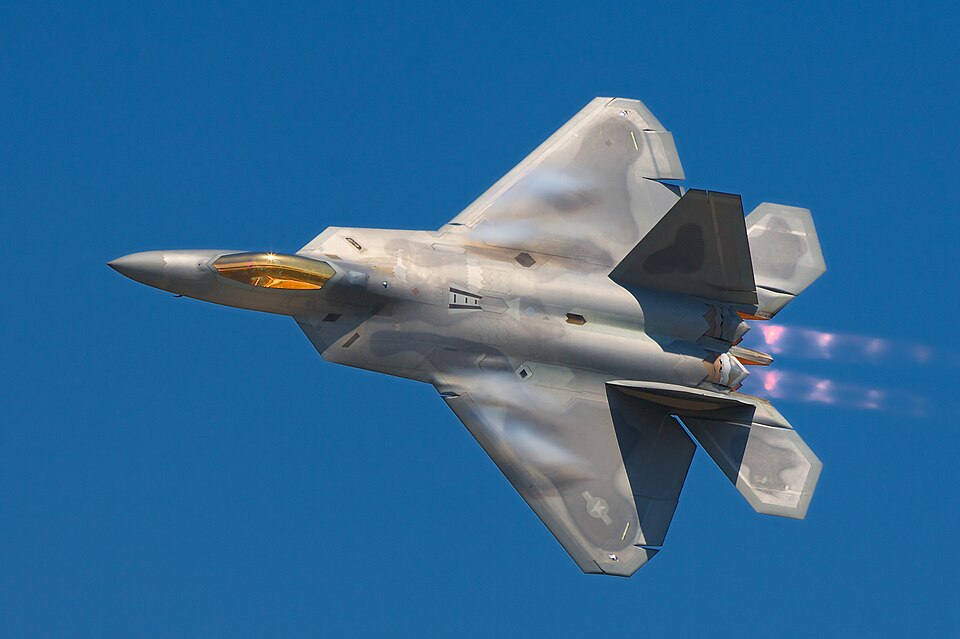
The Lockheed Martin F-22 Raptor is widely regarded as the most capable dedicated air superiority fighter in the world. Its two Pratt and Whitney F119-PW-100 engines each produce around 35,000 pounds of thrust, and both are equipped with two-dimensional thrust-vectoring nozzles that can move up or down by as much as 20 degrees.
That thrust vectoring is what gives the F-22 its signature ability to perform post-stall maneuvers. At airshows, it can point its nose almost straight up, hang nearly motionless, and then recover — something most aircraft without thrust vectoring simply cannot do without falling out of the sky.
The Raptor also has supercruise capability, meaning it can sustain supersonic flight without using its afterburners. This matters in a dogfight because afterburner burns through fuel at a punishing rate. By cruising fast without it, the F-22 arrives at a merge with more fuel for the fight itself.
Its sensor suite, including an active electronically scanned array radar and electronic warfare systems, gives pilots outstanding situational awareness. The F-22 first entered service in late 2005 and later flew real strike missions against ISIS targets in Syria beginning in 2014.
Pro Tip: The F-22's combination of supercruise, thrust vectoring, and stealth makes it a near-impossible opponent to set up against. Even in training exercises, it has repeatedly shown the ability to enter an engagement undetected and leave before opponents can react.
Why it ranks #1: No other jet currently combines stealth, supercruise, thrust vectoring, and sensor fusion the way the F-22 does. In a clean close-range fight, it is arguably unmatched.
2. F-16 Fighting Falcon (USA)
The General Dynamics (now Lockheed Martin) F-16 Fighting Falcon has been one of the world's most respected dogfighters since it entered U.S. Air Force service in 1979. Its design philosophy was simple and aggressive: build the lightest, most maneuverable jet possible around a single powerful engine.
The F-16's blended wing-body design, relaxed static stability, and fly-by-wire controls give it a naturally agile flight envelope. It can sustain high-G turns that would exhaust heavier jets, and its cockpit design — including a reclined seat and side-mounted control stick — helps pilots tolerate the G-forces better than in traditional setups.
The F-16 has an outstanding combat record across multiple conflicts and continues to serve with air forces in dozens of countries. Its cannon can fire around 6,000 rounds per minute, making it formidable in close gun fights.
Why It Matters: The F-16 has been called one of the best blends of instantaneous turn rate, roll rate, and pilot cueing for classic close-range maneuvering. Its decades of real combat experience set it apart from jets that have only been tested in exercises.
3. Eurofighter Typhoon (Multi-Nation Europe)
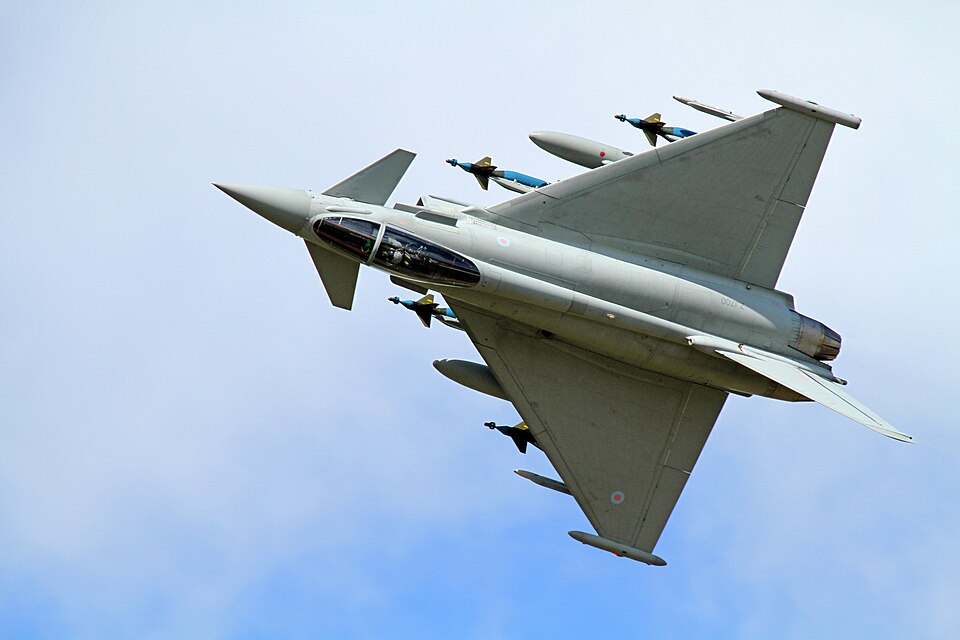
The Eurofighter Typhoon is built by a consortium involving the United Kingdom, Germany, Italy, and Spain, and it is widely considered NATO's finest non-stealth close-range fighter. Its canard-delta wing design creates lift and agility that would be impossible with a conventional wing layout.
The Typhoon's thrust-to-weight ratio in a light combat configuration can exceed 1:1, meaning it can accelerate vertically. It is also inherently aerodynamically unstable, which sounds like a problem but is actually a feature — its digital fly-by-wire system corrects for the instability thousands of times per second, allowing the jet to respond to pilot input faster than a stable aircraft ever could.
In training exercises, the Typhoon has achieved simulated kills against F-22 Raptors and F-35s in within-visual-range (WVR) engagements. During a 2012 Red Flag Alaska exercise, Typhoons reportedly scored multiple simulated victories against Super Hornets and Raptors in close combat.
The Typhoon maintains energy exceptionally well during high-speed maneuvers, which NATO pilots regularly highlight as one of its best qualities in a fight. It can sustain supersonic speeds while turning — a rare capability.
4. Dassault Rafale (France)
France's Dassault Rafale is one of the most capable multirole fighters in the world, and its dogfighting credentials are rock solid. Like the Typhoon, it uses a delta wing with forward canards, but the Rafale squeezes more low-speed performance out of its design through careful aerodynamic shaping.
At slower speeds, the Rafale's canards generate airflow over the main wing that effectively reduces wing loading, improving turning performance exactly when it matters most in a close fight. Combined with a near-1:1 thrust-to-weight ratio, it can recover energy quickly after hard maneuvering.
The Rafale entered combat in Afghanistan in 2007 and has since been used in Libya, Syria, Mali, and the Persian Gulf. India has purchased a significant number of Rafales to upgrade its air force's capabilities. The jet has proven itself not just in exercises but in real-world operations.
Fun Fact: Aviation experts note that the Rafale performs near the edge of aerodynamic instability on purpose. Its digital flight control system uses that instability to make the jet respond almost telepathically to pilot inputs.
If you are interested in how specialized aircraft design pushes the boundaries of performance, the engineering behind small aircraft designed for specific missions follows similar principles of matching form to function.
5. Sukhoi Su-35 Flanker-E (Russia)
Russia's Sukhoi Su-35 is one of the most maneuverable jets in the world, and its secret weapon is a pair of Saturn AL-41F1S turbofan engines equipped with three-dimensional thrust-vectoring nozzles. Unlike the F-22's two-dimensional system, the Su-35's nozzles can redirect thrust in any direction — giving the pilot control authority at extreme angles of attack that almost no other jet can match.
This is why Su-35 demonstration pilots can perform the famous Pugachev's Cobra maneuver, where the nose snaps back past the vertical while the jet continues moving forward at a much slower rate. In a close fight, this kind of nose-pointing ability can put weapons on a target before the opponent can react.
The Su-35 carries a powerful radar and a capable weapons suite, including high off-boresight short-range missiles that pair well with its agility. It has seen operational use in Syria and Ukraine.
Heads Up: While the Su-35's raw maneuverability is exceptional, real-world combat results suggest that avionics, pilot training, and integrated battlefield awareness often matter more than aerobatic capability alone.
6. Boeing F-15 Eagle (USA)
The F-15 Eagle has a combat record that few jets in history can match. Since entering U.S. Air Force service in 1976, the F-15 family has accumulated an impressive air-to-air kill record without a confirmed loss in air combat — a statistic that military aviation experts frequently cite when discussing the jet's effectiveness.
The F-15 is not the tightest-turning jet on this list, but it is a master of energy management. It can use its exceptional speed and powerful twin Pratt and Whitney F100 engines to control the pace of a fight, choosing when to engage and when to disengage. In a vertical fight or a high-speed engagement, the Eagle is in its element.
The Strike Eagle variant has evolved into a powerful multirole platform, but the original air superiority Eagle remains one of the most feared close-range fighters ever built.
7. Mikoyan MiG-29 Fulcrum (Russia)
The MiG-29 Fulcrum was designed by the Soviet Union to counter Western fighters like the F-16 and F-15, and in some areas it succeeded admirably. Its sustained turn rate is considered by many analysts to exceed that of the F-16, making it a serious threat in a prolonged turning fight.
The MiG-29 uses a twin-engine layout with large leading-edge root extensions that generate lift-enhancing vortices at high angles of attack. This helps the jet maintain control at slow speeds and in hard turns where other jets would become sluggish.
Its helmet-mounted sight system allows pilots to cue missiles at targets well off the jet's centerline — a significant advantage in close combat where locking up a target with the nose pointed directly at it is not always possible.
The MiG-29 has served with dozens of air forces around the world and has seen combat in multiple conflicts, including the 1991 Gulf War and ongoing operations in Ukraine.
Keep in Mind: The MiG-29 is a 1970s-era design, and its avionics in baseline form are less capable than modern Western jets. Upgraded variants like the MiG-35, which adds fly-by-wire technology and improved sensors, close much of that gap.
8. Boeing F/A-18 Super Hornet (USA)
The F/A-18 Super Hornet is the U.S. Navy's primary carrier-based fighter, and it is built to be effective across a wide range of missions — including close-range dogfighting. Its twin-engine design and aerodynamically optimized shape allow it to perform high-angle-of-attack maneuvers that many jets cannot match.
One of the Super Hornet's best-known traits is its ability to maintain controlled flight at extreme nose-high attitudes. This translates directly to a combat advantage: a pilot who can point the aircraft's nose at an opponent quickly, even in a slow-speed turning fight, has a real chance to score a gun or missile solution.
The Super Hornet has an extensive combat record dating back to operations over Iraq, Afghanistan, and Syria. It continues to be upgraded with advanced avionics and weapons, keeping it competitive in a modern threat environment.
The engineering principles behind jets like the Super Hornet, optimized for specific operational environments, are similar to those found in VTOL aircraft that must perform in highly constrained conditions.
9. Sukhoi Su-57 Felon (Russia)
Russia's Su-57 is its answer to the F-22 and F-35 — a fifth-generation stealth fighter with thrust vectoring. Like the Su-35, it uses a 3D thrust-vectoring system that gives it remarkable low-speed nose authority. Unlike the Su-35, it combines that agility with a stealth design intended to reduce its radar cross-section.
The Su-57 first flew in 2010 and has seen limited operational use. Its full production capability and real-world effectiveness remain subjects of considerable debate among defense analysts. Export interest from countries like India and Egypt faded over time due to reported concerns about performance and reliability.
That said, in pure aerobatic terms, the Su-57 is a fearsome machine. Its combination of supermaneuverability and claimed stealth characteristics would make it a difficult opponent for any pilot.
Good to Know: Western analysts generally believe the Su-57's stealth capability is less advanced than the F-22 or F-35. But in a close-range fight where radar matters less and raw agility matters more, those differences shrink considerably.
10. Saab JAS 39 Gripen (Sweden)
Sweden's JAS 39 Gripen is a compact, lightweight fighter that delivers surprisingly strong dogfight performance at a fraction of the cost of its peers. Its canard-delta layout, combined with a powerful General Electric engine in the C/D variants and a Volvo Aero-adapted variant in the E model, gives it excellent thrust-to-weight performance relative to its size.
The Gripen's emphasis on operational flexibility is one of its most notable features. It can be refueled and rearmed by a small ground crew on a public road in a matter of minutes — a capability that reflects Sweden's doctrine of dispersed operations. That same lightweight philosophy also makes it nimble and efficient in a close fight.
Several countries in Europe, South America, and Southeast Asia operate the Gripen. The latest E variant includes an advanced AESA radar and expanded weapons compatibility, keeping it relevant against more expensive competitors.
At Flying411, we believe that understanding what makes each aircraft type special is the foundation of smart aviation thinking — whether you're following military aviation or exploring the general aviation market.
11. Chengdu J-10C (China)
China's Chengdu J-10C is a relatively recent addition to the global conversation about top dogfighters. Its canard-delta configuration and thrust-vectoring-equipped engine in some variants give it strong agility credentials. The J-10C also carries an active electronically scanned array radar and a range of modern air-to-air missiles, including the PL-15 with a reported long effective range.
The J-10C drew significant international attention during the 2025 India-Pakistan conflict, where Pakistan's air force reportedly used J-10Cs alongside other jets to disrupt Indian airstrikes. Reports indicated that J-10C aircraft may have played a role in engagements involving Dassault Rafales, though the details and independent verification of exactly what happened remain subjects of ongoing analysis.
Regardless of how that specific conflict is ultimately assessed, the J-10C has clearly entered the global conversation as a serious close-range fighter worth watching.
Why It Matters: The J-10C represents China's growing ability to produce competitive advanced fighters domestically. Its reported performance in actual combat — if verified — would mark a significant milestone for Chinese military aviation.
The design principles behind specialized military aircraft like the J-10C are distinct from those of platforms designed for surveillance and patrol. Aircraft built around very different mission requirements, like maritime patrol aircraft, show just how dramatically mission shapes design.
12. Lockheed Martin F-35 Lightning II (USA)
The F-35 is a unique entry on this list because it was not primarily designed to be a close-range dogfighter. Its strengths lie in stealth, sensor fusion, and the ability to engage threats before they detect the F-35 at all. In many ways, the F-35 is designed so that it never has to get into a classic turning fight.
But here is the thing: when it does enter close combat, it can hold its own. Its advanced flight computers compensate for aerodynamic limitations, and its situational awareness systems mean the pilot almost always knows exactly where the opponent is — which counts for a lot. In training exercises, it has won and lost against fourth-generation jets depending on the scenario.
The F-35's real superpower in a dogfight is avoidance. By detecting and engaging threats at long range, it removes the close-range battle from the equation entirely. That is a different kind of dogfight dominance — one that is increasingly relevant in modern air combat.
Pro Tip: When evaluating the F-35 as a dogfighter, it helps to think of it like a chess player who avoids the endgame entirely by winning in the middle game. The ability to kill a threat before it becomes a close-range problem is its most powerful close-air capability.
13. Sukhoi Su-27 Flanker (Russia)
The Su-27 Flanker is the grandfather of Russia's modern fighter family. Designed to counter the F-15 Eagle, the Su-27 brought a large, powerful airframe to the fight with impressive range and a high angle-of-attack capability that surprised Western pilots when it was first revealed at airshows in the late 1980s.
The Su-27's Pugachev's Cobra maneuver — where the nose snaps past vertical while the aircraft continues forward — was a showstopper that demonstrated the jet's remarkable pitch authority. In a real close-range fight, this nose-pointing ability can be tactically useful for getting a missile lock when an opponent thinks they have passed safely behind.
The Su-27 family spawned the Su-30, Su-33, Su-34, and Su-35, all of which built on its core design. The original Su-27 continues to serve with Russia, China, Ukraine, and other air forces around the world, and in skilled hands it remains a dangerous opponent at close range.
The broad aviation ecosystem that includes jets like the Su-27 alongside transport aircraft, regional planes, and passenger jets reflects the full range of what human aviation has achieved. From close-range fighters to the largest passenger planes in the world, aircraft design always starts with the mission.
How These Jets Compare at a Glance
| Aircraft | Thrust-to-Weight | Thrust Vectoring | Stealth | Best Range |
| F-22 Raptor | ~1.08:1 | Yes (2D) | Yes | WVR and BVR |
| F-16 Falcon | ~1.09:1 | No | No | WVR |
| Eurofighter Typhoon | ~1.15:1 (combat) | No | Limited | WVR and BVR |
| Dassault Rafale | ~0.99:1 | No | Limited | WVR |
| Su-35 Flanker-E | ~1.13:1 | Yes (3D) | No | WVR |
| F-15 Eagle | ~1.07:1 | No | No | BVR and high-speed WVR |
| MiG-29 Fulcrum | ~1.01:1 | No (base) | No | WVR |
| F/A-18 Super Hornet | ~0.93:1 | No | No | WVR |
| Su-57 Felon | Est. ~1.19:1 | Yes (3D) | Yes (claimed) | WVR and BVR |
| JAS 39 Gripen | ~0.97:1 | No | No | WVR |
| Chengdu J-10C | Est. ~1.0:1 | Optional | Limited | WVR |
| F-35 Lightning II | ~0.87:1 | No | Yes | Stealth-first BVR |
| Su-27 Flanker | ~1.0:1 | No | No | WVR |
Note: Thrust-to-weight ratios vary by configuration and fuel load. Figures above represent approximate published estimates in typical combat configurations.
Does Pilot Training Matter More Than the Jet?
Almost every aviation expert and fighter pilot will tell you the same thing: the person in the seat matters more than the machine. A skilled, experienced pilot in a fourth-generation jet will beat an untrained pilot in a fifth-generation one the majority of the time.
This is not to downplay the importance of aircraft design. A great plane gives a great pilot more tools and more options. But the jet is only as good as the hands controlling it.
The U.S. Top Gun school and Red Flag exercises exist precisely to give pilots as much realistic close-range combat training as possible. Countries with strong pilot training pipelines consistently outperform those with more advanced jets but weaker training programs in mock combat exercises.
Quick Tip: If you ever watch footage of dogfight training exercises between allied nations, pay attention to the results — they often tell you more about training quality than about aircraft capability.
The regional aviation ecosystem that supports military and commercial aviation alike, including regional aircraft that move pilots, personnel, and cargo to and from remote bases, plays an invisible but essential supporting role in how air forces sustain their readiness.
Modern Trends Shaping the Future of Dogfighting
Air combat is evolving fast. Beyond-visual-range missile systems are getting more accurate and harder to defeat. Stealth technology makes detection harder. Electronic warfare can blind a pilot before they ever know an enemy is near.
So does dogfighting still matter?
Most air forces say yes — and they back it up with their training schedules and aircraft designs. Even the most stealthy jets carry short-range dogfighting missiles and internal cannons. The reason is simple: no technology is perfect. Missiles miss, radars get jammed, and situational awareness breaks down in the chaos of combat. When that happens, the pilot who can win a turning fight survives.
Sixth-generation fighter programs in the U.S., UK, Japan, and Europe are all incorporating lessons from modern close-range combat. Thrust vectoring, advanced sensors, and AI-assisted targeting are all on the table. The dogfight is not going away — it is evolving.
Aircraft designed for equally demanding, specialized missions such as firefighting aircraft remind us that purpose-built design always produces better results than general-purpose compromise — a principle that dogfighting jets embody better than almost anything else in aviation.
Conclusion
The world of aerial combat has changed enormously since the first jet fighters took to the skies over Korea and Vietnam. Missiles have gotten smarter, radar has gotten longer-ranged, and stealth has rewritten the rules of engagement. But the fundamentals of close-range air combat — energy, angles, awareness, and skill — remain as relevant as ever.
The best dogfighting jets on this list each represent a different answer to the same question: what does it take to win when another jet is trying to get behind you? Some answer with raw maneuverability. Others answer with sensor dominance. The best answer with both.
Whether you are drawn to the legendary F-22 Raptor, the battle-tested F-16, or the razor-sharp Eurofighter Typhoon, the aircraft on this list represent the absolute pinnacle of what modern aviation can achieve in a close-range fight.
For more expert coverage of the aircraft that matter, head over to Flying411 — your trusted source for everything from military aviation to general aviation news and analysis.
Frequently Asked Questions
What is the best dogfighting jet in the world today?
The F-22 Raptor is widely considered the best dedicated dogfighter currently in service, thanks to its combination of thrust vectoring, supercruise, stealth, and advanced avionics. However, the Eurofighter Typhoon is often cited as the best non-stealth close-range fighter, and the Su-35 is frequently highlighted for its extreme maneuverability.
Is the F-35 good at dogfighting?
The F-35 was not designed primarily for close-range dogfighting, but it can hold its own when it has to. Its greatest advantage is its ability to avoid close combat entirely by detecting and engaging threats at long range using stealth and advanced sensors.
What does thrust vectoring do in a dogfight?
Thrust vectoring allows a jet's engine nozzles to redirect exhaust in different directions, giving the aircraft the ability to point its nose rapidly even at very low speeds or in post-stall conditions. This is extremely useful in a close fight where getting the nose pointed at an opponent quickly can mean the difference between a missile lock and a missed opportunity.
What is the difference between instantaneous and sustained turn rate?
Instantaneous turn rate is how quickly a jet can begin a turn in a burst effort, usually achieved by pulling hard on the controls and accepting a rapid loss of speed. Sustained turn rate is how fast a jet can turn continuously without losing energy. In a prolonged dogfight, sustained turn rate is often more important.
Can a well-trained pilot beat a better aircraft?
Yes — and this happens regularly in training exercises. Pilot training, tactics, and experience can overcome significant disadvantages in aircraft performance, especially in close-range combat where decision-making speed and situational awareness matter enormously. The best outcome is combining a skilled pilot with a capable aircraft, which is why air forces invest heavily in both.