A Robinson R44 overhaul costs somewhere around $255,000 at a factory-authorized shop, and spread across the 2,400-hour interval that works out to roughly $106 an hour. At 80 flight hours a year, a Robinson R44 accumulates only 960 hours over twelve years, so calendar maintenance becomes a major ownership consideration. However, Robinson's 12-year inspection requirements are separate from the full 2,200-hour overhaul, and the work required can differ depending on component condition and remaining service life. Owners should obtain separate estimates for calendar-driven maintenance and the eventual hourly overhaul rather than assuming the same full overhaul cost applies to both events.
That one piece of arithmetic is why Robinson R44 vs Bell 206B JetRanger is a harder question than the sticker on the fuel truck suggests. The piston machine looks cheap per hour and the turbine looks expensive, and at 200 hours a year that is exactly right. At 60 or 80 hours a year, the gap narrows in ways most first-time buyers never see coming.
Here is what each one actually costs to keep flying, where the money goes, and how to tell which column of the table is really yours.
The Short Answer
If you fly 150 to 250 hours a year, carry three people and bags, and want the lowest defensible number on the invoice, the R44 wins and it is not close — figure roughly $270 to $320 an hour in direct costs against $450 to $525 for the JetRanger. If you need a fifth seat, a 1,400-pound useful load, a hook that will lift real weight, turbine starting reliability on cold mornings, or you are flying revenue work where a customer is paying, the 206B earns its extra money and the R44 simply cannot do the job. The trap in the middle is the low-utilization private owner: fly under about 100 hours a year and Robinson's 12-year overhaul clock inflates the piston's hourly cost toward turbine territory, while the JetRanger does not have the same aircraft-wide 12-year maintenance event as the R44, but it still has calendar-based inspections, component requirements and life limits that must be considered alongside engine and rotor-system hours. Its lower-utilization economics may be more favorable in some circumstances, but they depend on the condition and remaining life of each major component.
What Each One Burns in an Hour
Fuel is the part buyers understand first, and it is the smallest surprise of the three big line items.
The R44 Raven II runs a Lycoming IO-540-AE1A5, rated 245 horsepower for takeoff and derated to 205 continuous. Owners typically see 16 to 17 gallons per hour of 100LL in cruise. The carbureted Raven I, with the O-540-F1B5, burns closer to 14 to 15. At a representative 2025 US retail price of about $6.75 a gallon, that is roughly $108 an hour in the Raven II and about $95 in a Raven I.
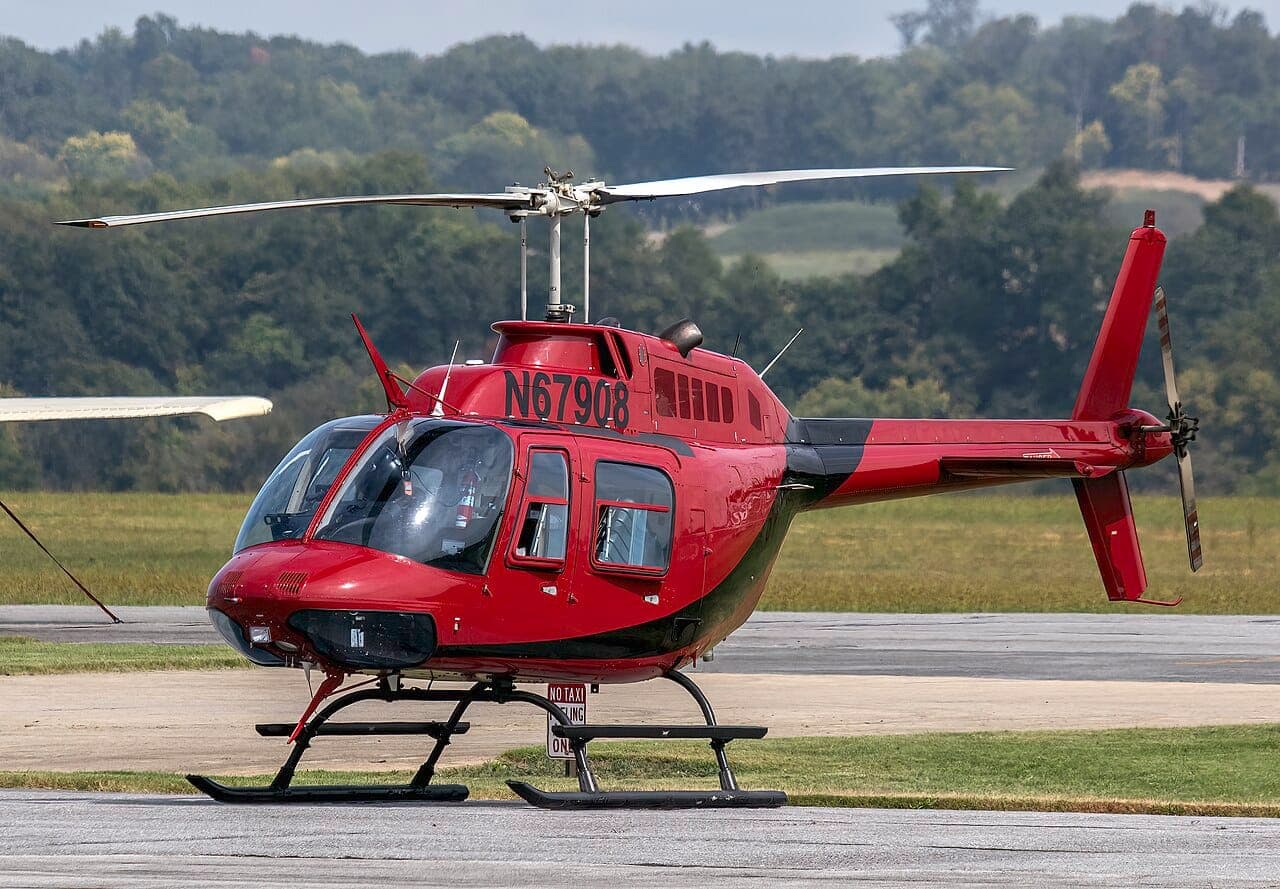
The Bell 206B-3 runs a Rolls-Royce (originally Allison) 250-C20B or C20J, a 420-shaft-horsepower engine derated to 317 for takeoff in this airframe. Typical cruise burn is 26 to 30 gallons per hour of Jet A. At about $6.25 a gallon — Jet A usually runs well below 100LL, and at self-serve pumps the gap can be a dollar or more — you are looking at roughly $175 an hour.
So the turbine burns nearly twice the fuel but buys it cheaper. Call it a $65 to $70 per hour penalty on fuel alone. That is real money over a year, but it is not what separates these two machines. The separation happens in the reserve accounts.
Quick Tip: Check what your home field actually sells before you commit. A growing number of airports have dropped 100LL entirely or price it as a boutique product, and the FAA's EAGLE initiative is pushing the fleet toward an unleaded replacement by 2030. Jet A is the one fuel every airport with a turbine customer will still be pumping in twenty years.
Edge: R44, by roughly $65 to $70 an hour on fuel — but the gap is smaller than the gallons suggest.
The Overhaul Clock: Hours Versus the Calendar
This is the dimension that decides the comparison, and it is where the two designs think about time completely differently.
Robinson specifies a 2,200-hour major scheduled maintenance interval for the R44 Raven I and Raven II, while the two-seat R44 Cadet has a 2,400-hour interval. The company also requires separate 12-year calendar maintenance, which may involve extensive inspections and component replacements without necessarily requiring the same work as a complete hourly overhaul. Engine, main rotor gearbox, tail rotor gearbox, blades, drive system, bearings, hoses, the lot.Robinson's published 2026 operating-cost estimate for the R44 Raven II allocates approximately $328,350 for the 2,200-hour engine and aircraft overhaul, including an exchange engine, overhaul parts kit and estimated labor. The final invoice depends on the helicopter's condition, equipment, service center and additional repairs, while the separate 12-year maintenance event may require a different scope and cost. It is less like an engine overhaul and more like trading your car in for an identical new one and paying the difference.
The 12-year half of that rule is the part buyers underestimate. It runs whether the helicopter flies or sits. A Robinson in a hangar depreciating toward its overhaul date is a bit like a gym membership billed monthly — the bill arrives on schedule and does not care how often you showed up.
The JetRanger has no equivalent sweep. Rolls-Royce publishes a 3,500-hour TBO for the 250-C20B series, with a hot section inspection at the 1,750-hour midpoint. Full overhauls run roughly $200,000 to $280,000 in the current market and hot sections commonly land between $50,000 and $90,000 depending on what the borescope finds. Set those against the hours and the engine reserve is about $100 an hour.
Then come the dynamic components. The 206 carries a long list of life-limited parts — main rotor blades, mast, hub, swashplate, freewheeling unit, tail rotor components — each retired on its own schedule in hours, cycles or calendar years rather than all at once. Experienced operators budget another $100 to $130 an hour against that list. The money is the same order of magnitude as Robinson's; it just arrives in irregular lumps instead of one bill every twelve years.
Heads Up: A 206B advertised at a low price with a "run-out" engine is not a bargain, it is a payment plan with a hidden balloon. Before you sign anything, get the engine's time since overhaul and time since hot section verified against the logs, and demand the component status sheet listing every life-limited part with hours remaining. A single set of main rotor blades can run into six figures.
Our guide on how much to set aside per flight hour walks through building these reserve accounts properly, and how to calculate aircraft operating cost per hour shows the full method if you want to run your own numbers with local fuel and hangar prices.
Edge: Draw at high utilization; clear win to the Bell 206B below about 100 hours a year, because the Robinson calendar limit does not forgive a quiet year.
Side by Side: The Real Figures
Figures below assume 100LL at $6.75 a gallon and Jet A at $6.25 a gallon, both representative of US retail in 2025, and 200 flight hours a year. Reserve figures are the midpoints of current shop quotes, not guarantees. Specification figures come from the manufacturers' published data for the R44 Raven II and the Bell 206B-3.
| Item | Robinson R44 Raven II | Bell 206B-3 JetRanger |
| Engine | Lycoming IO-540-AE1A5 piston | Rolls-Royce 250-C20B/C20J turboshaft |
| Takeoff power | 245 hp (205 hp continuous) | 420 shp derated to 317 shp |
| Seats | 4 | 5 |
| Max gross weight | 2,500 lb | 3,200 lb internal |
| Typical useful load | About 950–1,000 lb | About 1,350–1,450 lb |
| Cruise speed | About 110 kt | About 105–110 kt |
| Usable fuel | About 47 gal with aux tank | About 91 gal standard |
| Fuel burn | 16–17 gph, 100LL | 26–30 gph, Jet A |
| Overhaul interval | 2,200-hour major inspection for Raven II; separate 12-year maintenance | Engine overhaul and component intervals depend on the installed equipment and approved maintenance program |
| Mid-life inspection | None scheduled | Hot section at 1,750 hr |
| Overhaul cost basis | About $230,000–$280,000 | About $200,000–$280,000 engine, plus life-limited parts |
| Fuel cost per hour | About $108 | About $175 |
| Overhaul/component reserve | About $149/hr for the Raven II's 2,200-hour overhaul under Robinson's 2026 estimate; calendar maintenance considered separately | Illustrative engine and dynamic-component reserves require verification against current shop quotes and component records |
| Routine maintenance | About $50–60/hr | About $85–100/hr |
| Estimated direct cost per hour | About $270–320 | About $450–525 |
| Estimated all-in at 200 hr/yr | About $380–420 | About $610–680 |
| Production status | In production | Ended 2010 |
Fun Fact: The JetRanger started its life as a loser. Bell's OH-4A lost the US Army's light observation helicopter competition in the early 1960s, so Bell reworked the fuselage into a civil machine, sold it as the Model 206A, and then won the re-run of the same Army contest with it as the OH-58 Kiowa. More than 7,000 206-series airframes followed, which is exactly why parts support is still broad fifteen years after the last one rolled out.
Flying411 keeps light piston and turbine helicopter listings in one place, so you can compare an R44's remaining hours to overhaul against a JetRanger's time since hot section without juggling six browser tabs.
Routine Maintenance, Parts and Finding a Shop
Past the big reserves, the day-to-day differs in character as much as in cost.
The R44 is a 100-hour-inspection machine in most operations, and Robinson's maintenance manual is prescriptive to the point of being unforgiving. Drive belts, clutch actuator, main rotor and tail rotor bearings, flex couplings, and a long list of calendar-limited hoses and rubber parts all have their own replacement points. The individual items are cheap by helicopter standards; there are simply a lot of them. Owners commonly report $50 to $60 an hour for routine upkeep between overhauls, assuming nothing unusual turns up. Robinson's network of factory-trained service centers is wide, the parts come from one source at published prices, and that predictability is genuinely worth something.
The 206B costs more per hour to maintain but is a more forgiving airframe in the field. The turbine itself is almost boringly reliable between hot sections — no magnetos, no carb ice, no mixture, no shock cooling. What costs money is everything attached to it: the transmission, the two-bladed teetering head, the tail rotor drive, and the inspection labor those need. Budget $85 to $100 an hour. The flip side is a deep aftermarket, decades of accumulated knowledge in almost every helicopter shop in North America, and serviceable used parts that actually exist because thousands of airframes and military Kiowas were built.
Keep in Mind: Bell ended JetRanger production in 2010, so every 206B on the market is at least fifteen years old as of 2026. Corrosion history, previous operator type — utility, tour, law enforcement, flight school — and the honesty of the logbooks matter more on this airframe than the hour meter does.
If you are weighing the 206B against its stretched sibling, our breakdown of Bell 206B JetRanger vs 206L LongRanger costs covers where the extra cabin pays for itself. And for the broader mechanical picture, piston helicopter vs turbine helicopter explains why the two powerplants age so differently.
Edge: R44 on cost, Bell 206B on parts availability and shop familiarity. Call it a split.
Insurance, Training and the Turbine Checkout
Insurance is where low-time buyers get their real education, and it is the line item most often left out of hourly cost comparisons.
On the Robinson side, the FAA's Robinson-specific training rule, SFAR 73, sets minimum experience and recurrent training requirements for R22 and R44 pilots, including a flight review in type every twelve calendar months. Underwriters take it seriously and add their own conditions on top. A private owner with a few hundred hours of helicopter time will generally find R44 coverage available and affordable; a brand-new private pilot with 60 hours will find it available, expensive, and loaded with dual-instruction requirements.
On the JetRanger, the question changes from "how many hours" to "how many turbine hours." Insurers routinely want formal turbine transition training plus a block of mentored or dual time in type before they will write a low-time owner solo, and the premium reflects both the higher hull value and the higher liability exposure typical of turbine operations. Expect the annual premium on a 206B to run meaningfully above an R44 of similar hull value, and expect the first year to be the worst one.
Good to Know: Turbine time is a career asset in a way piston helicopter time is not. If you are building hours toward commercial work — utility, EMS, tour flying — the hours in a 206B logbook are worth more to a future employer than the same hours in an R44, which offsets part of the cost difference in a way no spreadsheet will show you.
Training cost also runs the other way. Finding an instructor qualified in R44s is easy and relatively cheap. Finding turbine instruction is a bigger project with a bigger invoice, though the 206 is one of the most widely taught turbine helicopters there is.
Edge: R44, clearly, on insurance and training cost — unless you need turbine time for a career, in which case the Bell's expense is tuition.
Flying411 keeps R44 and JetRanger listings side by side in one place, so you can compare hull values before you ask an underwriter what that number will cost you every year.
Mission: Seats, Load and What You Can Actually Carry
Cost per hour means nothing if the machine cannot do the job, and this is the cleanest difference between the two.
The R44 is a four-seat helicopter with a useful load around 950 to 1,000 pounds. Fill the main tank and the aux tank for a three-hour leg and you have roughly 700 pounds left for people and bags — three adults, light luggage, and honest planning. In summer heat at altitude, that shrinks. The R44 is an excellent two-to-three person machine and a theoretical four-person one.
The 206B carries about 1,350 to 1,450 pounds useful across five seats, with 91 gallons of fuel on board for roughly three hours. Load that fuel and you still have around 830 pounds of payload. More importantly, the turbine holds its power as the air thins and the temperature climbs, where the normally aspirated Lycoming simply does not. On a hot day at 6,000 feet, that gap is not a few percent — it is the difference between going and not going.
External load is the other divider. The 206 has decades of history on the end of a long line doing construction, powerline and logging support work. The R44 does light utility work but is not in the same category.
Why It Matters: If your actual mission is two people and a weekend bag, buying a 206B to haul capacity you will never use is paying $200 an hour for empty seats. If your mission is four passengers on a hot afternoon, the R44 will quietly make that decision for you on the performance chart.
Edge: Bell 206B, decisively, on load, hot-and-high capability and utility work.
Which One Should You Buy?
The private owner flying 150 to 250 hours a year. Buy the R44. At that utilization the overhaul reserve works out near its best-case number, fuel is cheap, maintenance is predictable, and you will spend roughly $380 to $420 an hour all in rather than $610 to $680. If you want more performance later, the step up is cleaner through the R66 than through a fifty-year-old turbine — our comparison of R44 vs R66 covers that path, and what it costs to own an R44 Raven goes deeper on the ownership side.
The owner flying 60 to 100 hours a year. Run the numbers carefully before assuming the piston wins. At 80 hours a year, the Robinson overhaul spreads over fewer than 1,000 hours in twelve years and the effective reserve more than doubles. The JetRanger's hour-based limits, by contrast, barely move. The Bell will still cost more per hour in total, but the difference narrows from roughly $250 an hour to something closer to $120 — and for that you get the fifth seat, the load and the turbine. One honest fix for the low-utilization piston owner is to stop owning alone and share the airframe, which pushes the hours up and the per-hour cost down.
The commercial or charter operator. The 206B, almost without exception. Customers expect turbine. Load and endurance support revenue work. Parts and maintenance expertise exist everywhere. And the JetRanger's residual value has held up remarkably well for an aircraft out of production since 2010, which means the depreciation line on your spreadsheet is kinder than the operating line.
The buyer who wants turbine but not a fifty-year-old airframe. Look sideways at the newer light turbines before committing. Our comparisons of the R44 Raven against the Bell 505 and R66 against the Bell 505 cover machines with glass panels, modern engines and full manufacturer support, at a higher purchase price but with less unknown history.
Flying411 keeps piston and turbine rotorcraft listings in one place, so you can compare what a mid-life R44 and a mid-life JetRanger are really asking before you decide which column of the cost table you can live with.
Where the Money Really Goes
The honest summary of Robinson R44 vs Bell 206B JetRanger is that the turbine costs roughly 1.6 to 1.8 times as much per hour at normal utilization, and that most of the difference is not fuel. It is the component reserve, the insurance and the inspection labor on a larger, older, heavier machine. What you buy for that premium is capability: a fifth seat, 400 more pounds of useful load, performance that does not melt on a hot day, and a powerplant that starts the same way every morning.
What you give up by choosing the R44 is some of that capability. What you gain is predictability — one manufacturer, one parts source, one big bill you can see coming twelve years out. For a lot of owners, that predictability is worth more than the fifth seat. Just make sure the hours you actually plan to fly, not the hours you imagine flying, are the ones you put in the denominator. That single number moves the answer more than anything else on this page.
When you are ready to compare listings, visitFlying411and see what is on the market today.
Frequently Asked Questions
How much more per hour is a Bell 206B than an R44?
At 200 flight hours a year, with 100LL around $6.75 and Jet A around $6.25 a gallon, expect roughly $270 to $320 an hour direct for an R44 Raven II and $450 to $525 for a 206B-3. Add hangar and insurance and the all-in figures land near $380 to $420 and $610 to $680 respectively. Fly fewer hours and both numbers rise, but the R44's rises faster because of its 12-year overhaul limit.
Does the R44's 12-year overhaul apply even if I barely fly?
Robinson requires major scheduled maintenance at 2,200 hours for the Raven I and Raven II, or 2,400 hours for the Cadet, together with separate 12-year calendar maintenance requirements. A helicopter reaching twelve years with hours remaining may qualify for the prescribed calendar inspection and component maintenance rather than a complete hourly overhaul.This is the single biggest reason low-utilization R44 ownership costs more per hour than buyers expect, and it is worth modelling honestly before you buy.
Is a turbine helicopter safer than a piston one?
Turbine engines fail less often than piston engines, which is a genuine advantage. But most helicopter accidents are not engine failures — they involve the pilot, the weather or the decision to fly at all. Our look at the R44 Raven safety record breaks down what the accident data actually shows rather than what the hangar talk says.
What should I check first on a used 206B?
Three things, in order: time since engine overhaul and since hot section inspection, the component status sheet showing hours remaining on every life-limited part, and the corrosion history, especially if the aircraft spent time near salt water or flew tours. A pre-buy inspection by a shop that knows 206s is not optional on an airframe that has been out of production since 2010.