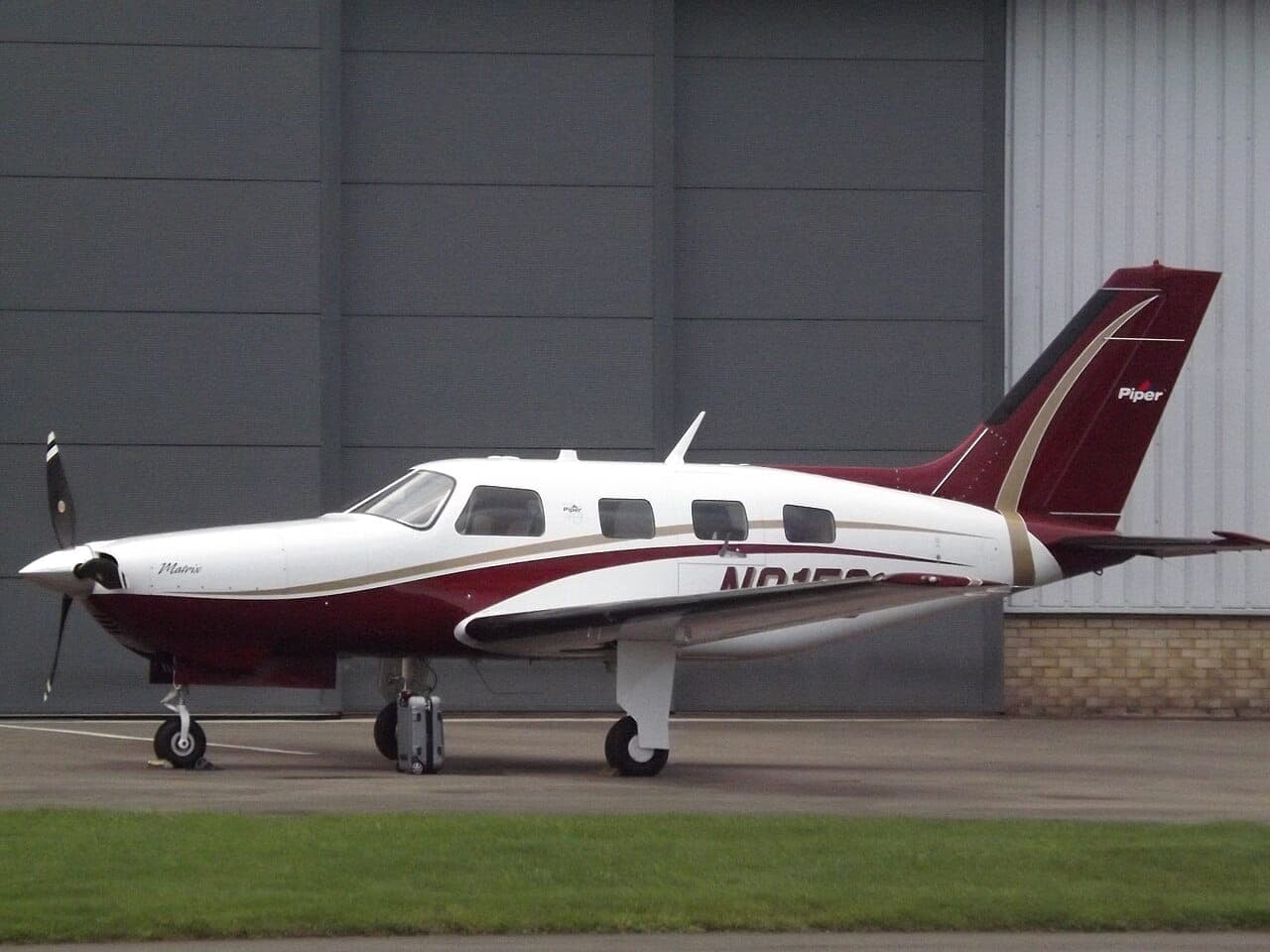
Five and a half pounds per square inch. That is the maximum cabin pressure differential of a Piper Malibu Mirage, and it is the entire reason one of these two airplanes costs more to buy, more to inspect and more to keep legal than the other. At 25,000 feet, that 5.5 psi holds the cabin at roughly 8,000 feet — about the elevation of a ski town. Take the pressurization away and you have a Piper Matrix: same wing, same fuselage, same 350-horsepower Lycoming, same six seats, and a stack of oxygen bottles where the convenience used to be.
That is why the Piper PA-46 Matrix vs Malibu Mirage question comes up so often among buyers moving into their first cabin-class single. Piper priced the two models roughly $200,000 to $250,000 apart when both were in production, and the gap does not end at the sale. Pressurization adds a recurring maintenance line item for as long as you own the airplane. The question is not which model is better built. They are the same airplane. The question is whether you will actually use the altitude you are paying for.
Key Takeaways
The Matrix and the Mirage share an airframe, a Lycoming TIO-540-AE2A engine and nearly identical published speeds, so the real decision is about how high you fly and how often. The Mirage buys you a comfortable cabin in the low flight levels without masks or cannulas, which matters enormously on legs over about three hours and with passengers who are not pilots. The Matrix gives that money back at purchase, trims roughly a hundred pounds of empty weight, and removes a whole category of recurring squawks — door seals, outflow valves, pressure controllers, crazed windows. If your typical trip is under 400 nautical miles with one or two people aboard, the Matrix is usually the smarter buy. If you routinely fly long legs with a full cabin, or you live in the mountain West where weather and terrain push you up, pay for the Mirage and stop second-guessing it.
What Actually Differs Between the Two
Piper launched the Matrix for the 2008 model year as a deliberately simplified Mirage. Both sit on the same FAA type certificate data sheet, A25SO, alongside the rest of the PA-46 family. The model designations tell the story: the Mirage is the PA-46-350P, where the P stands for pressurized, and the Matrix is the PA-46R-350T, with the T for turbocharged and no P at all.
Underneath, the similarity is almost total. Both use the Lycoming TIO-540-AE2A, a turbocharged, 350-horsepower six-cylinder with a 2,000-hour recommended TBO. Both carry 120 usable gallons. Both are certified to a maximum operating altitude of 25,000 feet. Both have the same retractable gear, the same airstair door, the same cabin roughly 50 inches across with club seating in back. Avionics track together too: the earliest Matrix airframes shipped with Avidyne Entegra glass, and both models moved to the Garmin G1000 for the 2011 model year.
The airframe is the same; the systems are not
Here is the part that surprises people. Piper did not design a lighter, cheaper fuselage for the Matrix. It is the same structure, built to the same standard, with the pressurization hardware deleted. You are buying a thermos and leaving the lid in the drawer. The weight saving is real but modest — call it about 100 pounds of bleed-air plumbing, valves, controller, heavier windows and door seal — not the 400 pounds you might expect if the airplane had been designed unpressurized from a blank sheet.
What the Matrix gains instead is a built-in oxygen system with outlets at every seat. What it loses is the ability to put a passenger in the back who has never worn a cannula and have them enjoy the flight.
Fun Fact: Because the Mirage's maximum operating altitude is exactly 25,000 feet and not above it, FAR 61.31(g) does not require a high-altitude endorsement to fly one. The rule applies to pressurized aircraft with a service ceiling or maximum operating altitude above 25,000 feet MSL. Your insurance company will still demand type-specific training, and you should get the high-altitude ground instruction anyway.
What Pressurization Costs You to Buy and to Own
Purchase price is the obvious half. Piper's own list prices put the Matrix well below the Mirage for every year both were offered, and the used market has carried that gap forward, though it has narrowed as the whole PA-46 fleet has aged and as Matrix buyers discovered how few were built. The Matrix had a short run — 2008 to 2015 — while the Mirage sold from 1989 until it was renamed the M350 in 2015. That means there are far more Mirages on the market at any given moment, in a far wider spread of years, panels and engine times. A Matrix shopper has a thin inventory and less negotiating room; a Mirage shopper can afford to be picky.
Flying411 keeps PA-46 listings from across the market in one place, so you can compare Matrix and Mirage asking prices, engine times and panel configurations side by side instead of chasing one broker at a time.
The recurring pressurization items
The ownership half is where the two airplanes separate for good. Pressurization is not one component; it is a system that touches the door, the windows, the firewall penetrations, the turbocharger bleed air path and the cabin structure itself. PA-46 specialist shops consistently flag the same items:
- Inflatable door seal. The Mirage door seals against an inflatable bladder fed by engine air. Seals age, crack and leak. Replacement is a four-figure part before labor, and most owners face it at least once or twice over a long ownership.
- Outflow and safety valves. These regulate cabin pressure and dump it on the ground. They are overhaul items, not lifetime parts, and a sticking valve shows up as a cabin that will not hold or will not climb smoothly.
- Cabin pressure controller. The brain of the system. When it drifts, you get cabin altitude excursions that are legal to ferry but miserable to live with.
- Windows. Pressurized cabin windows are thicker, stressed, and prone to crazing with age and UV. A full window replacement on a PA-46 is a five-figure job.
- Annual leak check. A proper Mirage annual includes verifying the cabin holds differential. That inspection time is not free, and it is where latent problems surface.
Owners and PA-46 shops generally report Mirage annual inspections running several thousand dollars above a comparable Matrix annual in a clean year, with the gap widening sharply in a year when a seal, a valve or a set of windows comes due. The Matrix simply does not have those line items. Its annual is a retractable-gear, turbocharged single's annual — still not cheap, but bounded.
Why It Matters: Some pressurization problems may permit continued flight at a lower altitude with appropriate oxygen, but others can make the aircraft unairworthy until corrected. Whether a Mirage can operate with a pressurization defect depends on the approved flight manual, equipment requirements and applicable regulations. A cabin that cannot maintain its specified pressure differential warrants proper troubleshooting rather than simply planning to use oxygen. Deferred pressurization maintenance is the classic way a Mirage quietly turns into the cheaper airplane you did not want to buy.
| Specification | Piper Matrix (PA-46R-350T) | Piper Malibu Mirage (PA-46-350P) |
| Production years | 2008–2015 | 1989–2015 (became M350) |
| Engine | Lycoming TIO-540-AE2A, 350 hp | Lycoming TIO-540-AE2A, 350 hp |
| Recommended TBO | 2,000 hours | 2,000 hours |
| Pressurization | None; built-in oxygen system | 5.5 psi maximum differential |
| Cabin altitude at FL250 | 25,000 ft (oxygen required) | Approximately 8,000 ft |
| Max operating altitude | 25,000 ft | 25,000 ft |
| Typical practical cruise altitude | Approximately 585–700 lb, depending on equipment | Approximately 500–600 lb, depending on equipment |
| Max cruise speed (Piper) | About 213 KTAS | About 213 KTAS |
| Usable fuel | 120 US gallons | 120 US gallons |
| Maximum takeoff weight | 4,340 lb | 4,340 lb |
| Typical full-fuel payload | Roughly 650–700 lb | Roughly 550–600 lb |
| Seats | 6 | 6 |
| FAA type certificate | A25SO | A25SO |
| 61.31(g) high-altitude endorsement | Not applicable (unpressurized) | Not required (max alt not above FL250) |
| Recurring pressurization maintenance | None | Door seal, outflow/safety valves, controller, windows, annual leak check |
Good to Know: The used Matrix pool is small enough that a well-kept example with low engine time can command money a Mirage shopper would find irrational. Scarcity does strange things to price. If you find a Matrix that fits your mission, do not assume you can walk away and find three more next month.
How They Fly: Altitude, Speed and Real Trip Times
Piper published essentially the same maximum cruise speed for both airplanes — around 213 knots true — and that number is achieved at the top of the envelope, in the mid-20s, where thin air rewards a turbocharged engine. The Matrix can legally and mechanically go there. The constraint is human, not mechanical.
Fly a Matrix at 15,000 or 16,000 feet, where a cannula is comfortable and legal for the pilot, and you give up real speed. The engine still makes its power, but the airframe is pushing through denser air, so true airspeed falls off and fuel flow per knot gets worse. The practical result is that a Matrix typically cruises 10 to 20 knots slower than a Mirage flying the same route on the same day, not because it is a slower airplane, but because it is flown lower.
On a 300-nautical-mile leg, that difference is maybe eight or ten minutes. Nobody changes an aircraft purchase over ten minutes. On a 900-mile leg with a headwind and a layer of convection you would like to top, the difference is an hour, a fuel stop, and a tired passenger in the back seat.
Keep in Mind: The Mirage's altitude advantage is as much about weather as it is about speed. Pressurization gives Mirage pilots greater flexibility to cruise above lower cloud layers, select smoother altitudes and avoid some icing conditions. However, icing can extend well into the flight levels, and neither aircraft's 25,000-foot operating ceiling guarantees the ability to climb above hazardous weather. The speed is a bonus.
Both airplanes share the PA-46's handling character: heavy on the controls compared with a Bonanza, very stable, and happiest on long cross-country legs rather than short hops. Both demand disciplined engine management. The TIO-540 is a turbocharged, high-output six, and it punishes sloppy leaning and rushed power changes. A modern engine monitor is close to mandatory equipment on either model — if the airplane you are considering does not have one, factor it in. We walk through that math in Is an Engine Monitor Worth the Install Cost?
Oxygen in Practice: The Thing Buyers Underestimate
On paper, an oxygen system looks like a fair trade for a pressure vessel. In practice, it changes how you use the airplane.
FAR 91.211 sets the rules. Above a cabin pressure altitude of 12,500 feet up to and including 14,000 feet, the required flight crew must use supplemental oxygen for any portion of the flight longer than 30 minutes. Above 14,000 feet, the crew uses it continuously. Above 15,000 feet, every occupant must be provided oxygen. In a Matrix, the cabin altitude is the airplane's altitude, so these thresholds bite immediately. In a Mirage at FL250, cabin altitude is around 8,000 feet, and 91.211 never enters the picture at all.
The lived difference looks like this. In the Matrix, every trip above the mid-teens starts with checking bottle pressure, fitting cannulas on everyone, monitoring flow, and dealing with a passenger who finds the whole thing claustrophobic. Cannulas are generally limited to 18,000 feet; above that, masks. A pulse-demand regulator stretches bottle duration dramatically and is a worthwhile upgrade on any Matrix, but it does not change the fact that you are managing a consumable in flight. Refilling the bottle means finding a field that can do it, which is routine at some FBOs and a phone-call project at others.
None of that is hard. It is friction. Friction is what determines whether you actually take the airplane on the 700-mile trip or drive.
Heads Up: A Mirage is not oxygen-free. It carries a built-in oxygen system for use after a pressurization failure, and that bottle needs servicing and hydrostatic testing on schedule like any other. The Mirage removes routine oxygen use, not oxygen maintenance.
Flying411 keeps equipment details on cabin-class singles in one place, so you can compare which PA-46 listings already carry pulse-demand oxygen, known-ice TKS or a current engine monitor before you spend money on a pre-buy.
Payload, Insurance and Training
Neither of these airplanes is a load-hauler. With 120 usable gallons aboard, fuel weighs approximately 720 pounds, leaving roughly 500 to 600 pounds of payload in many equipped Mirages and approximately 585 to 700 pounds in Matrix examples, depending on their actual empty weights and installed equipment. That is three adults and soft luggage, or four adults if you leave fuel behind. Six seats, in both airplanes, is a seating chart rather than a payload promise.
The Matrix's extra hundred pounds is a genuine advantage, and it is the one place where deleting the pressurization gives something back beyond money. If you regularly fly four people on two-hour legs, that hundred pounds is one more passenger's worth of margin.
Insurance and the training requirement
Insurers treat the PA-46 family as a step-up airplane and price it accordingly. Expect a carrier to require model-specific initial training from a recognized PA-46 provider plus annual recurrent, regardless of which version you buy. Low-time buyers and pilots with no retractable or turbocharged experience should plan on a mentor-pilot requirement for the first block of hours. Premiums move with hull value, total time, instrument currency and training history far more than with pressurization itself — a Mirage and a Matrix insured at the same hull value will quote broadly similarly for the same pilot.
The Malibu M-Class Owners and Pilots Association runs the training and safety culture around these airplanes, and insurers know it. Factoring annual recurrent training into your operating budget is not optional on a PA-46; it is part of the cost of ownership on both models.
Pro Tip: Get your insurance quote in writing before you sign a purchase agreement, for the specific tail number. More than one first-time PA-46 buyer has found the training and mentoring requirements add real money and real calendar time to the first year. Our breakdown of bill of sale versus purchase agreement explains where in the paperwork that contingency belongs.
Pre-Purchase: What to Check on Each
Everything in a standard cabin-class pre-buy applies to both: compressions and borescope on the TIO-540, turbocharger and exhaust system condition, landing gear rigging and actuator health, corrosion in the belly and wing roots, complete and continuous logbooks, and AD compliance across the airframe, engine and propeller. Our general guide to the aircraft pre-purchase inspection covers that groundwork, and logbook and maintenance history verification covers the paper trail.
On a Mirage, add these:
- A flight test to maximum differential. Not a ground test. Take it to the low flight levels and watch the cabin hold 5.5 psi, smoothly, without the controller hunting. A cabin that cannot make book differential is a negotiating point worth real money.
- Door seal age and condition. Ask when it was last replaced. If nobody knows, assume you are buying one.
- Window crazing. Inspect every pane in good light. Pressurized windows are expensive and they all age at about the same rate, so they tend to come due together.
- Outflow and safety valve history. Overhaul dates in the logs, or their absence.
- Bleed air path. Heat exchanger, sonic venturi and ducting, all of it living in the hot section of an already hot engine compartment.
On a Matrix, add these:
- Oxygen system serviceability. Bottle hydrostatic test date, regulator condition, outlet function at every seat, and whether the masks and cannulas supplied are actually usable.
- Evidence of high-altitude operation. Some Matrix airframes have spent their lives at 10,000 feet and some have been flown hard in the flight levels. The engine logs and monitor data tell you which.
- Unused pressurization provisions. The Matrix shares the Mirage's structure, and shops occasionally find blanked-off fittings or structure that deserves the same corrosion attention as a pressurized airframe.
Use a shop that works on PA-46s regularly. The family has well-known quirks, and a generalist A&P who has never seen a Malibu-class airplane will miss things that a specialist finds in an afternoon. If you want an independent number to argue price from, a certified appraiser is worth the fee on a purchase at this level.
Why It Matters: The PA-46's reputation took a beating after a cluster of in-flight breakups in the Continental-powered Malibu in the late 1980s. The FAA conducted a Special Certification Review in 1991 and found no design deficiency in the airframe; the findings pointed to operations in severe weather and loss of control. The lesson that stuck in the type-club community is that these airplanes reward trained, disciplined pilots and punish improvisation — which is exactly why insurers insist on recurrent training.
Which One Should You Buy?
Buy the Mirage if any of these describe you. You regularly fly legs of 500 nautical miles or more. You carry family or clients who are not pilots and will not tolerate a cannula for three hours. You operate in the mountain West, or anywhere terrain and weather routinely push you into the low flight levels. You want the option to top a layer rather than pick through it. In those missions, pressurization is not a luxury item — it is the feature that makes the airplane do the job, and the extra annual expense is simply the price of the capability.
Buy the Matrix if your honest flying looks like this. Most trips are under 400 miles. You fly solo or two-up more often than full. You would rather put the price difference into a fresh engine, a better panel or three years of flying. You want a cabin-class airplane with 1,300-nautical-mile legs and a club cabin, and you are content to cruise in the teens. The Matrix gives you about 90 percent of the Mirage's airplane and removes a maintenance category that never stops demanding money.
And if you find yourself arguing that you need pressurization and more speed, the honest answer may be that you are shopping one rung too low. The turbine conversions and the factory Meridian solve a different problem at a different price — we compare them in Piper Mirage vs JetProp DLX vs Meridian.
Conclusion
The Piper PA-46 Matrix vs Malibu Mirage decision is unusually clean because the two airplanes are, structurally, the same machine. You are not weighing a wing against a wing or an engine against an engine. You are deciding whether 5.5 psi of cabin differential is worth a six-figure purchase premium plus several thousand dollars a year in inspections, seals, valves and windows for as long as you own it.
Answer it with your logbook, not your ambitions. Pull the last two years of flights and count how many legs ran over three hours with more than two people aboard. If that number is small, the Matrix is the better-value airplane and you will not miss what you never had. If that number is most of your flying, buy the Mirage, budget honestly for the pressurization system, and get it inspected by someone who knows the type. Either way, build your offer around a real pre-buy and a written insurance quote — our aircraft purchase checklist covers the sequence.
Flying411 keeps Matrix and Mirage listings in one place, so you can compare engine time, avionics generation and equipment across the whole PA-46 market before you commit to a pre-buy slot.
When you are ready to compare listings, visitFlying411and see what is on the market today.