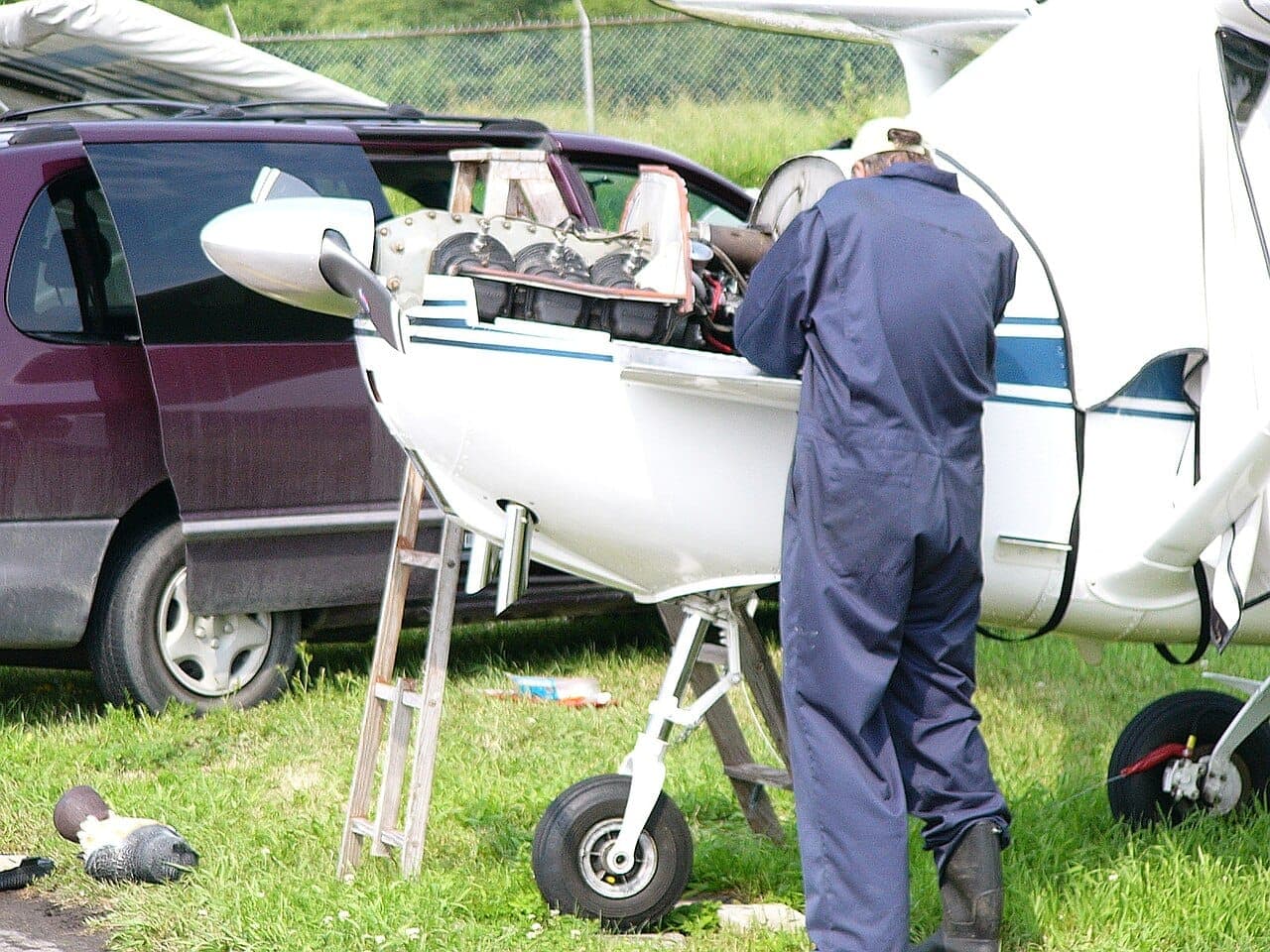
The costliest assumption a new owner makes is that the words "fresh annual" in a sales listing buy them twelve quiet months. They don't. The first annual after buying an airplane routinely lands at two to three times what the seller said the airplane "normally" costs to inspect, and for owners who spent every dollar on the purchase, that surprise shows up as a grounded airplane and a shop invoice they cannot pay. This article walks through where that money actually goes and what number to put in the bank before you close.
Realistic range, as of late 2025: a fixed-gear single like a Cessna 172 or Cherokee 180 usually runs $3,000 to $8,000 for its first annual under new ownership. A complex single — retractable gear, constant-speed prop, Bonanza or 210 class — lands between $5,000 and $15,000. A light piston twin starts around $8,000 and $20,000 is not rare. What pushes you to the bottom of those ranges is a thorough pre-buy done by a shop that knows the type, complete logbooks, and an airplane that has been flown regularly. What pushes you to the top is a long-neglected airplane, missing paperwork, and a seller who deferred everything for two years before putting it on the market.
Why the First Annual Costs More Than the Ones After It
An annual inspection is not an open-ended invitation to fix everything. Under 14 CFR 91.409, most Part 91 airplanes need an inspection every twelve calendar months, and Part 43 Appendix D spells out exactly what has to be opened, looked at, and checked. That scope is the same whether the airplane is yours this year or was somebody else's last year. So why does the first one hurt?
Because of what came before it. Four things stack up:
The seller's last annual was a selling annual. There is nothing illegal about a quick, minimal, by-the-book annual. An IA signs that the airplane meets the standard on that day. An IA does not sign that the tires have 300 hours left in them, that the vacuum pump is young, or that the brake linings are not at minimum. A seller preparing to sell has no reason to replace anything that still passes.
A new set of eyes finds new things. Shops develop a relationship with an airframe. The IA who has signed the same Cherokee for nine years knows which cracks he has been watching and which he already repaired. Your shop knows none of that, so it opens everything and reads everything. That is the right outcome, and it is also the expensive outcome.
Calendar items cluster. Transponder and static system checks come due on a 24-month calendar. ELT inspections are annual, battery replacement runs on its own schedule. Engine hoses age out. If the previous owner was quietly running down the clock on all of them, you inherit the whole cluster at once.
Paperwork debt comes due. Missing 337s, an equipment list that does not match the panel, an airworthiness directive that was probably complied with but was never written up properly. The previous IA knew the history. Yours has to rebuild it from the logs, and that is billable time.
Why It Matters: Think of it like buying a used house from someone who got it "inspection ready." Everything passes on the day. The water heater still passes with two years of life left in a fifteen-year tank. You are not being cheated — you are inheriting a maintenance curve that is further along than the price suggested.
The Base Inspection Itself
This is the one number a shop can actually quote you before they start: the labor to open the airplane up, run the Appendix D checklist, and close it back up. It covers removing inspection panels and cowling, pulling seats and carpet where needed, compression testing the cylinders, checking control cables and pulleys, inspecting the gear and brakes, checking fuel and oil systems for leaks, running the engine, and putting it all back together.
Shop labor rates at general aviation maintenance facilities commonly fall between $100 and $185 per hour as of 2025, with metro areas, turbine-capable shops, and factory service centers at the high end and rural single-IA operations at the low end. The hours vary mostly with complexity:
- Fixed-gear single (172, Cherokee, 150): typically 12 to 22 hours, or $1,200 to $3,200. Many shops quote this as a flat rate.
- Complex single (Bonanza, Mooney, 210, Arrow): 18 to 30 hours, or $2,000 to $4,800. Retractable gear adds a jack-and-swing cycle and a lot of inspection points.
- Light piston twin (Baron, Seneca, 310): 30 to 55 hours, or $3,500 to $9,000. Two engines, two of everything.
That base number is the floor, not the bill. Shops quote it because it is the only part they can predict. Anyone who quotes you a firm all-in price for a first annual on an airplane they have never seen is either padding heavily or planning to discover a lot later.
Flying411 keeps listings, ownership guides and maintenance explainers in one place, so you can compare what an airplane costs to buy against what it costs to keep.
Squawks: the Part Nobody Can Quote
This is where the first annual separates from every annual after it. Squawks are the discrepancies the inspection turns up — anything from a chafed wire to a cracked exhaust stack to corrosion under the floorboards.
On a well-maintained airplane you have owned for five years, squawks at annual might total $500 to $1,500. On an airplane you bought three months ago, the realistic range is $1,000 to $8,000, and on a neglected airframe it can exceed the airplane's purchase price. Common first-annual findings and what they tend to cost installed:
- One cylinder replaced or overhauled: $1,200 to $2,800 each. Compression below limits or a cracked head shows up more often on airplanes that sat.
- Exhaust system repair: $400 to $2,500. Cracked slip joints and burned mufflers are routine on older singles, and a muffler leak is a carbon monoxide issue, not a cosmetic one.
- Vacuum pump, alternator, or starter: $600 to $2,000 each. Age-limited parts with no required replacement interval, which is exactly why sellers leave them alone.
- Fuel bladder or tank sealant: $1,500 to $6,000. Expensive, slow, and nearly impossible to spot on a short pre-buy.
- Corrosion treatment: anywhere from $300 for surface treatment to five figures for structural repair. If you are facing this, read our walkthrough on corrosion found at your annual and what it does to resale before you authorize anything.
There is no honest way to put a single number on squawks. What you can do is shift the odds. A real pre-buy inspection — ideally done at a shop that specializes in your type, on your dime, with the airplane opened up the way an annual opens it — costs $1,500 to $4,000 and turns most of this list into negotiating leverage instead of a surprise. Buyers who skip it to save two thousand dollars are the ones who write the eight-thousand-dollar check later.
Pro Tip: Ask the seller for the last three annual invoices, not the logbook entries. The logbook says "annual inspection performed." The invoice says what was actually replaced, what the shop recommended and the owner declined, and how many hours it took. Declined recommendations from last year are your squawk list this year.
AD Compliance and Logbook Research
Every airworthiness directive that applies to your airframe, engine, propeller and appliances has to be complied with, and the status has to be documented. Under 14 CFR 91.417 the owner is responsible for keeping those records, and the IA has to be satisfied before signing.
On an airplane with a clean, well-organized AD compliance list, this is an hour or two of verification. On an airplane with sixty years of logs in three shoeboxes and no running AD list, it is six to fifteen hours of reading. Budget $200 to $1,500 for research the first time, and expect it to drop to near nothing in year two because your shop will build the list once and maintain it.
A few AD situations drive real money rather than real time. The PA-28 and PA-32 wing spar inspection required by AD 2020-26-16 is calculated from factored service hours, and airplanes with heavy training histories hit the threshold sooner. The Cessna 210 carry-through spar inspection has done the same thing to that fleet. For the Cessna 100 and 200 series, Cessna's Supplemental Inspection Documents (SIDs) are not mandatory for most Part 91 operators in the US, but plenty of shops now run at least the corrosion-related items, and an initial SID pass can add $2,000 to $15,000 depending on what it finds.
Paperwork gaps cost money too. A missing FAA Form 337 for a field-approved modification means either finding the original or getting the installation re-approved. An equipment list that does not match the panel means a new weight and balance. If the research stalls, your IA has the option under 14 CFR 43.11 of handing you a signed list of discrepancies instead of an approval for return to service — we cover what happens next in IA won't sign your annual, FAR 43.11 explained.
Calendar Items and Consumables That Come Due With It
These are the predictable ones, and the reason they feel unpredictable is that you inherited somebody else's clock on all of them.
Pitot-static and altimeter checks are required within the preceding 24 calendar months for operations in controlled airspace under IFR, as specified in 14 CFR Section 91.411. Under Section 91.413, an ATC transponder must also have passed the required inspection and test within the preceding 24 calendar months before it can be used. Aircraft operating without a transponder in airspace where one is not required are not subject to a universal biennial transponder inspection simply because they exist. Budget approximately $350 to $900 for combined checks when applicable, and verify whether any additional ADS-B testing is necessary following installation or maintenance.
ELT inspection is annual under 91.207(d). Battery replacement follows the manufacturer's schedule — most 406 MHz units run five to six years on a pack — and a replacement pack runs $75 to $500 depending on the model.
Magnetos. Most manufacturers call for an internal inspection at 500 hours. Budget $300 to $900 per magneto for an inspection, more if it turns into an overhaul or exchange.
Engine hoses. Rubber flex hoses age whether you fly or not, and many engine manufacturers and shops recommend replacement on a calendar basis in the eight-year neighborhood. A full hose change on a single runs $800 to $3,000.
Oil, filter, tires, brakes, battery. Call it $400 to $1,800 combined if several come due at once. An oil analysis is $30 and worth doing at every change, especially the first one, because it gives you a baseline on an engine whose history you only know from paper.
Keep in Mind: If the airplane has been sitting, every one of these ages faster than the hour meter suggests. Rust on cam lobes, dried seals, and flat-spotted tires are sitting problems, not flying problems. Our guide on what to check when an airplane has sat for a year covers the specific inspection points.
Downtime, Ferry Flights and the Cost of Waiting
The invoice is not the whole bill. A first annual commonly takes one to three weeks, and longer when parts go on backorder — a single backordered magneto or fuel servo can add a month. During that time you are still paying hangar or tie-down, still paying insurance, and still not flying.
If the shop you want is not on your field, you also pay to get there. A two-hour ferry each way on a 172 is modest; on a twin it is real money, and if the airplane turns out to be unairworthy mid-inspection you may need a ferry permit to bring it home. Budget $0 to $2,000 for repositioning, rental backup, and the odds of a second trip.
One more line most first-time owners forget: after a heavy annual, the airplane needs a proper shakedown. Panels have been off, controls have been disconnected and reconnected, and the statistics on post-maintenance flights are not kind. Plan that flight deliberately — our guide to the first flight after an annual lays out how.
Flying411 keeps aircraft listings and ownership-cost guides in one place, so you can compare asking prices against the real cost of the first year.
Key Takeaways
Put the base inspection, likely squawks, paperwork research, calendar items and downtime together and the arithmetic looks like this: a fixed-gear single usually totals $3,000 to $8,000 for the first annual, with the midpoint around $4,500 for an honestly maintained airplane. A complex single runs $5,000 to $15,000, a light piston twin $8,000 to $20,000. In every case the base inspection labor is only a quarter to a third of the total — squawks are the swing factor, and squawks are the thing a thorough pre-buy predicts. A useful approach is to reserve enough money for the estimated first annual, likely deferred maintenance and a separate contingency for major unexpected repairs. Some buyers use 10 percent of the purchase price or a multiple of the normal annual inspection cost as a starting point, but neither formula guarantees sufficient coverage. The second annual may cost less if the first inspection resolves deferred maintenance and paperwork issues, although savings depend on the aircraft's actual condition and any new discrepancies.
First Annual Cost Table
| Cost line | Low | High | Fixed or hours-driven |
| Base inspection labor — fixed-gear single | $1,200 | $3,200 | Fixed, every 12 calendar months |
| Base inspection labor — complex single | $2,000 | $4,800 | Fixed, every 12 calendar months |
| Base inspection labor — light piston twin | $3,500 | $9,000 | Fixed, every 12 calendar months |
| Squawk repairs, first annual under new ownership | $1,000 | $8,000+ | Variable, mostly one-time catch-up |
| AD research and logbook reconstruction | $200 | $1,500 | Largely one-time |
| Pitot-static, altimeter and transponder checks (91.411 / 91.413) | $350 | $900 | Fixed, every 24 calendar months |
| ELT inspection and battery | $75 | $500 | Fixed, annual inspection; battery on maker's schedule |
| Oil, filter, oil analysis | $150 | $400 | Hours-driven (typically every 25–50 hours) |
| Tires, brakes, battery | $300 | $1,800 | Hours-driven |
| Magneto 500-hour inspection, per mag | $300 | $900 | Hours-driven |
| Cylinder replacement or overhaul, each | $1,200 | $2,800 | Hours-driven |
| Engine flex hose replacement set | $800 | $3,000 | Calendar-driven, roughly 8 years |
| Cessna SID initial compliance (100/200 series) | $2,000 | $15,000 | Largely one-time |
| Ferry, rental backup, extra hangar during downtime | $0 | $2,000 | One-time per event |
Heads Up: Those lines are not additive — almost nobody pays every one in the same year. Pick your airframe's base labor, add a squawk allowance, then add the calendar items that are actually due according to the logs. That is your budget.
Ways to Spend Less
Pay for a real pre-buy at a type-specialist shop. This is the single biggest lever. A $1,500 to $4,000 pre-buy that opens the airplane up the way an annual does converts hidden squawks into price negotiation. What it trades: real money spent on airplanes you may not buy, and a slower deal — some sellers will not wait.
Time the purchase so the annual is nearly due, then do it yourself. Buying an airplane with two months left on its annual, with the price adjusted accordingly, means your shop sets the baseline instead of inheriting someone else's. What it trades: you cannot fly much before the airplane goes in, and you need the cash ready immediately.
Consider an owner-assisted annual. Some maintenance shops allow owners to help remove and reinstall inspection panels, seats, carpeting and cowling, or perform other permitted maintenance under appropriate supervision. Under 14 CFR Section 43.3(d), supervised maintenance is permitted within defined limits, but an owner cannot perform the required annual inspection itself merely by working under a mechanic's supervision. The inspection must be performed and signed off by an authorized inspector. Eligible pilots may separately perform the preventive maintenance permitted under Part 43, Appendix A. Owner assistance can reduce labor costs, but actual savings depend on the shop and the work involved.
Join the type club. The American Bonanza Society, Cessna Pilots Association, Piper Owner Society and their equivalents publish type-specific inspection guidance and maintain lists of shops that know the airplane. A hundred-dollar membership that steers you to the right shop pays for itself on the first cracked-bulkhead argument. What it trades: almost nothing — this is the cheapest advice in aviation.
Stay with one shop. Shop-hopping to save $400 on base labor resets the research clock every year and gives up the institutional memory that keeps annuals cheap. What it trades: leverage on price, and you lose the second opinion that occasionally catches something real.
Schedule in the slow season. Shops in northern states are slammed in spring. A January or February slot often gets you a better rate and a faster turn. What it trades: you are grounded during weather you might not have flown in anyway — which is really the point.
Fly the airplane 10 to 20 hours before the annual. Problems that hide on a cold ramp show up in flight. Finding a weak alternator in week three of ownership is far better than finding it at hour 40 of the inspection. What it trades: nothing, as long as you stay local and conservative while you learn the airplane.
Flying411 keeps type-by-type ownership and maintenance guides in one place, so you can see what a specific airframe tends to cost before you make an offer.
Budget It Before You Close, Not After
The owners who get wrecked by the first annual after buying an airplane are almost never the ones who spent too much on the airplane. They are the ones who spent exactly what they had. Treat the first annual as part of the purchase price — because functionally it is. You are not buying a maintained airplane; you are buying an airplane plus whatever the last owner put off. Ten percent of the purchase price in reserve, a type-specialist pre-buy, and a shop you intend to stay with for a decade will take most of the pain out of it. If you are still deciding what to buy, our roundups of the best first planes for new pilots and what flying really costs as a hobby are a good place to pressure-test the budget.
When you are ready to compare listings, visitFlying411and see what is on the market today.
Frequently Asked Questions
How much should I budget for the first annual on a Cessna 172?
Plan on $3,000 to $6,000 all in for a 172 with decent logs and no major surprises, against a routine recurring annual that more often lands in the $1,800 to $3,500 range. If the airplane sat for long stretches, had a training career, or shows corrosion in the pre-buy, push the top of that range up by several thousand. The 172's advantage is parts availability and the fact that nearly every shop in the country knows the airplane — that keeps labor hours honest, which is one reason the 172 stays so popular.
If the listing says "fresh annual," can I skip the pre-buy?
No. A fresh annual tells you an IA found the airplane airworthy on a specific day under Part 43 Appendix D. It tells you nothing about how much life is left in the consumables, whether the seller declined a list of recommendations, or whether the inspecting IA had been signing that airplane for fifteen years as a favor. A fresh annual is useful information and reasonable negotiating context. It is not a substitute for your own inspector.
Can the same mechanic do my pre-buy and my first annual?
Yes, and it is often the cheapest path. Some owners have the pre-buy performed as a full annual inspection, with the seller and buyer splitting the base labor and the discrepancy list driving the final price. You get the airplane with a fresh annual from a shop you chose, and the shop already has the AD list built. The catch is that the seller has to agree, and some will not open the airplane that far before a deal is firm.
What happens if the shop finds something I cannot afford to fix?
If the annual inspection identifies discrepancies that prevent approval for return to service, the inspector must make the appropriate maintenance-record entry under 14 CFR Section 43.11 and provide the owner with a signed and dated list of discrepancies and unairworthy items. The owner may arrange for an appropriately authorized mechanic or repair station to correct those items. A special flight permit may be available from the FAA for repositioning, provided the aircraft can safely accomplish the intended flight and the applicable conditions are met. The airplane must not be operated normally until the necessary corrections and approvals are completed.
Does the first annual get cheaper in year two?
Often, but not always. Returning to the same shop may reduce duplicated research and help the mechanic track previously identified issues. If the first annual addressed deferred maintenance, the second inspection may be less expensive. However, the cost depends on newly discovered discrepancies, maintenance schedules and the airplane's condition, so owners should not budget around a guaranteed percentage reduction.