A logbook entry reads "installed per STC SA01234SE, see Form 337 this date," and there is no form anywhere in the binder. So what is FAA Form 337, and does a missing one actually matter? Form 337 is the FAA's permanent record that a major repair or major alteration was done to an aircraft, who did it, and what approved engineering data it was done from. A missing one matters a great deal, because it is often the only proof that the modification on the airplane is legal.
Think of it as the building permit and final inspection card for your house. The work may look fine. Without the paperwork, you cannot prove anyone with authority ever approved the design or signed off the result, and the next buyer, the next mechanic and your insurer all have to take your word for it.
What is FAA Form 337, and when is one required?
FAA Form 337 is titled "Major Repair and Alteration (Airframe, Powerplant, Propeller, or Appliance)," and it is normally required to record a major repair or major alteration under Part 43, subject to limited exceptions such as the certificated-repair-station procedure for certain major repairs.
The form is one page. Block 1 identifies the aircraft by make, model, serial number and registration mark. Block 2 names the owner. Block 3 is marked "For FAA Use Only" and is where an FAA inspector signs a field approval when one is needed. Block 4 identifies the unit that was worked on, airframe, powerplant, propeller or appliance. Block 5 says whether it was a repair or an alteration. Block 6 is the conformity statement signed by the shop or technician who did the work. Block 7 is the approval for return to service. Block 8 is the description of the work, which is the part that actually tells you something, and which may continue onto attached sheets.
Routine work does not need a 337. An oil change, a tire, a brake pad, a 100-hour inspection, a magneto overhaul to the manufacturer's manual, all of that is recorded in the logbooks and nowhere else. Preventive maintenance a pilot-owner performs under Appendix A(c) to Part 43 needs a logbook entry only. The 337 exists for the work that changes the airplane from what the type certificate describes, or that repairs something structural enough that the FAA wants a copy on file in Oklahoma City.
Good to Know: Form 337 has nothing to do with the Cessna 337 Skymaster. The matching numbers confuse a surprising number of first-time buyers searching for one and finding the other.
What counts as a "major" repair or alteration?
The definitions are in 14 CFR 1.1 and, in much more useful detail, in Appendix A to Part 43, which lists examples by category. If the work is on that list, or fits the general definition, you need a form.
A major alteration is a change not listed in the aircraft, engine or propeller specifications that might appreciably affect weight, balance, structural strength, performance, powerplant operation, flight characteristics or other qualities affecting airworthiness, or that cannot be done by elementary operations. Appendix A lists things like changes to wings, fixed engine mounts, control surfaces and fuselage members; changes to the basic design of the fuel, oil, cooling, heating, cabin pressurization, electrical, hydraulic, de-icing or exhaust systems; engine conversions; and changes to propeller blades, hubs or governors.
A major repair is one that, if done improperly, might appreciably affect those same qualities, or that is not done by elementary operations. Appendix A names repairs to box beams, wing stringers, spar flanges, ribs, engine mounts, fuselage longerons and skin, plus most welded repairs to structure.
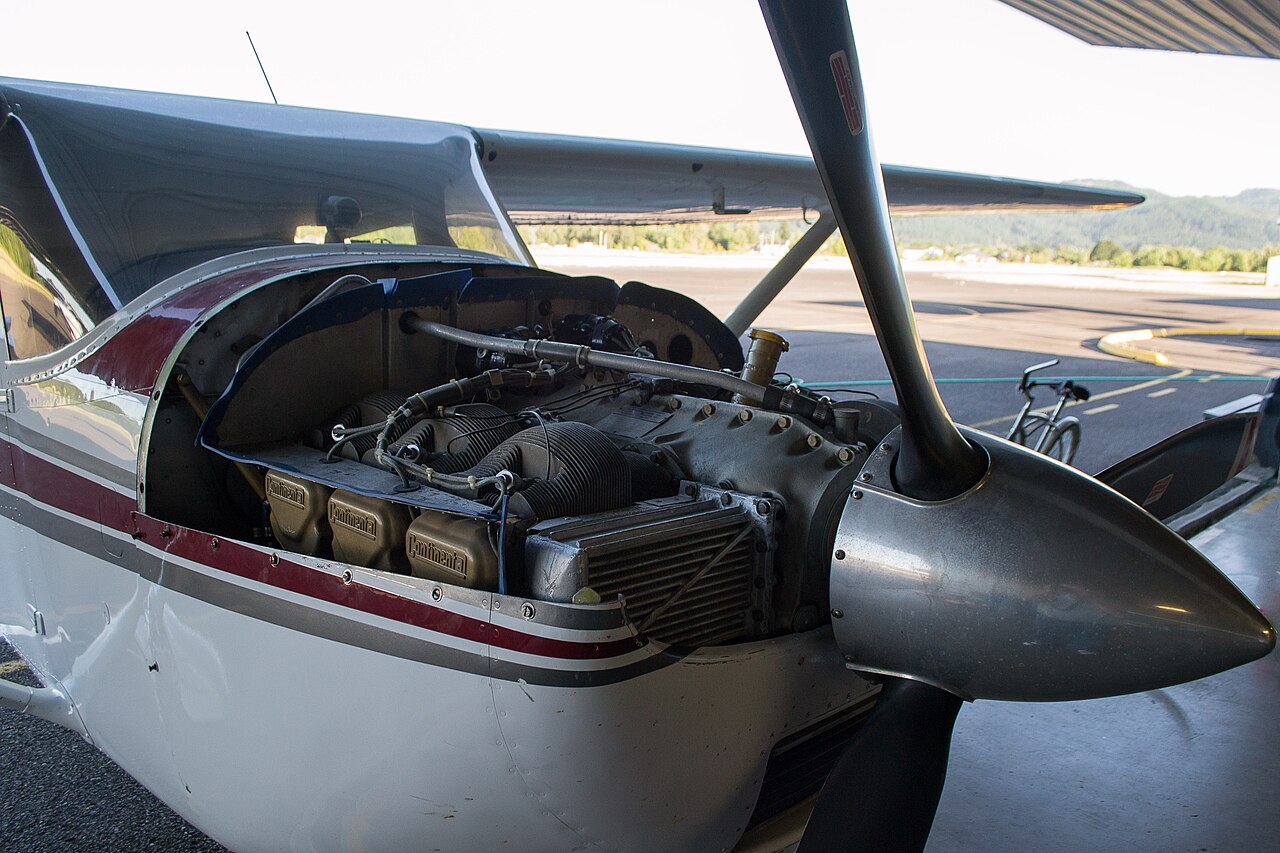
In practice, the everyday items that generate 337s on light aircraft are an engine upgrade, a tip-tank or STOL kit, an auxiliary fuel tank, a gross-weight increase, a cargo door, a full panel replacement with a new autopilot, a wing spar repair after a hangar rash incident, and a firewall or engine-mount repair after a prop strike. A Cessna 172 with the popular 180-horsepower conversion, an auto-fuel STC and a modern glass panel can easily carry five or six of them.
The gray area is real. Avionics installations are the usual argument. Replacing a radio in an existing tray with an identical form-factor unit approved for that installation is usually minor. Cutting a new panel, adding a servo, or installing equipment whose approval basis is an STC is an alteration, and the STC itself will tell you it requires a 337. When in doubt, the shop asks the local Flight Standards District Office, and the safe answer is almost always to file.
Who fills out the form, and who is allowed to sign it?
The person or shop that performed the work executes the form, and only certain people may approve the work for return to service. That distinction is where owners get tripped up.
Under 14 CFR 43.7 and 65.95, a major repair or major alteration to an airframe, powerplant, propeller or appliance must be approved for return to service by a mechanic holding an Inspection Authorization (an A&P with an IA), by an appropriately rated certificated repair station, or by the manufacturer. A plain A&P can do the work with skilled hands and cannot sign Block 7. An IA does not have to be the one who turned the wrenches, but the IA has to inspect the work and is putting their certificate behind the statement that it conforms to approved data.
Block 6, the conformity statement, is signed by the agency doing the work and states that the repair or alteration was made in accordance with the requirements of Part 43. Block 7 is the return to service. Some forms show the same name in both boxes; that is normal when an IA both performed and inspected the work.
There is one shortcut worth knowing. Appendix B to Part 43, paragraph (b), lets a certificated repair station, for major repairs made to a manual or specifications acceptable to the FAA, use the customer's work order and a signed maintenance release instead of a 337. The shop gives the owner a signed copy of the work order and keeps a duplicate for at least two years. That shortcut does not extend to major alterations, and it explains why some overhauled components arrive with a repair station release or an FAA Form 8130-3 tag rather than a 337.
Where do the copies go, and how fast?
The form is executed in at least duplicate, one signed copy goes to the aircraft owner, and one copy goes to the FAA Aircraft Registration Branch in Oklahoma City within 48 hours after the aircraft is approved for return to service. Those three steps are spelled out in Appendix B to Part 43, paragraph (a).
| Item | Requirement | Where it is written |
| Who executes the form | The person or shop that performed the work | 14 CFR 43.9(a) |
| Number of copies | At least two | Part 43, Appendix B(a)(1) |
| Owner's copy | A signed copy given to the aircraft owner | Part 43, Appendix B(a)(2) |
| FAA copy | Forwarded to the FAA Aircraft Registration Branch, Oklahoma City, within 48 hours of return to service | Part 43, Appendix B(a)(3) |
| Who may approve for return to service | A&P with Inspection Authorization, appropriately rated repair station, or the manufacturer | 14 CFR 43.7, 65.95 |
| Repair station alternative (major repairs only) | Work order plus signed maintenance release; shop keeps a copy at least 2 years | Part 43, Appendix B(b) |
| Owner's record-keeping duty | Keep the records required by §91.417 for their specified retention periods; records under §91.417(a)(2), including Form 337 copies for currently installed major alterations, must be retained and transferred with the aircraft at sale | 14 CFR 91.417(a) and (b) |
| Data used for the work | FAA-approved data must exist before the work is done | AC 43-210A; Block 6 conformity statement |
That 48-hour clock is the most commonly missed item on the whole list. Nothing dramatic happens when a shop files late, but decades later the only searchable national copy of the work is the one sitting in the FAA record. When it was never mailed, the form exists in exactly one place: the owner's binder. Lose the binder and the history is gone.
The owner's obligation under 14 CFR 91.417 is separate. Records listed in §91.417(a)(2), including Form 337 copies for major alterations currently installed on the aircraft and its installed engines, propellers, rotors and appliances, must be retained and transferred with the aircraft when it is sold.
Flying411 keeps listings, specifications and ownership guidance in one place, so you can compare what two similar airplanes actually carry on paper before you pay for a prebuy.
What is "approved data," and what does a field approval mean?
Approved data is engineering data the FAA has already blessed for that specific change, and every major repair or alteration has to be done from some form of it. The FAA's AC 43-210A, which standardizes how this data is obtained, walks through the acceptable sources.
The common ones are the type certificate data sheet, a Supplemental Type Certificate (STC), FAA-approved manufacturer service information, an Airworthiness Directive, DER-approved data such as FAA Form 8110-3, ODA-approved data, and technical data approved by the FAA through the field-approval process and documented in Block 3 of Form 337
For alterations, the FAA's current companion guidance is AC 43.13-2C, issued in July 2026; applicable alteration data in that AC may also serve as approved data when its stated conditions are met and the specific reference is entered in Block 8.
A field approval is what happens when none of the off-the-shelf sources cover the job. The shop submits the 337 with substantiating data to the FSDO, and an aviation safety inspector signs Block 3, approving that data for that aircraft. The wording in Block 3 makes the scope clear: it approves the data for the aircraft described above, subject to conformity inspection by a person authorized under 14 CFR 43.7. It is not a certificate you can copy onto another airplane. A field approval on N12345 covers N12345.
Heads Up: Block 3 is blank on most 337s, and that is perfectly normal. If the work was done under an STC or manufacturer-approved data, no FAA signature is required. An empty Block 3 is only a problem when Block 8 describes something homemade and cites no approval basis at all.
Why should a buyer care about the 337s during a prebuy?
Because a major alteration without valid paperwork means the airplane may no longer conform to its type certificate, and an aircraft that does not conform to its approved configuration is not airworthy. That is the whole reason to read them.
Start by counting. Order the FAA aircraft record, list every 337 in it, then walk the airplane and match each form to something you can see. Three outcomes are possible, and all three come up regularly.
The first is a form with no hardware. A 337 on file for tip tanks that were removed twenty years ago, with no second form recording the removal. Reverting an alteration is itself an alteration, and it needs its own 337 and its own weight and balance revision.
The second is hardware with no form. An obvious modification on the airframe, nothing in the FAA record, nothing in the logbooks. That is the expensive one. Somebody has to produce approved data after the fact, and if none exists, the choices are to get a field approval, pay for DER data, or remove the modification.
The third, and the most common, is a form that does not match the airplane. Block 8 cites an STC number that covers a different serial-number range, or the installation on the aircraft differs from the drawing referenced on the form. This is where a thorough logbook and maintenance history verification earns its fee several times over.
A 337 also tells you things no seller's advertisement will. A form for an engine mount and firewall repair, dated shortly after a gap in the flying, usually means a prop strike. A structural repair to a wing spar means damage history, and the next question is who did it, to what data, and whether the repair scheme came from the airframe manufacturer or from an inspector's field approval. None of that is disqualifying. All of it is priced.
What should be attached to a 337, and what is often missing?
A 337 rarely stands alone. The complete package for a major alteration normally includes the form, the approval basis, a revised weight and balance, and instructions for continued airworthiness.
- The STC paperwork. For an STC installation you want a copy of the STC certificate, the approved model list or serial applicability, and, where the STC holder requires it, the one-time-use letter of authorization permitting that installation.
- A revised weight and balance and equipment list. Any alteration that changes empty weight or moment requires a new computation. If the last weight and balance in the binder predates three panel upgrades, the numbers you are flying on are fiction.
- Flight manual supplements. Autopilots, engine conversions, gross weight increases and most avionics STCs come with an AFM or POH supplement that must be carried in the aircraft. A missing supplement is a paperwork discrepancy that shows up the first time a ramp check or a rental checkout looks closely.
- Instructions for Continued Airworthiness. Alterations bring their own inspection and maintenance requirements. Your next IA has to know that the new tanks need an inspection at a stated interval, or that the modified exhaust has a life limit. AC 43-210A addresses the ICA expectation directly, and it is the single most-often-missing piece on older field approvals.
Anything with a life limit that came in on an alteration deserves its own attention, because that clock does not reset when the airplane changes hands. Our guide to life limited parts covers how those records should read.
Flying411 keeps model histories, ownership costs and maintenance explainers in one place, so you can compare the paperwork burden of two candidate aircraft, not just their asking prices.
How do I get copies of every 337 on an aircraft?
Order the complete aircraft record from the FAA Civil Aviation Registry in Oklahoma City, which holds the registration history, liens, and every 337 that was actually mailed in. The fee has been modest, in the range of ten dollars for a digital copy in recent years, and the FAA continues to expand online access to scanned records, so check the current registry page for pricing and format before you order.
Treat that record as the master list and the seller's binder as the field copy. Neither is complete on its own. The FAA copy is missing anything a shop never filed. The owner's binder is missing anything filed correctly but lost in a hangar move. Where the two disagree, the difference is your question list for the seller.
Read the record in order. Registration transfers, then the 337s in date sequence, and match them against logbook entries and against any airworthiness directive compliance list. An AD that requires a repair or modification will often be memorialized on a 337, and the two records should tell the same story. The FAA's updated maintenance records guidance, described in our breakdown of AC 43-9C to AC 43-9D, is the current reference for how all of this should be documented.
Do the ordering early. Records come back in days, not hours, and you want them in hand before the prebuy inspection so the mechanic can inspect against the paperwork instead of inspecting blind.
Does a 337 hurt or help resale value?
It depends entirely on what is on the form and how clean the package is. A complete, well-documented STC installation adds value. An undocumented modification subtracts more than the modification ever cost.
Buyers pay up for useful, properly papered alterations: an engine upgrade, a modern autopilot, long-range tanks, a gross weight increase. The 337 with its STC, supplement and revised weight and balance is what turns "it has a nice panel" into a number an appraiser will support.
Field approvals sit lower on the ladder than STCs, for two reasons. They apply to one airplane, so the next owner inherits a one-off configuration that any future shop has to study before touching. And they can complicate export. When an aircraft leaves the U.S. registry, the importing authority reviews the alteration history, and a stack of one-off field approvals invites questions that an STC list does not. If you ever expect to sell abroad, that is worth weighing now.
There is also the operating side. An alteration that was never properly approved can leave you needing a special flight permit just to reposition the aircraft to a shop that can sort it out, and insurers have declined claims where the aircraft was not in an approved configuration at the time of loss.
Why It Matters: The 337 requirement applies to type-certificated aircraft maintained under Part 43. Experimental amateur-built aircraft operate under their own operating limitations and do not file 337s, and light-sport rules work differently again, which is one reason the MOSAIC rule changes matter to buyers shopping across those categories.
What do I do with 337s after I buy the airplane?
Keep the 337s and supporting records required by §91.417 for the applicable retention period, organize them so the next person can follow the aircraft's configuration, and document future major repairs or alterations as required.
A practical system: one binder or one scanned folder, 337s in date order, each with its STC certificate, flight manual supplement, ICA and the weight and balance revision that accompanied it, plus a single-page summary listing every alteration currently installed. Hand that summary to your IA at every annual. It saves inspection time and it prevents the classic mistake of a shop signing off an inspection while unaware that an STC requires a special check.
When you add something, make sure the shop gives you your signed copy before the airplane leaves and confirm the FAA copy went out. When you remove something, insist on the 337 documenting the removal and the updated weight and balance. And when you sell, the records go with the airplane. Organize them before you list, not during the closing process, because a buyer who cannot trace a modification will discount the price or walk.
Flying411 keeps buying guides, records explainers and live listings in one place, so you can compare aircraft with clean alteration histories against the ones that will need paperwork work.
At a Glance
FAA Form 337 is the FAA's permanent record of a major repair or major alteration, required by 14 CFR 43.9(a) and handled per Appendix B to Part 43: executed in at least duplicate by whoever did the work, one signed copy to the owner, one copy to the Aircraft Registration Branch in Oklahoma City within 48 hours of return to service. Major repairs and alterations are defined in 14 CFR 1.1 and listed by example in Appendix A to Part 43, and they must be approved for return to service by an IA, an appropriately rated repair station, or the manufacturer. Every one of them has to rest on FAA-approved data, whether that is an STC, manufacturer data, DER data on Form 8110-3, or a field approval signed in Block 3 for that one aircraft. As a buyer, order the FAA aircraft record, match every form to something you can see on the airplane, and chase down the attachments that are usually missing: the STC certificate, the flight manual supplement, the revised weight and balance, and the instructions for continued airworthiness. As an owner, keep them together and pass them on, because 14 CFR 91.417 says they belong to the airplane, not to you.
When you are ready to compare listings, visitFlying411and see what is on the market today.