Park a Beechcraft Baron and a Cessna 337 Skymaster side by side on the same ramp and the price tags tell two very different stories. The Baron might be a half-million-dollar airplane. The Skymaster next to it, with two engines, six seats and retractable gear, may be asking less than a clean Cessna 182. For a pilot who has always wanted a second engine, that gap is hard to ignore.
That gap is also the whole question. A Cessna 337 Skymaster is the cheapest recognizable route into twin-engine ownership, and there are good reasons it is cheap. Some of those reasons are unfair — the airplane looks odd, and odd airplanes get discounted. Some of them are entirely fair, and they show up as invoices.
This article walks through the three things that actually decide whether a Skymaster is a bargain or a trap for you: what the FAA's centerline-thrust limitation does to your certificate, what the back engine costs in maintenance and attention, and what a realistic yearly budget looks like when you stop guessing and start adding.
Key Takeaways
The Cessna 337 buys you twin-engine redundancy at a single-engine purchase price, and it removes the asymmetric-thrust handling problem that kills pilots in conventional light twins. What it does not remove is the cost of two engines, two propellers, two exhaust systems and a retractable gear system. A multiengine rating earned in a Skymaster carries a "limited to center thrust" restriction that you must remove with another practical test in a conventional twin. Plan on roughly $30,000 to $60,000 a year to own and fly one 100 hours, and budget for a pre-buy that goes deep on the rear engine, the exhaust and the tail booms. If your goal is the rating and a résumé line, buy differently; if your goal is a fast, load-hauling family airplane with two motors, the math can work.
| Question | Short answer |
| Is it a cheap way into a twin? | Cheap to buy, not cheap to own. Acquisition is the smallest number in the deal. |
| Does it have a Vmc problem? | No. Both engines are on the centerline, so there is no asymmetric thrust and no published Vmc. |
| Does the rating count? | It is a real multiengine land rating, but limited to center thrust until you test in a conventional twin. |
| Biggest maintenance risk? | The rear engine: cooling, exhaust, access and cylinder life. |
| Typical all-in cost at 100 hr/year | Roughly $300 to $600 per hour depending on hangar, insurance and how many squawks the airplane hands you. |
| Who it suits | Owners who want redundancy and cabin room, and who have a mechanic comfortable with the type. |
What the Skymaster Actually Is
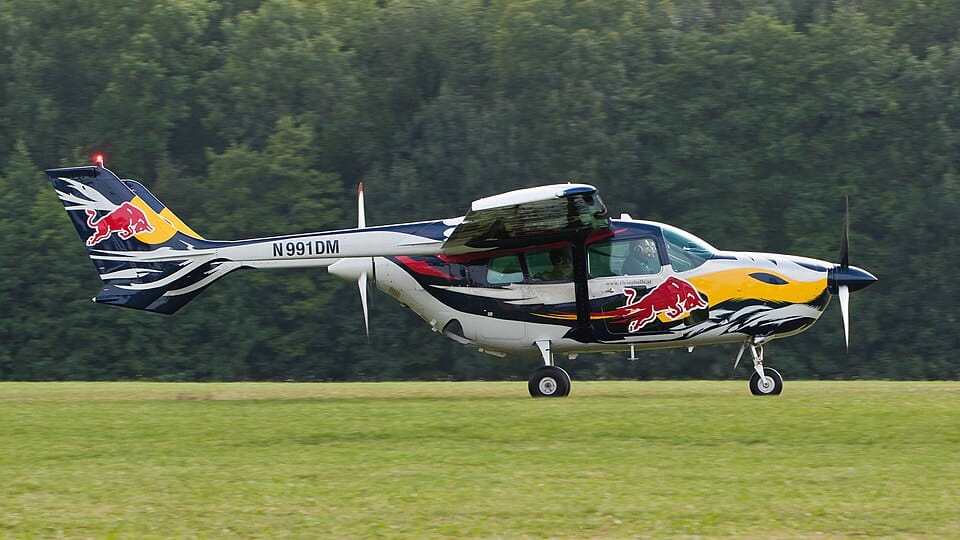
Cessna's answer to the light-twin handling problem was to stop putting engines on the wings. The Skymaster has one engine in the nose pulling and one behind the cabin pushing, with the tail carried on two booms so the rear propeller has somewhere to live. Think of it as a tandem bicycle rather than a rowboat with two oars — if one rider quits, the bike still tracks straight.
The fixed-gear Model 336 arrived in 1964 and sold poorly. The retractable-gear 337 followed in 1965 and became the volume airplane, running through 1980 in normally aspirated (337), turbocharged (T337) and pressurized (P337) forms. Cessna built roughly 3,000 civil Skymasters, Reims built more under license in France, and the U.S. Air Force flew several hundred militarized O-2s as forward air control aircraft in Vietnam.The FAA covers the 337 family under Type Certificate Data Sheet A6CE.
What engines does it use?
Normally aspirated 337s use a pair of Continental IO-360 engines rated at 210 horsepower each. Turbocharged models use the TSIO-360, and the pressurized P337 uses a turbocharged version rated at 225 horsepower. Continental publishes recommended time between overhaul for these families in the 1,400 to 1,800 hour range depending on the exact dash number, so check the current Continental TBO service information letter against the data plate on the airplane you are looking at rather than assuming a round 2,000 hours.
How fast and how much will it carry?
Owners commonly report 155 to 165 knots true in cruise on roughly 18 to 22 gallons per hour total for both engines. Maximum takeoff weight varies substantially by model, from roughly 4,200 pounds on early 337s to 4,630 pounds on later normally aspirated versions, with pressurized models reaching about 4,700 pounds. Useful load likewise varies with model and equipment, so use the specific airplane's current weight-and-balance dataStandard usable fuel is about 90 gallons, with long-range tanks available. Like most six-seat piston airplanes, it seats six or fills the tanks, rarely both.
Fun Fact: The pressurized P337, introduced in 1973, was Cessna's first pressurized piston airplane — it beat the better-known P210 Centurion to market by several years.
Why It Matters: Those cruise numbers put the Skymaster in the same speed bracket as a good high-performance single, not a Baron. You are buying redundancy and cabin volume, not speed.
The Centerline-Thrust Rating Limitation
This is where a lot of first-time twin buyers get surprised, and it is worth being precise about.
What does "limited to center thrust" mean?
If you take your multiengine practical test in a Skymaster, the FAA issues an Airplane Multiengine Land rating with the limitation "Limited to Center Thrust" printed on the certificate. That limitation is real and enforceable. It means you may act as pilot in command of centerline-thrust twins only. Walk out to a Seneca, an Aztec or a Baron and you are not legally rated to fly it as PIC, no matter how many hours you have in the 337.
How do you remove the limitation?
You remove it by satisfactorily completing the required practical-test tasks in a multiengine airplane with a manufacturer-published VMC. In practice that means some training in a conventional light twin followed by an examiner check focused on engine-out handling, VMC demonstration and the other required multiengine tasks. The FAA does not prescribe a fixed number of training hours for removing the limitation.
Does Skymaster time count as multiengine time?
Yes, you log it as multiengine airplane time, and it counts toward aeronautical experience requirements expressed in multiengine hours. What it does not do is impress a chief pilot. Operators and insurers know that centerline-thrust time contains no engine-out asymmetric handling, so they routinely discount it when they look at your logbook. If you are building time toward a commercial multi job, a Skymaster is a poor investment. If you are an owner-pilot who wants a second engine for night and hard IFR over bad terrain, the discount does not matter.
Heads Up: Insurance underwriters do not give you a break for the missing Vmc. Most treat the 337 as a retractable-gear twin for rating purposes, and many require a type-specific checkout and a minimum number of hours in make and model before solo.
Flying411 keeps light twin listings, specs and ownership guides in one place, so you can compare a Skymaster against a conventional twin before you commit to a rating path.
If the rating itself is your goal, read our overview of small twin engine prop planes first — the conventional options there keep your certificate unrestricted from day one. And if you are still building toward the instrument ticket that makes a twin worth owning, our step-by-step instrument rating guide lays out the sequence.
Rear-Engine Headaches: What Owners Actually Fight
The front engine on a 337 is a normal Cessna installation. Open the cowl, and it looks like any other 210-horsepower Continental. The rear engine is the one that generates the stories.
Why does the rear engine run hot?
The back engine sits behind the cabin, buried in a cowl that has to pull cooling air through ducts rather than straight into the face of the slipstream. On the ground and in a high-power, low-speed climb, airflow is at its worst exactly when the engine is working hardest. Owners and type-club material consistently point to rear-engine cylinder head temperature management as the single biggest determinant of how long that engine's cylinders last. Baffling condition matters more on a Skymaster than on almost any other piston airplane — a missing or hardened baffle seal that would cost a 172 a few degrees can cost the 337 a cylinder.
What about the takeoff with a dead rear engine?
This is the signature Skymaster accident, and it is worth stating plainly. Because there is no yaw when the rear engine quits, a pilot who is not paying attention can begin a takeoff roll with the back engine producing little or no power and not notice until the airplane refuses to climb. Accident reports going back decades include departures made with the rear engine shut down, at idle or failed. The fix is procedural: a real static runup on both engines, a check of rear-engine instruments before brake release, and a hard gate at the go/no-go point if the acceleration feels wrong. A twin that hides its own engine failure is a twin that demands a disciplined checklist.
What costs more to fix than you expect?
Access is the recurring theme. Work that takes two hours on the front engine can take four on the back one, because the mechanic is reaching around structure, ducting and the firewall. The exhaust system on the rear engine lives in a hot, cramped space and is a known inspection item on every annual — cracks and leaks there are both a cost and a carbon-monoxide concern. The retractable gear uses an electro-hydraulic power pack with gear doors, and like all Cessna twin gear systems of the era, it rewards regular rigging and punishes neglect. Add the tail booms, which are structure you cannot see into easily and which deserve a careful corrosion inspection on any airplane that has lived near salt water.
Pro Tip: Ask any prospective shop how many Skymaster annuals they have done. A mechanic who has never had the rear cowl off will find the same problems as an experienced one, just three times slower and on your dime.
Are there airworthiness directives and inspection programs to worry about?
The type is more than forty years out of production, so the AD list is long and includes recurring items. Cessna also published Supplemental Inspection Documents (SIDs) for the 300-series airplanes, including the Skymaster. In the United States, SID compliance is generally not mandatory for Part 91 operations, but several foreign authorities do require it, and a buyer should know whether the airplane has been through the program. Have your mechanic pull a current AD search by serial number before you spend money on a pre-buy — it is a fifteen-minute job that occasionally ends the conversation early.
Real Ownership Costs
Here is the part most "cheap twin" articles skip. Acquisition is a one-time number. Ownership is a subscription.
What does a Skymaster cost to buy?
Asking prices move with the market, so treat these as broad brackets and verify against current listings. Flying, reasonably equipped normally aspirated 337s have generally traded in the rough neighborhood of $90,000 to $200,000, with turbocharged T337s asking somewhat more and pressurized P337s more still. Airplanes priced dramatically below those ranges usually have two runout engines, an avionics panel that predates GPS, or logbook gaps — and two runout Continentals can exceed the purchase price of the airplane.
What does a year of ownership look like?
The table below assumes 100 hours flown per year in a normally aspirated 337 with average equipment. Your numbers will move with fuel price, hangar rate and how lucky you are.
| Cost item | Typical annual range | Notes |
| Insurance | $2,500 – $6,500 | Higher for low-time multi pilots and higher hull values |
| Hangar or tiedown | $3,000 – $9,000 | Wide airport-to-airport spread |
| Annual inspection | $4,500 – $9,000 | Two engines plus retractable gear; rear engine access adds labor |
| Unscheduled maintenance | $3,000 – $10,000 | Cylinders, exhaust, gear rigging, alternators |
| Engine reserve (both) | $6,000 – $9,000 | Two overhauls against Continental's published TBO |
| Propeller reserve | $1,000 – $2,000 | Two constant-speed props on calendar and overhaul cycles |
| Fuel (100 hours) | $10,000 – $15,000 | About 19 gph total at typical 100LL prices |
| Total | $30,000 – $60,000 | Roughly $300 – $600 per flight hour |
Keep in Mind: Fly only 50 hours a year and the fixed costs do not shrink — they just spread over half as many hours. A Skymaster flown 50 hours annually can easily cost more per hour than a turboprop flown 300.
How does that compare to the alternatives?
| Aircraft | Engines | Typical cruise | Relative ownership cost |
| Cessna 337 Skymaster | 2 × 210 hp Continental IO-360 | 155–165 kt | Lowest entry price among six-seat twins; mid-range running costs |
| Piper Aztec | 2 × 250 hp Lycoming | ~170 kt | Higher fuel burn, simpler access, strong parts support |
| Cessna 310 | 2 × 260–285 hp Continental | ~180 kt | Faster, thirstier, similar two-engine overhead |
| Beechcraft Baron 58 | 2 × 300 hp Continental | ~190 kt | Much higher purchase and parts cost, best cabin |
| Cirrus SR22 | 1 × 310 hp Continental | ~175 kt | One engine to feed; faster than a 337 for less money per hour |
That last line is the uncomfortable one. A good high-performance single will out-cruise a normally aspirated Skymaster while burning half the fuel and overhauling one engine instead of two. We ran that comparison in detail in RV-10 vs SR22: What Ownership Really Costs, and the numbers hold up. You buy a Skymaster because you want the second engine, not because it is the efficient choice.
Flying411 keeps operating-cost guides and current aircraft listings in one place, so you can test your own hourly math against real asking prices instead of forum estimates.
Who Should Buy One — and Who Should Not
The Skymaster makes sense if you fly regularly over water, mountains or at night, you want six seats and a big cabin, and you have found a mechanic who knows the type. It makes sense if the handling risk of a conventional twin genuinely worries you, because the centerline layout removes the single most dangerous failure mode in light twins. It makes sense if you can absorb a $15,000 surprise without selling the airplane.
It does not make sense as a time-builder, as a first airplane, or as a way to get a multiengine rating on the cheap. If low-cost ownership is the actual goal, the honest answer is a simple single — our roundups of cheap planes for beginners and affordable small aircraft worth owning cover airplanes you can fly 100 hours a year for a third of what a Skymaster costs.
Good to Know: Two engines only add safety if the pilot stays proficient. A twin flown by someone who has not practiced single-engine work in a year is arguably more dangerous than a well-flown single.
What to Demand in a Pre-Buy Inspection
Every Skymaster pre-buy should be done by a shop with type experience, and it should include the rear cowl coming off. Ask specifically for a borescope of all twelve cylinders on both engines, a compression check, and a written note on rear-engine cylinder head temperature history if the airplane has an engine monitor with downloadable data. Have the exhaust systems inspected and pressure-tested. Have the tail booms and the wing carry-through inspected for corrosion. Have the gear swung on jacks and the hydraulic power pack checked for leaks.
On the paperwork side, confirm every AD by serial number, look for SID compliance records, and read the logbooks for unexplained gaps — especially around the rear engine, which is the item most likely to have been nursed rather than fixed. Our guide to reading metal in an oil filter is a useful primer on what an oil analysis history is telling you, and the principles apply to Continentals too.
Quick Tip: Ask the seller for the last three oil analysis reports on each engine. A seller who has never done one is telling you something about how the airplane has been managed.
Flying411 keeps pre-buy checklists, maintenance explainers and marketplace listings in one place, so you can walk into an inspection knowing exactly what to ask the shop to open up.
One more budget item people forget: the panel. Many surviving Skymasters still carry 1970s radios. Bringing one up to a modern IFR standard with a certified navigator, an autopilot that works and current transponder equipment is a five-figure project on any airplane, and on a twin you may be paying for duplicated equipment. Our walkthrough of the cheapest path to ADS-B compliance shows how those quotes get built, and the same logic applies here.
Conclusion
A Cessna 337 Skymaster is a cheap twin to buy and an ordinary twin to own. The purchase discount is real, and so is the reason for it: an unusual airframe, a back engine that is harder to cool and harder to reach, a rating limitation that sends you back for a second checkride, and two of every expensive thing. Add it up honestly at $30,000 to $60,000 a year and decide whether the second engine is worth that to you.
For the right owner — someone flying families over water at night, someone who values a wide cabin and no Vmc, someone with a shop that knows the type — it is one of the better values in piston aviation. For everyone else, the money buys a faster, simpler single. Run your own numbers on your own mission before you fall for the ramp appeal of two propellers.
When you are ready to compare listings, visitFlying411and see what is on the market today.
Frequently Asked Questions
Does a Cessna 337 have a Vmc speed?
No published minimum control speed for asymmetric thrust, because both engines are on the centerline and an engine failure produces no yaw. The airplane still has a single-engine climb limitation and a published single-engine service ceiling, so losing an engine at a high weight on a hot day is still a serious event.
Can I fly a Baron with a centerline-thrust multiengine rating?
Not as pilot in command. The "limited to center thrust" restriction confines you to aircraft that meet that limitation until you complete the required practical-test tasks in a multiengine airplane with a published VMC and have the limitation removed.
How much fuel does a Skymaster burn?
Owners typically report 18 to 22 gallons per hour total in cruise for the normally aspirated 337, which is roughly nine to eleven gallons per hour per engine. Turbocharged and pressurized models burn more, especially at high power settings in the climb.
Is the rear engine really less reliable than the front?
The engines themselves are the same family. The difference is the installation: the rear engine's cooling airflow is compromised, its exhaust lives in a hot confined space, and its accessories are harder to reach. Airplanes with well-maintained baffling, an engine monitor and a pilot who watches cylinder head temperatures tend not to have unusual rear-engine problems.
Are parts still available for the Skymaster?
Engine and propeller parts are readily available since the Continental IO-360 and TSIO-360 are common. Airframe-specific parts — cowlings, gear doors, boom structure, rear-engine ducting — are harder to source and are where the active owner community and specialist shops earn their keep.
Would a Skymaster make a good first airplane?
Generally no. A retractable-gear twin with six cylinders per side and a fixed cost base in the tens of thousands is a lot of airplane for a new owner. Most buyers are better served starting in a simple single and moving up once they know their real annual utilization.