Just think of being grounded on a perfectly good travel day not because of a hurricane, but because of a low cloud layer that a more qualified pilot could fly right through. That is the reality for pilots who only hold a private pilot certificate with no instrument rating. And the stakes go beyond missed trips.
A University of Illinois study found that pilots without an instrument rating lose control of their aircraft within an average of 178 seconds of accidentally flying into clouds. One extra certification changes all of that. It opens the sky on days that would otherwise be a no-go. It makes you a sharper, more confident pilot.
And it puts you on a direct path toward bigger aviation goals. Earning your instrument rating takes real work but it is absolutely within reach for any motivated pilot.
Key Takeaways
To get an instrument rating, you need a private pilot certificate, a third-class medical, and at least 40 hours of instrument time (35 hours under Part 141). You must pass a written knowledge exam and a checkride with an FAA examiner. Training typically costs $8,000–$15,000 and takes 4–12 months depending on your pace.
| Key Detail | What You Need to Know |
| Minimum age | 17 years old |
| Certificate required | Private pilot certificate (or concurrent application) |
| Instrument flight time | 40 hours (Part 61) / 35 hours (Part 141) |
| Time with a CFII | At least 15 hours |
| Cross-country requirement | 250 NM, 3 airports, 3 approach types (Part 61) |
| Written exam passing score | 70% (60 questions) |
| Simulator credit allowed | Up to 20 hours (Part 61) |
| Typical total cost | $8,000–$15,000 |
| Time to complete | 4–12 months (full-time vs. part-time) |
| Currency to stay legal | 6 approaches, holds, and tracking every 6 months |
What Is an Instrument Rating?
An instrument rating is an official FAA certification that allows a pilot to fly in weather conditions that would ground most pilots. Without it, you are limited to Visual Flight Rules — meaning you need to see where you are going at all times. With an instrument rating, you can fly under instrument flight rules, also called IFR. That means navigating through clouds, fog, rain, and low visibility using only the instruments inside your cockpit.
Here is why that matters. Standard VFR flying requires you to stay clear of clouds and maintain a certain level of visibility. On days when the sky is overcast or the ceiling is low, VFR pilots stay on the ground. IFR-rated pilots, on the other hand, can file an IFR flight plan, get a clearance from Air Traffic Control, and fly through those same conditions legally and safely.
What changes when you earn this rating?
- You can fly in clouds and low-visibility conditions
- You can access Class A airspace, which starts at 18,000 feet MSL
- You can use IFR routing, which often gives you more direct paths
- You become a significantly more skilled and situationally aware pilot
- You are eligible to pursue commercial flying certifications
The rating covers a wide range of skills. You learn to control the aircraft using instruments alone — no outside visual reference. You learn how to read and fly instrument approach procedures, which guide you safely down toward a runway when you cannot see it yet. You learn how to hold a fix, communicate with ATC in a busy IFR system, and handle unexpected situations like a failed instrument in the cockpit.
What exactly are you flying by?
Your instrument panel includes tools like the attitude indicator, altimeter, airspeed indicator, heading indicator, vertical speed indicator, and turn coordinator. Together, these give you a full picture of what your aircraft is doing — even when you cannot see the horizon outside. Instrument flying teaches you to trust those gauges completely, which is a skill that makes you a better pilot in every type of flying, not just IFR.
The FAA issues this rating under Title 14 of the Code of Federal Regulations, Part 61, Section 65 — or simply, FAR 61.65. It is one of the most respected and widely pursued ratings in general aviation. And for good reason. The training makes you more precise, more aware, and more prepared for the unexpected.
Why Pilots Choose to Get Instrument Rated
Ask any instrument-rated pilot why they did it, and you will hear different answers. Some did it for safety. Some did it for career advancement. Some just wanted to stop canceling trips because of a cloudy sky. All of those are great reasons — and the rating delivers on every one of them.
Safety is the biggest reason.
Weather-related accidents are a leading cause of fatal general aviation crashes. Many of those accidents happen when a VFR pilot accidentally flies into instrument conditions — clouds, fog, or low visibility — without the training to handle it. That scenario is sometimes called "VFR into IMC," and it is extremely dangerous. Instrument training teaches you to recognize hazardous weather, make smart go/no-go decisions, and handle the aircraft if you ever find yourself in unexpected low visibility. Even pilots who rarely fly IFR benefit from that training.
More flying days means more freedom.
Weather cancels a lot of flights for VFR-only pilots. A low overcast layer, a thin fog bank, or a few scattered clouds can turn a perfectly flyable day into a ground day. Instrument-rated pilots can often fly through those same conditions legally. That means fewer canceled plans, more consistent flight schedules, and a much more practical aircraft for travel.
Here is what the rating opens up for your flying life:
- Fly on days that VFR pilots cannot
- Travel more reliably for business or personal trips
- Land at airports with lower weather minimums
- Use GPS and nav systems to their full potential
- Build the aeronautical experience needed for commercial flying
Career advancement is another strong motivator.
An instrument rating is required for most professional pilot roles. Flying passengers for hire at night or beyond 50 nautical miles requires it. Commercial airlines, charter operators, and corporate flight departments all require it. If your goal is to make flying your career, this rating is not optional — it is the foundation everything else is built on.
Flight training for the instrument rating also makes you better at everyday flying.
You learn to communicate more precisely with ATC. You learn to read weather products in much more detail. You develop tighter aircraft control because instruments do not lie — small mistakes show up immediately on the gauges. Pilots who complete instrument training consistently report feeling more confident and capable in all types of flying conditions, not just IFR.
The training pushes you. It is more mentally demanding than your private pilot training. But that challenge is exactly what makes the rating so valuable. By the time you pass your checkride, you have built a level of skill and discipline that puts you in a completely different category as a pilot.
Who Can Apply for an Instrument Rating?
The good news is that the instrument rating requirements are straightforward. The FAA lays them out clearly in FAR 61.65, and if you already hold a private certificate, you are closer to being eligible than you might think.
Here is what you need to qualify:
- A private pilot certificate — You must already hold one, or you can apply for both at the same time. Either way, the private certificate is the foundation.
- Age — You must be at least 17 years old.
- Medical certificate — A current third-class FAA medical is the minimum required.
- English proficiency — You must be able to read, speak, write, and understand English. All ATC communication in the U.S. national airspace is conducted in English.
- Instructor endorsement — Before you can take the written knowledge exam, a flight instructor must sign off in your logbook that you have received the required ground training and are ready to test.
What about cross-country time?
Under Part 61, you need at least 50 hours of cross-country flight time logged as pilot in command. This is time you likely built during and after your private pilot training. If you have been flying since earning your certificate, you may already have a good portion of this logged.
Under Part 141 — a structured, FAA-approved school program — the requirements are slightly different. The minimum instrument hours drop to 35, and the cross-country distance requirement for the training flight is 100 nautical miles instead of 250. These programs are more tightly structured, which is why the FAA allows fewer minimum hours.
Which path is right for you?
- Part 61 is flexible and self-paced. You work with a CFII (Certified Flight Instructor – Instrument) on your schedule. Great for working adults or part-time students.
- Part 141 is structured and follows an approved syllabus. Great for full-time students or those who benefit from a set progression.
Both paths lead to the same rating and the same privileges. The difference is in the structure and minimum hour requirements.
Can you use a simulator?
Yes — and you should. The FAA allows up to 20 hours of your required 40 hours of instrument time to be logged in an aviation training device (AATD) or flight simulator under Part 61. This is one of the smartest ways to reduce cost and build solid procedural skills before you ever turn the ignition on a real aircraft. A flight simulator lets you practice approaches, holds, and emergencies repeatedly — without burning avgas or worrying about weather.
Once you check all the eligibility boxes, you are ready to start training. The next step is ground school, and that is where the real learning begins. The knowledge you build there will carry you all the way to your checkride — and beyond.
The path to becoming a fully instrument-rated pilot starts with meeting these basics. And if you already have your private pilot certificate, you are already standing at the starting line.
Your Complete Step-by-Step Guide to Earning an Instrument Rating
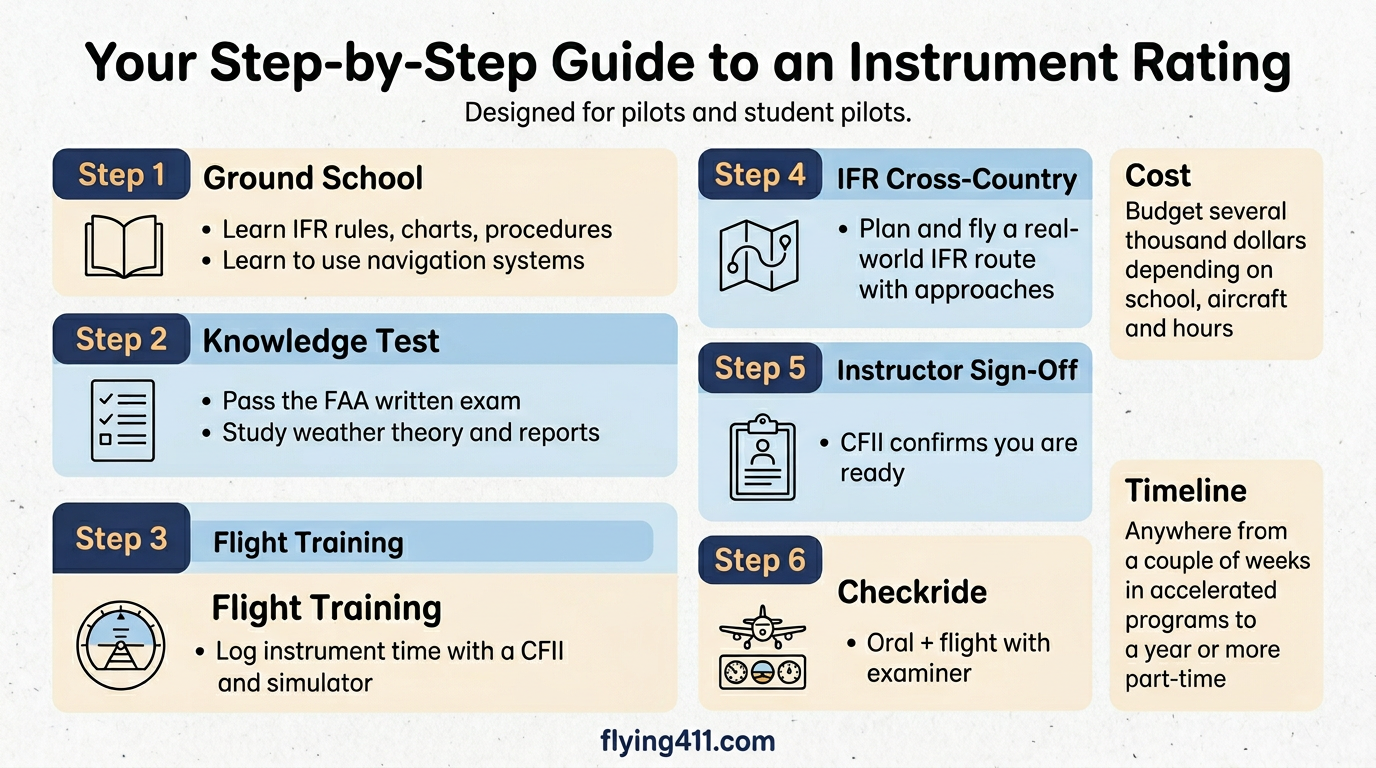
This is the part most pilots want to get to. The steps below follow the exact path you will take — from your first ground school session all the way to the moment an examiner hands back your logbook with a new rating endorsed in it. Each step builds on the last. Follow them in order, and you will be on the most direct path possible.
Step 1: Start with Ground School
Everything begins on the ground. Ground school is where you learn the knowledge that supports every hour of flying you will do later. It covers IFR regulations, how to read approach plates and en route charts, weather products, ATC procedures, navigation systems, and aeronautical decision-making.
You have a few options for completing ground school:
- Online courses — Platforms like Sporty's, King Schools, and Pilot Institute offer flexible, self-paced programs. Cost typically runs $300–$600. This is the most popular choice for busy pilots.
- In-person classroom — Some flight schools offer structured classroom instruction. It costs more (around $2,500), but some learners do better with a live instructor in front of them.
- Home-study courses — The FAA allows approved home-study programs. Your instructor will point you toward what qualifies.
Do not rush ground school. The written exam tests everything you study here — and the oral portion of your checkride will go back to this material as well. Build a real understanding, not just a test score.
If you are still working toward your private pilot certificate or thinking about getting started from scratch, check out How to Become a Pilot: Your Complete Step-by-Step Guide — it covers the full path from zero experience to your first certificate.
Step 2: Pass the FAA Instrument Rating Knowledge Test
Before you can take your checkride, you need to pass the FAA knowledge test — the written exam. Here is what to expect:
- 60 questions drawn from topics covered in ground school
- 2.5 hours to complete it
- Minimum passing score: 70%
- Delivered at an FAA-approved computer testing center
The test covers IFR chart reading, holding patterns, instrument approaches, weather theory, navigation, ATC procedures, and FARs. You need a signed endorsement from your flight instructor before you can sit for it. That endorsement confirms you have completed the required ground training and are ready to test.
Your test report is valid for 24 calendar months. Use it — do not let it expire.
Step 3: Log Your Required Flight Hours
This is where instrument training gets real. Under Part 61, you need a minimum of 40 hours of actual or simulated instrument time. Under Part 141, the structured school path, that minimum drops to 35 hours because of the program's tighter oversight and curriculum requirements.
Here is the full breakdown of what you need to log:
- 50 hours of cross-country flight time as pilot in command (you likely have some of this already from your private training)
- 40 hours of actual or simulated instrument time (35 under Part 141)
- At least 15 hours of that instrument time with a CFII (Certified Flight Instructor – Instrument)
- Up to 20 hours of instrument time in a flight simulator or aviation training device (under Part 61)
That last point is worth emphasizing. Simulator time is cheaper than aircraft rental, and it lets you practice the same procedures over and over without worrying about weather or airspace. Use every hour of it you are allowed.
What are you actually practicing during instrument flying?
- Controlling the aircraft using instruments only — no looking outside
- Flying standard instrument departure and arrival procedures
- Executing instrument approach procedures to a runway in low visibility
- Holding patterns — flying a racetrack-shaped path over a navigation fix
- Partial panel flying — handling the aircraft if key instruments fail
- Reading and understanding approach plates, en route charts, and NOTAMs
- Communicating clearly with ATC in a busy IFR flight environment
Your flight training hours build gradually. Early lessons focus on basic attitude instrument flying. Later lessons add navigation, approaches, holds, and cross-country IFR planning. By the end, everything ties together into smooth, consistent IFR operations.
Step 4: Complete the IFR Cross-Country Flight
Under Part 61, the FAA requires a specific cross-country training flight that covers at least 250 nautical miles of total distance. This flight must include:
- Instrument approaches at three different airports
- At least three different types of approaches — for example, an ILS, an RNAV/GPS, and a VOR approach
This is not just a flight hour — it is a full test of your real-world instrument flying skills. You will plan the route, file an IFR flight plan, pick up a clearance, navigate between airports, and shoot approaches at each one. Under Part 141, the cross-country distance is at least 100 nautical miles.
If you are curious how this kind of training compares across different aircraft types, Rotary Wing vs. Fixed Wing Aircraft: The Complete Pilot's Guide to Choosing Your Path breaks down the differences in training, cost, and career options between helicopters and airplanes.
Step 5: Get Your Instructor Endorsements
Before you can schedule your checkride, your CFII needs to sign off in your logbook. That endorsement confirms you have met all the instrument rating requirements and are ready to be evaluated by an FAA examiner. Your instructor will not sign unless they are confident you are ready — so treat every lesson as checkride prep.
Step 6: Pass the Instrument Rating Checkride
The checkride is the final step. It has two parts — an oral exam and a flight exam — both conducted by an FAA Designated Pilot Examiner (DPE).
The oral exam typically runs one to two hours. The examiner will test your knowledge of:
- IFR regulations and procedures
- Weather interpretation and go/no-go decision making
- Chart reading and flight planning
- Instrument systems and their failure modes
- ATC expectations and phraseology
The flight exam usually runs 1.5 to two-plus hours. You will demonstrate:
- Attitude instrument flying
- At least two or three instrument approaches, including one with partial panel
- A holding pattern
- Intercepting and tracking navigation courses
- Missed approach procedures
The checkride is evaluated against the FAA's Instrument Rating Airman Certification Standards (ACS). Meet the standards in every task, and you walk away as a fully instrument-rated pilot.
How Much Does an Instrument Rating Cost?
The total cost varies quite a bit depending on your location, the aircraft you train in, and how many hours beyond the minimums you need. Here is a realistic breakdown:
| Expense | Estimated Cost |
| Online ground school | $300–$600 |
| In-person ground school | ~$2,500 |
| Aircraft rental + CFII (flight hours) | $6,000–$10,000+ |
| Simulator / AATD time | Lower than aircraft — varies |
| FAA knowledge test fee | ~$160 |
| Checkride (DPE fee) | $400–$600 |
| Medical certificate | $75–$250 |
| Typical total | $8,000–$15,000 |
Part 141 all-inclusive programs tend to run $13,000–$15,000. Part 61 costs can be lower if you use the maximum allowable simulator time and come to each lesson well-prepared.
Three ways to keep costs reasonable:
- Use the full 20 hours of allowed flight simulator or aviation training device time
- Complete ground school online instead of in person
- Come to every lesson prepared — review the material beforehand so you are not burning flight time relearning concepts
How Long Does It Take?
There is no single answer here — it depends entirely on how much time you can dedicate to training.
- Full-time students typically finish in 4–6 months
- Part-time pilots (training on weekends and evenings) often take 6–12 months or more
- Accelerated programs can compress the training into 10–14 days — but you need to pass the written exam before you start, and you need the mental energy for daily lessons
One thing that slows most students down is inconsistency. Long gaps between lessons mean you have to re-learn procedures before you can build on them. Frequent, regular lessons — even just two or three per week — produce faster progress and better retention than occasional marathon sessions.
The IFR rating rewards pilots who show up consistently and take it seriously. Put in the work, and the timeline takes care of itself.
Conclusion
The instrument rating is one of the best investments you can make as a pilot. It makes you safer, more capable, and far more versatile in the air. It opens career doors and gives you the confidence to fly on days that used to ground you. The training is challenging — but every hour you put in builds real, lasting skill. Whether you train part-time over several months or go all-in with an accelerated program, the steps are the same: meet the requirements, complete your training, pass your tests, and earn that rating. You have what it takes. Now go fly.
For more guides like this one, check out Flying411 — your go-to resource for everything general aviation.
Frequently Asked Questions
Can I start instrument training before I finish my private pilot certificate?
Yes. The FAA allows you to begin instrument ground training and even log instrument flight time before you hold your private certificate. However, you must hold (or concurrently apply for) the private certificate before your instrument rating can be officially issued.
Do I need a specific type of airplane to train for the instrument rating?
No specific make or model is required, but the aircraft must be equipped for IFR flight. That means it needs the proper navigation and communication equipment, functioning instruments, and an airworthiness certificate. Your instructor or flight school will confirm the aircraft meets these standards.
What happens if I fail the instrument rating knowledge test?
You must wait at least 30 days before retaking it. You will also need a new endorsement from an authorized instructor confirming additional ground training was completed. Your original test report must be given to the proctor before retesting.
Is the instrument rating valid for all aircraft categories?
No. An instrument rating is category and class specific. An instrument-airplane rating only covers airplanes. If you want to fly helicopters or powered-lift aircraft under IFR, separate instrument ratings are required for those categories.
Can I log instrument time I fly on my own without an instructor?
Yes, as long as you are flying in actual IMC (real clouds or low visibility) or under a view-limiting device with a qualified safety pilot on board. Time logged in actual instrument conditions counts toward your requirements even without an instructor present.