You have logged the hours, studied the books, and practiced your maneuvers until they feel second nature. Now the big day is almost here — your private pilot checkride. For a lot of student pilots, just hearing that word is enough to make their palms sweat.
And here is something worth knowing before you walk in: according to 2024 FAA airmen statistics, the private pilot checkride has the highest failure rate of all FAA practical exams, with more than 1 in 4 candidates not passing on their first attempt.
But here is the truth: the checkride is not meant to trick you. It is a structured test with a clear roadmap, and knowing what is coming makes all the difference. This post goes over every step so you can show up ready, calm, and confident.
Key Takeaways
The private pilot checkride has two main parts: an oral exam and a flight portion. Your examiner will review your documents, test your aviation knowledge on the ground, and then fly with you to watch you perform specific maneuvers and procedures. The whole test usually takes three to five hours.
| Key Takeaway | Quick Summary |
| Who gives the test | A Designated Pilot Examiner (DPE), not your CFI |
| How long it takes | About 3 to 5 hours total |
| Two main parts | Oral exam (ground) + Flight portion (in the air) |
| What guides the test | The Airman Certification Standards (ACS) |
| Documents needed | Logbook, medical, IACRA application, aircraft records |
| Common flight tasks | Steep turns, stalls, slow flight, emergency procedures, landings |
| Three possible outcomes | Pass, Failure, or Discontinuance |
Your Flight Instructor Has to Sign You Off First
Before you can sit down with an examiner, your flight instructor has to officially say you are ready. This is called a checkride endorsement, and it is a big deal. Your CFI is not going to put their name on the line unless they genuinely believe you can pass. So if you have that endorsement in hand, take a breath — someone who knows your flying very well thinks you are ready.
To reach that point, the FAA requires you to meet a set of minimum flight hours under 14 CFR 61.109. Here is what that looks like:
- 40 total flight hours — at least 20 hours of dual instruction and 10 hours of solo flight
- 3 hours of dual cross-country training
- 3 hours of dual instrument training (flying under the hood)
- 3 hours of dual night flight, including a 100 NM cross-country and 10 night landings
- 150 NM solo cross-country with 3 legs and 3 different airports
- 3 solo full-stop landings at a towered airport
- 3 hours of dual checkride prep within the 2 calendar months before your test date
Those are the minimums. Many students finish with 60 to 70 hours before they feel truly ready, and that is completely normal.
Your CFI also has to endorse your logbook for the specific tasks covered in training — not just the flight hours but also ground instruction on flight maneuvers. It is a good idea to use sticky tabs to flag each required item in your logbook before you arrive. Your examiner will be flipping through it, and making it easy to find things shows that you are organized and prepared.
One more thing worth knowing: you must have passed the FAA Knowledge Test (the written exam) within the last 24 months before your checkride. If your score has expired, you will need to retake it. Your CFI will review any questions you missed on that test, because your examiner may ask about those exact areas during the oral portion. More on that in just a moment.
A Stranger Will Be in the Right Seat
Here is something that catches a lot of student pilots off guard: your CFI will not be the one testing you. A completely different person will. Your test will be conducted by a DPE — short for designated pilot examiner. A DPE is an experienced pilot who has been authorized by the FAA to conduct practical tests on their behalf. They are not FAA employees, but they follow FAA standards closely.
This can feel a little nerve-wracking at first. You have been training with your instructor for weeks or months, and now someone you have never met is going to watch your every move. That is fair — and it is a feeling most student pilots share on checkride day.
But here is the good news: the DPE is working from a published document called the ACS — the Airman Certification Standards. This document is not a secret. You can download it for free from the FAA website. It lists every single thing you will be tested on, from the knowledge questions to the flight maneuvers. The ACS became the official standard in 2016, replacing the older Practical Test Standards (PTS). As of 2025, it carries the full force of law — meaning both you and the examiner are held to exactly what it says.
What does the ACS actually cover? Every task is broken into three parts:
- Knowledge — What you understand about a concept or procedure
- Risk Management — How you identify and handle potential hazards
- Skill — How well you actually perform the task in the airplane
This is important because it means the DPE is not just watching your hands on the controls. They are listening to how you think and talk through problems. If you explain your reasoning out loud, that works in your favor.
The practical test is also administered in a specific airplane — usually the one you trained in. You are responsible for making sure that airplane is airworthy and that all required documents are on board. The DPE will check. We will cover exactly what to bring in the next section.
One last thing: DPEs charge a fee for their time, usually in the range of a few hundred dollars. FAA inspectors do not charge a fee, but they are rare and hard to schedule. Most checkrides in the US are conducted by DPEs.
Show Up With the Right Paperwork or the Test Does Not Start
This is one area where students lose points before the test even begins. If you show up without a required document, the examiner may not be able to start — and that could mean rescheduling. The good news is that this is 100% preventable with a simple checklist.
What you need to bring for yourself:
- IACRA application — This is the FAA's online certification system. You need your FAA Tracking Number (FTN) ready. Paper applications (Form 8710) are heavily discouraged and come with a $50 processing fee, so use IACRA
- Original FAA Knowledge Test results — Must be stamped, original copy, and taken within the last 24 months
- Current medical certificate — Or valid BasicMed documentation. Double-check the expiration date
- Student pilot certificate — With all required endorsements on the back
- Government-issued photo ID — Driver's license or passport
- Pilot logbook — With all hours and endorsements clearly organized
What you need to bring for the aircraft:
The aircraft must have the AROW documents on board:
- A — Airworthiness Certificate
- R — Registration
- O — Operating Limitations (your POH or AFM)
- W — Weight and Balance documentation
You will also need the aircraft maintenance logbooks. Your examiner will check for specific inspection entries using the AV1ATE memory aid:
- A — Annual inspection
- V — VOR check (if used for IFR, not required for VFR-only)
- 1 — 100-hour inspection (if flown for hire)
- A — Altimeter check
- T — Transponder check (FAR 91.413)
- E — ELT inspection and battery replacement date
Know where all of these entries are in the aircraft logbooks before you arrive. Many students flip through those logs for the first time right in front of the DPE — and that does not make a great first impression.
Other items to bring:
- Completed cross-country flight plan (often assigned a day or two before)
- Weight and balance calculation for the planned flight
- Current sectional charts
- POH (your personal copy, for reference during the oral)
- E6B or electronic flight computer
- Plotter
- Hood or foggles for the instrument portion
- Headset
Here Is Exactly What Happens During Your Private Pilot Checkride
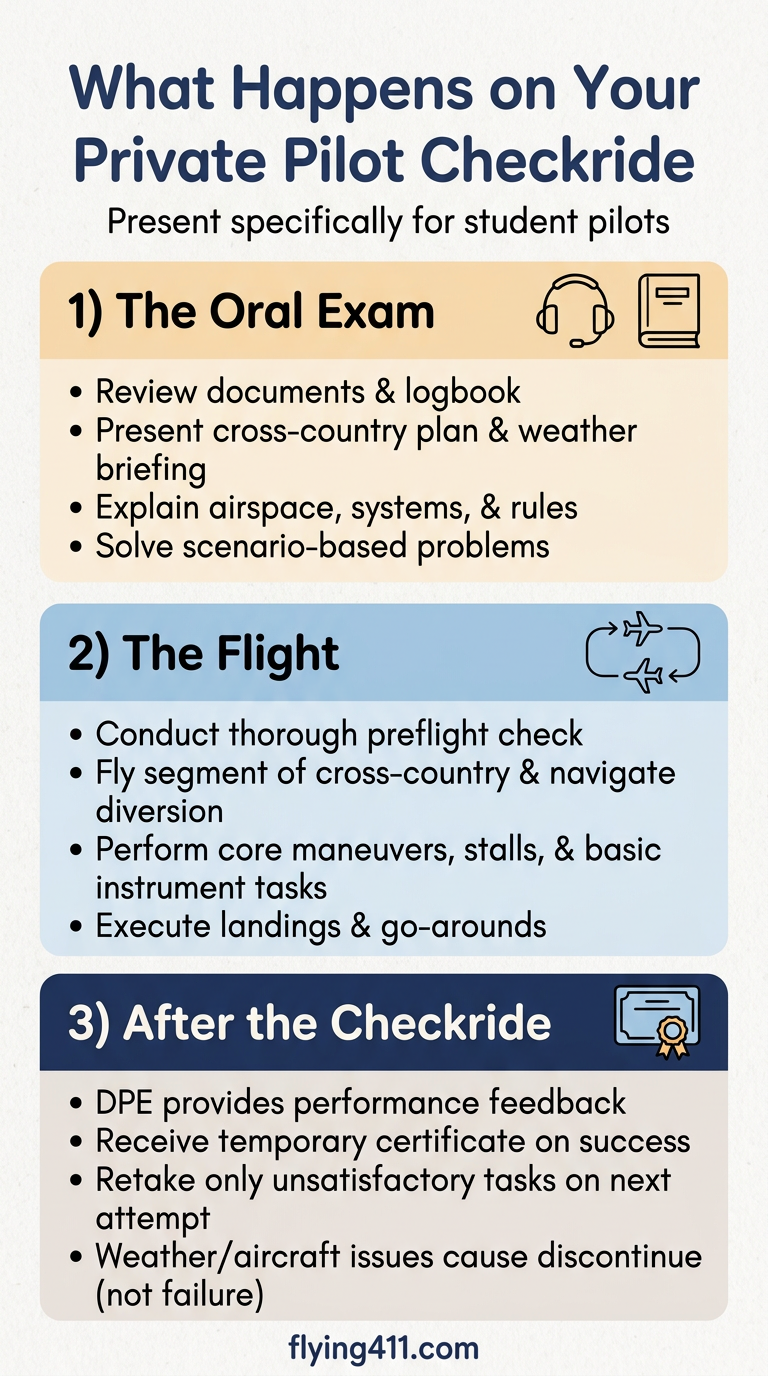
This is the part most people want to know about. The checkride has two main phases: the oral exam on the ground and the flight portion in the air. Together, they give the examiner a complete picture of your skills, your knowledge, and your judgment as a pilot. Let's break it down step by step.
The Oral Exam (About 1.5 to 2 Hours)
The oral exam kicks things off. Before you ever touch the controls, you and the DPE — your designated pilot examiner — will sit down together and go through a structured conversation about aviation topics. It sounds intense, but here is something that helps: it is open book. You can reference your charts, your Pilot's Operating Handbook (POH), your FAR/AIM, and your sectional. No one expects you to have the entire Federal Aviation Regulations memorized word for word.
The FAA publishes the ACS — the Airman Certification Standards — which is the official guide the DPE follows. Every topic on the oral exam comes from that document. Download it, read it, and know what is in it. There should be no real surprises.
Here is how the oral typically flows:
- Document and logbook review — The DPE starts by checking your paperwork. They will look through your logbook to confirm your flight hours and endorsements. They will also review the aircraft maintenance records, checking for required inspection entries. Get your logbook organized with sticky tabs ahead of time. This is not the moment to be flipping through pages trying to find things
- Cross-country planning — You will have a cross-country route prepared in advance. The DPE will walk through it with you — asking about weather, fuel planning, alternate airports, NOTAMs, and performance calculations. Weather knowledge is one of the most commonly weak areas for student pilots, so spend extra time with METARs, TAFs, PIREPs, and the Graphical Forecasts for Aviation
- Aircraft systems — Know your airplane. The DPE may ask how your fuel system works, what the pitot-static system does, or what happens if your alternator fails. Your POH has the answers — study it
- Airspace — You need to know the classes of airspace cold. Class A, B, C, D, E, and G each have different entry requirements and weather minimums. Special use airspace — like MOAs and TFRs — may come up too
- Regulations and procedures — Passenger currency rules, flight review requirements, PIC authority, and required aircraft equipment are all fair topics
- Scenario-based questions — The DPE may present a situation and ask how you would handle it. For example: "You are 30 minutes from your destination and the weather ahead is deteriorating. What do you do?" These questions test your aeronautical decision-making, not just your ability to recall facts
One important note: the oral exam does not stop when you walk out to the airplane. The DPE will continue asking questions during the flight. Stay mentally in the game.
The Flight — From Preflight to Shutdown
Once the oral is done, it is time to fly. The DPE rides along as a passenger — but a very observant one. The flight instructor who trained you has already reviewed these tasks with you dozens of times. Now you are doing them in front of someone new, which is the main difference.
Preflight inspection
The practical test begins the moment you walk to the airplane. Your preflight is evaluated. Use your checklist. Work through it in order. The DPE is watching to see that you treat this as a real safety procedure, not a box-checking exercise.
Takeoff and departure
Brief the DPE before each task — say what you are going to do and how you plan to do it. You will start with a normal takeoff, and the DPE will ask for a short-field or soft-field takeoff at some point during the flight.
Cross-country navigation
You will fly the route you planned during the oral. Pilotage and dead reckoning are expected, and using an EFB like ForeFlight is permitted under the current ACS. The DPE may ask you to identify a VOR station by its Morse code — do not skip this step. Students have failed by tracking the wrong VOR, and the examiner knows how serious a navigation error can be in the real world.
At some point, expect to be redirected mid-flight to a different airport. This in-flight diversion is a common stumbling block. Practice it specifically with your CFI before the big day.
Maneuvers in the practice area
After the cross-country segment, you will head to an open area for the maneuver portion. Here is what to expect:
- Steep turns — 45 degree bank, plus or minus 100 ft altitude, plus or minus 10 knots airspeed, roll out within plus or minus 10 degrees of your entry heading. Steep turns demand divided attention and smooth coordination — practice them until they feel automatic
- Slow flight — Fly at a reduced airspeed with flaps extended while maintaining altitude and full control. The ACS no longer requires you to fly right at the edge of a stall, but you must show you are in full command of the airplane at low speed
- Stalls — You will demonstrate a power-off stall (simulating an approach configuration) and a power-on stall (simulating a departure). Clear the area, set up correctly, and recover smoothly with minimal altitude loss
- Ground reference maneuvers — Turns around a point and S-turns across a road are the main ones. Enter at 600 to 1,000 ft AGL and maintain plus or minus 100 ft altitude throughout. The whole point of ground reference maneuvers is wind correction — show that you are constantly adjusting for wind drift to hold a consistent ground track
- Emergency procedures — The DPE will simulate an engine failure by reducing power. Your job is to pitch for best glide speed, pick a suitable emergency field, and run through the engine restart checklist. You are the pilot in command during emergency procedures — if you decide to go around before committing to a low-altitude approach, that is your call to make
Basic instrument flight
You will fly for a short period under the hood or foggles. Straight-and-level flight, climbs, descents, and unusual attitude recovery are typical tasks. Tolerances are slightly more relaxed than full IFR standards, but stay focused and fly smoothly.
Traffic pattern and landings
You will return to the airport and fly the traffic pattern. Expect at least three landings — a normal landing, a short-field landing, and possibly a soft-field or go-around. Fly stabilized approaches. If a landing does not look right on final, go around without hesitation. That is always the right decision, and the DPE knows it.
What the DPE Is Really Watching For
The ACS defines specific tolerances for each maneuver, but the DPE is also evaluating something bigger: your judgment and behavior as a pilot certificate holder. Here is what stands out to most examiners:
- Checklist discipline — Using your checklists consistently shows professionalism. Skipping them — even once — sends the wrong message
- PIC mindset — Fly the airplane first. If the DPE drops something or asks a question at a tricky moment, manage the distraction and keep flying. The airplane is always your first priority
- Self-correction — Everyone makes small errors. If you catch your own mistake and fix it quickly — without the DPE saying anything — that can save the ride. The ACS specifically notes that consistent errors and failure to take prompt corrective action are what lead to a failure, not a single slip
- Communication — Brief each task before you execute it. Explain what you are doing and why. This shows the DPE that you are thinking like a pilot, not just reacting
- Risk awareness — Every task in the ACS includes a risk management element. The DPE wants to see that you identify hazards before they become problems
If you are just beginning your aviation journey and want a full roadmap before you even get to checkride prep, Pilot License Types and Requirements: Full Breakdown Guide is a great place to start. And if you are still deciding what type of flying fits your goals, How Much Does a Helicopter License Cost? A Full Breakdown for USA Pilots can help you figure out which direction makes the most sense for you.
What Happens After the Checkride Ends
When the engine shuts down and you are back on the ramp, the DPE will often ask: "So, how do you think you did?" Be honest. This is not a trick — it is a chance to show that you can evaluate your own performance clearly. Good pilots know what they did well and where they can improve.
Then comes one of three outcomes:
- Pass — The DPE issues a temporary pilot certificate on the spot, valid for 120 days while the FAA processes your permanent one. You are officially a private pilot
- Notice of Disapproval — If you did not meet the standard on one or more tasks, you receive a Notice of Disapproval. You only need to retest the failed tasks after additional training with your flight instructor. One failure on your FAA record is not a career-ender — many successful pilots have one. What matters is that you learn from it and come back prepared
- Letter of Discontinuance — If the checkride cannot be finished due to weather, an aircraft issue, or another uncontrollable circumstance, the DPE issues a Letter of Discontinuance. This is not a failure. It simply documents what was completed, and you pick up from there on another day
You Are More Ready Than You Think
The checkride can feel like a mountain when you are staring up at it. But once you break it down into its parts — the paperwork, the oral exam, the flight, the maneuvers — it becomes something you can actually prepare for. And that is exactly what you have been doing this whole time.
Your flight instructor signed off on you for a reason. The FAA built the ACS so there are no hidden surprises. The DPE is not there to catch you off guard — they are there to confirm what your training has already shown. You know this material. You have flown these maneuvers. You have studied the airspace, reviewed the regulations, and practiced until the procedures feel natural.
A few things to carry with you on the day:
- Bring everything on your checklist — missing documents can stop the test before it starts
- Brief each task out loud — tell the examiner what you are doing and why
- Fly the airplane first — manage every distraction with that mindset
- Catch your own mistakes and correct them — that matters more than being perfect
- Stay calm after a rough moment — keep going, the ride is not over until the DPE says it is
One in four student pilots does not pass on the first try, and that is okay. A setback is not a stop sign. You retrain, you retest, and you come back sharper. But with solid preparation and a clear picture of what to expect, you give yourself the best possible shot at walking away with that temporary pilot certificate in hand.
For more helpful guides on flight training, aviation regulations, and everything pilots need to know, head over to Flying411 — your go-to resource for clear, trustworthy aviation information.
Frequently Asked Questions
Can you reschedule a private pilot checkride if the weather is bad on the day of the test?
Yes, absolutely. Bad weather is a completely valid reason to reschedule. If weather makes the flight unsafe, either you or the DPE can call it off. If the test has already started and weather rolls in, the DPE can issue a Letter of Discontinuance so you only finish the remaining tasks later.
How much does a private pilot checkride cost?
DPE fees typically range from $400 to $700 or more, depending on location and examiner. FAA inspectors do not charge a fee but are rarely available. You will also need to factor in aircraft rental costs for the flight portion, which varies by school and aircraft type.
Do you have to complete all checkride tasks in one day?
You do not. If the checkride is interrupted for reasons outside your control — like weather or a mechanical issue — the DPE issues a Letter of Discontinuance. You can then complete the remaining tasks on another day without starting over. However, if you fail a task, you must get additional training before retesting those specific areas.
What happens to your FAA record if you fail the private pilot checkride?
A failure is recorded permanently in the FAA's system. Future employers and airlines can see your checkride history. One failure with a clear explanation is generally not a disqualifying factor. However, multiple failures across different checkrides can raise concerns during airline hiring interviews.
Is the cross-country flight plan for the checkride assigned in advance or on the day of the test?
Most DPEs assign the cross-country destination one to two days before the checkride so you can plan in advance. Some may assign it the morning of the test. Check with your specific examiner when you schedule to know what to expect and have your planning tools ready either way.