
The FAA has published more than 23,000 airworthiness directives since 1994. Every single one of them started with the same thing: someone found a safety problem that needed to be fixed.
If you own or fly an aircraft, these directives are part of your world. They tell you what to inspect, what to replace, and when to do it. Some you handle once and move on. Others come back again and again on a schedule. Mix up the two, and you could end up grounded or worse.
The tricky part is that ADs come in different forms, with different deadlines and different rules for tracking them. A one-time AD and a recurring AD may both apply to the same airplane, but the way you handle each one is very different.
So let's walk through how airworthiness directives work from the ground up, starting with what they are, who has to follow them, and how one-time and recurring compliance actually play out in the real world.
Key Takeaways
An airworthiness directive is a legally required order from the FAA that tells aircraft owners to fix a known safety problem. ADs come in two main forms: one-time ADs that require a single action (like replacing a faulty part), and recurring ADs that require repeated inspections or maintenance at set intervals. Both types are mandatory. If you skip either one, your aircraft is not legally airworthy and cannot fly.
| Topic | Key Takeaway |
| What is an AD? | A mandatory FAA order to correct an unsafe condition in an aircraft, engine, propeller, or appliance |
| Legal authority | 14 CFR Part 39. ADs are federal regulations, not suggestions |
| One-time AD | Requires a single action. Once completed and logged, it is done |
| Recurring AD | Requires repeated inspections or part replacements at set intervals (hours, calendar time, or cycles) |
| Who is responsible? | The aircraft owner or operator under FAR 91.403 |
| What if you don't comply? | The aircraft is legally unairworthy. You cannot fly it, and you face potential FAA enforcement action |
| Where to find ADs | FAA Dynamic Regulatory System (DRS) at drs.faa.gov, plus email subscription service for new ADs |
| Recordkeeping rule | 14 CFR 91.417. You must log the AD number, method of compliance, and next due date for recurring ADs |
What Is an Airworthiness Directive and Why Does It Matter?
An airworthiness directive is a formal order from the FAA that says, "We found a safety problem, and you need to fix it." That is the short version. The longer version matters just as much.
Under 14 CFR Part 39, the FAA has the authority to issue ADs any time it finds an unsafe condition in a certified product. That product could be an airframe, an engine, a propeller, or an appliance like a fuel pump or an alternator. The unsafe condition might come from a design flaw, a manufacturing defect, or something that wears out in a way nobody expected.
ADs are not optional. They are federal regulations. Every time you fly an aircraft that has an open AD, you are in violation of the law. That is true even if every other part of the airplane is in perfect shape.
Here is how to think about it. An annual inspection checks the overall condition of the aircraft. An AD targets one specific known problem. The annual might pass with flying colors, but if a recurring AD deadline slipped by two months ago, that airplane is still not legal to fly.
So what do ADs actually require? It depends on the directive. Some common actions include:
- Inspections: Visual checks, borescope exams, eddy current testing, or other methods to look for cracks, corrosion, or wear
- Part replacements: Swapping out a component that has a known failure pattern for an improved version
- Modifications: Changing the design of a part or system to eliminate the root cause of the problem
- Operational limitations: Restricting how the aircraft can be used until the fix is in place (like limiting speed or altitude)
The goal of every AD is the same: keep the airplane safe to fly. The Federal Aviation Administration builds the AD system around one idea. If a known problem exists in one aircraft of a certain type, it probably exists in others of the same type. So the fix has to reach all of them.
That is why aviation safety depends so heavily on ADs. They are the FAA's fastest tool for pushing mandatory fixes out to the entire fleet.
How the FAA Issues an Airworthiness Directive
ADs do not appear out of thin air. Each one follows a structured process that starts with someone discovering a problem and ends with a published federal regulation. The path it takes depends on how urgent the problem is.
The most common route is the notice of proposed rulemaking, or NPRM. This is the standard process. The FAA identifies an unsafe condition, writes up a proposed fix, and publishes it in the Federal Register. The public gets a chance to comment. Aircraft owners, mechanics, and manufacturers can weigh in. After the comment period closes, the FAA reviews the feedback, makes changes if needed, and publishes the final rule AD. That final rule is the version everyone has to follow.
But not every AD can wait for public comment. When the problem is urgent but not an immediate danger, the FAA uses a faster path called a Final Rule with Request for Comments. This is sometimes called an "immediately adopted rule." The AD takes effect right away, but the FAA still asks for comments after the fact. If someone raises a valid concern, the FAA can revise the rule later.
Then there is the fastest path of all: the emergency AD. This one bypasses everything. When the FAA finds a problem that puts lives at risk right now, it issues an emergency AD that takes effect the moment the operator receives it. No comment period. No waiting. The aircraft cannot fly again until the required action is done.
A well-known example is the Boeing 787 battery AD from 2013. After two lithium-ion battery fires on separate 787s, the FAA grounded the entire fleet with an emergency AD until the battery system was redesigned and proven safe.
Here are a few more details worth knowing about how ADs are published and tracked:
- Every AD gets a unique number. For example, AD 2011-10-09. The first part is the year, the second is the biweekly period, and the third is the sequence within that period
- When an AD is revised, it keeps the original number and adds an "R" suffix (like R1, R2, and so on)
- All ADs are published in the Federal Register as amendments to §39.13
- The FAA also posts them to the Dynamic Regulatory System (DRS) at drs.faa.gov, where you can search by make, model, or AD number
- You can sign up for free email alerts to get new ADs and Special Airworthiness Information Bulletins (SAIBs) sent directly to your inbox based on your aircraft type
Understanding the different types of ADs and how they are issued helps you plan ahead. An NPRM gives you a heads-up that a new requirement is coming. An emergency AD gives you no warning at all.
Who Is Responsible for AD Compliance?
This is one of the most misunderstood parts of aircraft ownership. Many people assume the mechanic handles AD compliance. Others think the flight school keeps track. But the regulations are clear: the responsibility falls on the owner or operator.
Under FAR 91.403, aircraft owners are primarily responsible for maintaining their aircraft in an airworthy condition. That includes staying current with every applicable AD. It does not matter if you have the best mechanic in the country. If an AD is overdue, you are the one on the hook.
That responsibility goes deeper than most people realize. Here is what it means in practice:
- You need to know which ADs apply to your airframe, engine, propeller, and installed appliances
- You need to track compliance time for every recurring AD by hours, calendar date, or cycles
- You need to make sure your maintenance records show the current status of each AD under 14 CFR 91.417
- You need to verify that any work done to meet an AD is logged properly, including the AD number, revision date, method of compliance, and the date and aircraft time at completion
The FAA made an important clarification on this point in a ruling against a flight school. The agency said that a flight school has an independent duty to track when ADs come due. It cannot simply rely on its repair station to handle compliance. The school, as the operator, carries the legal responsibility.
One common mistake trips up a lot of owners. They see a current annual inspection in the logbook and assume the airplane is airworthy. But that is not always the case. A recurring AD might come due six months after the annual. If the owner misses that deadline, the aircraft is grounded even though the annual is still valid.
The bottom line is simple. Your mechanic performs the work. Your IA signs it off. But you, as the owner or operator, must make sure it all gets done on time.
And if an AD applies to your aircraft but you are not sure how to comply, or you believe a modification already eliminated the unsafe condition, you can request an Alternative Method of Compliance (AMOC). The FAA has a formal process for reviewing and approving these requests. But until that approval comes through, the original AD requirements still stand.
The safety of flight for every aircraft in the fleet depends on owners who take this responsibility seriously. The FAA built the AD system on the assumption that owners will stay informed. Tools like the DRS database, email alert subscriptions, and third-party tracking services make that easier than ever. But the final responsibility always rests with you.
Now that we have covered the basics, what ADs are, how they are issued, and who has to follow them, let's get into the core question. What is the real difference between a one-time AD and a recurring AD, and what does that mean for the way you manage corrective action on your aircraft?
One-Time vs Recurring AD Compliance: What Every Aircraft Owner Needs to Know
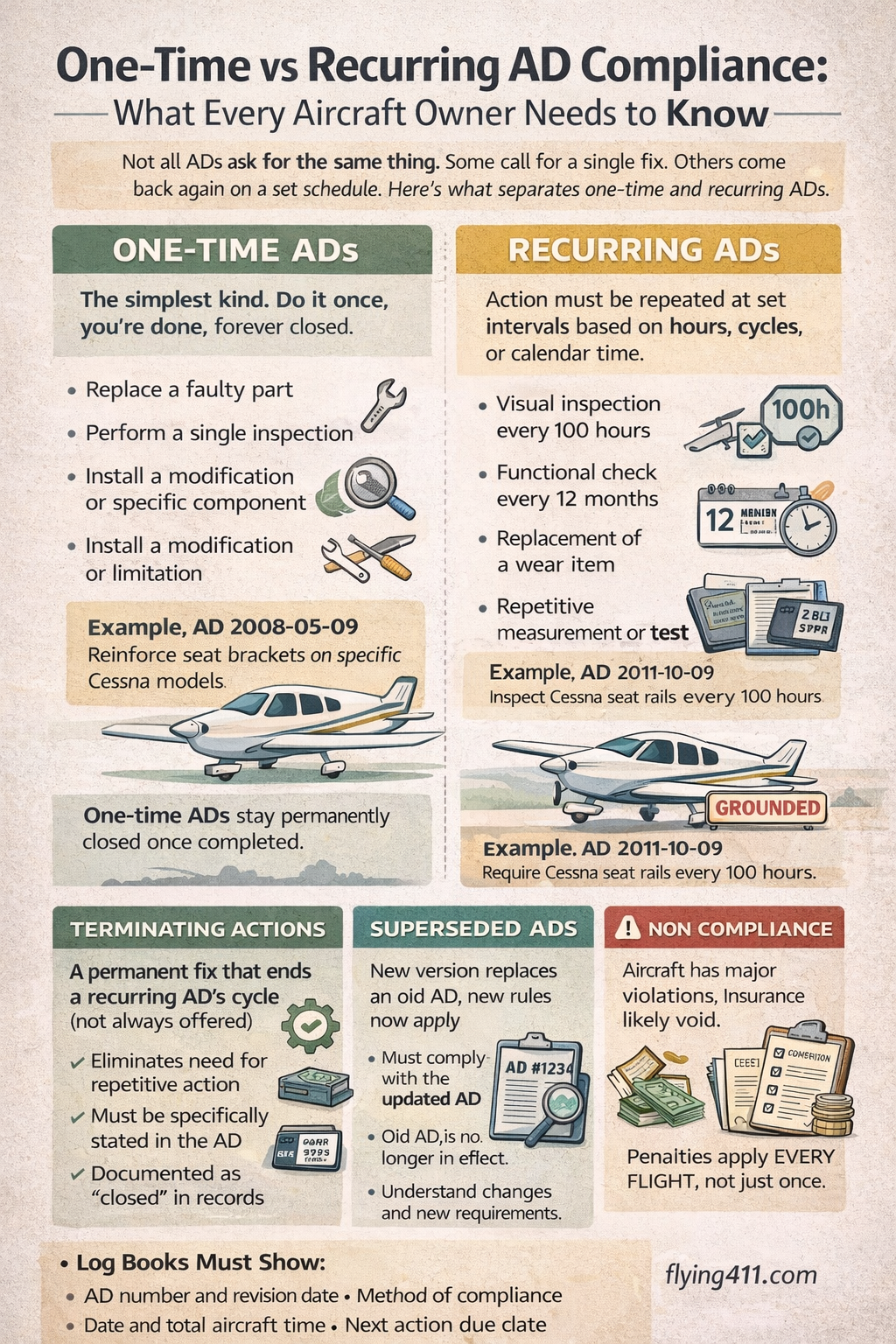
Not all ADs ask you to do the same thing. Some call for a single fix. Others come back again and again on a set schedule. Knowing the difference between the types of ADs can save you time, money, and a whole lot of headaches at annual inspection time.
Let's take a loot at each type so you know exactly what you're dealing with.
One-Time ADs
A one-time AD is the simplest kind. The FAA identifies an unsafe condition, tells you what to do about it, and once you do it, you're done. The AD is closed. You move on.
The required corrective action might look like any of the following:
- Replacing a faulty part with an updated version
- Performing a single inspection of a specific component
- Installing a modification or hardware upgrade
- Adding a placard or operational limitation to the aircraft
A good real-world example is AD 2008-05-09. This one applied to certain Cessna 172, 182, and 206 models. The FAA found that the seat base/back attach bracket could fail at the weld point. If that bracket broke in flight, the seat could collapse backward and the pilot could lose control. The fix was straightforward. Remove the crew seats, modify the brackets, and reinstall. One and done.
Once a one-time AD is completed and signed off in the maintenance records, it stays closed for the life of the aircraft. You still need to keep it listed on your AD compliance record, but you don't need to repeat the work.
Recurring (Repetitive) ADs
Recurring ADs are a different story. These require the same action to be performed over and over at set intervals. The interval might be based on flight hours, calendar time, or engine cycles. And if you miss the deadline, even by a single hour, the aircraft is no longer airworthy.
Here's what a recurring AD might require:
- A visual inspection of a specific part every 100 hours of time in service
- A functional check of a component every 12 calendar months
- Replacement of a wear item at a set hour or cycle interval
- A repetitive measurement or test at each annual or 100-hour inspection
The classic example here is the Cessna seat rail AD. The original version dates back to 1987 (AD 87-20-03), and it has been revised and superseded multiple times since then. The current version, AD 2011-10-09, requires repetitive inspections of the seat rail holes, seat pin engagement, rollers, washers, tang thickness, and lock pin springs. Cessna seat slippage has caused real accidents, so the FAA keeps this one active with no permanent fix for most older models.
One critical detail that catches aircraft owners off guard: there is no provision to overfly the maximum hour requirement on a recurring AD unless the AD itself specifically allows it. If the AD says every 100 hours, you cannot fly at 101 hours without compliance. The aircraft is grounded until the work gets done.
Recurring ADs also demand extra attention in your records. Under 14 CFR Part 39 and the recordkeeping rules in 14 CFR 91.417, you must document not only that the work was completed but also when the next action is due. That "next due" entry is what keeps you legal between inspections.
Terminating Actions
Here's some good news for owners dealing with a nagging recurring AD. Some of these directives include a terminating action. That's a permanent modification or upgrade that, once completed, eliminates the need for the repetitive inspections.
Think of it this way. A recurring AD might require you to inspect a fuel line fitting every 200 hours. But paragraph (h) of that same AD might say that if you replace the fitting with a redesigned version (per the manufacturer's service bulletin), the repetitive inspections are no longer required. That replacement is the terminating action.
A few things to watch out for with terminating actions:
- The AD must specifically state that the action terminates the repetitive requirement. Don't assume
- Replacing a part with the same part number does not count as terminating action unless the AD says so
- You still need to document the terminating action in your maintenance records and AD compliance list
- Even after terminating action, the AD remains on your compliance record. It just shows as "closed" or "terminated"
Not every recurring AD has a terminating action available. Some keep going for the entire service life of the aircraft. That Cessna seat rail AD is one of them for most older models.
Superseded ADs
An AD gets superseded when the FAA replaces it with a newer version. The old AD is no longer in effect, and there are no compliance requirements for a superseded directive. The new AD takes over.
This happens for a few reasons:
- The FAA adds new inspection steps or expands the scope of the original AD
- A revision corrects errors or clarifies confusing language in the earlier version
- New data from service difficulty reports or accident investigations requires updated action
When you see a superseding AD, read the new one carefully. It might carry forward all the same requirements from the old AD and add new ones on top. Or it might change the compliance time or affected serial numbers. Either way, you comply with the current version only.
Understanding Compliance Time Language
AD language can be tricky, and two phrases trip people up more than any others.
- "Whichever occurs first" means the clock is running on multiple timelines, and you must act when the earliest one hits. For example, an AD might say "within 300 hours time in service or 12 calendar months after the effective date, whichever occurs first." If you hit 300 hours in month six, you're due at month six.
- "Whichever occurs later" gives you more room. You don't have to act until the last condition is met. An AD might say "at 2,000 hours time in service or 25 hours after the effective date, whichever occurs later." You comply when both thresholds have passed.
Misreading these terms is one of the fastest ways to end up out of compliance without realizing it. When in doubt, ask your A&P or IA to walk through the math with you.
AD Compliance and Your Maintenance Records
Good recordkeeping is the backbone of aviation safety when it comes to ADs. Under 14 CFR 91.417, every aircraft owner or operator must maintain the current status of all applicable airworthiness directive entries. Each entry needs to include:
- The AD number and revision date
- The method of compliance (what was done)
- The date and total aircraft time at completion
- If the AD involves recurring action, the time and date when the next action is due
These records transfer with the aircraft when it's sold. If you're looking at the Aircraft Closing Process Explained: Documents, Escrow, and FAA Filing when buying or selling, complete AD records are one of the most important items in the package.
Many experienced owners keep a separate AD compliance spreadsheet organized by airframe, engine/propeller, appliances, and recurrent items. This makes it much easier to see what's due at a glance, especially if you're managing recurring ADs across multiple components.
What Happens If You Don't Comply
Let's be direct. Operating an aircraft with an overdue or not complied AD is a federal regulation violation. Every single flight counts as a separate violation under §39.7.
The consequences can include:
- The aircraft is considered unairworthy and cannot legally fly
- Civil penalties up to $100,000 for individuals (up to $1,200,000 for non-individuals)
- Certificate suspension or revocation for pilots and mechanics
- Insurance claims denied if an accident involves a known AD non-compliance issue
The FAA does have a compliance-first approach for honest mistakes. If the non-compliance was unintentional and you're willing to cooperate, the agency often resolves it through counseling or corrective action rather than formal enforcement. But intentional or reckless disregard for an AD gets zero tolerance.
If you're unsure about the registration status of your aircraft, understanding the paperwork side is just as important. Understanding FAA Registration and Deregistration Procedures: What You Need to Know walks you through the full process.
How ADs Affect Aircraft Value
If you've ever been through a pre-buy inspection, you know that AD compliance is one of the first things a buyer's mechanic checks. Incomplete or missing AD records can reduce an aircraft's market value by 15 to 25 percent.
Here's what buyers and their inspectors look for:
- Full AD compliance history with signed logbook entries for every applicable directive
- Clear documentation showing recurring ADs are current and not overdue
- Evidence of terminating actions where available
- No gaps or missing entries that raise questions about the aircraft's maintenance history
A clean AD record signals that the aircraft has been cared for properly. A messy one, or one with unexplained gaps, sends buyers running. It also gives the buyer's side strong leverage to negotiate the price down or walk away from the deal entirely.
Alternative Methods of Compliance (AMOC)
Sometimes the action spelled out in an AD doesn't quite fit your situation. Maybe a modification on your aircraft makes the standard procedure impossible. Maybe a different repair achieves the same level of safety of flight. That's where an alternative method of compliance comes in.
An AMOC lets you propose a different way to address the unsafe condition, as long as it provides an equal level of safety. Here's how the process works:
- Submit your proposal through your principal inspector (PI) or directly to the FAA office listed in the AD
- Include the specific actions you're proposing and explain how they resolve the unsafe condition
- The manager of the responsible FAA office reviews and either approves or denies the request
- You cannot use the alternative method until the FAA gives written approval
Keep in mind that if an AD applies to your aircraft and you've made changes that affect your ability to comply as written, you are required to request an AMOC. You can't just skip the AD because your setup is different.
An emergency AD follows the same AMOC rules, but given the urgency, getting approval can be more challenging and time-sensitive.
Also worth noting: a notice of proposed rulemaking stage is your chance to comment on a proposed AD before it becomes final. If you think the proposed action is unreasonable or needs adjustment, this is the time to speak up. The FAA does consider public comments, and ADs have been revised based on feedback from owners and industry groups.
How to Stay Current on ADs
Staying ahead of ADs takes a little effort, but the tools are available and most of them are free:
- FAA Dynamic Regulatory System (DRS): Search for current ADs by make, model, or AD number at drs.faa.gov
- Email alerts: Sign up through the FAA's GovDelivery system to get new ADs and Special Airworthiness Information Bulletins (SAIBs) sent directly to your inbox based on your aircraft type
- Federal Register: All ADs are published here as amendments to §39.13
- Third-party tracking tools: Services like ADLog and the Aviation DataBase help owners build aircraft profiles and track compliance digitally
One tip that saves a lot of headaches: when you search for ADs on your aircraft, also search separately for the installed engine, propeller, and any appliances. ADs are issued at the product level, so your airframe search won't catch engine-specific or propeller-specific directives.
Conclusion
Airworthiness directives are one of the most important safety systems in aviation. They exist to catch known problems and make sure every affected aircraft gets the fix it needs.
The difference between a one-time AD and a recurring AD comes down to how often you have to act. A one-time AD is a single task. Do it, log it, and move on. A recurring AD is a commitment. It comes back at set intervals, and missing even one deadline makes your aircraft unairworthy.
Both types demand the same level of attention from owners. You need to know which ADs apply, track the deadlines, keep your records clean, and make sure every required action gets done right and on time. The FAA does not accept excuses for missed compliance, and neither will a buyer during a pre-purchase inspection.
The good news is that staying on top of ADs is very doable. Use the FAA's DRS database and email alerts. Work with a mechanic who knows your aircraft type. Keep a clean, organized AD compliance list. And review your status regularly, not just at annual time.
Your aircraft, your passengers, and your wallet will all benefit from taking AD compliance seriously.
For more guides on aircraft maintenance, ownership, and staying compliant, visit Flying411.com.
Frequently Asked Questions
Can a pilot perform AD compliance work on their own aircraft?
Only if the AD specifically states that the owner or pilot may do the work. Most ADs require a certified A&P mechanic or IA to perform and sign off the corrective action. Always check the AD text before starting any work yourself.
Do ADs apply to experimental or amateur-built aircraft?
ADs typically apply to type-certificated aircraft. However, if an AD targets a specific engine or propeller installed on an experimental aircraft, it may still apply. Contact your local FSDO for guidance on your specific setup.
What happens when an AD is superseded by a newer one?
The older AD is no longer in effect. The superseding AD identifies which directive it replaces. You only need to comply with the new version. However, review it carefully. Superseding ADs sometimes add new requirements.
How much does AD compliance typically cost for general aviation aircraft?
Costs vary widely. A simple one-time inspection AD might cost a few hundred dollars in labor. A recurring AD that requires part replacements could cost several thousand over the life of the aircraft. Always factor AD costs into your ownership budget.
Can I get a ferry permit to fly my aircraft to a shop if an AD is overdue?
In some cases, yes. Your local FSDO may issue a special flight permit to fly the aircraft to a repair facility. However, the FAA can add restrictions or deny the permit if it determines the aircraft cannot be moved safely.