Aviation just had one of its biggest regulatory years in decades. In 2025, the International Civil Aviation Organization locked in a set of new rules. These rules will change how airlines operate, how aircraft get built, and how operators track and offset their carbon emissions. These are not small tweaks. They are major shifts that set the course for all of international aviation all the way to 2050.
And the stakes are real: aviation accounts for 2.5% of global CO2 emissions today, but has already contributed around 4% to total global warming to date. That gap matters, and regulators are now moving fast to close it.
Right now, airlines are managing three things at once. Current carbon offsetting deadlines are already counting down. A mandatory global compliance phase starts in 2027. And new aircraft design standards have been approved that will reshape fleet planning for the next decade. Missing any one of these is not an option for operators flying international routes.
This article breaks down what changed, why it changed, and what you must do next, starting with the organization behind all of it.
Key Takeaways
ICAO finalized major new carbon emissions rules in 2025. Airlines must report emissions each year, buy carbon offset credits under Carbon Offsetting and Reduction Scheme for International Aviation (CORSIA), and get ready for a fully mandatory global compliance phase starting in 2027. New aircraft design standards will require at least 10% better fuel efficiency for new aircraft types by 2031. Sustainable aviation fuels and carbon offsets are the main tools airlines can use to meet these rules.
| Topic | Key Detail |
| New aircraft CO2 standard | 10% more stringent for new type designs, effective December 31, 2031 |
| In-production aircraft | Up to 6% reduction required starting in 2035 |
| 2028 production cut-off | Aircraft not certified by January 1, 2028 cannot continue to be produced |
| CORSIA Phase 1 | Covers 2024-2026; final offset credits due by January 31, 2028 |
| CORSIA Phase 2 | Mandatory for nearly all states starting 2027 |
| Who must report | Operators emitting more than 10,000 tonnes of CO2 annually on international flights |
| SAF global goal | 5% CO2 reduction from cleaner fuels by 2030 |
| Net-zero target | Net-zero carbon emissions from international aviation by 2050 |
| ICAO member states | 192 states unified behind net-zero at the 2025 Assembly |
| Carbon credit prices | Projected $25-$60 per tonne by the late 2020s |
What Is ICAO?
Before diving into the new rules, it helps to know who ICAO is and why its decisions matter so much. ICAO stands for the International Civil Aviation Organization. It is a United Nations agency created in 1944 through the Chicago Convention. Its headquarters are in Montreal, Canada.
ICAO does not operate airlines or fly planes. It sets the global rules that govern how international aviation works. Every country that wants to take part in international air travel agrees to follow ICAO's Standards and Recommended Practices, called SARPs.
Here is how that works in practice:
- ICAO sets a standard for things like aircraft noise, emissions, or safety steps.
- Member states adopt that standard into their own national rules.
- National aviation authorities like the FAA in the United States or EASA in Europe then enforce those rules.
So when ICAO updates its carbon emissions rules, those changes flow into FAA and EASA regulations. Airlines flying internationally have no real way to ignore them. Non-compliant aircraft can be blocked from flying across borders.
ICAO currently has 193 member states. That makes it one of the most widely joined international bodies in the world. At the 42nd session of the ICAO Assembly in October 2025, a record 192 of those states stood together behind ICAO's long-term environmental goals. That level of agreement tells you something important: this regulatory direction is not going to reverse.
ICAO's technical work is done through working groups and committees. The most important one for emissions is the Committee on Aviation Environmental Protection, or CAEP. CAEP includes more than 1,200 experts from governments, airlines, manufacturers, and research groups. When CAEP agrees on a recommendation, it goes to the ICAO Council for review. From there, it becomes binding international policy.
The ICAO Council is made up of 36 elected member states and meets several times a year. The Council formally adopted the new CAEP/13 CO2 standard in June 2025. The full Assembly ratified it in October. That two-step process, from committee to Council to Assembly, is how ICAO turns expert input into enforceable rules.
The 2025 rule changes are not proposals or suggestions. They are formally adopted standards that national governments are already working to put in place.
How ICAO Controls Aviation Carbon Emissions
ICAO uses a set of tools to cut carbon emissions from international aviation. These tools work together. No single one is enough on its own. Together, they make up what ICAO calls its "basket of measures."
The four main tools are:
- Aircraft technology — building more fuel-efficient planes
- Operational improvements — flying smarter routes, cutting fuel burn
- Sustainable aviation fuels — swapping fossil jet fuel for lower-carbon options
- Market-based measures — carbon offsetting programs like CORSIA
Each tool plays a specific role. Aircraft technology cuts how much fuel a plane burns. Operational improvements get more out of existing fleets and airspace. Sustainable aviation fuels swap conventional jet fuel for fuels that produce far fewer carbon emissions across their full lifecycle. Market-based measures make sure that emissions that cannot yet be cut are offset by reductions somewhere else.
This layered approach exists because aviation is hard to decarbonize quickly. Aircraft have long service lives, often 20 to 30 years. The global fleet cannot be replaced overnight. New technologies like hydrogen or electric aircraft are still years away from wide commercial use. The strategy has to work across short, medium, and long timeframes at once.
Here is how aviation environmental protection fits into the bigger picture:
- Short term (now to 2030): Focus on CORSIA offsetting, SAF use, and fuel efficiency gains
- Medium term (2030 to 2040): Fleet renewal with cleaner aircraft, more SAF production
- Long term (2040 to 2050): New propulsion tech, deep emissions cuts, net-zero achievement
The ICAO new carbon emissions standards 2025 sit in the medium-term layer. They set the fuel efficiency bar for the next generation of aircraft. Manufacturers that want to sell new aircraft types after December 31, 2031 must meet these tougher standards at certification. The message to Boeing, Airbus, and every other manufacturer is clear: design cleaner planes now.
The global framework ICAO built around these tools is backed by a strong monitoring and reporting system. Since January 1, 2019, all airline operators with annual emissions above 10,000 tonnes of CO2 from international flights must report their emissions each year. An independent third-party verification body checks those reports before submission. This keeps the data accurate and ensures all operators play by the same rules.
The 2025 Turning Point That Changed the Rules
Two events in 2025 changed aviation emissions regulation for good. The first was the CAEP/13 meeting in February. The second was the ICAO Assembly in October. Together, they moved aviation from goal-setting into formal, binding compliance.
CAEP/13: February 2025
The 13th meeting of CAEP took place at ICAO headquarters in Montreal from February 17 to 28, 2025. It was historic for one key reason. For the first time, ICAO's technical committee agreed to tighten both aircraft noise standards and CO2 standards at the same time. This is called "integrated dual stringency." Noise and fuel burn are connected at the aircraft design level, so looking at both together leads to better outcomes.
The 31 recommendations from CAEP/13 included:
- A new emissions standard requiring new aircraft type designs to be at least 10% more fuel efficient, effective December 31, 2031
- A separate standard for in-production aircraft requiring up to 6% improvement, effective January 1, 2035
- A new noise standard for new aircraft type designs effective January 1, 2029
- The first global system for monitoring and reporting progress toward the LTAG, ICAO's Long-Term Aspirational Goal
- Faster work on certifying new SAF production pathways to support the 5% CO2 reduction goal by 2030
- Progress on climate adaptation guidance for airports and aviation infrastructure
The global aspirational goal, or LTAG, is ICAO's formal target of reaching net-zero carbon emissions by 2050 from international aviation. The new tracking system adopted at CAEP/13 means progress toward that goal will be measured for the first time.
The ICAO 42nd Assembly: October 2025
The 42nd session of the ICAO Assembly met in Montreal from September 23 to October 3, 2025. This three-year meeting of all ICAO member states is where the highest-level policy decisions get made. The 2025 session was the most significant environmental assembly in ICAO's history.
Key outcomes included:
- Formal adoption of the CAEP/13 CO2 and noise standards
- Unanimous support for the net-zero carbon emissions by 2050 target, with no reservations from any member state, a first in ICAO history
- Endorsement of the ICAO Global Framework for SAF and cleaner energies, including the 5% CO2 reduction target by 2030
- Strengthened support for CORSIA as the world's only global market-based measure for international aviation
- Launch of the ICAO Finvest Hub, connecting aviation decarbonization projects with investors
- Expanded support for ACT-SAF and ACT-CORSIA programs to help developing states comply
The Assembly confirmed that 130 states now take part in CORSIA, up from 88 in 2021. And 154 states submitted Action Plans on CO2 emissions reductions, up from 133 in 2022. More states are committed, so the compliance expectations are rising for everyone.
The aviation sector has had a net-zero goal since 2022. What 2025 added was a formal tracking system, tighter technology standards, and a clear compliance calendar. The rules are locked in. The hard work of meeting them starts now.
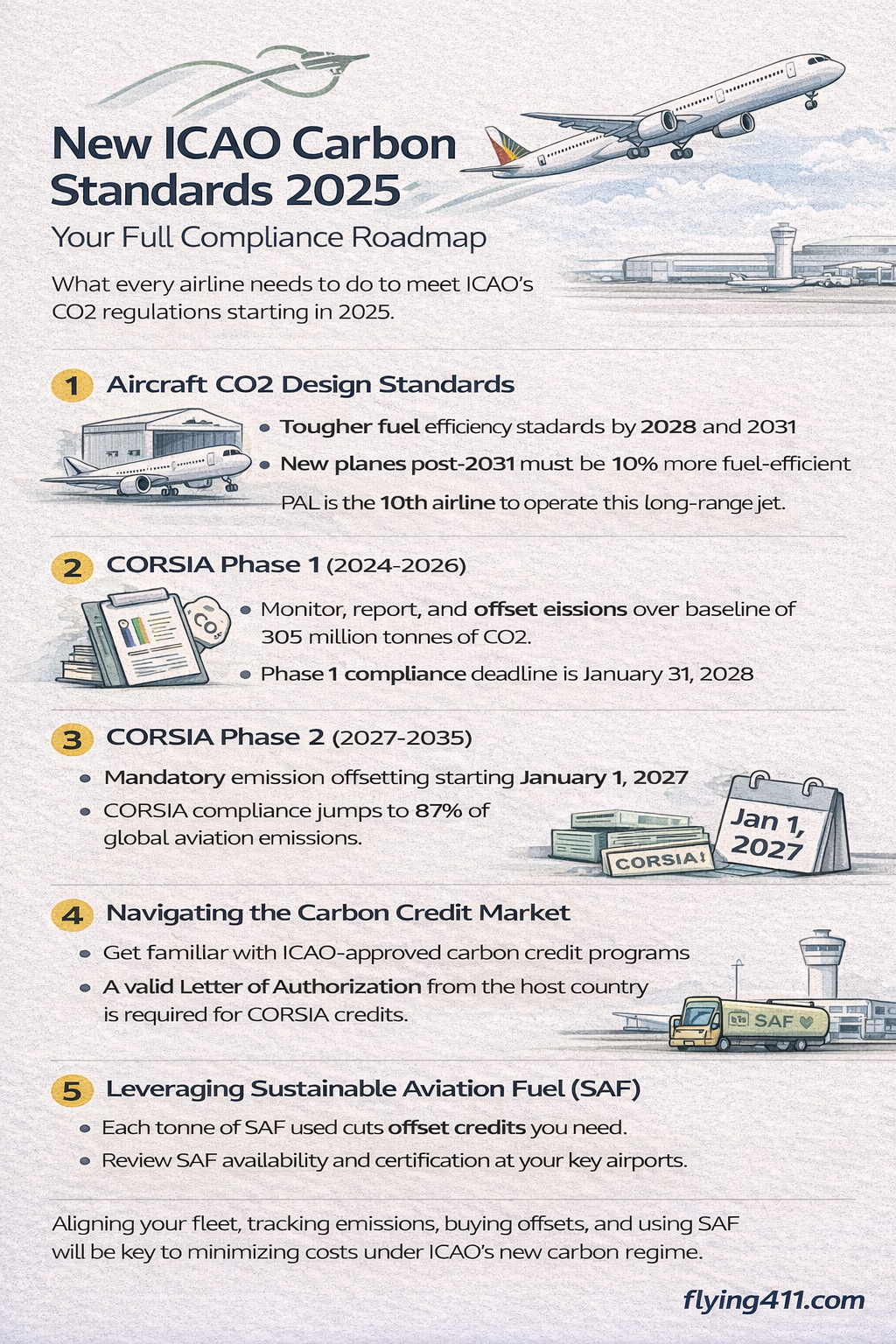
New ICAO Carbon Standards 2025: Your Full Compliance Roadmap
This is where everything gets practical. The rules are set. The deadlines are real. The New ICAO Carbon Standards 2025: Your Full Compliance Roadmap covers five areas every airline and operator needs to understand. Work through each one and you will have a clear picture of where you stand and what comes next.
The New Aircraft CO2 Design Standards
The aircraft you fly today were designed under older efficiency rules. Aircraft you order for the next decade will need to meet a much higher bar. The New Aircraft CO2 Design Standards approved at CAEP/13 in February 2025 set two separate rules based on aircraft type.
For new aircraft type designs:
- The CO2 standard becomes 10% more stringent, effective December 31, 2031
- Any aircraft type applying for certification after that date must meet this tougher fuel efficiency rule
- This applies to subsonic jets over 5,700 kg and propeller-driven aircraft over 8,618 kg
- Non-compliant new designs will not get international certification and cannot fly across borders
For in-production aircraft types (already certified and currently being built):
- A separate standard requires up to 6% improvement, effective January 1, 2035
- All in-production aircraft types must be certified against the current ICAO CO2 standard by January 1, 2028
- Aircraft types that miss the 2028 deadline cannot legally continue to be made
- As of early 2025, Airbus is the only manufacturer to have certified in-production types, including the A330-800neo and A330-900neo
That 2028 deadline is already creating urgency. Airlines planning fleet orders need to confirm that aircraft they buy will be certified and available for delivery after that cutoff. This is a fleet planning issue right now.
If you are buying new aircraft in the next few years, check the certification status. If you are ordering new aircraft types for delivery after 2031, expect those aircraft to reflect the new 10% efficiency standard. Manufacturers are already working toward this.
CORSIA Phase 1: What You Must Do Right Now
CORSIA Phase 1 covers 2024 through 2026. If your airline flies international routes and emits more than 10,000 tonnes of CO2 each year, you are already inside this compliance window. Here is exactly what CORSIA Phase 1: What You Must Do Right Now requires.
Step 1: Monitor your emissions
Track fuel use on every international flight. ICAO has approved five fuel monitoring methods. Operators who cannot use these methods may qualify to use ICAO's CO2 Estimation and Reporting Tool, known as CERT.
Step 2: Report annually
Submit your annual emissions report to your national aviation authority. This has been required since January 1, 2019. The report covers all international flights in the calendar year.
Step 3: Get verified
Before submission, an independent third-party verification body must check your report. This step is mandatory. It keeps data accurate and ensures all operators work from the same standard.
Step 4: Know your offsetting obligation
Your state will tell you your individual offsetting requirement by November 30 of the following year. For example, your 2024 requirement was due by November 30, 2025. The amount comes from multiplying your covered emissions by the sector's annual growth factor. For 2024, that growth factor was approximately 0.154, based on total emissions of 361 million tonnes against a baseline of 305 million tonnes.
Step 5: Cancel your offset credits
The final Phase 1 deadline is January 31, 2028. Operators with an obligation above 3,000 tonnes of CO2 must buy and cancel the required number of CORSIA Eligible Emission Units (EEUs) by that date. IATA puts the total cost of Phase 1 CORSIA compliance across the industry at $4 to $5 billion.
Do not wait until late 2027 to source credits. The market is already tightening.
CORSIA Phase 2: The Mandatory Shift Starting 2027
CORSIA Phase 2: The Mandatory Shift Starting 2027 is a very different situation from Phase 1. Phase 1 was voluntary for most states. Phase 2 is mandatory for nearly all ICAO member states. The only exceptions are least developed countries, small island developing states, landlocked developing countries, and very small aviation markets.
The scale change is big:
- CORSIA now covers about 64% of international aviation emissions under voluntary participation
- With Phase 2, coverage jumps to roughly 87% of international aviation emissions
- China, India, and Brazil are expected to join, bringing three of the world's largest aviation markets into full compliance
For airlines, more of your routes will fall under CORSIA starting January 1, 2027. If you fly between two countries that were not both in Phase 1, those routes may now be covered for the first time.
The financial exposure is real. Aviation consultancy IBA projects that the top 10 international carriers alone will need to offset 29 million tonnes of CO2 in 2027. That is about 37% of the global total. Large long-haul operators like Emirates could face costs as high as $346 million in that single year. Credit prices are also expected to rise to $25 to $60 per tonne by the late 2020s.
Key Phase 2 dates:
- January 1, 2027: Phase 2 compliance begins
- From 2030 onward, individual airline obligations are based on each operator's own emissions growth
- The Phase 2 compliance period runs through 2035
Start Phase 2 planning now. Airlines that build offset strategies early will have a real cost and supply advantage.
Navigating the Carbon Credit Market
Not all carbon credits qualify under CORSIA. Navigating the Carbon Credit Market is one of the most important compliance skills an airline can build right now. The rules around which credits qualify are strict, and supply is tightening fast.
ICAO approves carbon credit programs through a Technical Advisory Body, known as TAB. As of late 2025, eight programs have been approved for Phase 1 and four for Phase 2. The six approved registries include Gold Standard, Verra, Climate Action Reserve, Global Carbon Council, ACR (American Carbon Registry), and ART TREES.
What makes a credit CORSIA-eligible?
- It must come from an approved registry
- The project must have started its first crediting period on or after January 1, 2016
- The emissions reductions must have occurred between January 1, 2021 and December 31, 2026 (for Phase 1)
- The host country must issue a Letter of Authorization (LoA) under Article 6 of the Paris Agreement
That last point is critical. The LoA requirement means the country where the carbon project is located must formally authorize the credit for CORSIA use. Without it, the credit does not qualify. This stops the same emission reduction from being counted twice.
A supply problem to watch:
67% of airlines surveyed by PwC and IETA expect an undersupply of eligible credits by 2027. Two major US-based registries hold a large share of available credits, but their CORSIA eligibility is now uncertain. The US withdrawal from the Paris Agreement means US projects may lack the LoAs needed to qualify. That removes a big chunk of potential supply just as demand is rising.
Build your procurement strategy now. Spread purchases across registries and geographies. Verify that every credit you buy carries a valid Article 6 authorization before you count it toward compliance.
How SAF Reduces Your Offsetting Burden
Sustainable aviation fuel is the most powerful tool airlines have to cut their CORSIA obligation without relying only on carbon credits. How SAF Reduces Your Offsetting Burden can change your compliance cost picture in a meaningful way.
Here is how it works. CORSIA measures your offsetting obligation based on your reported CO2 emissions from international flights. When you use SAF, the lifecycle carbon emissions of that fuel are much lower than conventional jet fuel. ICAO lets operators apply those lifecycle savings directly to their emissions total. A lower number means a smaller gap above the CORSIA baseline, and that means fewer offset credits to buy.
The numbers behind SAF:
- SAF can cut lifecycle CO2 emissions by up to 80% compared to conventional jet fuel
- ICAO's global goal is a 5% CO2 reduction from international aviation through SAF and cleaner energies by 2030
- As of 2024, SAF makes up only 0.53% of total global jet fuel use
- SAF currently costs 2 to 4 times more than conventional jet fuel
- IATA estimates SAF could deliver about 65% of the total emissions cuts needed to reach net zero by 2050
The price gap is the main barrier. SAF is not yet cost-competitive at scale. But the gap is closing as production grows and policy support expands. The EU's ReFuelEU Aviation regulation requires fuel suppliers at EU airports to blend at least 2% SAF starting in 2025, rising to 70% by 2050. The UK has a similar rule. These policies are pushing investment into new SAF production plants around the world. Before purchasing your next aircraft, it is worth reading our Aircraft Engine Inspection: Complete Guide for Owners and Pilots to understand how fuel type and engine condition connect to your total compliance costs.
Practical steps for operators:
- Review SAF supply agreements with fuel suppliers at your key airports
- Calculate your potential CORSIA offset credit reduction from more SAF use
- Check SAF sustainability certifications to make sure the fuel meets ICAO's CORSIA Eligible Fuels criteria, which requires at least 10% lower lifecycle CO2 vs. conventional jet fuel
- Treat SAF procurement as part of your compliance budget, not a separate sustainability expense
SAF is not a full replacement for CORSIA offsetting right now. Supply is still limited. But every tonne of SAF you use is a tonne of offset credits you do not need to buy.
In a market where credits are getting more expensive and harder to source, that is a real financial advantage. Operators selling aircraft with SAF-compatible engines should also review our How to Avoid Liability After Selling an Aircraft guide to stay protected during transitions.
Conclusion
Aviation has never had a more clearly defined emissions compliance calendar than it does right now. The ICAO new carbon emissions standards 2025 set firm deadlines for aircraft manufacturers, fleet planners, and operators alike. CORSIA reporting is already underway. Phase 2 mandatory compliance begins in 2027. New aircraft type standards take effect in 2031. And the net-zero target for 2050 now has a formal global tracking system behind it.
These requirements build on each other. The choices airlines and operators make today about fleet composition, SAF procurement, and carbon credit sourcing will directly shape their compliance position in 2027 and beyond. Starting early is the smartest move any operator can make.
If you want to stay ahead of aviation regulations, technical updates, and industry news that affects your operations, Flying411 is your resource. From aircraft ownership to maintenance, compliance, and market trends, Flying411 keeps you informed with clear, reliable aviation content built for pilots, owners, and operators who take their flying seriously.
Frequently Asked Questions
What is the difference between CORSIA Phase 1 and Phase 2?
CORSIA Phase 1 runs from 2024 to 2026 and is voluntary for most states. Airlines flying between participating countries must report emissions and offset growth above the baseline. Phase 2 starts in 2027 and is mandatory for nearly all ICAO member states, including major aviation countries that sat out Phase 1.
How does SAF actually reduce an airline's carbon offset obligation under CORSIA?
When an airline uses SAF, the lifecycle CO2 emissions of that fuel are lower than conventional jet fuel. CORSIA lets operators apply that emissions reduction directly to their calculated CO2 output. A lower reported emission level means a smaller gap above the baseline, which means fewer offset credits are needed for compliance.
Are business jets and charter operators subject to CORSIA?
CORSIA applies to any aircraft operator whose international flights produce more than 10,000 tonnes of CO2 per year. Many smaller business aviation operators fall below that threshold and are not subject to offsetting obligations. However, they are still required to monitor and report their emissions each year if they fly internationally.
What does the 2028 production cut-off mean for airline fleet buyers?
Aircraft manufacturers must certify all in-production aircraft types against the current ICAO CO2 standard by January 1, 2028. Any aircraft type that does not meet the standard by that date cannot legally continue to be produced. Airlines planning fleet orders should verify that the aircraft they are buying will be certified and deliverable after that date.
How will the ICAO LTAG monitoring system affect airlines directly?
The LTAG monitoring and reporting methodology approved in 2025 tracks the aviation sector's overall progress toward net-zero by 2050 at the global level. It does not create new direct compliance obligations for individual airlines right now. But the data it generates will inform future policy decisions, tighter standards, and potentially more aggressive CORSIA baselines in future phases.