A plane may look like it is taking a simple trip from one city to another. But that trip depends on open skies, safe paths, and careful timing. When part of the sky closes, the whole plan can change fast. That can happen because of war, missile risk, military activity, or a major security event. In some cases, airspace closures begin far from the people buying tickets, but the effects still reach them.
That is why the true cost of rerouting matters. A closed patch of airspace can force one airline to change its route, add miles, carry more fuel, and rebuild the day’s schedule. In fact, IATA said that up to 1,500 flights per day must be rerouted to avoid restricted airspace, which shows how quickly one closure can turn into a system-wide airline problem. A single flight may leave late, land late, miss a gate, and throw off crews and aircraft that were supposed to be somewhere else next. And yes, the fuel bill gets ugly fast.
This gets even harder on a long-haul trip. A short change on the map can turn into hours in the air. That means higher operating costs, tighter crew limits, and harder choices for the people planning the trip. If a hot spot sits near a busy corridor, the pain can spread across many flights in one day.
To see why this happens, it helps to start with the basic question every traveler and planner ends up asking: why do airlines have to fly around closed skies in the first place?
Key Takeaways
When airlines must fly around danger, the trip usually gets longer, heavier, and harder to manage. That raises jet fuel costs, adds delay risk, strains crews, and can push up ticket prices over time. A rerouted flight may still be safe and legal, but it often costs much more to operate.
| Key takeaway | Why it matters |
| Flights get longer | More time in the air means more fuel burn |
| Aircraft carry extra fuel | Extra weight can raise fuel use again |
| Crews face tighter limits | Longer duty time can disrupt schedules |
| Delays can spread | One late flight can affect many later flights |
| Airlines may pay more overall | Higher costs can affect routes and prices |
Why Do Airlines Have to Fly Around Closed Airspace?
Airlines fly around closed skies because safety comes first. That sounds simple, and it is. If a part of the sky becomes risky, the airline does not treat it like a small problem. It treats it like a serious one. A closed area may be linked to war, missiles, drones, military drills, or a sudden security threat. In other cases, a government may warn carriers to avoid an area even if the sky is not fully shut down.
This is often tied to a geopolitical problem. A conflict on the ground can create danger in the sky. If tensions rise near Iran, or near a major path like the Strait of Hormuz, airlines may review routes right away. A busy path can look normal one day and risky the next. That is why route teams watch global events closely.
A reroute decision is not made by one person looking at a map. It usually involves safety teams, dispatchers, flight planners, operations control, and government notices. They look at threat reports, air traffic limits, fuel needs, and how far the aircraft can safely go with a new plan. Then they decide if the flight should go around, stop for fuel, leave later, or not operate at all.
Here is what can trigger a change:
- A country closes part of its sky
- Military action creates a new risk area
- A state issues a warning to avoid certain skies
- Airlines make their own safety choice before a formal closure
- Traffic gets packed into fewer safe routes
That last point matters a lot. Even when one area closes, flights still need to move. So many aircraft may be pushed into a smaller safe zone. That creates disruption fast. Think of it like traffic after one highway lane shuts down. The cars still move, but the system slows.
The airline must also think about what kind of aircraft is flying. A smaller plane may have fewer options. A large carrier may have more backup aircraft and crews, but it also has more flights that can be affected. A reroute that looks easy on paper can still become a big problem during real operations.
So yes, airlines go around closed skies because they have to protect people and aircraft first. That part is clear. The next question is the one many readers care about most: is the new path only a little longer, or does it change the trip in a much bigger way?
Is a Longer Route Just a Small Detour?
Usually, no. A longer path is often much bigger than it looks. On a map, the new line may seem like a simple bend. In real flying, that bend can mean extra time, extra fuel, extra planning, and extra stress on the whole operation. This is where people often miss the real cost.
Start with time. When an aircraft must make a reroute, it may have to avoid a whole region, not just one point. That can add hundreds of miles. On some trips, the flight may also need a different altitude, a different speed, or even a stop to refuel. So the change is not always one clean curve. It can be a full rebuild of the trip.
Fuel is the first big hit. Longer flying means more burn. But it does not stop there. If the plane must carry extra fuel from the start, the aircraft gets heavier. A heavier aircraft burns more fuel too. That is why planners watch fuel prices, jet fuel prices, oil prices, and the price of crude oil so closely. When those numbers rise, every extra mile hurts more.
That can lead to a few hard outcomes:
- The airline may spend much more on the same trip
- Cargo space may be reduced to make room for fuel
- Crew duty time may get tighter
- The aircraft may miss its next assignment
- The route may become less profitable
This is one reason people sometimes hear about fuel surcharges. When fuel and schedule pressure rise across a market, airlines look for ways to recover part of that cost. It does not always happen right away, and it does not happen on every route, but the pressure is real.
It can also affect the ticket a traveler sees. A higher fare does not always come from one single issue, but rerouting can be one of the things pushing costs up behind the scenes.
So no, a longer path is rarely a tiny detour. It can be a chain reaction. That is especially true during an Iran conflict or any event that closes major skies near key east-west routes. A small line change on a screen can become a large cost problem by the time the aircraft lands.
That brings us to the next step in the story. Once a reroute is approved, what changes first inside the airline’s operation?
What Changes First When a Flight Gets Rerouted?
The first thing that changes is the plan. Before the aircraft even leaves the gate, teams must rebuild the trip around the new path. They check distance, time, weather, traffic flow, crew limits, and fuel. This sounds like office work, but it shapes everything that happens next in the air.
Fuel planning is usually one of the first big tasks. Dispatchers must calculate how much fuel the flight now needs, how much reserve fuel must be carried, and how much that extra weight will do to performance. This matters because an aircraft cannot simply fill up forever. Weight limits are real. If more fuel goes on board, something else may need to come off. That might be cargo, bags, or in rare cases limits on seats sold.
Then comes timing. A later arrival can affect the gate, the next crew, the next city, and the next flight using that same aircraft. Airlines build tight schedules because aircraft make money when they keep moving. When one trip gets stretched, the whole day can wobble.
Teams also look at these questions:
- Can the crew still fly the full trip legally?
- Will the aircraft still make its next assignment?
- Does the new plan need a fuel stop?
- Is the new path crowded with other rerouted flights?
- Will passengers miss connections at the hub?
That last one matters a lot. A missed bank of connections at a hub can turn one late arrival into many passenger problems. Bags may need rework. New seats must be found. Customer service lines get longer. Hotels may be needed. The cost grows quickly, even if the aircraft itself landed safely.
Rerouting can also change airport choices. A planned path may no longer work with the same alternate airport options, especially if weather or traffic makes nearby backups less useful. Operations teams must think ahead so the flight stays legal and safe from start to finish.
This is why a rerouted flight is never only about the captain turning left instead of right. By the time the aircraft pushes back, many parts of the airline have already adjusted to the new reality. The cost is built into the plan before takeoff.
And that is the heart of the topic. Rerouting does not begin with a higher bill at the fuel truck. It begins with a full operational reset, and the fuel bill is only one part of what follows.
How Airspace Closures Raise Fuel Costs and Disrupt Airline Operations
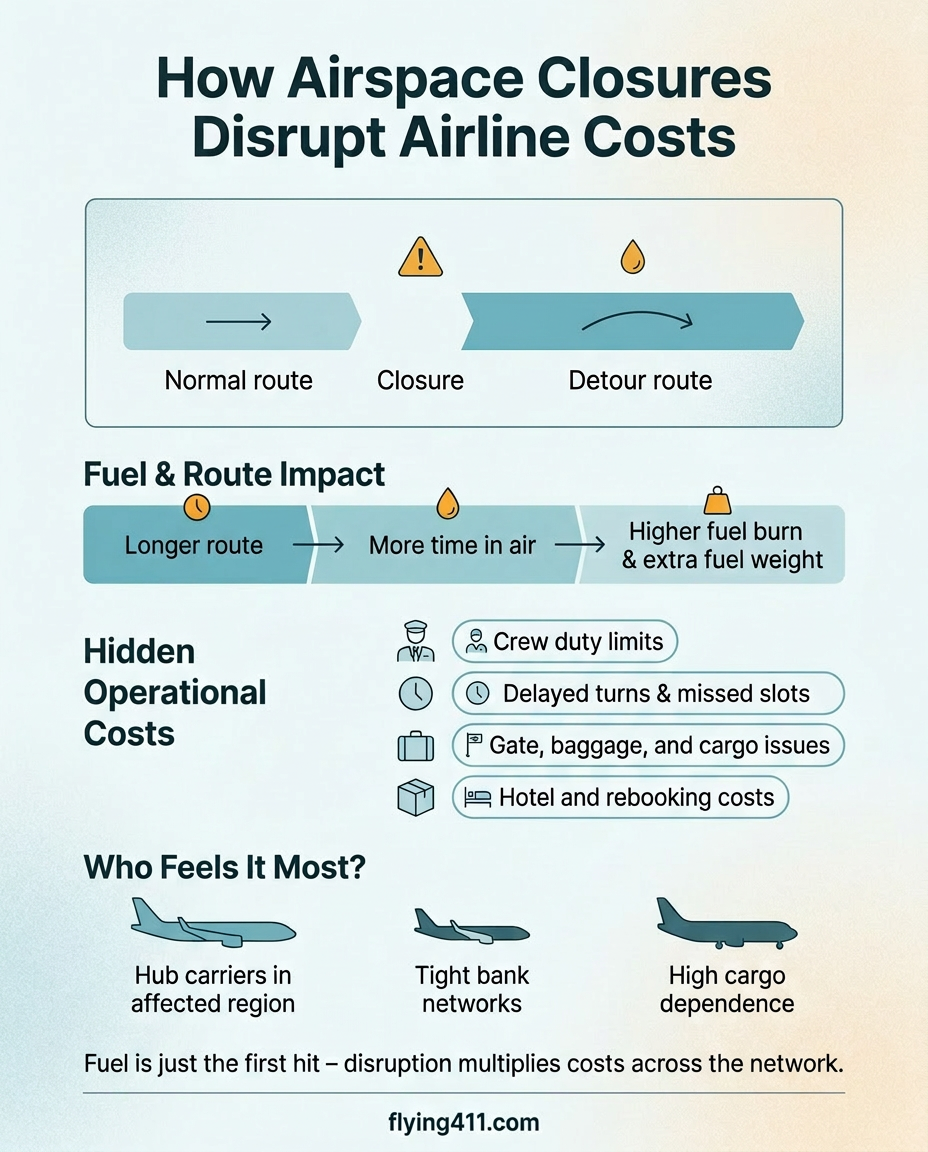
The first cost people think about is fuel, and that makes sense. When a plane must avoid a closed part of the sky, the trip often gets longer right away. A longer route means the aircraft stays in the air for more time. That usually means higher jet fuel costs for the trip.
But the problem grows fast. The plane may need to carry extra fuel before takeoff in case traffic, weather, or congestion gets worse along the new path. That extra fuel adds weight. More weight means the aircraft burns more fuel during climb and cruise. So the airline pays twice in a way: once because the path is longer, and again because the plane is heavier.
This gets even harder when fuel prices are already high. If jet fuel prices rise because oil prices or crude oil markets are under pressure, every extra mile hurts more. A closure near Iran or the Strait of Hormuz can make airlines worry about energy markets too, because those places matter in the global oil trade. During an Iran conflict, the cost pressure can hit both the map and the fuel market at the same time.
Here is how the chain usually works:
- A part of the airspace becomes unsafe or restricted
- The airline must plan a reroute
- The new path may use a crowded corridor
- The flight takes longer
- The plane burns more fuel
- The airline’s operating costs go up
And then the operation starts to wobble.
A delayed aircraft may miss its next departure slot. The next crew may time out. Passengers may miss connections. Bags may miss the same trip. Ground teams may need to move gates or swap aircraft. One change can spread across the network in a few hours.
This is a big issue for a long-haul trip. A short domestic delay is painful, but a long intercontinental detour can change the whole day for that aircraft. The plane may land too late for its next mission. A fuel stop may be needed. A backup crew may be required. Hotels and rebooking costs can appear quickly. None of that is cheap.
Some airlines may also look at fuel surcharges or fare changes later if high fuel and disruption last long enough. Passengers do not always see the planning behind the scenes, but the bill shows up somewhere.
So yes, fuel is the first hit. But even at the start, it is already tied to time, crew, gates, and schedule pressure. That is why airspace events affect airline operations so quickly.
Why the Real Cost Is Bigger Than Fuel Alone
Fuel is easy to spot because it has a number attached to it. The real cost is broader, and in many cases it can do more damage than the extra fuel burn itself.
Start with crew time. Airlines build schedules carefully so pilots and cabin crews stay within legal duty limits. If a flight runs longer because of airspace closures, the crew may no longer fit the original plan. The airline may need reserve crew, hotel rooms, meals, and transport. That cost adds up fast.
Then look at aircraft use. Airlines want every plane to keep moving. A jet sitting on the ground because one earlier sector ran late is expensive. It still needs parking space, staff, maintenance planning, and gate coordination. A late inbound can also hurt the next outbound trip, and then the next one after that.
The real cost often spreads in these ways:
- Missed passenger connections
- Rebooking on later flights
- Baggage handling problems
- Cargo delays
- Gate conflicts
- Crew repositioning
- Maintenance timing changes
This is why the word disruption matters so much. It is not one problem. There are many small problems stacking up at once.
Revenue can also take a hit. If the plane must carry extra fuel, the payload may need to drop. That can mean less cargo, fewer bags, or lower flexibility on a busy day. The flight still operates, but it may earn less money while costing more to run. That is a painful mix for any carrier.
And there is also the customer side. If repeated closures keep pushing costs up, airlines may adjust the fare on some markets. That does not happen for one bad day alone, but repeated detours can slowly change pricing, route choices, and even which cities stay in the network.
So the real lesson is simple. Fuel matters a lot, but the true cost includes time, labor, asset use, revenue loss, and customer recovery. Once those parts start moving together, the airline feels the strain across the whole operation.
Which Airlines Get Hit the Hardest?
Not every airline gets hurt the same way. The biggest losers are often the airlines that depend heavily on the region that just became risky or restricted.
For example, an airline with many Asia-Europe flights may feel major pain if a key overflight zone becomes unsafe. A U.S. airline with fewer daily flights through that area may feel less direct damage. Geography matters. Network design matters. Fleet type matters too.
Airlines often get hit hardest when they have:
- Heavy exposure to one closed region
- Many flights built around tight bank connections
- Aircraft with less extra range margin
- High cargo dependence
- Limited spare aircraft and spare crews
Competition also matters. One airline may have to go around the trouble spot while another airline can still use a shorter path because of its traffic rights, national rules, or network structure. That changes the trip cost quickly. The longer-path operator now burns more fuel, uses more crew time, and may sell a weaker schedule to passengers.
This is why some closures become a competitive story as well as a safety story. The map changes, and the business changes with it.
A major geopolitical event can also split the market in uneven ways. Some carriers may shift traffic through other hubs. Others may reduce service or leave a route entirely. A strong hub carrier in one region may gain traffic while another loses it.
The key point here is simple: closures do not create equal pain. Airlines with the wrong geography, the wrong timing, or the wrong fleet for the moment often pay the highest price.
What Airspace Closures Tell Us About Modern Airline Costs
Airspace problems tell us something important about the airline business today. Modern flying is efficient, but it is also tightly connected. That makes it strong in normal times and fragile when a major route suddenly changes.
A single closure can affect planning, fuel, crew, gates, cargo, and passenger flow within hours. That tells us airline costs are not isolated in neat little boxes. Fuel, labor, schedule reliability, and fleet use all touch each other.
It also shows that airline economics depend on safe access to key global lanes. If one important path closes, the cost does not stay inside that one zone. It spreads outward through the network. The airline must react fast, and often at high cost.
So what do airspace closures teach us?
- Safety decisions come first
- Small map changes can create large cost changes
- Fuel is only one part of the bill
- Network design can help or hurt resilience
- Airlines need flexibility to stay competitive
That is the modern cost story. Planes are faster and smarter than ever, but they still depend on access, stability, and smart operations. When those break down, the bill gets big very quickly.
Conclusion
The big lesson is simple. When skies close, airlines do not just take a harmless side path and move on. The trip gets longer, the planning gets harder, and the costs can spread across fuel, crew time, gates, delays, and missed connections. The True Cost of Rerouting shows up across the whole system, even when travelers only notice a later arrival time on the board.
That is why route changes matter so much. They protect people first, which is the right call. But they also put pressure on schedules, aircraft use, and the money behind every trip.
If you enjoy clear aviation explainers like this, keep reading with Flying411.
Frequently Asked Questions
Can airlines get insurance help for losses from airspace closures?
Sometimes, but not always. Insurance may help with some war-risk or disruption-related losses. It usually does not erase all the added fuel, crew, and schedule costs from a longer route.
Do pilots choose the new route by themselves?
No. Pilots work with the plan they are given, but airline dispatchers, safety teams, and operations control usually help build and approve the rerouted path before departure.
Can a rerouted flight need a different aircraft type?
Yes. A longer trip may need an aircraft with better range, payload, or crew setup. If the original plane no longer fits the mission well, the airline may swap equipment.
Do airspace problems affect cargo flights too?
Yes. Cargo carriers can be hit hard because added fuel may reduce payload, and time-sensitive shipments may miss planned handoffs or onward connections.
Can a route stay changed for months or years?
Yes. Some closures last a long time. When that happens, airlines may rebuild schedules, drop weak routes, or shift service to cities that work better under the new map.