Most people never think about what goes on behind the scenes before a plane takes off. They book a ticket, pack a bag, and show up at the gate. But long before that flight leaves the ground, aviation experts are scanning the world's skies for danger. Some of those skies are safe. Others? Not so much. In the seven days before Malaysia Airlines Flight MH17 was shot down in 2014, roughly 900 flights crossed that same stretch of airspace over eastern Ukraine and most passengers had no idea they were flying above an active war zone.
When a part of the world becomes too risky to fly over, a special safety warning goes out, one that can redirect or cancel hundreds of flights in a matter of hours. That warning is called a conflict zone information bulletin, and it plays a huge role in keeping passengers safe.
Understanding how these bulletins work helps explain why your flight sometimes takes a longer route, why certain destinations suddenly disappear from booking sites, and how global events on the ground can affect what happens 35,000 feet in the air. Let's start with who is responsible for issuing these warnings in Europe.
Key Takeaways
EASA issues Conflict Zone Information Bulletins (CZIBs) to warn airlines when flying through certain airspace is dangerous. These warnings are triggered by war, missile threats, or military activity. Airlines use them to reroute or cancel flights. CZIBs are not flight bans, but most airlines treat them like one. Active CZIBs currently cover regions including the Middle East, Russia, and Ukraine.
| Topic | Key Detail |
| What is a CZIB? | A safety warning for dangerous airspace |
| Who issues it? | EASA (European Union Aviation Safety Agency) |
| Is it a flight ban? | No — it's a strong recommendation |
| Who must follow it? | EU airlines and EASA-authorized carriers |
| What triggers one? | War, missiles, military activity, misidentification risk |
| Current active zones | Middle East, Russia, Ukraine, Afghanistan, Sudan |
| What happens when lifted? | Airlines cautiously resume routes |
What Is EASA and What Does It Do?
Most people have heard of the FAA — the United States agency that oversees aviation safety in America. EASA plays a similar role, but for Europe. EASA stands for the European Union Aviation Safety Agency. It is the official aviation safety authority for the European Union, and its job is to make sure that flying in and around Europe is as safe as possible.
EASA sets the rules that airlines in Europe must follow. It certifies aircraft, approves pilots, and checks that airlines are meeting safety standards. But EASA does more than just regulate planes on the ground. It also watches the skies — specifically for signs that certain parts of the world have become too dangerous for civil aviation.
Here is what EASA oversees:
- Aircraft certification — making sure planes are safe to fly
- Pilot and crew standards — setting training and qualification rules
- Airline operations — checking that carriers follow safety procedures
- Airspace risk monitoring — tracking danger zones around the world
EASA works closely with the governments of EU member states, the European Commission, and international bodies like ICAO (the International Civil Aviation Organization). When a new threat appears anywhere in the world — a war, a military build-up, or a weapons incident — EASA gets involved right away.
One of EASA's most important tools is the Integrated EU Aviation Security Risk Assessment Group, also called the IRAG. This group meets regularly to study threats and decide if a safety warning needs to go out. The IRAG includes representatives from EU governments, intelligence services, and airline associations. When they spot a high risk situation, they move quickly.
It is worth knowing that EASA's reach goes beyond just European airlines. Its rules also apply to Third Country Operators — that means airlines from outside the EU that are authorized by EASA to fly into European airports. So when EASA issues a warning, it matters to carriers from many different parts of the world.
EASA also publishes everything publicly. When a warning goes out, it goes on their website for the whole world to see — airlines, passengers, governments, and journalists alike. That kind of transparency is part of what makes the system work.
The agency has been at the center of some of the most important aviation safety decisions in recent years. From warnings over Russian airspace after the Ukraine conflict began, to urgent bulletins covering the entire Middle East during escalating tensions — EASA has proven itself to be one of the most active aviation safety voices on the planet.
What Happened to Flight MH17 — and Why It Changed Everything
To understand why EASA's conflict zone warnings exist, you have to go back to July 17, 2014. That was the day a passenger jet called Malaysia Airlines Flight MH17 was shot down over eastern Ukraine. The plane was flying from Amsterdam to Kuala Lumpur — a routine international route that hundreds of aircraft used regularly.
It never made it.
MH17 was hit by a surface-to-air missile at 33,000 feet. All 298 people on board were killed. It remains the deadliest civil aircraft shoot-down in history. The missile was fired from territory controlled by Russian-backed separatist forces during the conflict in eastern Ukraine. An investigation later confirmed that a Buk missile system brought the plane down.
Here is what made this tragedy so shocking from a safety standpoint:
- In the seven days before the crash, around 900 flights crossed the same airspace over the Donetsk region
- 37 airlines were still flying that route at the time
- Warnings existed about Crimea, but not about the exact area where MH17 went down
- Some airlines like Qantas had already stopped using that route months earlier
The disaster exposed a serious gap in global aviation safety. There was no unified system for quickly sharing information about dangerous airspace across all airlines and governments. Some carriers had the resources to do their own risk assessment and chose to avoid the area. Others did not. And that inconsistency cost lives.
After MH17, the European Union launched the EU Conflict Zone Alerting System in 2016. The goal was simple: make sure that when a part of the sky becomes dangerous, every airline gets that information fast and from a single, trusted source.
The tragedy of MH17 was not the only wake-up call. In January 2020, Ukraine International Airlines Flight PS752 was shot down shortly after takeoff from Tehran, Iran. All 176 people on board were killed. Iranian military forces mistakenly identified the civilian aircraft as a threat and fired on it. That incident added another layer of urgency to the conversation about keeping airline flights out of war zones.
Both crashes shared something in common: civil planes flew into airspace where military systems were active and on edge. In war zones, radar operators are stressed, communication can break down, and the risk of misidentifying a military system targeting a civilian plane by mistake becomes very real.
The lessons from MH17 and PS752 were hard and painful. Flying over a conflict zone, even at high altitude, is not automatically safe. And the world needed a better system to say so.
What Is a Conflict Zone Information Bulletin?
A CZIB stands for Conflict Zone Information Bulletin. Think of it as an official safety alert one that tells airlines a specific part of the sky has become too dangerous to use. EASA publishes these bulletins when the risk to aircraft flying through or over a conflict area has risen to a serious level.
A CZIB is not a law. Airlines are not legally forced to follow one. But in practice, most European carriers treat a CZIB like a direct order. Here is why: if an airline ignores a CZIB and something goes wrong, the consequences legally, financially, and in terms of public trust would be catastrophic. So the vast majority of airlines follow the guidance without hesitation.
Here is how the CZIB system works:
Step 1 — A threat is identified Intelligence services, governments, and aviation experts share information about a region where conflict or military activity is increasing.
Step 2 — IRAG meets and assesses the risk The Integrated EU Aviation Security Risk Assessment Group reviews the information. They decide how serious the threat is and what kind of action to take.
Step 3 — EASA drafts and publishes the bulletin If the risk is confirmed as serious, EASA drafts a CZIB. It is reviewed by a network of aviation focal points, then published publicly usually within two working days.
Step 4 — Airlines act on the warning Airlines update their flight plans, reroute services, or suspend operations in the affected FIR (Flight Information Region) , the defined block of airspace managed by a specific air traffic control authority.
There are two levels of EASA conflict zone warnings:
| Warning Type | Risk Level | Who Sees It |
| CZIB | High risk | Public — posted on EASA's website |
| Information Note (IN) | Medium risk | Need-to-know basis — distributed privately |
A CZIB includes details like which aviation safety risks are present, what altitudes are affected, what specific geographic area is covered, and sometimes a minimum altitude floor — for example, "do not fly below FL260" (about 26,000 feet).
A conflict zone earns a CZIB when threats like the following are present:
- Surface-to-air missiles capable of reaching cruise altitude
- Active military aircraft or air defence systems that could target civilian planes
- GPS jamming or spoofing that could cause navigation errors
- Risk of a military system misidentifying a passenger jet as a threat
CZIBs are not permanent. EASA reviews them regularly sometimes every few days during a fast-moving crisis. They can be extended, revised, downgraded, or lifted entirely as the situation on the ground changes. The bulletin issued for the Middle East in early 2026, for example, was updated multiple times within weeks as military activity shifted across the region.
How EASA Conflict Zone Bulletins Actually Ground Airlines
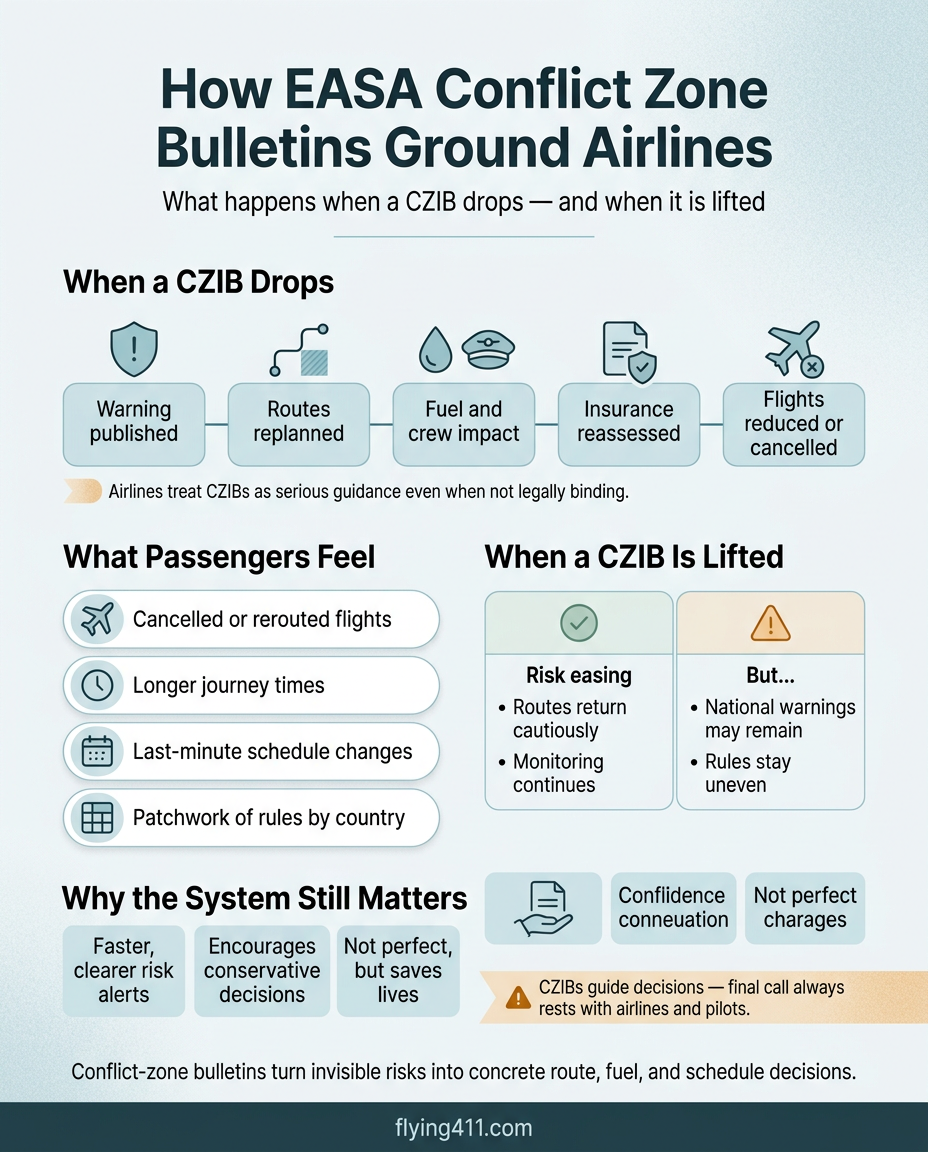
So a CZIB goes out now what? This is where things get very real for airlines, passengers, and everyone involved in keeping flights moving. A conflict zone information bulletin might not be a legal flight ban, but its effects on the industry are anything but small.
The moment EASA publishes a bulletin, airlines must factor that warning into every single flight decision connected to the affected region. That means updating route plans, briefing dispatchers, reviewing crew assignments, and in many cases, pulling flights off the schedule entirely. The process moves fast and it has to.
Here is what happens on the operations side when a CZIB drops:
- Route planning changes immediately. If a bulletin covers a specific FIR the block of airspace managed by a regional air traffic authority airlines must plan around it. That often means flying longer routes through different countries, adding hours to a trip.
- Fuel loads go up. Longer routes burn more fuel. For a widebody jet on a long-haul flight, that extra fuel cost can run into tens of thousands of dollars per trip.
- Crew scheduling gets complicated. Longer flights mean longer duty times. Airlines sometimes have to add a third or fourth pilot to a rotation, or schedule extra rest stops that were never part of the original plan.
- Insurance costs jump. War-risk insurance premiums go up fast when a conflict zone is active. Underwriters reassess coverage as soon as a new bulletin is published. Some airlines face higher premiums even if they are rerouting around the area.
One of the most striking examples happened in early 2026. Following major military strikes in Iran and the wider Middle East, EASA issued a bulletin covering 11 countries including Bahrain, Iraq, Israel, Jordan, Kuwait, Lebanon, Qatar, the UAE, and Saudi Arabia. The bulletin warned that air defence systems in the region were on heightened alert and that the risk of a military system targeting a civilian plane by misidentification was very real. The result? A 59% drop in all flights operating to, from, and within the region tracked by aviation intelligence firm IBA.
Dutch carrier KLM cancelled flights to Dubai, Riyadh, Dammam, and Tel Aviv within days. The reasoning was straightforward: flying near active missile systems and stressed military radar networks is not a risk worth taking, no matter how busy the route normally is.
The key thing to understand about aviation safety is that the system works because airlines take warnings seriously even when they are not forced to. Most carriers interpret a CZIB conservatively. The potential downside of ignoring one catastrophic incident, massive legal exposure, and destroying public trust far outweighs the short-term revenue loss from cancelling a route.
The threats that CZIBs typically warn about include:
- Surface-to-air missiles capable of reaching cruise altitude
- Active military aircraft and radar systems operating in civilian airspace
- GPS jamming or spoofing that can push navigation systems off course
- Military operators unable to accurately distinguish a passenger jet from a threat
For passengers, the visible effect is cancelled bookings, longer flight times, and rerouted itineraries. Behind the scenes, it is a full-scale logistics overhaul one that can last days, weeks, or even months. It is also worth noting: if your flight to Asia suddenly takes a longer southern route, a CZIB covering Russian or Middle Eastern airspace might be exactly why. To understand how governments formally close off airspace to all aircraft, not just issue advisories, No Fly Zone Explained: Types, Rules, and Who Enforces Them breaks down exactly how those restrictions work and who has the authority to put them in place.
What Happens When a CZIB Is Lifted?
A conflict zone information bulletin does not last forever. EASA reviews active bulletins regularly sometimes every few days during a crisis, and at least every few months during longer-term situations. When the threat level drops, the bulletin gets updated, downgraded, or removed entirely.
The process for lifting a CZIB follows the same logic as issuing one. The IRAG meets, reviews the latest intelligence and situation reports, and decides if the risk has genuinely decreased. If it has, EASA either removes the bulletin or replaces it with a lower-level Information Note, a more private, need-to-know advisory for situations that still carry some risk but not enough to warrant a public warning.
What the return to normal looks like:
- Airlines begin cautiously reintroducing routes into the previously restricted area
- Regulators monitor the situation closely for any signs of renewed escalation
- National governments may independently keep their own warnings in place even after EASA lifts a CZIB — so individual countries can still restrict their own carriers from flying a route
- Passengers start seeing flights reappear on booking platforms, sometimes with adjusted schedules
A clear example came in mid-2025, when EASA lifted its CZIB for Israel after tensions in the region cooled. Lufthansa, British Airways, ITA Airways, and Wizz Air all announced plans to resume flights to Tel Aviv. The return was welcomed — but airlines were careful. Risk monitoring continued, and carriers made clear that services could be suspended again at short notice if the situation changed.
One important thing to know: lifting a CZIB does not mean all restrictions vanish. National aviation authorities operate independently. A country might maintain its own airspace warning even after EASA steps back. That creates a patchwork of rules that airlines have to track carefully.
For operators who want to understand how civil aviation registration and compliance work on the ground — especially when routes change and new authorities are involved — Understanding FAA Registration and Deregistration Procedures: What You Need to Know is a helpful starting point for navigating the paperwork side of aviation operations.
Does the System Always Work?
Here is the honest answer: the CZIB system is one of the best tools the aviation world has — but it is not perfect.
EASA created the EU Conflict Zone Alerting System specifically to fix the gaps that allowed tragedies like MH17 to happen. And it has made the system significantly better. Airlines get faster, clearer, more consistent information than they did before 2016. The risk assessment process is more coordinated. The warnings are public. And the speed of response has improved dramatically.
But there are real limitations that the aviation world is still working through.
The key challenges:
- CZIBs are not legally binding. Following them is the right call and most airlines do but no rule forces them to. A carrier could technically ignore a CZIB and fly the route anyway. Political, financial, and diplomatic pressures sometimes influence decisions more than safety guidance alone.
- National warnings are inconsistent. Different countries issue their own advisories at different levels. One nation might issue a full flight ban while another only recommends caution for the same airspace. Airlines operating across multiple national registries have to reconcile those conflicting signals — and that creates an uneven playing field.
- High risk situations can develop faster than the system can respond. The 2020 shoot-down of Ukraine International Airlines Flight PS752 near Tehran, Iran, is a painful example. Iranian air defence fired on a civilian aircraft shortly after takeoff, killing all 176 people on board. The crew had no warning. The threat materialized in seconds — far faster than any bulletin could account for.
- Not all operators have the same resources. Larger airlines have full-time safety teams, intelligence feeds, and legal departments dedicated to tracking aviation safety risks in real time. Smaller operators may rely almost entirely on EASA's public warnings, with little capacity to run their own assessments.
- The gap between recommendation and action. Even with a CZIB in place, the final call always rests with the aircraft commander. Pilots have the authority — and the responsibility — to refuse a flight they consider unsafe. But that requires timely, accurate briefing information. If the information pipeline has delays, the crew may not have the full picture before departure.
The system has saved lives. There is little doubt about that. But MH17 and PS752 are reminders that no warning system is a guarantee. Flying over a conflict zone, even at high altitude, carries real risk and the tools designed to manage that risk are only as effective as the speed, accuracy, and authority behind them.
The aviation world continues to push for stronger, more binding international standards. Until then, the CZIB system remains a critical if imperfect layer of protection between passengers and the dangers that can lurk in otherwise ordinary airspace.
Conclusion
Aviation safety is one of the most carefully managed systems in the world and EASA Conflict Zone Bulletins are a big part of why. When war breaks out, when missiles fly, or when military tensions spike, the skies above those regions become unpredictable. CZIBs exist to make sure airlines know exactly where the danger is and what to do about it.
They are not perfect, and they are not legally binding, but they carry enormous weight. Airlines listen, reroute, and sometimes cancel flights entirely because of them.
And that saves lives. The next time you hear about flights being suspended over a troubled region, there is a good chance a CZIB is part of the story.
Want to stay sharp on everything happening in aviation? Flying411 has clear, easy-to-read articles covering aviation safety, airspace rules, airline operations, and much more written for everyday people who want to understand how flying really works.
Frequently Asked Questions
What is the difference between a CZIB and a NOTAM?
A NOTAM (Notice to Air Missions) is a short-term operational notice about a specific hazard or change in airspace, like a closed runway or a temporary restricted area. A CZIB is a broader safety advisory focused on conflict-related risks in a region over a longer period.
Can passengers find out if their flight is affected by a CZIB?
Yes. EASA publishes CZIBs publicly on its website. Passengers can also check flight tracking sites and airline updates. When a CZIB is active, airlines typically notify affected passengers directly about delays, cancellations, or route changes.
Do CZIBs cover all types of aircraft, or just commercial airliners?
CZIBs apply to civil air operators regulated under EU rules, which primarily means commercial airlines. They do not apply to state aircraft, such as military or government repatriation flights, though those operators are still expected to fly safely.
How quickly can EASA issue a CZIB when a new conflict starts?
EASA can issue an emergency CZIB within two working days through a rapid alert process — and sometimes faster during a sudden crisis. The Middle East CZIB in February 2026 was published within hours of major military strikes in the region.
What role does ICAO play alongside EASA in conflict zone safety?
ICAO sets the international framework that all countries follow for managing airspace risks. EASA operates within that framework but provides a more targeted, Europe-focused layer of guidance. The two organizations work in parallel, not in competition.