Picture boarding a flight and finding out your pilot had only six hours of broken sleep before takeoff. That thought alone is enough to make anyone grip their armrest. And it happens more than most people realize.
A peer-reviewed study published in Sleep Science and indexed by the National Institutes of Health found that 90.6% of airline pilots report experiencing fatigue, with nearly 6 in 10 dealing with daytime sleepiness.
Pilot fatigue is one of the oldest and most serious safety problems in commercial aviation and for decades, the rules meant to stop it simply were not strong enough. That changed in a big way after a deadly crash in 2009 forced the entire industry to take a hard look at how airlines were scheduling their crews.
The FAA responded with some of the most sweeping changes to pilot scheduling in over 60 years. Understanding what changed, why it changed, and what it means for everyone in the sky is exactly what this article walks you through.
Key Takeaways
The federal aviation administration updated its fatigue rules for commercial airline crews through FAR Part 117, which took effect in January 2014. These rules set a 10-hour minimum rest period before flight, limit daily duty time based on start time, and require pilots to confirm they are fit to fly before every flight. The goal is to make sure every pilot in the cockpit is rested, alert, and ready.
| Topic | Key Detail |
| Rule name | FAR Part 117 |
| Effective date | January 4, 2014 |
| Minimum rest period | 10 hours (includes 8 hrs uninterrupted sleep) |
| Old minimum rest | 8 hours |
| Max daily duty time | 9 to 14 hours (based on start time) |
| Old max duty time | Up to 16 hours |
| Weekly rest requirement | 30 consecutive hours off duty |
| Applies to | Part 121 passenger operations |
| Cargo pilots covered? | No, cargo carve-out still in effect |
| Triggering event | Colgan Air Flight 3407, February 2009 |
What Happens to a Pilot's Brain When They Don't Get Enough Sleep
Most people know what it feels like to be tired. You move slower. You forget things. Small problems feel bigger than they are. Now picture feeling that way while landing a 150,000-pound aircraft in the dark, in bad weather, with dozens of lives depending on your next decision. That is the reality of pilot fatigue and it is more dangerous than most passengers ever realize.
When a person does not get enough sleep, the brain starts to struggle with basic tasks. Reaction time slows down. The ability to focus drops. Memory gets fuzzy. These are not just uncomfortable feelings. They are measurable, proven changes in brain function. Studies have shown that after 17 to 19 hours without sleep, a person's performance can be similar to someone with a blood alcohol level of 0.05%. After 24 hours awake, it gets even worse.
For airline pilots, this is a critical problem. Their job demands sharp thinking, fast decisions, and calm responses to unexpected events, often at 35,000 feet. A small lapse in focus during a routine approach can have very serious consequences.
There is also a biological factor that makes this even trickier. The human body runs on a 24-hour internal clock called the circadian rhythm. This clock tells the body when to sleep and when to be awake. During certain hours, roughly 2 a.m. to 6 a.m., the body is biologically programmed for sleep. Scientists call this the Window of Circadian Low, or WOCL. During the WOCL, alertness and performance hit their lowest point of the day, no matter how rested a person feels.
Here is why that matters for aviation:
- Night flights are higher risk. A pilot flying at 3 a.m. is operating during their body's lowest performance window.
- Fatigue compounds over time. Missing even one hour of sleep per night over several days builds up into a serious sleep debt that cannot be fixed with a single nap.
- Start time changes everything. A pilot who starts their duty day at midnight is biologically in a very different state than one who starts at 9 a.m.
There is also a second, smaller dip in alertness that happens in the early afternoon, usually between 3 p.m. and 5 p.m. Most people recognize this as the post-lunch slump. For pilots flying long afternoon shifts, this is another window of increased risk.
Fatigue in aviation comes in three forms:
- Transient fatigue is short-term tiredness from one or two nights of bad sleep.
- Cumulative fatigue is built-up tiredness from repeated nights of not enough sleep.
- Circadian fatigue refers to reduced performance caused by flying during the body's natural sleep window.
Understanding these three types is exactly why the new rules are built the way they are. The federal aviation administration did not just raise a number on paper. They used real sleep science to build rules that match how the human body actually works.
Why the FAA Had to Step In and Rewrite the Rules
For most of aviation's history, the rules around pilot rest were pretty loose. Before 2014, commercial pilots operating domestic flights could legally be on duty for up to 16 hours a day. The minimum rest requirement was just 8 hours and that 8 hours included travel time, meals, and winding down. In reality, a pilot might get only 5 or 6 hours of actual sleep before being expected back in the cockpit.
The industry knew fatigue was a problem. The national transportation safety board had been flagging fatigue as a contributing factor in aviation accidents for years. Between the late 1980s and 2009, the NTSB linked pilot fatigue to more than two dozen accidents and over 250 fatalities. That is a serious pattern and yet the rules had not changed in more than 60 years.
Then came the night of February 12, 2009.
Colgan Air Flight 3407 departed Newark Liberty International Airport on a routine regional flight to Buffalo, New York. On board were 49 passengers and crew. The aircraft, a Bombardier Q400 turboprop, never made it. It stalled on approach and crashed into a home in Clarence Center, New York, killing everyone on board and one person on the ground.
The investigation into flight 3407 revealed something deeply troubling. Both pilots were exhausted. The captain had commuted from Florida to Newark the night before and slept in the airport crew lounge. The first officer had flown in from Seattle on a cargo plane overnight and arrived just in time for her shift. Neither pilot had slept in a proper bed or had a real opportunity to rest. They were legally cleared to fly but they were not ready.
The aviation safety investigation found that fatigue played a direct role in the crew's inability to respond correctly when the stick shaker activated, warning of an impending stall. The captain pulled back on the controls, exactly the wrong response, and the aircraft went down.
The public reaction was immediate and intense. Families of the victims became powerful advocates for reform. Congress held hearings. The FAA was put under enormous pressure to act. In 2010, Congress passed the Airline Safety and Federal Aviation Administration Extension Act, which directed the FAA to develop new, science-based pilot rest requirements within a set timeframe.
Key problems the investigation exposed:
- Pilots were allowed to commute across the country and show up to fly with almost no real rest.
- Airlines had no requirement to track whether crews had actually slept during their rest window.
- The old rules treated a midnight duty start the same as a morning start, ignoring circadian science entirely.
- Regional airline pilots, who often earned very low salaries, felt pressured to fly even when exhausted because calling in fatigued could hurt their careers.
Flight 3407 became the defining moment that ended 60 years of regulatory inaction on pilot fatigue. It was not a technical failure or a weather event that brought the aircraft down. It was a preventable human factors problem, one that better rules could have helped stop.
What FAR Part 117 Actually Changed for Commercial Pilots
Before 2014, the rules governing how long a pilot could work and how much rest they needed were built on outdated thinking. The old system had been patched together over decades, and it showed. Different rules applied to domestic flights, international flights, and unscheduled flights. None of them were based on modern sleep science. And none of them accounted for something as basic as what time of day a pilot started their shift.
The federal aviation administration knew this needed to change. After the national transportation safety board investigation into Colgan Air flight 3407 exposed just how broken the system was, the pressure to act became impossible to ignore. The result was FAR Part 117, a sweeping overhaul that replaced the old rules with one unified, science-based framework. Here is exactly what changed and why every single update matters.
The New 10-Hour Rest Minimum
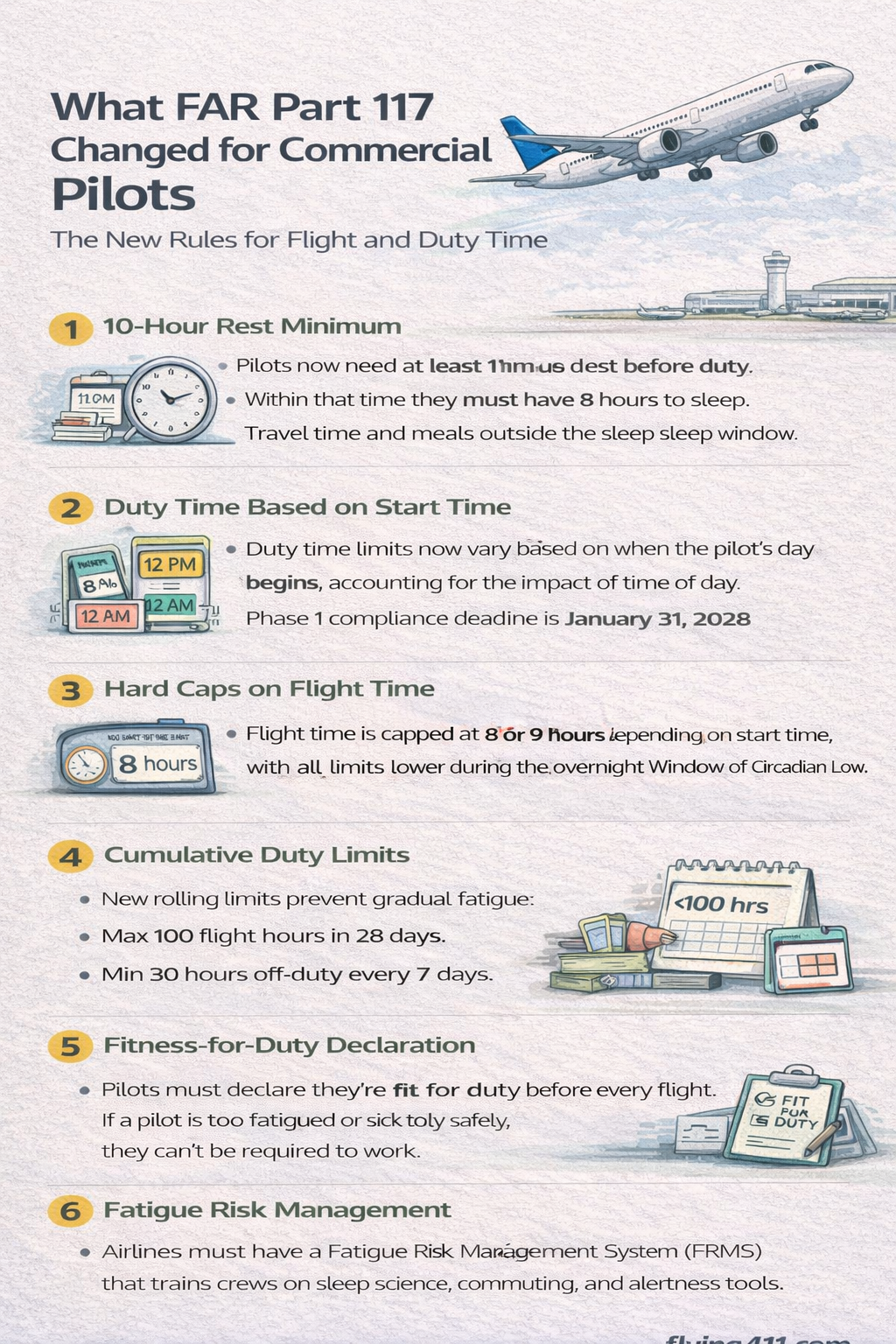
The most talked-about change was the new rest period requirement. Under the old rules, pilots needed just 8 hours of rest before a duty period. That sounds reasonable until you realize that the 8-hour clock started the moment a pilot was released from duty, meaning travel to the hotel, dinner, winding down, and getting back to the airport all counted against that rest window. In practice, many pilots were getting closer to 5 or 6 hours of actual sleep.
Under FAR Part 117, the minimum jumped to 10 hours. But the number alone is not the most important part. The rule also requires that within those 10 hours, pilots must have the opportunity for at least 8 hours of completely uninterrupted sleep. Travel time, meals, and everything else must fit around that 8-hour sleep window, not inside it.
If a pilot figures out that their rest situation will not allow for a full 8 hours of sleep, they are required to notify the airline before the flight duty period begins. This single change put real teeth into pilot rest requirements that had been soft for generations.
Duty Times Now Depend on When the Day Starts
This is one of the most scientifically significant changes in the entire rule. Under the old system, a long duty day was a long duty day regardless of what time it started. A pilot could be assigned the same maximum hours starting at 6 a.m. or starting at midnight. The biology of the situation simply did not factor in.
Part 117 fixed that. The maximum length of a flight duty period now depends on two things: the time the pilot's day begins and how many flight segments are scheduled. The logic is straightforward. A pilot starting at midnight is working right through the Window of Circadian Low, the period between 2 a.m. and 6 a.m. when the human body is at its lowest point of alertness. That pilot needs a shorter duty window to account for the biological reality they are dealing with.
Here is how the limits work in practice for a two-pilot crew:
- Starting at 6 a.m.: up to 13 hours of flight duty period allowed
- Starting at noon: up to 13 hours allowed
- Starting at 6 p.m.: up to 11.5 hours allowed
- Starting at midnight: only 9 hours allowed
More flight segments also shorten the allowed duty period. A pilot flying four legs in a day gets a shorter window than one flying two legs. Each takeoff and landing adds workload, and the rule accounts for that. This kind of detail is exactly what was missing from the old fatigue rules.
Hard Caps on Actual Flight Time
Duty time and flight time are two different things, and Part 117 puts limits on both. Flight time refers specifically to the hours the aircraft is actually moving under its own power.
For commercial pilots flying with a two-person crew, the limits are:
- 8 hours of flight time if the duty period starts between midnight and 5 a.m.
- 9 hours if the duty period starts between 5 a.m. and 8 p.m.
For larger crews, the limits increase because augmented crews allow in-flight rest:
- 3-pilot crews can fly up to 13 hours
- 4-pilot crews can fly up to 17 hours
These caps exist because flight time is the most demanding part of a pilot's day. The FAA recognized that the number of hours in the cockpit needed its own limit separate from the broader duty period.
Cumulative Limits to Fight Long-Term Fatigue
One of the sneakier forms of pilot fatigue is cumulative fatigue. This is the kind that builds up slowly over days and weeks of slightly short sleep. A pilot might feel okay on Monday and Tuesday, but by Thursday their reaction time is slower, their focus is softer, and their decision-making is not as sharp. The old rules did almost nothing to prevent this.
Part 117 addresses it directly with rolling limits:
- No more than 100 hours of flight time in any 28-day period
- No more than 1,000 hours of flight time in any calendar year
- A minimum of 30 consecutive hours free from all duty every week, which is a 25% increase over the old standard
These hours of rest and time-off requirements make it structurally difficult for airlines to quietly grind their crews into the ground over a long trip sequence or a heavy month of flying.
The Fitness-for-Duty Declaration
Before every single flight, airline pilots must now formally state that they are fit to fly. This is not just a checkbox. It is a regulatory requirement with real consequences. Under Part 117, no airline may assign a pilot to a flight duty period if that pilot has reported being too fatigued to fly safely. And a pilot cannot accept the assignment either.
This shared responsibility model was a direct response to one of the most troubling findings from the aviation safety investigation into flight 3407. Both pilots were exhausted, both were legally cleared to fly, and neither felt empowered to say stop. Part 117 changed that dynamic by making fitness for duty a two-way obligation.
Understanding the full scope of these protections starts with knowing what certifications and responsibilities come with commercial flying. Pilot License Types and Requirements: Full Breakdown Guide gives you a clear look at the credentials behind every cockpit seat.
The Fatigue Risk Management System
Every airline operating under Part 117 must also maintain a Fatigue Risk Management System, known as an FRMS. This is a data-driven, ongoing program that requires carriers to monitor fatigue risks across their entire operation, not just on paper but in practice.
The FRMS requirement includes mandatory pilot training every two years. That training must cover:
- The science of sleep and how fatigue develops
- How commuting affects rest quality before a duty period
- Practical fatigue countermeasures pilots can use
- How lifestyle factors like nutrition and exercise affect alertness
The goal is to make fatigue management a continuous process, not a one-time compliance check. This was a significant cultural shift for an industry that had historically treated rest as the pilot's personal problem.
For pilots thinking about where these rules apply in the real world, knowing 11 Best Plane to Fly as a Commercial Pilot gives useful context on the aircraft types these crews are managing under these new scheduling standards.
Conclusion
Pilot fatigue is not a new problem but the rules to fight it are finally catching up to the science. FAA pilot fatigue rule updates under FAR Part 117 changed the game for commercial aviation by making rest a legal priority, not just a personal one. Pilots now have guaranteed sleep time, scientifically calibrated duty limits, and a formal obligation to say when they are not fit to fly. Airlines have required systems in place to track and manage fatigue risks. Passengers benefit from knowing that the person at the controls has had real, protected rest.
There is still work to be done, especially on the cargo side of the industry. But the progress made since 2009 is significant and measurable. The skies are safer because of it.
For more articles on aviation safety, regulations, and everything pilots and aviation enthusiasts need to know, visit Flying411, your go-to resource for trusted, in-depth aviation content.
Frequently Asked Questions
Does FAR Part 117 apply to private pilots?
No. FAR Part 117 applies only to flight crew members conducting passenger operations under Part 121, which covers most commercial airlines. Private pilots flying under Part 91 are not subject to these rest requirements, though the FAA strongly encourages all pilots to follow safe fatigue practices.
Can an airline schedule a pilot right up to the legal duty limit every day?
Technically yes, but Part 117's cumulative limits prevent airlines from consistently maxing out pilot schedules. The 28-day flight time cap of 100 hours and the weekly 30-hour rest requirement act as guardrails that make it difficult to push pilots to their legal edge day after day.
What counts as a "rest period" under FAR Part 117?
A rest period is the time between the end of one flight duty period and the start of the next. It must be at least 10 hours long and must give the pilot the opportunity for 8 hours of uninterrupted sleep. Travel, meals, and other activities must fit around that protected sleep window, not reduce it.
Can a pilot be fired for calling in fatigued?
Under FAR Part 117, pilots are legally protected when they report being too fatigued to fly safely. Airlines cannot legally assign a pilot who has declared fatigue. While workplace culture can vary, the regulation makes it clear that both the airline and the pilot share responsibility for ensuring fitness for duty.
How do time zone changes affect pilot duty limits under Part 117?
Part 117 accounts for time zone crossings. For operations crossing multiple time zones, duty limits are calculated based on the local time at the location where the crew was last acclimated, not the destination time zone. This helps prevent situations where a pilot is operating deep in their WOCL without the rules reflecting that biological reality.