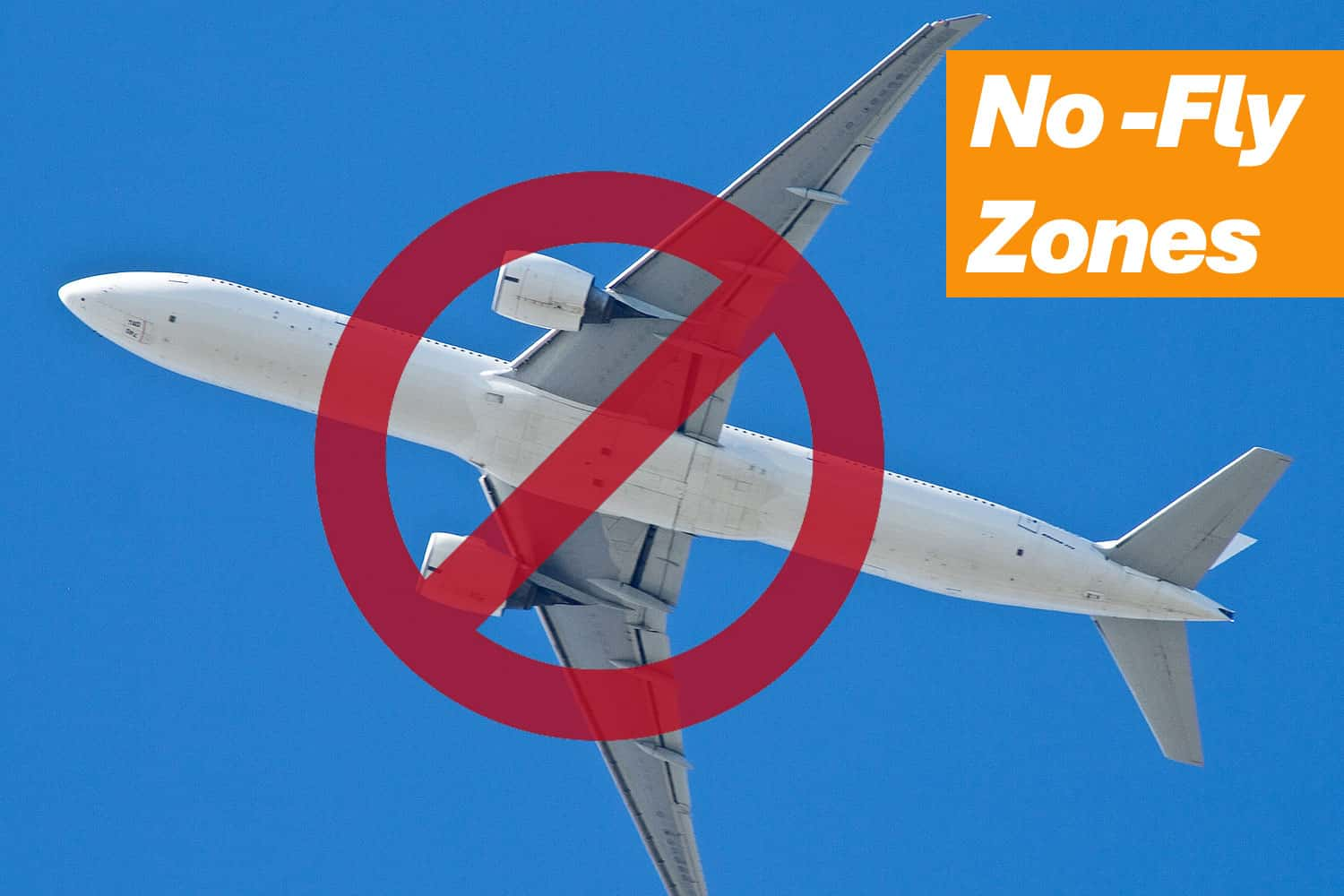
There are places in the sky where no aircraft is allowed to go — not a commercial jet, not a small Cessna, and definitely not a hobby drone. These restricted areas exist all over the United States and around the world, and if you cross into one without permission, the consequences can be very serious.
When Russia launched its invasion of Ukraine in 2022, multiple countries immediately closed their airspace to Russian aircraft — showing just how fast a no fly zone can reshape global aviation. But these zones are not just a wartime concept. They exist quietly every single day, over places like the White House, nuclear power plants, major sports stadiums, and busy airports.
Understanding what a no fly zone is, why it gets declared, and who enforces it is something every pilot — and every drone operator — needs to know. It is also just fascinating stuff for anyone curious about how the sky actually works.
Key Takeaways
A no fly zone is a section of airspace where flight is restricted or completely off-limits. These zones are created to protect people, places, and national security. They can be temporary or permanent, and they apply to everyone — from massive commercial airliners to small hobby drones. The FAA (Federal Aviation Administration) manages most of these restrictions inside the United States, but the military, Department of Homeland Security, and international organizations like the United Nations all play a role too. Violating a no fly zone is not a minor infraction — penalties range from heavy fines and license suspension to military aircraft interception and criminal charges.
| Key Takeaway | Details |
| What it is | A restricted area of airspace where flying is limited or banned |
| Who creates them | The FAA, military, president, or international organizations |
| Types | Prohibited, restricted, temporary, military, national security |
| Who enforces them | FAA, military, DHS, air traffic control |
| Applies to | All aircraft — commercial planes, private planes, drones |
| Penalties | Fines, license suspension, aircraft interception, criminal charges |
Flying411 is your go-to source for clear, practical aviation knowledge — from airspace rules to aircraft ownership tips. Browse the site before your next flight and fly smarter.
What Is a No Fly Zone and Where Did the Idea Come From?
A no fly zone is an area of airspace where aircraft are not allowed to fly — or where flying requires special permission. It is a boundary drawn in the sky, not on the ground. You cannot see it, but it is very real, and violating one can get you into serious trouble fast.
The concept goes back further than most people realize. The United States started putting formal restrictions on airspace in the 1920s, when aviation was still a young industry. As planes became more common and more powerful, the government needed a way to protect sensitive areas — military bases, government buildings, crowded stadiums, and more. Over time, those rules became more detailed, more layered, and far more enforceable.
The modern airspace management system used today is largely overseen by the FAA, which was established in 1958. The FAA created a structured set of rules for who can fly, where they can fly, and at what altitude. These rules apply to every aircraft that takes off in U.S. airspace — from a wide-body commercial jet to a small remote-controlled drone buzzing around a neighborhood park.
Fun Fact: The term "no fly zone" became widely known during international conflicts in the 1990s, when the United Nations used them to prohibit military flights over countries like Iraq and Bosnia. But in the U.S., airspace restrictions have existed in one form or another for over a century.
How a No Fly Zone Differs from Regular Airspace
Regular airspace has rules, but most licensed pilots can fly through it freely with the proper clearances. A no fly zone adds a hard restriction on top of that. Here is what makes them different:
- Regular airspace — Open to licensed pilots following standard procedures
- Restricted airspace — Entry limited; special permission may or may not be available
- Prohibited airspace — No exceptions, no entry period
- Temporary restrictions — Short-term closures tied to specific events or situations
- Violations — Not treated like a traffic ticket; criminal charges and military intercepts are real possibilities
For new pilots learning to understand airspace, or anyone thinking about how private planes work at airports, airspace awareness is one of the most important foundations to build first.
What Are the Different Types of No Fly Zones?
Not all restricted areas are the same. The FAA and other agencies use several different categories to describe where flying is limited, how limited it is, and for how long. Knowing the difference matters a great deal — especially if you are planning a flight near any sensitive area.
Prohibited Areas
These are the strictest zones in the system. Flying here is completely banned — no exceptions for regular pilots, no waivers for drone operators. Prohibited areas include the airspace directly over the White House and the U.S. Capitol. On aviation charts, they are marked with a "P" followed by a number — like P-56, which covers central Washington, D.C.
Heads Up: Prohibited areas are not negotiable. There is no clearance to request, no workaround available. If you are flying near Washington, D.C., you need to understand the Special Flight Rules Area (SFRA) and the Flight Restricted Zone (FRZ) that surround the capital — and follow every step of the required process before getting anywhere near that airspace.
Restricted Areas
These zones limit regular flight activity, but they can sometimes be entered with permission from the controlling authority. They often exist near military bases or areas where weapons testing takes place. The key word is "restricted" — not always impossible to enter, but definitely not open to anyone without authorization.
Temporary Flight Restrictions (TFRs)
TFRs pop up for specific events or situations and go away once the reason for them is resolved. A TFR might appear around a major sporting event, a presidential visit, a wildfire, a chemical spill, or a disaster zone. They are one of the most common types of airspace restriction that everyday pilots encounter, and they can appear with very little warning.
Military Operations Areas (MOAs)
These zones are set aside for military training exercises — things like low-altitude maneuvers, formation flying, and aerial combat practice. Civilian pilots are technically allowed in MOAs, but flying through one while military activity is happening can be risky. Always check with air traffic control before entering a MOA.
National Security Areas (NSAs)
NSAs are established around sensitive facilities like nuclear power plants, dams, water treatment facilities, and certain government installations. Flying is not strictly banned in most NSAs, but pilots are strongly encouraged to avoid them — and authorities watch closely for any aircraft that lingers.
Special Flight Rules Areas (SFRAs)
Some airspace has its own unique set of rules that do not fit neatly into the other categories. The Washington, D.C. area is the best-known example. Its SFRA requires pilots to follow a very specific set of procedures — including background checks and transponder requirements — just to fly in the vicinity of the capital.
Good to Know: There are also airspace designations like Class B, C, D, and E that carry their own requirements. No fly zones and restricted areas exist within this broader airspace classification system, not separate from it.
| Zone Type | Can You Enter? | Permission Required? | Typical Location |
| Prohibited Area | No | No | White House, Capitol |
| Restricted Area | Sometimes | Yes, from controlling authority | Military test ranges |
| TFR | No (while active) | No | Sporting events, disaster zones |
| MOA | Yes (with caution) | Recommended ATC contact | Military training ranges |
| NSA | Discouraged | Not technically, but monitored | Power plants, dams |
| SFRA | Yes, with compliance | Yes — security process required | Washington, D.C. |
Why Does a No Fly Zone Get Declared in the First Place?
There is always a specific reason behind a restricted airspace designation. These zones do not appear randomly. Every single one exists because a government agency, a military branch, or an international body decided that keeping aircraft out of a specific area was important enough to make it official.
National Security
This is the biggest driver. Sensitive government buildings, military installations, nuclear facilities, and intelligence sites all need protection from aircraft that could be used as weapons or for surveillance. After the September 11 attacks, the United States dramatically expanded the number of restricted areas around critical infrastructure. The FAA worked closely with national defense agencies to build a much tighter airspace control system — and that tighter system has remained in place ever since.
Why It Matters: Before September 11, 2001, there were relatively few prohibited areas in U.S. airspace. Today, the number of designated sensitive areas has grown significantly, and the systems for monitoring and enforcing those boundaries are far more sophisticated.
Military Operations
When the military is conducting live-fire training, testing new aircraft, or carrying out active operations, other aircraft need to stay clear. This applies both domestically — over training ranges in the American Southwest and elsewhere — and internationally during active conflicts. No fly zones declared over Iraq in the 1990s and Libya in 2011 are well-known examples of military-driven international airspace restrictions.
Disaster Response
When a wildfire breaks out, a hurricane makes landfall, or a major industrial accident happens, emergency crews need clear airspace to do their jobs. Rescue helicopters and aerial firefighting planes cannot operate safely if private aircraft and drones are crowding the area. A TFR solves that problem quickly and gives emergency responders the room they need.
VIP Protection
Whenever the president of the United States travels, a TFR appears around their location. The same goes for other high-profile government officials in certain situations. These are some of the most strictly enforced temporary restrictions in the country — and they can pop up with very little public notice.
Major Public Events
The Super Bowl, major political conventions, large outdoor festivals — these events draw TFRs because of the security risk that comes with large crowds in a concentrated area. An aircraft flying low over a packed stadium is a legitimate threat, and authorities take that seriously.
Pro Tip: Before any flight — especially near urban areas, military installations, or large events — always check for active TFRs using the FAA's official tools or apps like B4UFLY. A two-minute check before takeoff can save you from a very serious situation.
Environmental and Wildlife Protection
Some restricted areas exist to protect wildlife refuges or ecologically sensitive natural environments. These are less common than security-driven zones, but they do exist — and they carry real penalties for violations, just like any other restricted area.
Who Has the Power to Enforce a No Fly Zone?
Declaring a no fly zone is one thing. Making sure people actually follow it is another. In the United States, several agencies share enforcement responsibility, and internationally, the picture gets even more complex.
The Federal Aviation Administration
The FAA sits at the top of the enforcement chain for civilian airspace in the U.S. The agency sets the rules, monitors airspace, and investigates violations. When a pilot strays into restricted airspace, the FAA is typically the first to open a case. Penalties range from a warning letter to full certificate suspension, depending on the severity and intent of the violation.
The FAA uses radar systems, air traffic control (ATC) reports, and flight data to track aircraft movements in real time. ATC towers across the country watch the skies continuously and can issue immediate warnings to aircraft that are drifting into restricted areas. If a pilot does not respond, the situation escalates quickly — and the escalation chain is fast and well-practiced.
The Military
When a violation involves national defense airspace or a military-controlled zone, the Department of Defense takes over. Military aircraft — including fighter jets — are authorized to intercept aircraft that enter restricted airspace without clearance. This is not theoretical. It happens. U.S. Air Force pilots have intercepted small private planes that accidentally wandered into restricted zones over Washington, D.C.
An intercepting fighter jet will fly alongside the offending aircraft and signal it to land immediately or change course. Near an air force base, the rules are tight and the response is fast. Anyone who crosses that boundary without authorization can expect to be forced to land and face federal investigators on the ground.
Understanding how planes take off and land is just one piece of the puzzle — knowing where you are allowed to fly is equally critical, especially near military airspace.
Keep in Mind: Military intercepts of civilian aircraft are rare but real. The Air Force's Air Defense Command maintains around-the-clock readiness to respond to airspace violations that could pose a national security threat. Do not count on getting a friendly warning before a jet appears off your wingtip.
The Department of Homeland Security
The DHS plays a significant role in national security airspace, especially when a threat crosses the line from an aviation violation into a potential terrorism concern. DHS coordinates with the FAA, the military, and local law enforcement to monitor no fly zones around sensitive government locations. In the Washington, D.C. area, there is a layered security system that involves multiple federal agencies working together in real time. Any unauthorized aircraft approaching the Flight Restricted Zone triggers a coordinated response across all of those agencies simultaneously.
Air Traffic Control
ATC is the real-time voice of airspace management. Controllers monitor every airline flight, every private plane, and every known unmanned aircraft in their coverage area. When a new NOTAM (Notice to Air Missions) goes up announcing a TFR or other restriction, controllers are immediately updated and begin enforcing those boundaries in real time.
A pilot who receives a warning from ATC and does not comply is flagged immediately. That flag goes to the FAA, and depending on the severity, it can go to the military or DHS within minutes.
Drone Enforcement and Unmanned Aircraft
The rise of drone technology has added a whole new layer of complexity to no fly zone enforcement. Drone pilots are required by law to check for airspace restrictions before every single flight. Apps like B4UFLY make this easy — they show real-time airspace restrictions based on your location.
Unmanned aircraft systems (UAS) that violate no fly zones can be tracked using specialized radar and radio frequency (RF) detection technology. If a drone operator is identified, the penalties can be steep. The FAA can issue fines of up to tens of thousands of dollars per violation for civil cases, and criminal violations can result in even more serious consequences. Federal agencies including the FAA, DHS, and even the FBI have jurisdiction over UAS violations depending on the nature and intent of the breach.
Quick Tip: Drone pilots who need to fly in controlled airspace must apply for authorization through the LAANC system (Low Altitude Authorization and Notification Capability) or through the FAA's DroneZone portal. Without that authorization, flying a drone in restricted areas is a federal violation — and ignorance of airspace restrictions is not a legal defense.
International Enforcement
Outside the U.S., no fly zone enforcement gets considerably more complicated. International no fly zones are typically authorized through the United Nations Security Council and enforced by coalitions of countries. NATO has been involved in multiple no fly zone operations throughout history, including over Bosnia in the 1990s and Libya in 2011.
During the Libyan conflict, NATO enforced a no fly zone that prohibited the Libyan government from using its air force against civilians. Military aircraft from member nations patrolled the skies, and any aircraft that violated the zone faced the very real possibility of being forced down — or worse. This was not just about waving planes away. It was a full military operation designed to control the region's airspace entirely.
The situation over Ukraine following Russia's 2022 invasion raised serious questions about how exclusion zones are managed when a major military power is involved — and how difficult enforcement becomes when one side has both the motivation and the capability to challenge the boundaries directly.
What Happens When Someone Violates a No Fly Zone?
The response to a violation depends heavily on context — who did it, where, with what aircraft, and whether it appears to have been intentional.
Private Pilot Accidental Entry
For a small private plane that accidentally clips a TFR boundary, the outcome is usually an FAA investigation, possible fines, and a certificate review. Accidental entries are treated differently from intentional ones, but "I didn't know" is not a guaranteed pass. Pilots are expected to check for restrictions before every flight.
Fun Fact: Washington, D.C.'s airspace is among the most tightly controlled in the world. The Special Flight Rules Area covers a large radius around the capital, and inside that is an even tighter ring called the Flight Restricted Zone. Getting it right there requires advance planning, background checks, and strict adherence to specific routing and communication procedures.
Commercial Airline Entry
If a commercial airline enters restricted airspace without clearance, ATC will immediately contact the flight crew and direct them out of the area. The FAA will open an investigation. Depending on the circumstances, both the airline and the crew could face significant fines and regulatory scrutiny — though accidental entries tend to be handled differently than willful ones.
Drone Violations
For a drone operator who flies into restricted airspace near a major airport or government building, federal charges are possible — especially if the flight appears intentional or reckless. The FAA has made clear it has zero tolerance for drone flights near commercial airport operations, and enforcement actions are taken publicly and seriously.
Military Intervention Scenarios
For military aircraft from a foreign nation entering national defense airspace, the response can involve armed intercept, emergency diplomatic communications, and in extreme cases, the use of force. The rules of engagement in those situations are set at the highest levels of government. What has happened historically — from the Iraqi no fly zones of the 1990s to more recent airspace disputes — shows that the line between airspace enforcement and active conflict can be very thin.
Understanding just what happens if you keep flying straight without checking charts or restrictions illustrates why airspace awareness is so important for every aviator.
A Closer Look: The Washington, D.C. Airspace System
Washington, D.C. deserves special attention because it is one of the most complex and tightly enforced airspace environments in the world. The capital's airspace is not just a single no fly zone — it is a layered system of overlapping designations.
- The Air Defense Identification Zone (ADIZ) — A large outer ring requiring pilots to have a flight plan, two-way radio, and operating transponder
- The Special Flight Rules Area (SFRA) — A tighter ring with specific routing requirements and pilot registration requirements
- The Flight Restricted Zone (FRZ) — The innermost ring directly over the capital, where flight is extremely limited and security procedures are most stringent
Pilots who want to fly anywhere near D.C. must go through a security process that includes a TSA background check. Even with that clearance, they must follow strict routing, communication, and transponder requirements at all times.
Pro Tip: If you are planning to fly near Washington, D.C., visit the FAA's official SFRA page well in advance of your flight. The procedures are specific, the training is required, and getting it wrong in that airspace has serious consequences.
No Fly Zones and the Future of Aviation
As aviation continues to evolve — with electric aircraft, autonomous drones, urban air mobility vehicles, and potentially supersonic passenger jets — the way no fly zones are managed will likely evolve too. The FAA has already been expanding its drone integration frameworks, and the integration of supersonic flight coming back into civilian aviation will raise new questions about airspace management at high altitudes.
The basic principle, though, is unlikely to change: some places in the sky are off-limits, and the rules around them exist for good reasons. Staying current with those rules is part of what it means to be a responsible aviator — whether you are flying a commercial jet, a small personal aircraft, or a drone.
Good to Know: The FAA publishes all active TFRs on its official website and through apps like ForeFlight and B4UFLY. These tools update in real time and are available to anyone — pilot or not. Checking them before any flight is one of the simplest habits you can build.
Aircraft ownership also comes with the responsibility of knowing airspace rules deeply. Understanding how airplanes hold their value is one part of smart ownership — understanding where you can legally fly that aircraft is another.
Conclusion
No fly zones exist for good reasons — safety, security, and order in a sky that millions of people share every single day. From permanent prohibited zones over government buildings to temporary restrictions around disaster areas, these designations are a core part of how aviation works in the modern world.
Every pilot, every drone operator, and every aviation enthusiast benefits from understanding where these zones exist, what they mean, and why the rules behind them matter. The sky is remarkably open — but it has real boundaries, and knowing them makes you a smarter, safer, and more confident flyer.
For more clear, helpful aviation guides and honest answers to your flying questions, visit Flying411 and explore everything the site has to offer.
Frequently Asked Questions
What exactly is a no fly zone and who creates one?
A no fly zone is a designated section of airspace where aircraft are either completely prohibited from flying or must obtain special permission before entering. In the United States, the FAA has primary authority to create these zones for civilian airspace. The military can designate restricted airspace around its installations, and the president has the authority to create emergency airspace restrictions. Internationally, the United Nations Security Council can authorize no fly zones over foreign territories during conflicts or humanitarian crises.
Can a no fly zone be declared over private property?
Yes. A no fly zone can be established over privately owned land if there is a legitimate security, safety, or national interest reason. The FAA has the authority to restrict airspace above private property — particularly near critical infrastructure like power plants or government facilities. Under U.S. aviation law, property owners do not automatically have control over the airspace above their land.
What happens if a commercial airline accidentally enters a no fly zone?
If a commercial airline enters restricted airspace without clearance, air traffic control will immediately contact the flight crew and direct them to exit the area. The FAA will typically open an investigation afterward. Depending on the circumstances, the airline and crew could face significant fines and regulatory action, though accidental entries are usually handled differently than intentional ones.
Are there no fly zones specifically for drones that do not apply to manned aircraft?
Yes. Some airspace restrictions apply specifically to unmanned aircraft systems and not to manned planes. For example, certain low-altitude drone restrictions exist around stadiums, correctional facilities, and critical infrastructure where manned aircraft may still be permitted to fly at higher altitudes. Drone pilots should always use tools like B4UFLY or the FAA's DroneZone portal to check rules specific to unmanned flight before taking off.
How long does a temporary flight restriction usually last?
The duration of a TFR varies widely depending on why it was issued. TFRs tied to presidential travel might last only a few hours. Those connected to wildfires or major disasters can last days or even weeks. TFRs for sporting events are usually active for a few hours before, during, and after the event. The FAA publishes the exact start and end times for every active TFR on its official website and through aviation apps.
Can a foreign country's no fly zone legally affect U.S. aircraft?
Yes. If a U.S. aircraft is operating in foreign airspace, it is subject to that country's aviation laws and any active no fly zones in place there. The FAA and the U.S. State Department issue advisories when foreign airspace is considered unsafe or restricted. U.S. airlines are required to comply with these advisories, and flying into a foreign no fly zone without authorization can have serious legal and diplomatic consequences.
What is the LAANC system and why does it matter for drone pilots?
LAANC stands for Low Altitude Authorization and Notification Capability. It is a system the FAA created to allow drone pilots to quickly request and receive authorization to fly in controlled airspace. Instead of waiting days for a manual approval, LAANC can grant authorization in near real-time through compatible apps. If you want to fly a drone in airspace that requires clearance — near an airport, for example — LAANC is the primary tool you are expected to use.
What happens if a plane loses power near a no fly zone?
A sudden loss of engine power changes the priorities immediately — the pilot's first job is always to fly the aircraft and find a safe place to land. ATC and the FAA understand that emergencies override normal airspace rules, and pilots declaring an emergency have the right to deviate from any clearance or restriction to handle it safely. Understanding what happens if a plane loses power is something every pilot should think through well before an emergency occurs.
How do international no fly zones get enforced in practice?
Enforcement of international no fly zones is typically carried out by military coalitions authorized under a United Nations Security Council resolution. Member nations contribute aircraft to patrol the restricted area, and any aircraft violating the zone faces interception — and potentially the use of force. Historical examples like the no fly zones over Iraq in the 1990s and Libya in 2011 showed that sustained enforcement requires significant military resources, clear rules of engagement, and ongoing political coordination among participating countries.