Most pilots will never hear "ESCAT is in effect" over the radio. But on September 11, 2001, that changed. In under 90 minutes, more than 4,200 aircraft were ordered out of U.S. skies, and every single one complied.
The U.S. government has a plan to shut down all airspace when national security is at risk. That plan is called ESCAT, short for emergency security control of air traffic, and knowing how it works could matter more than you think.
Key Takeaways
ESCAT is a U.S. emergency preparedness plan. It gives the government the power to control, or fully shut down, civil and military air traffic during a national security crisis. The Department of Defense, the FAA, and the Department of Homeland Security all manage it together. When active, an eight-level priority list decides which aircraft can keep flying. Most general aviation pilots are at the bottom of that list and may be grounded until the emergency ends.
| Key Detail | Summary |
| What it stands for | Emergency Security Control of Air Traffic |
| Who manages it | DoD (NORAD), FAA, DHS/TSA |
| Governing document | Advisory Circular 99-1E / 32 CFR Part 245 |
| When it can activate | Air defense emergency, defense emergency, or national emergency |
| Who can declare it | NORAD Commander, USPACOM Commander |
| Priority system | 8-tier EATPL (most GA = Priority 8) |
| Only real-world use | September 11, 2001 (modified activation) |
| Tested how often | At least once per year |
What SCATANA Was and Why the U.S. Replaced It With the ESCAT Plan
Before ESCAT existed, the U.S. used a plan called SCATANA. That stands for Security Control of Air Traffic and Air Navigation Aids. It was a Cold War plan. Back then, the biggest threat to U.S. airspace was a nuclear strike. The plan was simple: clear the skies fast, shut down radio navigation aids, and hand control to the military.
SCATANA sat on the shelf for decades. It was tested in drills but never used in a real emergency, until September 11, 2001.
That morning, hijacked planes hit the World Trade Center and the Pentagon. FAA National Operations Manager Ben Sliney gave the order to ground every aircraft in U.S. airspace. It was his very first day on the job. About 4,200 flights were in the air. Within 90 minutes, every one of them was on the ground.
Even then, SCATANA was only partly used. The military kept all radio navigation aids running. Turning them off would have made it much harder for planes to land safely. The Defense Department also left air traffic control with the FAA. That decision helped get planes down without chaos.
That day showed that SCATANA was not built for modern threats. A terrorist attack is very different from a nuclear strike. The U.S. needed a more flexible plan. One that could start in stages, keep navigation aids on, and let some flights continue instead of grounding everything at once.
That is what the updated ESCAT plan was built to do. It replaced SCATANA and is now written into 32 CFR Part 245. It is also explained for civil pilots in FAA Advisory Circular 99-1E. Under it, the joint action to be taken by the Department of Defense, the Department of Transportation, and the Department of Homeland Security is clearly defined. The Federal Aviation Administration handles the civil side of that coordination.
The change was not just a name swap. It brought a more modern approach to aviation security and emergency preparedness. Instead of a simple on/off switch for the whole airspace, the implementation of ESCAT can be scaled up or down based on the emergency condition at hand.
What Kind of Air Defense Emergency Can Trigger ESCAT Implementation
ESCAT is not for bad weather or a small security issue. It is for situations where the safety of the entire nation may be at risk. Various emergency scenarios can trigger it, from a direct attack on the continent to a serious threat that has not yet reached full crisis level. In each case, the goal is the same: identify and control air traffic within the affected area as fast as possible. The ESCAT plan lists three conditions that can trigger ESCAT implementation.
The conditions are:
- An air defense emergency declared by the appropriate military authority. NORAD and USPACOM commanders can act right away. This is the most serious level, a full-scale threat to U.S. airspace.
- An adjacent military command is under attack, but a formal air defense emergency has not yet been declared. NORAD and USPACOM commanders can still activate ESCAT in their own areas if needed.
- Emergency conditions that threaten national security or vital U.S. interests, but do not yet meet the bar for a Defense Emergency or Air Defense Emergency. This covers serious situations that still need some airspace control.
So who makes the call? The authority to declare an air defense emergency and get ESCAT implementation started rests with NORAD, the North American Aerospace Defense Command. NORAD is based in Colorado Springs, Colorado. It has three regional commands: the Alaska NORAD Region, the Canadian NORAD Region, and the CONUS NORAD Region. Each regional commander has authority in their own area.
Before a formal declaration, the military must talk with the FAA Administrator and the TSA Administrator. The goal is to get approval from the Secretary of Defense first, unless the situation moves too fast.
ESCAT is implemented in phases. Phase One is a prep stage. It can start early so pilots and controllers are ready. Phase Two is full activation, with all restrictions in place. This step-by-step approach gives authorities more control and makes transitions smoother.
ESCAT also does not have to cover the whole country. It can apply to one state, a set region, or a specified air defense area. All restrictions stay within a specified air defense boundary, leaving the rest of the country unaffected. That makes it far more practical than the old SCATANA plan.
How ESCAT Reaches Pilots and What to Do With Your Flight Plan
The most useful question any pilot can ask about ESCAT is: how will I know it has been activated?
The main official channel is the FDC NOTAM. That stands for Flight Data Center Notice to Airmen. The FAA issues it. When an air defense emergency is declared and ESCAT is implemented, an FDC NOTAM goes out right away. These NOTAMs carry the highest urgency. They go to every air traffic control facility in the system. If you are on the ground, this is likely how you will first hear that ESCAT is active.
Behind the scenes, the FAA runs the Domestic Event Network, or DEN. It is a 24/7 phone conference that links every Air Route Traffic Control Center in the U.S. with key government agencies. The DEN gets critical aeronautical information and air navigation updates to the right people fast when a security event unfolds.
If you are already in the air when ESCAT activates, act fast. ATC will broadcast instructions to aircraft on frequency. The pilot in command must comply as soon as they hear that ESCAT has been put in place. No waiting.
Here is what that looks like in practice:
- If you are airborne: Follow ATC instructions right away. Expect to be told to land at the nearest available airport or divert to a designated field.
- If you are on the ground: You may need to file a flight plan and get FAA approval before any takeoff. You do not just taxi out and go.
- For VFR pilots: Normal VFR rules are replaced by Defence VFR, or DVFR. Under DVFR, you must notify ATC before any course change and keep two-way radio contact at all times.
Some civil aviation flights can still operate with prior coordination. Civil defense flights, disaster relief flights, and border patrol flights may be allowed. But each case needs clearance from the military authority.
Federal aviation field facilities send ESCAT instructions to aircraft operators and airports as soon as the order comes down. The Transportation Security Operations Center inside the Department of Homeland Security directs TSA field offices to impose restrictions on civil operators. The system is built to move information from the top to pilots and airports as fast as possible.
The key rule: if ESCAT is ever active, do exactly what ATC tells you. If you see ESCAT-related NOTAMs before a flight, treat them as seriously as a presidential TFR.
How the ESCAT Air Traffic Priority List Decides Which Aircraft Can Fly
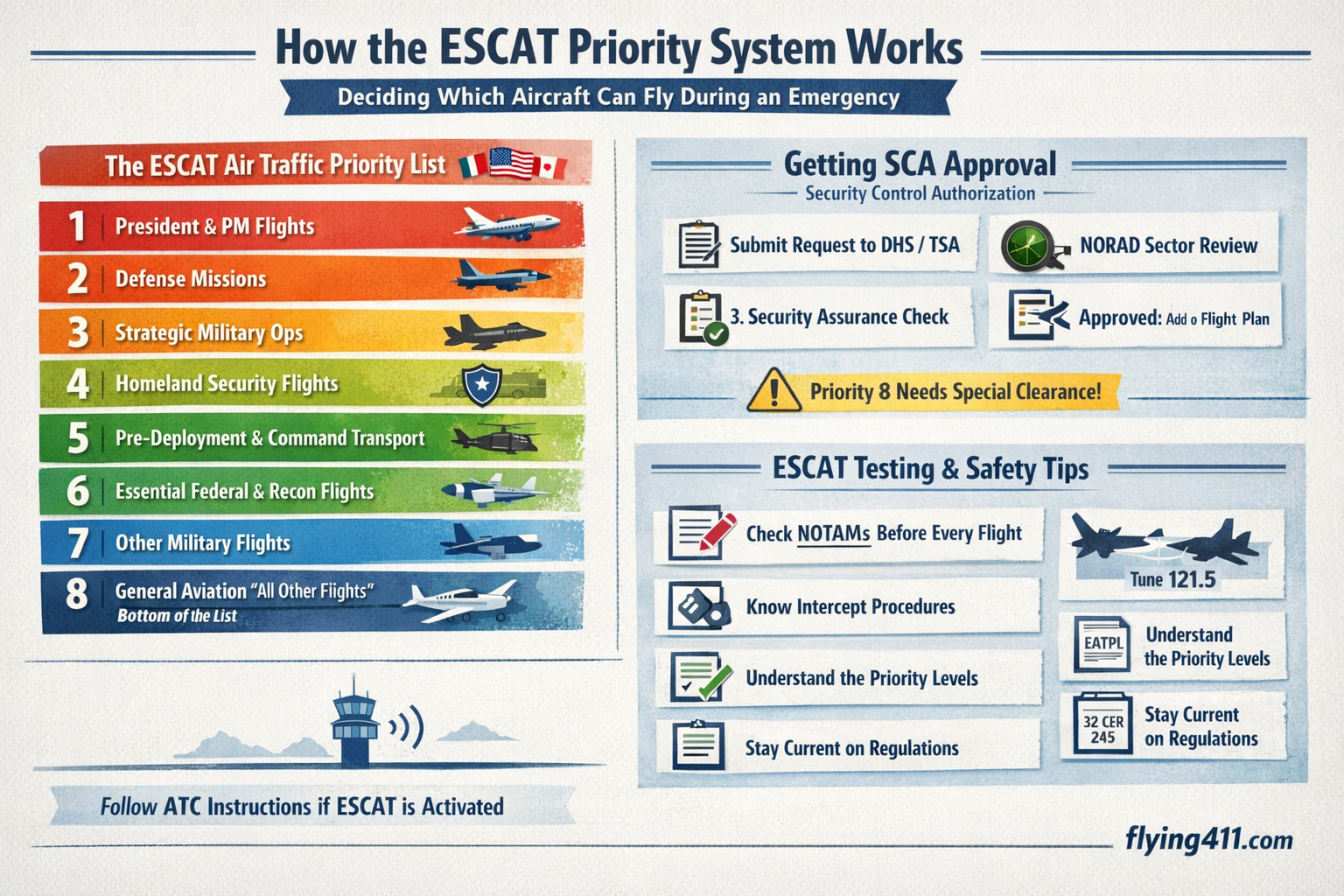
When ESCAT is implemented, not every aircraft gets grounded. Some flights are too important to stop. The ESCAT plan uses a ranked list called the ESCAT air traffic priority list, known as the EATPL. It has eight levels. The higher your number, the lower your priority. Most GA pilots are at the very bottom.
Here is how the eight levels break down:
- Priority 1: The President of the United States, the Prime Minister of Canada, and their key cabinet members and security staff. These flights are never delayed.
- Priority 2: Aircraft on active defense missions, including interceptors, anti-submarine aircraft, air refueling tankers, and early-warning aircraft like the E-3 AWACS or E-2 Hawkeye.
- Priority 3: Military aircraft on strategic missions, including tanker support; airborne command aircraft that back up combat control systems.
- Priority 4: Forces in direct support of U.S. military operations, including Civil Reserve Air Fleet aircraft; federal homeland security flights protecting nuclear plants, dams, and chemical facilities.
- Priority 5: Forces in pre-deployment training; transport of military commanders and key DoD civilian staff; dispersal of non-tactical military aircraft.
- Priority 6: Federal agency aircraft; flights needed to deliver supplies critical to national security; certain airborne reconnaissance missions.
- Priority 7: Other military flight operations not listed above.
- Priority 8: All other flights. This is where most GA flights fall.
The EATPL keeps the most critical civil and military air traffic moving while clearing the rest. Priorities 1 and 2 cannot be delayed or rerouted without direct NORAD approval. Everything else can be held or adjusted as needed.
Being Priority 8 does not mean you are grounded for good. There is still a path to fly if your mission is truly needed. That path is called a Security Control Authorization, or SCA.
An SCA is a case-by-case approval for Priority 8 operators, including federal, state, and local government agencies, who have a real need to fly. Here is how it works:
- The pilot or operator sends a request through the Department of Homeland Security and TSA.
- TSA reviews it and, if it approves, sends it to the right NORAD Sector.
- If approved, the aircraft must go through a Security Assurance Check before departure. This is a review of the crew, cargo, and aircraft to confirm nothing has been tampered with.
- The approved priority number must go in the remarks section of the flight plan so air traffic control can manage the airspace well.
Some cases fall outside the EATPL entirely. Aircraft in active emergencies and inbound international flights that cannot safely divert are handled one by one. ATC and the military work together based on the urgency of each case.
One thing to keep straight: EATPL priorities during emergency security control of air traffic are separate from civil aircraft priorities under the State and Regional Disaster Airlift plan. Every decision made under ESCAT is in the interest of national security. Any flight that gets approved to operate must also pass a special security review before departure.
For GA pilots, the bottom line is simple. During an active ESCAT event, you are Priority 8. You will need an SCA to fly. Stay on the ground, watch official channels, and wait for guidance. If your flight is truly needed, the SCA process is there to help.
Why ESCAT Testing and Civil Aviation Awareness Matter for Every Pilot
ESCAT has only been activated once in real life, and even then it was a modified version. It is easy to see it as a distant concern. But there is a real reason every pilot in civil aviation should know what it is. ESCAT testing happens at least once a year, and it shows up in the NOTAM system pilots must check before every flight.
Under 32 CFR Part 245, the military must give at least 30 days' notice to civil agencies before any test. When the test runs, it starts with "Exercise, Exercise, Exercise" so controllers know it is not real. But those tests can still create airspace restrictions and NOTAM activity. If you skip your preflight NOTAM check and an ESCAT restriction is active in your area, you could end up with an armed fighter on your wing and a lot to explain on the ground.
ESCAT testing also checks that the whole system works. It confirms that NORAD, the FAA, TSA, and pilots can all communicate fast when it counts. These tests make sure the system responds in minutes, not hours.
Knowing the ESCAT plan also makes you a safer pilot in daily flying:
- Check NOTAMs before every flight. Restrictions tied to federal aviation security events, including ESCAT tests, TFRs, and air defense emergency declarations, can show up fast. Missing one is not an excuse the FAA or military will accept.
- Know your intercept procedures. If a military aircraft intercepts you, tune to 121.5 MHz (or 243.0 MHz for military), reverse course, and follow instructions right away. The fighters are armed. For a full breakdown of restricted airspace types and enforcement, read No Fly Zone Explained: Types, Rules, and Who Enforces Them.
- Know the ESCAT air traffic priority list before you need it. Knowing where GA sits in the EATPL helps you request an SCA faster and with the right information.
- Stay current on the rules. The core rules that control air traffic during emergencies are in 32 CFR part 245 and FAA Advisory Circular 99-1E. These are public documents written for pilots.
Emergency preparedness usually makes pilots think of weather, engine trouble, or a medical issue. But airspace-level emergencies are just as real. ESCAT is a preparedness plan built for national-level threats. The Federal Aviation Administration and homeland security agencies run annual drills to make sure it is ready when needed. A specified air defense area can be declared near your home airport with little warning. Knowing how to respond, and what to expect from air traffic control, keeps you calm when it matters most.
ESCAT implementation only works if every pilot responds correctly. One pilot who misses a NOTAM or ignores an ATC call can cause real problems in a genuine emergency. That is a big responsibility. But it is not hard to meet. Check your NOTAMs, know the rules, and do what ATC tells you. If you want to build strong in-cockpit habits for emergencies of all kinds, Cessna 172 Common Emergency Procedures: Simple Steps Every Pilot Should Know is a great place to start.
ESCAT is something most pilots will never need to act on. But knowing it exists, and knowing what to do if it activates, is exactly what sets a prepared pilot apart.
Conclusion
ESCAT is a quiet plan. It runs in the background of U.S. aviation, rarely talked about and almost never used. But it is always ready. When national security is at risk, it gives the U.S. government the power to exercise security control of civil and military air traffic under a strict order of priority. For most GA pilots, that means staying on the ground until the all-clear comes. For pilots who need to fly during an emergency, it means following the ESCAT air traffic priority list and getting the right approval before any takeoff.
The best preparation is simple. Know the plan exists, check your NOTAMs, and trust the system. If ESCAT is ever activated in your flying lifetime, the pilots who respond correctly will be the ones who already knew what it was.
For more on airspace rules, regulations, and what pilots need to know, visit Flying411, your resource for practical general aviation information.
Frequently Asked Questions
Can ESCAT be activated for just one region of the U.S.?
Yes. ESCAT does not have to cover the entire country. It can apply to a single state, a set region, or a defined air defense area. The scale depends on where the threat is and how serious it is.
What happens to commercial airline flights under ESCAT?
Commercial airlines fall under EATPL Priority 4 when used as part of the Civil Reserve Air Fleet or under military mission control. Otherwise they may be treated as Priority 8 and subject to the same ground stop and SCA process as other civil operators, handled through TSA and NORAD.
Does ESCAT apply to Canadian airspace too?
Yes. Canada has its own ESCAT plan managed through Transport Canada, NAV CANADA, and the Canadian NORAD Region. The two countries' plans are closely linked through NORAD, which covers aerospace defense for all of North America.
What is a Security Assurance Check?
A Security Assurance Check is a security review done before any aircraft with an SCA can depart during ESCAT. It confirms that the crew, cargo, and aircraft have not been tampered with before the flight is cleared to go.
How is ESCAT different from a Temporary Flight Restriction (TFR)?
A TFR restricts a specific area for a set time, such as around the President or a major event. ESCAT is a full national emergency framework. It can affect the entire U.S. airspace system and involves DoD, FAA, and DHS all managing civil and military air traffic under a formal priority system.