A war breaks out on the other side of the world. Within hours, flight routes that handle thousands of passengers a day simply disappear from the map. Airlines scramble. Dispatchers refile flight plans. Pilots get new briefing packages. And somewhere in all of that, a string of coded text published in all capital letters is doing some very heavy lifting.
That coded text is a NOTAM. And when it points to a closed Flight Information Region, the ripple effects can reach every corner of global aviation. In January 2023, a single corrupted database file knocked the FAA's NOTAM system offline and triggered the first nationwide US ground stop since the September 11 attacks, delaying nearly 10,000 flights in a matter of hours. That was just a technical glitch. When the cause is an active conflict zone, the stakes are higher and the closures last far longer.
Most pilots know what a NOTAM is. But understanding how the system works when things get serious, when a conflict zone forces a country to shut its airspace entirely, is a different level of knowledge. It connects preflight paperwork to geopolitics, and it explains why a missile fired over the Middle East can delay your flight from London to Singapore.
The sections ahead break down how this system works, step by step.
Key Takeaways
NOTAMs (Notices to Air Missions) are official alerts that tell pilots and flight crews about changes in airspace, closed runways, navigation hazards, and safety restrictions. A Flight Information Region (FIR) is a defined block of airspace managed by a specific country under ICAO rules. When conflict breaks out, countries can close their FIR to all civil flights and issue NOTAMs to warn the world. This can force airlines to reroute around entire regions, adding hours to flights and millions in costs. Managing this at scale is why many operators rely on dedicated NOTAM management software to filter critical and warning NOTAMs and get them to the right people.
| Key Takeaway | Detail |
| What is a NOTAM? | An official alert to pilots about hazards, closures, or airspace changes |
| What is a FIR? | A defined block of airspace managed by a country under ICAO rules |
| Who closes airspace? | The host country, guided by ICAO's Chicago Convention |
| How are pilots notified? | Through NOTAMs issued by national aviation authorities like the FAA |
| What triggers a closure? | Conflict, missile threats, military activity, or political instability |
| What happens to flights? | Airlines reroute, burn more fuel, and face higher operating costs |
| Famous case study | MH17 (2014): shot down flying above a restricted zone |
What Is a NOTAM in Aviation?
Every pilot checks NOTAMs before a flight. It is a requirement, not a suggestion. Under FAR 91.103, pilots must become familiar with all available information before any flight. That includes NOTAMs.
A notice to air missions (NOTAM) is an official bulletin issued by a country's aviation authority to alert pilots, dispatchers, and air traffic controllers about conditions that could affect flight safety. These alerts are time-sensitive. They cover things that are not already printed on charts or in official publications because they just happened, or they are about to happen.
Here are some common reasons a NOTAM gets issued:
- A runway or taxiway is closed for maintenance
- A navigational aid (like a VOR) is out of service
- A Temporary Flight Restriction (TFR) is in effect
- A country's airspace is restricted or closed entirely
- GPS interference is reported in a region
- A hazard near an airport has been identified
In the United States, the FAA issues NOTAMs through the FAA NOTAM system. Internationally, each country's aviation authority publishes them through systems that follow ICAO standards. They are all written in uppercase letters, filled with abbreviations, and can look like a foreign language at first glance.
For example, a basic runway closure NOTAM might look like this:
!ORD 06/001 ORD RWY 04L/22R CLSD 2106231700-2106232300
Decoded, that tells you: Chicago O'Hare's runway 04L/22R is closed from 1700 to 2300 UTC on June 23, 2021. Short, coded, and packed with meaning once you know how to read it.
NOTAM types include:
- NOTAM D (Distant): The most common type. Covers airports, NAVAIDs, procedures, and airspace
- FDC NOTAMs (Flight Data Center): Regulatory in nature. These can enact Temporary Flight Restrictions or reference a Special Federal Aviation Regulation (SFAR)
- Security NOTAMs (KICZ prefix): Used by the FAA for conflict zone prohibitions and advisories
- Pointer NOTAMs: Direct pilots to a related SFAR or regulation for fuller details
The NOTAM system has faced criticism for years. The National Transportation Safety Board once called NOTAMs "a bunch of garbage that nobody pays any attention to." In 2023, the US Congress passed the NOTAM Improvement Act, requiring the FAA to modernize the system. As of 2026, the FAA has described the current environment as "fragmented and outdated" and has requested significant funding to fix it.
Despite its flaws, the NOTAM system remains the primary tool used globally to communicate critical aviation safety information. For conflict zone situations in particular, NOTAMs are the first official signal that an airspace has become dangerous. And a notice to airmen of that kind carries serious legal weight.
What Is a Flight Information Region (FIR)?
Think of the sky as a giant map, divided into tiles. Each tile has a manager. That manager is responsible for keeping flights safe inside their tile. Those tiles are called Flight Information Regions, and every single piece of sky on Earth belongs to one.
A Flight Information Region (or FIR) is a defined block of airspace within which a country (or a group of countries) provides flight information services and alerting services. The concept was formalized by ICAO in 1947 as part of the post-World War II effort to build a structured, cooperative global air traffic system.
The global airspace is divided into nine ICAO air navigation regions:
- Africa-Indian Ocean (AFI)
- Asia (ASIA)
- Caribbean (CAR)
- European (EUR)
- Middle East (MID)
- North American (NAM)
- North Atlantic (NAT)
- Pacific (PAC)
- South America (SAM)
Each of those regions is then broken into individual FIRs. Smaller countries may have just one. Large countries like the United States have several. Each FIR is identified by a unique four-letter ICAO code. Here are some you will see often in conflict zone coverage:
- OIIX: Tehran FIR (Iran)
- ORBB: Baghdad FIR (Iraq)
- LLLL: Tel Aviv FIR (Israel)
- UKFV: Simferopol FIR (Crimea, contested between Ukraine and Russia)
- OAKX: Kabul FIR (Afghanistan)
- OSTT: Damascus FIR (Syria)
Inside each FIR, the managing authority handles routing, separation, and flight operations coordination. When an aircraft crosses from one FIR into another, it is handed off from one control center to the next, much like passing between air traffic control sectors domestically.
Here is why this matters for conflict zones. Each country owns and controls its FIR. Under the Chicago Convention, that country is legally responsible for the safety of civil aviation inside it. If a threat emerges, such as a missile system, an active military engagement, or GPS jamming, that country can close its FIR to civil traffic and issue a NOTAM telling the world.
When a major FIR closes, flights that relied on passing through it must go around it. The altitude at which aircraft cruise does not automatically make them safe. As the world learned with the MH17 disaster in 2014, a missile can reach far higher than most people assumed.
Understanding FIRs is essential for any pilot or dispatcher involved in international flight planning. They define the legal and operational boundaries that shape every long-haul route on the planet.
How States Decide to Close Their Airspace
Closing a country's airspace is not a small decision. It affects airlines, passengers, cargo, and international diplomacy. So how does it actually happen?
The foundation is the Chicago Convention — the 1944 international agreement that created ICAO and established the basic rules of global aviation. Under the Convention, every country has full sovereignty over its airspace. That means each country has both the right and the responsibility to manage what flies above it. If the skies above a country become dangerous, that country is expected to act.
The threat assessment process
Before an airspace is closed, aviation and military officials look at two key factors:
- Capability: Does a weapon system in the conflict zone have the range and accuracy to threaten a civil aircraft at cruising altitude? Surface-to-air missiles (SAMs), man-portable air defense systems (MANPADS), and anti-aircraft artillery (AAA) are all assessed
- Intent: Is there a realistic chance that such a weapon would be used against a civil aircraft, either deliberately or by mistake?
Both factors have to be weighed together. A weapon capable of reaching FL350 is a different kind of threat than one that tops out at FL150. And in active combat zones, the fog of war means that intent can be very difficult to judge. Targeting mistakes happen. Non-military aircraft get misidentified.
Who actually issues the NOTAM?
When the decision to close or restrict airspace is made, the country's civil aviation authority publishes the NOTAM through official channels. In the US, serious prohibitions are codified as Special Federal Aviation Regulations (SFARs), which carry the force of law.
Other countries then issue their own NOTAMs advising or requiring their operators to avoid the affected FIR. The briefing package a pilot or dispatcher reviews before a long-haul international flight can include warnings from multiple countries covering the same airspace, each with slightly different wording and legal standing.
Not all closures are the same
Airspace closures exist on a spectrum:
- Full closure: No civil flights permitted under any circumstances
- PPR (Prior Permission Required): Flights may enter only with specific advance authorization
- Altitude floor restrictions: Civil flights permitted above a certain level (e.g., above FL320)
- Waypoint corridor restrictions: Only specific entry and exit points are permitted
- ESCAT (Emergency Security Control of Air Traffic): An emergency protocol that enables controlled access during active threats
The ICAO Annex 17 standard requires countries to keep a constant review of threats to civil aviation in their airspace and adjust their security programs accordingly. In practice, the speed and quality of that review varies widely. And history has shown that the consequences of getting it wrong can be catastrophic.
Changes in airspace status can happen in minutes. A country that is open today can close overnight. That is exactly what happened when the UAE shut its entire airspace for two hours on March 16 to 17, 2026, during a missile threat and then reopened. Airlines that had flights en route had to react in real time. Flight crews received updated routing mid-flight. Preflight planning assumptions that were valid at departure were no longer valid an hour later.
That kind of volatility is exactly what the global NOTAM and FIR system was built to handle. And it is also why understanding the system — not just checking a box before departure — matters so much for anyone involved in international flight operations.
When Conflict Zones Shut Down the Sky: What Pilots Do About It
This is where everything covered so far comes together in the real world. NOTAMs get issued. FIR boundaries get redrawn overnight. Airlines scramble. And the pilots and dispatchers on the front line of flight operations have to figure out what to do next — fast.
How a Conflict Zone Closure Actually Unfolds
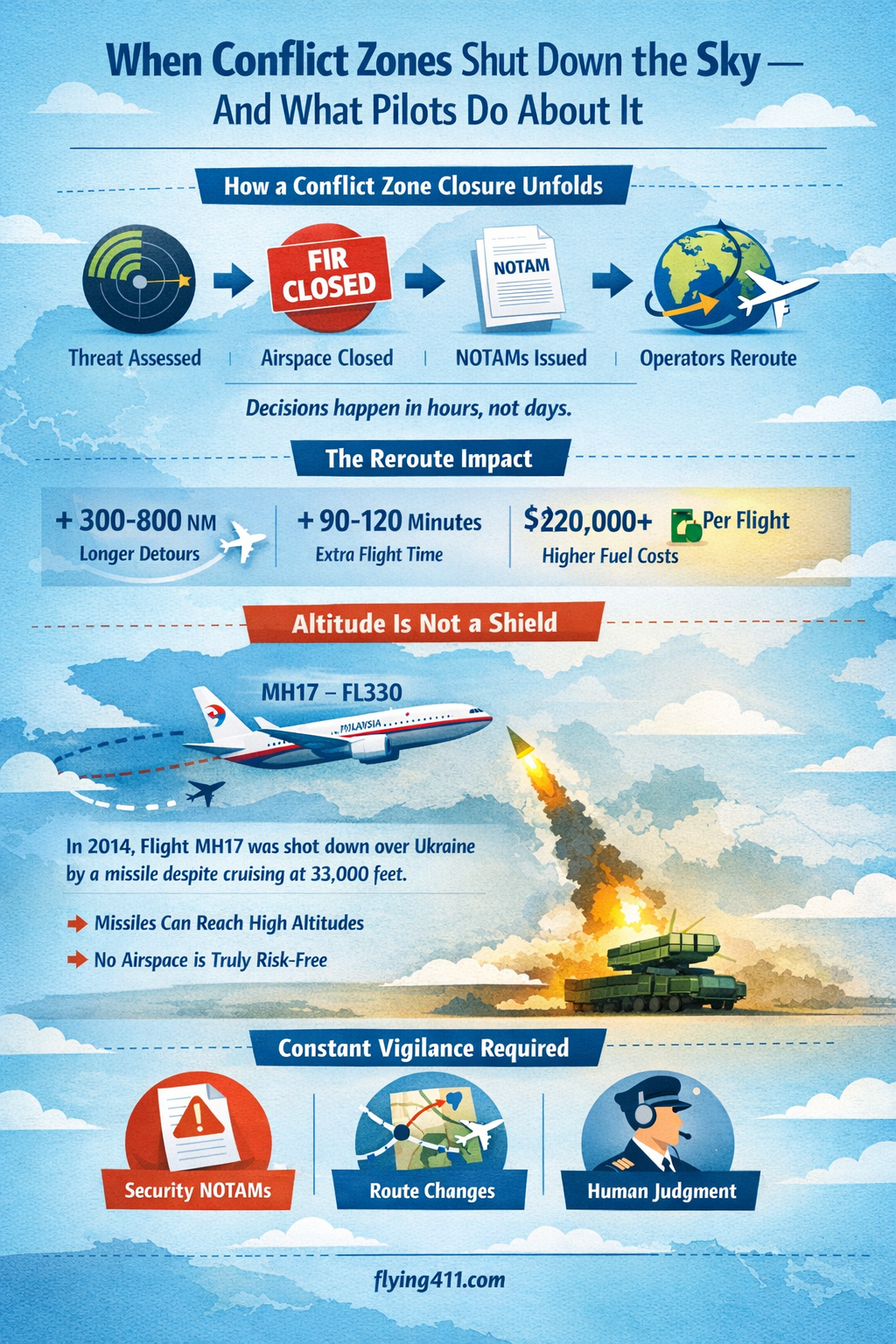
When a conflict breaks out or escalates, the sequence of events in aviation moves quickly. Here is a typical pattern:
- The host country's civil aviation authority assesses the threat level in its airspace
- A decision is made to restrict or fully close the FIR
- A NOTAM is published and distributed through international systems
- Other countries — the US FAA, EASA in Europe, Transport Canada, CASA in Australia — issue their own NOTAMs advising or legally prohibiting their operators from entering the affected zone
- Airlines pull up the updated briefing packages and begin rerouting
That entire chain can happen in a matter of hours. Sometimes faster. When the UAE closed its entire airspace for two hours on the night of March 16 to 17, 2026, during a missile threat, airlines had flights either in the air or preparing to depart. There was no waiting for a scheduled briefing cycle. Operations centers pushed updated guidance immediately, and flight crews responded in real time.
What Pilots and Dispatchers Are Actually Looking At
Before any international flight, the dispatcher and the flight crew pull a full preflight package. For routes near active conflict regions, that package includes security NOTAMs from multiple countries, each covering the same zone with slightly different language and legal requirements.
A US operator flying from New York to Dubai, for example, might review:
- An FAA SFAR prohibiting certain flight paths over Iranian territory
- An ICAO-compliant NOTAM from the UAE authority defining approved waypoint corridors
- Advisories from Germany, the UK, and Canada covering overlapping portions of the same region
- GPS interference warnings affecting navigation reliability along the route
The notice to airmen system was never designed to be simple. Reading a stack of conflict zone NOTAMs takes experience and careful attention. Each one has a validity window, a defined geographic area, an altitude band, and specific exceptions. Miss a detail and the legal and safety consequences can be serious.
This is also why flight planning software has become so critical. Modern dispatch systems can flag active restrictions automatically, filter NOTAMs by route, and model alternate paths around closures. But the human review still matters. Software flags the issue. The dispatcher and crew assess what it means for their specific flight.
The Reroute Problem: What It Costs
When a major FIR closes, flights do not just take a slight detour. They sometimes have to completely rebuild their route from scratch. The airspace available shrinks. The remaining corridors fill up with displaced traffic. And every extra mile flown means more fuel burned.
Consider the current state of the Middle East corridor as of early 2026. The airspace of Iran, Iraq, Bahrain, Kuwait, and Syria is closed by NOTAM. Israel and Qatar are heavily restricted. The Gulf corridor that once handled the bulk of Europe-to-Asia traffic is effectively gone. Flights that used to cross straight through are now forced to reroute either north through the Caucasus or south through Egypt, Saudi Arabia, and Oman.
The numbers are significant:
- Rerouting can add 300 to 800 nautical miles to certain Europe-to-Asia routes
- That can extend flight time by 90 to 120 minutes per flight
- A single Tokyo-London detour can burn approximately 5,600 extra gallons of fuel
- That translates to roughly $20,000 in additional fuel cost per flight
- Across hundreds of daily flights, industry costs can reach into the hundreds of millions of dollars if closures persist
For pilots, the fuel impact also changes preflight math directly. Longer routes require more fuel uplifted at departure, which adds weight, which affects performance calculations. In some cases, the original fuel load planned before the closure will not cover the new routing. A fuel stop may be required. That adds time, cost, and additional coordination.
A real example: an IndiGo flight from Delhi to Manchester had to turn back mid-flight in early 2026 when West Asia airspace closures cut off its planned route. The aircraft did not have enough fuel to safely complete an alternate routing, so returning to Delhi was the safest option. These are the kinds of decisions that play out in operations centers every time a new notice to air missions hits the system.
The MH17 Warning: Why Altitude Is Not a Shield
One of the most important lessons in modern conflict zone aviation safety came on July 17, 2014. Malaysia Airlines Flight MH17 was cruising at FL330 (33,000 feet) over eastern Ukraine. The airspace below FL320 had been restricted by Ukrainian authorities. But the airspace above it was considered open and safe.
It was not safe. A Buk surface-to-air missile reached FL330 and destroyed the aircraft. All 298 people aboard were killed.
The hazard that brought down MH17 was a military-grade weapon system that nobody had officially assessed as a threat to civil aircraft at cruise altitude. The NOTAM that was in place only covered airspace up to FL320. MH17 was flying 1,000 feet above that limit and was considered to be in safe airspace based on the published guidance.
The Dutch Safety Board later concluded that Ukraine had sufficient reason to close the entire airspace before the disaster. Changes in airspace restrictions came only after the crash. ICAO subsequently established a Task Force on Risks to Civil Aviation from Conflict Zones and developed new guidance documents. In May 2025, ICAO's Council ruled Russia liable under Article 84 of the Chicago Convention for failing to prevent the missile strike, the first ruling of its kind in the organization's history.
The MH17 case is a permanent reminder that flight crews and operators cannot simply assume that an open airspace is a safe airspace. Active intelligence, updated NOTAMs, and conservative routing decisions all play a role. If your flight planning software says the airspace is open but a conflict is actively developing below, that judgment call belongs to the humans reviewing the package not just the system that generated it.
For pilots planning to travel through or near contested regions, understanding the full scope of what a NOTAM covers and what it does not cover is as important as any other part of the preflight process. Speaking of airspace rules that surprise even experienced pilots, Why Is Antarctica a No-Fly Zone? What the Treaty Really Says is worth a read for anyone curious about how international agreements shape the boundaries of where civil aircraft can and cannot go.
And if you operate US-registered aircraft internationally, Understanding FAA Registration and Deregistration Procedures: What You Need to Know is a practical guide to the documentation side of flying across borders.
Conclusion
The global airspace system is one of the most coordinated things humans have ever built. Every FIR, every NOTAM, every reroute decision is part of a framework designed to keep aircraft safe even when the world below is not. When conflict breaks out, that framework gets tested hard. NOTAMs go out. FIRs close. Flight crews adjust. And somehow, most flights still get where they need to go.
Understanding how these systems work is not just useful for professional pilots. It helps anyone who follows aviation news make sense of what is actually happening when a region lights up on a conflict map and flight paths start bending around it.
Want to go deeper on how the global aviation system works? Flying411 covers the topics that matter most to pilots, aircraft owners, and operators from regulatory updates to operational know-how.
Frequently Asked Questions
Do NOTAMs expire automatically?
Yes. Every NOTAM includes a start time and an end time in UTC format. Once the end time passes, the NOTAM is no longer active. For conflict zone NOTAMs, expiry times are often extended repeatedly as the situation continues, sometimes rolling over every few days.
Can a NOTAM be issued for oceanic airspace?
Yes. Oceanic FIRs are managed just like any other FIR and can have NOTAMs issued for them. These often cover GPS interference, military activity, or temporary routing restrictions over open water where standard radar coverage does not exist.
What is a SIGMET and how is it different from a NOTAM?
A SIGMET (Significant Meteorological Information) covers weather hazards like turbulence, volcanic ash, or icing. A NOTAM covers operational and airspace conditions. Both are checked during preflight, but they come from different sources and serve different purposes.
How quickly can a conflict zone NOTAM be issued?
Emergency NOTAMs can be issued within minutes of a decision being made. The FAA issued its Venezuela NOTAM within hours of the January 3, 2026 operation. Speed of publication depends on the country's civil aviation authority and the urgency of the threat.
What happens to flights already airborne when an FIR closes suddenly?
Aircraft already inside a closing FIR are typically given priority handling to exit safely. Operations centers contact flight crews with updated routing. In some cases, aircraft divert to the nearest available airport outside the restricted area if fuel or safety margins require it.