Planes circle the globe every single day. They cross oceans, deserts, and mountain ranges without much fuss. But one place on Earth stays mostly untouched by regular air traffic — Antarctica, the frozen continent at the very bottom of the world. Most people have heard that Antarctica is off-limits, but the real story behind why is Antarctica a no-fly zone is more layered than a simple rule.
The cold is just the beginning. The geography, the legal framework, and the sheer danger all play a part — and it starts with a document signed more than six decades ago.
Antarctica is not technically a strict no-fly zone in the legal sense, but a combination of treaty restrictions, extreme weather, and a near-total lack of infrastructure makes it one of the most avoided regions in all of aviation.
Most commercial airlines skip it entirely, while only a small number of research and charter flights ever make it down there. The Antarctic Treaty sets the legal tone, and nature does the rest.
Key Takeaways
Antarctica is not officially banned from air traffic, but a combination of international treaty rules, extreme polar weather, and the total absence of commercial airport infrastructure makes flying there genuinely impractical for almost every aircraft. The Antarctic Treaty — signed in 1959 and in force since 1961 — established the continent as a shared space for peaceful scientific use. It does not ban civilian flights outright, but it creates conditions that, combined with ETOPS regulations and the harshest weather on Earth, keep most planes far away. Only research missions, government supply flights, and highly regulated charter operations ever fly in the region.
| Key Takeaway | Details |
| Is Antarctica a true no-fly zone? | Not legally, but conditions make most flights impractical |
| What governs Antarctica? | The Antarctic Treaty, signed 1959, in force since 1961 |
| Who signed the original treaty? | 12 founding nations; now around 54 signatory countries |
| Why do airlines avoid it? | No airports, no radar, no rescue options, extreme weather |
| Can you fly there at all? | Yes — research, charter, and some scenic flights do operate |
| What is ETOPS and why does it matter? | Rules requiring diversion airports; Antarctica has none |
| What is the main safety risk? | No emergency landing options across millions of square kilometers |
Flying411 is your go-to source for everything aviation — from aircraft rules and polar flight facts to buying guides and ownership tips. Bookmark us and come back any time you want a straight answer about the skies.
What Is Antarctica and Why Is It So Extreme?
Antarctica sits at the very bottom of the planet, centered almost perfectly on the South Pole. It is surrounded entirely by the Southern Ocean, which makes it the most remote landmass on Earth. The nearest major populated areas — the southern tips of South America, including parts of Argentina and Chile — are still thousands of kilometers away. To put the scale in perspective, the Antarctic region is larger than Europe, covering an area of around 14 million square kilometers, most of it buried under ice that is, in places, several kilometers thick.
There are no roads here. There are no cities, no hotels, and no resident population. The only people who live on the continent — temporarily — are scientists and support staff working at scattered research stations. Temperatures in the interior can drop to extraordinary lows during winter, and for months at a time, the sun simply does not rise. Getting supplies in and out requires serious advance planning even in the best conditions.
A Few Key Geographic Facts Worth Knowing
- Antarctica is considered the highest continent on Earth by average elevation, sitting at roughly 2,300 meters above sea level
- The South Pole sits in the middle of the East Antarctic Ice Sheet, far from any coastline
- The Antarctic Peninsula stretches northward toward South America and is the most accessible part of the continent
- Queen Maud Land, a vast coastal territory, is claimed by Norway — Norwegian explorers were among the first recorded people to reach the South Pole in the early twentieth century
- South Georgia, a sub-Antarctic island in the South Atlantic, sits just outside the treaty zone but is closely tied to the region's history
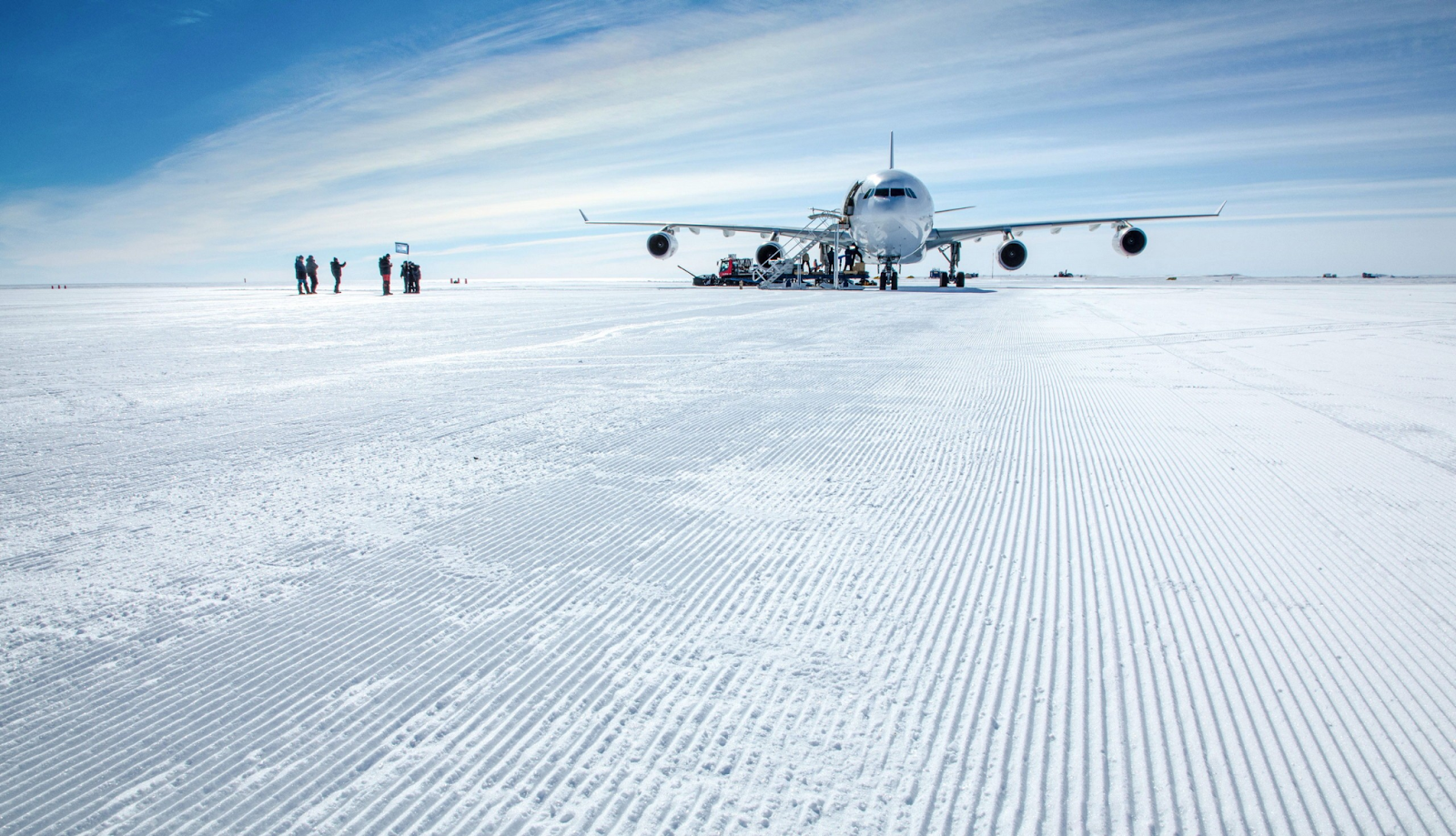
Good to Know: The polar geography directly affects aviation. There are no commercial airports in Antarctica. A handful of gravel and ice landing strips exist at research bases, but none of them can handle regular airline traffic. Any aircraft operating there needs to be specially built and prepared for polar conditions.
Who Actually Owns Antarctica — and Why That Complicates Airspace
This is where things get genuinely interesting. No single country owns Antarctica. Several nations have made territorial claims over parts of the continent — including Argentina, Chile, Norway, Australia, the United Kingdom, France, and New Zealand — but those claims are effectively frozen in place by international agreement. The Antarctic Treaty does not recognize or reject any of these claims. It simply puts them all on hold.
Ownership matters for aviation because airspace is normally controlled by the country beneath it. If you want to fly over most countries, you need permission. Antarctica complicates that system entirely. Since no country holds recognized sovereignty over the continent, there is no single authority controlling its airspace. That creates a legal gray area that affects everything from route planning to emergency response.
How the Territorial Picture Breaks Down
- Argentina and Chile both claim overlapping sections of the Antarctic Peninsula, the closest part of the continent to South America
- Norway's claim covers Queen Maud Land, a vast stretch of the coastline
- Several claims were staked before and after World War II, particularly during the tense post-war years
- The Arctic, by contrast, is divided among several nations with clear jurisdictions — Antarctica has no equivalent system
Why It Matters: The absence of clear sovereignty means there is no air traffic control infrastructure, no standardized navigation system, and no coordinated emergency response across most of the continent. That alone is enough to make most airlines look elsewhere when planning a route.
When Did the World Decide Antarctica Needed International Rules?
The push for binding international rules came during the Cold War. The late 1950s were a tense time politically, but Antarctica offered a rare chance for cooperation. In 1959, the Antarctic Treaty was signed in Washington, D.C., by 12 nations. It came into force in 1961, making it one of the first major international agreements to set aside an entire region for peaceful, scientific use.
The original signatories included the United States, the Soviet Union, the United Kingdom, Argentina, Chile, Norway, South Africa, and several others — all countries with active interests in the region, whether from exploration, research, or territorial ambitions. The treaty froze all existing territorial claims and banned any new ones. It also prohibited military activity, nuclear testing, and the dumping of nuclear waste.
Key Moments in the Antarctic Treaty Timeline
| Year | Event |
| 1959 | Antarctic Treaty signed in Washington, D.C., by 12 nations |
| 1961 | Treaty enters into force as binding international law |
| 1991 | Madrid Protocol added — bans mining and drilling, strengthens environmental rules |
| Today | Around 54 countries are now part of the treaty system |
The treaty did not write detailed rules for aviation specifically, but it set the broader tone: Antarctica is a shared space for science and international cooperation, not for commercial exploitation. That spirit shapes how the world treats polar flights to this day. Aviation-specific rules developed separately through international bodies, building on the treaty's foundation.
Fun Fact: The Antarctic Treaty is widely considered one of the most successful international agreements in modern history. It has kept the continent demilitarized and free of nuclear weapons for over 60 years — and not a single armed conflict has ever taken place there.
What Does the Antarctic Treaty Actually Say About Flying?
The phrase "no-fly zone" gets used loosely when people talk about Antarctica, but it is worth being precise. The Antarctic Treaty itself does not explicitly ban civilian flight over the continent. What it does do is create conditions — legal, logistical, and environmental — that make most flights impractical or outright dangerous.
The treaty bans military activity, which includes military aircraft operating freely in the region. It also requires that all activities be transparent and open to inspection by other member nations. Any expedition to Antarctica, including by air, must follow the treaty system's rules. The Madrid Protocol — added in 1991 — tightened environmental rules significantly.
What the Treaty and Related Agreements Say About Aviation
- All aerial activities must be for peaceful purposes only
- Any aircraft operating in the region must be available for inspection by other member nations
- Environmental impact must be assessed before any significant activity, including operating aircraft
- Strict rules apply around pollution and waste, which directly affects fuel handling and base operations
- Military aircraft may be used for scientific and logistical support, but not for strategic or combat purposes
Heads Up: The result is a kind of shared custody over the continent. No country can dictate airspace rules the way they would over their own territory, which creates a vacuum where standard international aviation rules technically apply — but with no one consistently on the ground to enforce them.
If you want to understand how aviation rules work in more regulated domestic contexts, This article has a clear breakdown of what a no-fly zone actually means and how airspace restrictions are enforced in practice.
How ETOPS Rules Make Antarctica Even More Off-Limits
Beyond the treaty, international aviation regulations add another critical layer. ETOPS — Extended-range Twin-engine Operational Performance Standards — is a set of rules that governs how far a twin-engine commercial aircraft can fly from a viable diversion airport. In simple terms: if one engine fails, the plane needs to be close enough to land safely somewhere.
Antarctica has no qualifying airports. The few landing strips at research bases are not equipped to handle modern commercial jets. They lack fuel, maintenance crews, spare parts, and the facilities needed to care for passengers in an emergency. This means any commercial aircraft flying over the continent would be operating outside ETOPS requirements — or would need a special exemption that is extremely difficult to obtain.
How ETOPS Breaks Down in Practical Terms
- A standard twin-engine jet must stay within roughly 60 to 180 minutes of a diversion airport, depending on its certification level
- The interior of Antarctica is more than 2,000 kilometers from any suitable diversion point
- Extreme cold affects engines, hydraulics, and avionics in ways that require special equipment and preparation
- The Basler BT-67 — a turboprop conversion of the classic DC-3 — is one of the most common aircraft used in Antarctica precisely because it is rugged and does not depend on the same systems as modern jets
- Magnetic compasses become unreliable near the South Pole, and GPS can behave unpredictably at very high latitudes, adding a navigation challenge on top of everything else
Pro Tip: If you are curious about aircraft that were built to handle extreme conditions and unusual missions, the story of the Spruce Goose is a fascinating look at how engineers have historically pushed the boundaries of what planes can do.
How Does Antarctica's Weather Make Flying Even More Dangerous?
Even if the legal and technical hurdles did not exist, Antarctica's weather would make flying there one of the most demanding challenges in all of aviation. The continent generates its own extreme weather systems, and they can appear with very little warning.
Katabatic winds are among the most serious hazards pilots face. These are powerful downslope winds that form when dense, cold air rushes off the polar plateau toward the coast. They can reach extraordinary speeds in some areas — strong enough to flip vehicles and destroy equipment. For any aircraft attempting a landing or takeoff, katabatic winds are a serious threat.
Other Major Weather Hazards in Antarctica
- Extreme cold that causes fuel to thicken and mechanical systems to fail at critical moments
- Whiteout conditions in which pilots cannot distinguish the ground from the sky
- Rapidly changing weather that makes forecasting unreliable, even just hours in advance
- Ice fog and blowing snow that reduce visibility to near zero
- A near-complete absence of weather reporting stations across most of the continent, leaving pilots with very little real-time data
Rescue operations in the event of a crash are slow and logistically difficult. The nearest hospitals and emergency services are in South America or South Africa, many hours away by air. In a worst-case scenario, a diversion from the middle of the continent could take longer than the fuel supply of most jets would allow.
Keep in Mind: Survival on the ground in Antarctic conditions, without proper shelter and gear, is measured in hours. This is not like a diversion to a remote airfield elsewhere in the world. It is a categorically different level of risk.
The Air New Zealand Flight 901 Disaster and Its Lasting Impact
One of the darkest chapters in Antarctic aviation history came in November 1979. Air New Zealand had been running sightseeing overflights of the continent since the late 1970s — a popular service that allowed passengers to view the ice from the air without landing. The flights were considered safe because they stayed at altitude and did not attempt to land.
On November 28, 1979, Air New Zealand Flight 901 crashed into the slopes of Mount Erebus on Ross Island, killing all 257 people on board. The cause was a combination of navigational errors and a whiteout condition that made it impossible for the crew to distinguish the white slope from the white sky. It remains one of the worst aviation disasters in the history of the Southern Hemisphere.
The crash had a lasting effect on how the aviation industry thinks about polar operations. Most airline operators pulled back from Antarctic overflight tourism for years afterward. The event reshaped safety thinking, reinforced the dangers of whiteout conditions, and highlighted just how unforgiving the Antarctic environment is when things go wrong.
Why It Matters: Some expedition operators and sightseeing companies have since returned to offering scenic flights over parts of Antarctica, but they are highly regulated, carefully planned, and nothing like the casual overflights of the 1970s. The ocean surrounding Antarctica adds another layer of risk — even a controlled water landing in those temperatures would be fatal within minutes.
Why Do Commercial Airlines Still Avoid Antarctica Even When It Is Technically Allowed?
Even setting aside the legal and safety issues, there is a straightforward business reason why airlines avoid Antarctica: there is no commercial demand for scheduled flights to a continent with no cities, no hotels, and no passenger infrastructure.
The route economics simply do not work. An airliner flying from Buenos Aires to Sydney could theoretically dip further south to slightly shorten the distance, but the savings would not come close to covering the added risk, special insurance costs, required fuel reserves, and regulatory complexity. The most efficient routes between destinations in the northern and southern hemispheres generally do not pass over the deepest parts of Antarctica anyway.
Why Airlines Stay Away — A Quick Summary
- No functioning commercial airports or refueling facilities
- No emergency landing options across most of the interior
- ETOPS rules make it legally very complicated for twin-engine jets
- Special insurance and liability costs that exceed any route savings
- Extreme weather with minimal real-time forecasting data
- No paying passenger base on the continent itself
- Environmental impact rules restrict casual overflights
- Specialized research and government supply flights use turboprops, not commercial jets
Quick Tip: Countries like Argentina and Chile do operate regular supply flights to their bases on the Antarctic Peninsula using turboprop aircraft suited to polar conditions. South Africa runs similar logistics flights. But these are government operations, not commercial services open to the public.
The Falkland Islands and South Georgia occasionally serve as waypoints for aircraft operating in the sub-polar southern ocean zone, but even those locations are remote and limited in their facilities. Avoiding the Antarctic interior is standard practice — not because of any conspiracy or hidden rule, but because the risk-to-reward calculation simply does not add up for anyone except those on a specific scientific or logistical mission.
For readers interested in aircraft that can operate in unusual or challenging environments — including water landings — this post has a detailed look at planes that can land on water and what makes them different from conventional aircraft.
What Flights Actually Do Operate in Antarctica?
Despite all the obstacles, Antarctica is not completely unreachable by air. A small number of operations do fly there regularly, under carefully controlled conditions.
Research and Government Logistics Flights
National Antarctic programs — run by countries including the United States, Australia, the United Kingdom, Argentina, Chile, and New Zealand — operate supply and personnel flights to their research bases. These use a mix of aircraft types, including ski-equipped planes that can land on ice runways. The U.S. Antarctic Program, for example, has operated LC-130 Hercules aircraft for decades — a ski-equipped version of the famous C-130 transport.
Charter and Expedition Flights
A small number of charter operators offer expedition flights to remote parts of the continent, primarily for adventure travelers and scientific teams. These are expensive, heavily planned, and dependent on a narrow seasonal window when conditions are marginally safer — roughly October through February.
Scenic Overflights
Australian and New Zealand operators have offered scenic overflights since the 1990s, allowing passengers to view the continent from altitude without landing. These flights are carefully routed to avoid the most hazardous terrain and are operated with extensive weather monitoring.
Fun Fact: Wilkins Aerodrome, near Australia's Casey Station, has handled wheeled aircraft landings from full-size jets — but as one-off logistical achievements, not as part of any regular commercial service.
For anyone curious about how mental and physical fitness plays into high-stakes flying environments, this post explores mental health in aviation — a topic that is especially relevant for pilots operating in extreme and isolated conditions like Antarctica.
How Does the Arctic Compare to Antarctica for Aviation?
The Arctic offers a useful contrast. The northern polar region has somewhat more developed aviation infrastructure, largely because countries like Norway, Canada, Russia, and the United States have territories and communities in the polar north that require regular air service. Polar routes across the Arctic are now a standard feature of long-haul aviation between North America and Asia.
| Feature | Arctic | Antarctica |
| Sovereignty | Divided among several nations | No recognized sovereignty |
| Air Traffic Control | Available in some areas | None across most of the continent |
| Commercial Airports | Yes — several in Alaska, Canada, Norway, Russia | None — only research base strips |
| Regular Scheduled Flights | Yes — polar routes used by major airlines | No — only research and charter |
| Rescue Infrastructure | Limited but present | Extremely limited |
| Permanent Civilian Population | Yes — in Arctic communities | None |
The South Pole has no equivalent to the Arctic's network of communities, infrastructure, or established polar routes. This is not a conspiracy or a cover-up — it is simply the reality of a continent that has never had a permanent civilian presence.
Good to Know: Polar route flights over the Arctic now connect cities like New York and Tokyo or Los Angeles and London on optimized great-circle routes. Antarctica has never developed equivalent infrastructure because there are no destinations on the other side worth connecting to.
If you want to understand the FAA's evolving rules around new aircraft categories and how regulatory bodies shape what is and is not permitted in aviation, this guide has a solid explainer on the FAA MOSAIC rule and what it means for pilots and aircraft owners.
Conclusion
Antarctica stands apart from every other place on the planet — in its geography, its legal status, and its relationship with aviation. The Antarctic Treaty did something genuinely remarkable: it got countries that were rivals to agree to leave an entire continent alone, and that agreement has held for more than 60 years. The result is a place where flying is not banned outright, but is so difficult, so risky, and so economically impractical that the aviation world largely stays away.
The skies over the South Pole remain quiet — not because of a hidden rule or a conspiracy, but because of treaty obligations, physics, weather, and economics all pointing in the same direction. For a curious traveler, an aviation enthusiast, or someone who just heard about it and wanted answers, the real story is always more interesting than the myth.
For more on aviation rules, aircraft history, and practical flying knowledge, head over to Flying411 and keep exploring.
Frequently Asked Questions
Can private pilots fly to Antarctica on their own?
Technically, a private pilot can apply to conduct a flight to Antarctica, but the process is far from simple. Any flight must comply with the Antarctic Treaty system, which requires advance notification to the relevant national authority. The near-total lack of fuel, maintenance facilities, and emergency services makes solo private flights extremely dangerous and very rarely approved in practice.
Has anyone ever landed a commercial jet in Antarctica?
Full-size commercial jets have landed in Antarctica, but only in very controlled, one-off situations — not as part of regular service. The most notable example is a runway at Wilkins Aerodrome near Australia's Casey Station, which has handled wheeled aircraft landings. These are logistical achievements, not signs of a developing commercial route network.
Why does the Antarctic Treaty not mention aviation specifically?
The treaty was written in 1959, when aviation in remote regions was far less advanced than it is today. The focus was on land-based activity, territorial claims, and military restrictions. Aviation rules developed later through separate international frameworks, including ICAO guidelines and the Madrid Protocol's environmental provisions, which together fill the gap the original treaty left open.
Are there any airlines that fly near Antarctica regularly?
A small number of charter and sightseeing operators run flights that pass near or over parts of Antarctica, particularly the Antarctic Peninsula. Australian and New Zealand operators have offered scenic overflights since the 1990s, and some long-haul routes between South America and Australia pass relatively close to the sub-Antarctic zone — though not directly over the continent's interior.
What would happen if a plane had an emergency over Antarctica?
An in-flight emergency over Antarctica would be among the most serious scenarios in aviation. There are no suitable diversion airports across most of the interior, rescue services are many hours away, and survival on the ground in Antarctic conditions without proper shelter and equipment is extremely difficult. This is precisely why ETOPS rules effectively prohibit most commercial jets from flying over the region without special waivers.
What is a katabatic wind and why is it so dangerous for aircraft?
A katabatic wind is a powerful downslope wind that forms when dense, cold air rushes off the high polar plateau toward the coast. These winds can reach extreme speeds and appear with very little warning. For a pilot attempting to land or take off, a sudden katabatic event can make the aircraft nearly uncontrollable, especially on a short gravel or ice strip with no go-around options.
Why do float planes or seaplanes not solve the airport problem in Antarctica?
While seaplanes and floatplanes can operate without traditional runways, the waters around Antarctica present different but equally serious challenges. Sea ice, extreme cold, and the ferocity of the Southern Ocean make open-water landings extremely hazardous. Is it expensive to book a flight that goes near Antarctica?
Flights to or near Antarctica are among the most expensive and difficult-to-arrange journeys in aviation. Expedition flights and scenic overflights require significant advance planning, specialized aircraft, and narrow seasonal windows. Costs vary widely, but they are far beyond the price of a typical long-haul commercial ticket.