Some planes change history with thousands of flights. The Spruce Goose changed history with just one. On a cool November day in 1947, the largest aircraft ever built at that time lifted off the waters of Long Beach Harbor — and never flew again. That single flight lasted less than a minute, but people are still talking about it today.
In fact, the Spruce Goose is now on permanent display at the Evergreen Aviation & Space Museum in McMinnville, Oregon, where visitors by the millions have come to see it up close. If you've ever wondered how a plane this massive got built, why it only flew once, and where it ended up, you're in the right place. This post goes over in detail one of the most fascinating stories in all of aviation history.
Key Takeaways
The Spruce Goose, officially known as the Hughes H-4 Hercules, was a massive wooden flying boat built during World War II to carry troops and supplies safely across the Atlantic Ocean. Designed and piloted by Howard Hughes, it flew only once — on November 2, 1947 — traveling roughly a mile at an altitude of about 70 feet above Long Beach Harbor. The war ended before the plane could ever serve its intended purpose, and it never flew again. Today, it lives at the Evergreen Aviation Museum in McMinnville, Oregon, where it remains the largest wooden aircraft ever built and the world's only surviving example of its kind.
| Key Detail | Quick Answer |
| Official Name | Hughes H-4 Hercules |
| Built By | Howard Hughes / Hughes Aircraft |
| Year It Flew | 1947 |
| Number of Flights | 1 |
| Flight Distance | About 1 mile |
| Flight Altitude | ~70 feet |
| Flight Duration | ~26 seconds |
| Made Of | Birch wood (Duramold process) |
| Wingspan | 320 feet |
| Weight (fully loaded) | ~400,000 pounds |
| Engines | Eight Pratt & Whitney R-4360 Wasp Major |
| Location Today | Evergreen Aviation Museum, McMinnville, OR |
| Original Purpose | Wartime cargo and troop transport |
Flying411 covers all kinds of fascinating aircraft stories and aviation insights — explore the site to fuel your love of flying.
What Exactly Is the Spruce Goose?
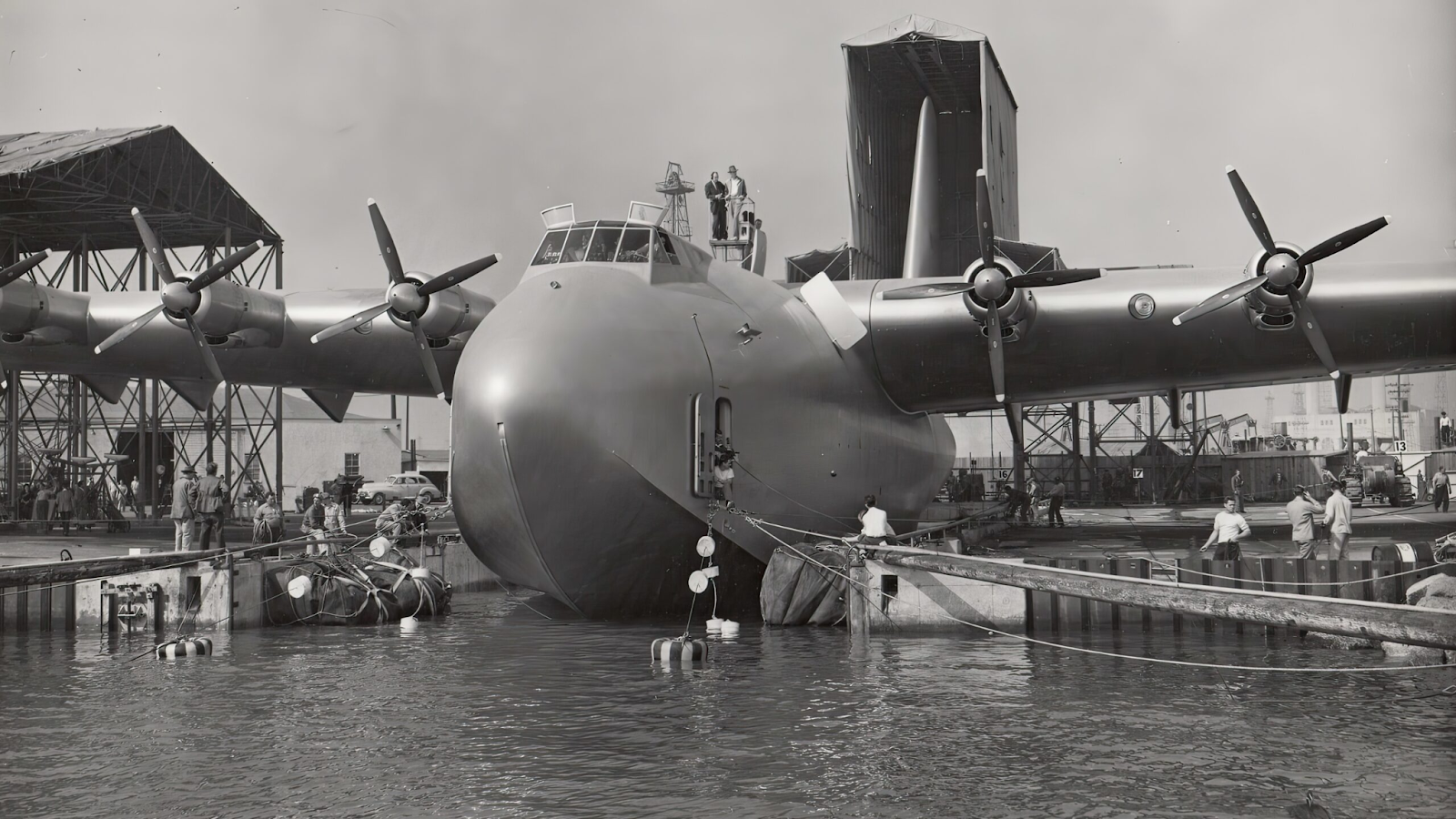
The Spruce Goose is one of the most famous aircraft ever built. Its official name is the Hughes H-4 Hercules, and it was a massive flying boat — meaning it was designed to take off and land on water instead of a traditional runway. It's the kind of aircraft that makes your jaw drop just looking at it.
A Record-Breaking Machine by Every Measure
Here's what made the H-4 Hercules so remarkable:
- Wingspan of 320 feet — longer than an American football field, end zones included. That wingspan set a record that stood for decades.
- Fully loaded weight of around 400,000 pounds, making it one of the heaviest aircraft of its era.
- Height equivalent to a six-story building when measured from keel to the top of its tail.
- Designed to carry up to 750 fully equipped troops or a pair of 30-ton Sherman tanks in a single load.
The plane was technically a prototype — a one-of-a-kind test model. It was never produced in large numbers because the war ended before it could go into service. But as a single example of what engineers could achieve in the 1940s, it remains jaw-dropping even by today's standards.
Good to Know: The nickname "Spruce Goose" was actually a bit of a jab from the press. Reporters gave it that name because they thought the project was a joke — too big, too expensive, too ambitious. Howard Hughes reportedly hated the nickname. But it stuck, and today it may be the most recognizable nickname in aviation history for a plane that flew exactly one time.
More Than Just a Big Box
What makes the Spruce Goose even more interesting is that it wasn't simply huge — it was thoughtfully engineered. It featured a full flight deck up top with complete controls, eight massive radial engines, and an interior spacious enough to feel like a small warehouse. The design reflected serious engineering ambition, even if the final product never got its real chance to prove itself in regular service.
The H-4 Hercules officially holds the record for the largest seaplane ever built. For many years it also held the record for the largest aircraft of any kind. Only much more modern aircraft — like the Stratolaunch, first flown decades later — have since surpassed its wingspan.
Who Built the Spruce Goose and Why?
The story behind the Spruce Goose starts during World War II, when the stakes couldn't have been higher.
The Wartime Problem That Started It All
The United States needed to move enormous quantities of troops, weapons, and supplies across the Atlantic Ocean. But there was a critical problem: German submarines, known as U-boats, were attacking and sinking Allied ships at an alarming rate. Shipping lanes across the Atlantic had become extremely dangerous, and the losses were piling up fast.
The military needed another option — something that could fly high above the reach of those submarines and deliver cargo safely.
Henry Kaiser's Big Idea
Enter Henry Kaiser, a powerhouse American industrialist who had already proven he could build things fast. Kaiser was known for constructing Liberty ships — cargo vessels — at remarkable speed during the war. He had the idea to build giant flying boats that could leapfrog the U-boat threat entirely.
Kaiser partnered with Howard Hughes, a wealthy and extraordinarily talented aviator and engineer, to make the concept real. Hughes had already made a name for himself with the H-1 Racer, a sleek aircraft he personally designed and flew to set a world speed record. He was known for pushing limits far beyond what others thought possible.
Fun Fact: Howard Hughes was not just a financier — he was a genuinely skilled pilot who broke multiple airspeed and distance records before the Spruce Goose project even began. He was as comfortable in a cockpit as he was in a boardroom.
The Partnership That Fell Apart
The project officially kicked off with government funding, and the Hughes Aircraft company was tasked with making it happen. But the relationship between Kaiser and Hughes didn't go smoothly. Kaiser eventually withdrew from the project, leaving Hughes to carry it forward alone. Hughes poured his own money into the effort — reportedly around $18 million of his personal funds on top of the government's contribution.
Here's a quick snapshot of how the project came together:
| Factor | Detail |
| The Threat | German U-boats destroying Allied cargo ships in the Atlantic |
| The Goal | A massive flying boat to carry troops and supplies through the air |
| Original Partners | Henry Kaiser (concept) + Howard Hughes (design and build) |
| Total Estimated Cost | Around $23 million (~$300 million or more in today's money) |
| Construction Start | 1942 |
| Completion | 1947 — after the war had already ended |
Heads Up: By the time the H-4 Hercules was completed, the war was over. The urgent need that created it had disappeared. That timing shaped everything that followed.
The Hughes Aircraft company built the plane at a dedicated facility in Culver City, California. It became one of the most ambitious manufacturing projects of the entire war era — even if it arrived too late to play any part in the fighting.
Why Was the Spruce Goose Built Out of Wood?
This is one of the first questions people ask about the Spruce Goose, and it's a completely fair one. Why on earth would anyone build the world's largest aircraft out of wood?
Wartime Material Restrictions
The answer comes down to government rules. During World War II, the U.S. government placed strict controls on aluminum and steel. Those metals were desperately needed for fighter planes, tanks, warships, and weapons. Large experimental or civilian projects simply could not use them freely.
So Hughes and his team had to get creative. They turned to wood — specifically birch — and developed an advanced manufacturing technique called Duramold.
How Duramold Worked
Duramold wasn't just ordinary woodworking. It was a carefully engineered process:
- Thin strips of birch wood were layered together, similar to plywood.
- Those layers were glued together and then molded into curved shapes using heat and pressure.
- The result was a material that was lighter than aluminum of similar strength, smooth on the outside, and capable of being formed into complex aerodynamic curves.
Fun Fact: Despite being nicknamed the "Spruce Goose," the aircraft contains almost no spruce at all. It was built almost entirely from birch using the Duramold process. The name was catchy, but it wasn't accurate.
Duramold wasn't just a clever workaround — it was actually a legitimate engineering solution for building at that scale. The finished material could be shaped into the large, smooth surfaces needed for an aircraft this size, something that would have been difficult with aluminum technology of the day.
The Challenges of Building Big in Wood
Wooden construction did come with real challenges. Wood absorbs moisture over time, which can cause warping and structural degradation. That's one of the key reasons the Spruce Goose has spent most of its long life in carefully climate-controlled environments — first in a massive hangar near Long Beach Harbor, and later at its current home in Oregon. Keeping the humidity and temperature stable has been essential to its preservation.
Pro Tip: If you're ever visiting the Evergreen Aviation Museum, look closely at the smooth exterior surface of the H-4 Hercules. That finish is the result of the Duramold process — layers of birch wood shaped and pressed into curves. It's hard to believe it's wood at all.
The Eight Engines That Made It Fly
Powering the H-4 Hercules were eight Pratt & Whitney R-4360 Wasp Major engines. These were among the most powerful piston engines ever built — massive 28-cylinder, air-cooled radial powerplants. Each engine alone was an engineering feat. Together, they gave the Spruce Goose the raw power it needed to lift all that wood, fuel, crew, and potential cargo off the surface of the water.
Understanding how aircraft engines and airframes work together at this scale puts the H-4 Hercules in a new light — and if you're curious about how planes take off and land, the physics involved with the Spruce Goose are a fascinating extreme case.
The One Historic Flight: What Happened on November 2, 1947?
The story of the Spruce Goose's first and only flight is one of the most dramatic moments in aviation history. It didn't happen because everything went according to plan. It happened because Howard Hughes decided — in the middle of a public demonstration event — to just fly the thing.
The Political Storm Before the Flight
By late 1947, the Spruce Goose had become a lightning rod in Washington. The war was over. The plane had never been used. Congress was investigating whether Hughes had misused government funds on the project. Hughes was called before the Senate War Investigating Committee to defend his work.
He was furious at the accusations. He publicly declared that if the plane proved to be a failure, he would leave the country. This wasn't the statement of a man who doubted what he had built. It was a challenge — and he was about to back it up.
A few months after those Senate hearings, Hughes organized a series of taxi tests on Long Beach Harbor. These tests were designed to show that the aircraft at least functioned on the water. He invited journalists, officials, and crew members on board to witness the demonstration up close.
The Moment the Plane Left the Water
On November 2, 1947, the H-4 Hercules was out on the harbor for what was officially described as another taxi run. Hughes was at the controls. The plane began moving across the water, picking up speed.
Then it lifted off.
The aircraft climbed to roughly 70 feet, traveled approximately one mile at around 80 miles per hour, and gently settled back down onto the harbor. The entire time in the air lasted roughly 26 seconds.
Nobody watching from the shore was entirely sure whether Hughes had planned to fly the plane that day or not. Some historians believe it was always part of the plan, a calculated move to silence his critics once and for all. Others think Hughes simply seized the moment. Either way, the flight was real, controlled, and completely intentional in its execution.
Why It Matters: That 26-second flight was not just a publicity stunt. It proved that the world's largest aircraft of its time was capable of controlled, powered flight. Hughes had been called a fraud and a waster of public money. That brief hop over Long Beach Harbor was his answer.
Flight Details at a Glance
| Detail | Fact |
| Date | November 2, 1947 |
| Location | Long Beach Harbor, California |
| Altitude | Approximately 70 feet |
| Distance | About 1 mile |
| Speed | Around 80 mph |
| Duration | Roughly 26 seconds |
| Pilot | Howard Hughes |
| People On Board | Approximately 36 crew and observers |
| Engines | Eight Pratt & Whitney R-4360 Wasp Major |
Why Did the Spruce Goose Only Fly Once?
After that single flight, the H-4 Hercules never took to the air again. The Hughes Aircraft company continued to maintain the plane for years, but no second flight was ever attempted. Several factors came together to seal that outcome.
The War Was Already Won
The most fundamental reason is simple: the mission was gone. The Spruce Goose was built to solve the problem of German U-boats threatening Allied shipping. By the time it flew in 1947, the war had been over for more than two years. There was no longer any strategic reason to operate a massive flying boat designed for trans-Atlantic cargo runs.
Hughes Never Scheduled Another Flight
Howard Hughes remained personally obsessed with the aircraft and continued funding its upkeep out of his own pocket until his death in 1976. But he never committed to a second flight. Whether that was due to the cost and complexity of operating such a massive machine, lingering political sensitivities around the project, or simply his notoriously unpredictable decision-making, no second flight ever materialized.
Keep in Mind: Hughes paid for the maintenance of the Spruce Goose entirely out of his personal fortune for nearly three decades after its single flight. The plane sat in a massive climate-controlled hangar near Long Beach Harbor, right next to the Queen Mary ocean liner. Hughes's commitment to preserving it — even with no plan to fly it again — is part of what made survival possible.
The Cost of Operating It Was Enormous
Running a machine this large required enormous resources. Fuel, maintenance, specialized crew, and hangar space all added up quickly. Without a clear operational purpose, the expense was difficult to justify.
No Champion After Hughes
When Howard Hughes died in 1976, the Spruce Goose lost the one person most personally invested in its future. Without his direct support, the question of what to do with the world's largest wooden aircraft became very complicated very fast.
Howard Hughes: The Man Behind the Machine
You can't fully understand the Spruce Goose without understanding Howard Hughes. He was one of the most remarkable — and most eccentric — figures in American history.
Aviator, Engineer, and Visionary
Hughes was born in 1905 and inherited a fortune from his father's drill bit company. But Hughes didn't sit still with inherited wealth. He threw himself into filmmaking, business, and aviation with extraordinary energy. By the time the Spruce Goose project began, he had already set multiple airspeed records, flown around the world, and built a reputation as one of the most daring aviators alive.
He had a hands-on approach to engineering that was unusual for someone of his wealth. He didn't just fund projects — he designed them, argued over technical details, and, in the case of the Spruce Goose, personally flew the thing.
Fun Fact: Hughes set a transcontinental airspeed record in 1935 and flew around the entire world in under four days in 1938. He was a genuine aviator, not just a wealthy enthusiast.
The Senate Hearings and the Pressure to Perform
The Senate investigation in 1947 was a turning point in Hughes's public life. He was accused of war profiteering and misusing government funds on a plane that had never flown. His fiery defense of himself and his public vow to leave the country if the plane failed made the eventual flight feel like something personal — a man proving the world wrong on his own terms.
Whether you admire Hughes or find him a complicated figure, there's no denying that the Spruce Goose reflects his personality almost perfectly: outrageously ambitious, impeccably engineered, and ultimately defined by a single dramatic moment rather than a long operational career.
For aviation enthusiasts who are curious about how even modern aircraft hold up as long-term investments, how airplanes hold their value is a fascinating follow-on question the Spruce Goose story naturally raises.
Where Can You See the Spruce Goose Today?
After Hughes passed away in 1976, the future of the Spruce Goose became urgent. The plane was too historically important to destroy, but it was also enormous, fragile, and expensive to maintain. What happened next was itself a remarkable logistical story.
From Long Beach to McMinnville
For years after Hughes's death, the aircraft remained in its climate-controlled hangar in Long Beach, California. Then, in the early 1990s, a decision was made to move it to Oregon. The Evergreen Aviation organization in McMinnville had both the space and the mission to preserve it properly.
Moving the Spruce Goose was no small feat. The aircraft was too large to move by road in one piece, and flying it again was not a realistic option. Instead, it was disassembled partially and transported by barge — up the Pacific Coast and then along the Willamette River to McMinnville, a small city about 40 miles southwest of Portland. Once there, it was reassembled inside a purpose-built museum structure.
Good to Know: The journey of the Spruce Goose from Long Beach to McMinnville was a massive logistical operation that took careful planning across multiple agencies and organizations. The museum building in McMinnville was actually designed with the aircraft's dimensions in mind — it was built to house the H-4 Hercules specifically.
The Evergreen Aviation & Space Museum
Today, the Spruce Goose is on permanent display at the Evergreen Aviation & Space Museum in McMinnville, Oregon. It is the undisputed centerpiece of the collection, and the museum experience is built around it.
Here's what you can expect when you visit:
- The aircraft is displayed in a massive, climate-controlled gallery that keeps temperature and humidity stable year-round to protect the wooden structure.
- You can walk directly underneath the eight massive engines and view the hull from multiple angles to appreciate the true scale of the machine.
- Interactive exhibits cover the history of Howard Hughes, the wartime context that created the aircraft, and the engineering innovations involved in building it.
- The museum also houses dozens of other historic aircraft, making it well worth a full day's visit.
- A space museum is located next door, adding even more to explore for aviation and aerospace enthusiasts.
Pro Tip: McMinnville is about 40 miles southwest of Portland, making it an easy and worthwhile day trip. Plan to spend at least three to four hours if you want to take in both the aviation museum and the adjacent space museum.
Why Preservation Matters So Much
The Spruce Goose is the only aircraft ever built of its kind. No replica exists. No second example was ever made. What stands in McMinnville today is the actual aircraft that Howard Hughes piloted across Long Beach Harbor on November 2, 1947. That authenticity is irreplaceable.
The fact that it has survived at all is remarkable. Wood deteriorates. Giant structures get dismantled. But because Hughes maintained it obsessively during his lifetime, and because the Evergreen Aviation team has cared for it with expertise ever since, the world's most famous one-flight wonder is still here — and still impressive — for anyone willing to make the trip.
Whether you're a lifelong aviation enthusiast or someone who just appreciates a great underdog story, standing next to the Spruce Goose in person delivers something that photographs simply cannot.
How Does the Spruce Goose Compare to Modern Giants?
It's natural to wonder how the Spruce Goose stacks up against the massive aircraft we know today. The comparison is both humbling and impressive, depending on which direction you look.
Wingspan Comparison
| Aircraft | Wingspan | Era |
| Hughes H-4 Hercules (Spruce Goose) | 320 feet | 1947 |
| Boeing 747-8 | ~225 feet | Modern |
| Airbus A380 | ~262 feet | Modern |
| Antonov An-225 Mriya | ~290 feet | 1988 |
| Stratolaunch | ~385 feet | 2019 |
The Spruce Goose held the record for the largest wingspan of any aircraft for decades. Only the Stratolaunch — a modern aircraft designed to launch rockets from the air — has surpassed it. The H-4 Hercules still holds the record for the largest wooden aircraft ever built, and no seaplane has come close to matching its size.
Why It Matters: To put 320 feet in perspective, that's wider than the wingspan of a Boeing 747 by a significant margin. And it was built in the 1940s, mostly by hand, out of wood.
Payload and Purpose
The Spruce Goose was designed to carry roughly 60 tons of cargo or up to 750 troops in a single trip. By comparison, a modern Boeing C-17 Globemaster III military transport can carry around 85 tons. That's impressive for a modern jet — but the C-17 had seven decades of aviation advancement behind its design. The H-4 Hercules was doing something of that scale in the 1940s, using propeller engines and birch wood.
If you're curious about how modern aircraft handle extraordinary engineering challenges — like what happens if a plane loses power — the Spruce Goose offers an interesting historical perspective on just how much confidence engineers had to place in their designs from the very first flight.
Could a Flying Boat Like the Spruce Goose Work Today?
It's a fun question to think about. Flying boats — seaplanes large enough to take off from and land on open water — had a real moment in aviation history before and during World War II. Could that concept make a comeback?
The Golden Age of Flying Boats
Before airports were widespread, flying boats made a lot of practical sense. They could land on any body of water large enough to accommodate them, which meant they could serve routes that had no runway infrastructure. Pan American Airways operated large flying boats called Clippers on trans-Pacific and trans-Atlantic routes in the 1930s and 1940s, connecting cities in ways that were otherwise impossible.
The Spruce Goose was designed to be the ultimate version of that concept — a flying boat so large it could replace entire convoys of ships.
Why Flying Boats Faded Away
After World War II, two things changed the equation dramatically. First, the war had left behind a massive network of airports and runways all around the world, built to support military operations. Second, jet technology was advancing rapidly, making land-based aircraft faster, more efficient, and more practical than any propeller-driven flying boat.
Good to Know: There have been occasional proposals in recent decades to revive large flying boats for specific uses — firefighting, remote area access, or even luxury tourism. But none has come close to the scale of the Spruce Goose. The combination of engineering cost and limited market demand has kept the concept grounded.
Understanding how aviation has evolved since the flying boat era — including developments like whether supersonic flight is coming back — puts the Spruce Goose's legacy in fascinating context.
Legacy: What Did the Spruce Goose Actually Prove?
That single 26-second flight in 1947 seems almost anticlimactic on paper. One flight. No operational service. No follow-on aircraft. And yet the Spruce Goose left a legacy that continues to resonate.
It Proved the Concept Was Real
The most immediate thing the flight proved was that a wooden aircraft of that scale could actually fly. Before November 2, 1947, plenty of people — including members of the U.S. Senate — believed the whole project was a boondoggle. One controlled, uneventful flight answered every one of those critics.
It Pushed Composite Materials Forward
The Duramold process Hughes's team developed to build the H-4 Hercules was, in some ways, ahead of its time. The idea of layering and molding materials under heat and pressure to create lightweight, strong structural components is a concept that lives on in modern composite materials used in aircraft like the Boeing 787 Dreamliner. The Spruce Goose wasn't the direct ancestor of those aircraft, but it was proof that composite-style thinking could work at enormous scale.
It Became a Symbol of What One Person Can Build
Perhaps most powerfully, the Spruce Goose became a symbol of what one determined, obsessive, brilliantly talented person could make real against long odds. Howard Hughes funded it personally when the government wouldn't. He defended it publicly when Congress came after him. And then he flew it — alone, without warning, in front of a crowd of journalists.
Pro Tip: If the story of how individual vision drives aviation forward interests you, it's worth exploring how private planes work at airports — the private aviation world Hughes helped shape still reflects his outsized influence.
Conclusion
The Spruce Goose flew for 26 seconds. That's it. And yet it remains one of the most talked-about aircraft in the history of aviation. It was too big, too expensive, too ambitious — and it worked anyway. Howard Hughes built something the world said couldn't be done, proved it could fly, and left behind a legacy that still draws crowds to a small town in Oregon every single year.
The H-4 Hercules is a reminder that some of the best stories in aviation aren't about the planes that flew the most. They're about the ones that dared to fly at all.
If you want to keep exploring the world of aircraft, aviation history, and flying, head over to Flying411 for guides, insights, and everything in between.
Frequently Asked Questions
Was the Spruce Goose ever meant to be a commercial passenger plane?
No. The H-4 Hercules was designed purely for military use during World War II. Its mission was to carry troops and cargo safely across the Atlantic Ocean, bypassing the threat of German U-boat attacks on ships. There were never any plans to convert it for commercial passenger service, and once the war ended, no civilian use case was seriously pursued.
How long did it take to build the Spruce Goose?
Construction began in 1942 and wasn't completed until 1947 — roughly five years in total. The project faced repeated delays caused by material shortages, the complexity of the Duramold construction process, design changes, and the falling-out between Howard Hughes and his original partner, Henry Kaiser. Building the world's largest aircraft out of wood, largely by hand, took far longer than anyone initially planned.
Did anyone else fly the Spruce Goose besides Howard Hughes?
Howard Hughes was the only pilot ever to fly the H-4 Hercules. During the one and only flight on November 2, 1947, he had a flight crew on board to assist with systems and controls, but Hughes personally flew the aircraft from the cockpit from takeoff to landing. No other pilot ever took the controls during actual flight.
Could the Spruce Goose theoretically fly again today?
Experts generally agree that a second flight is not practical. The aircraft has been preserved as a museum piece for decades, and attempting to fly it would require extensive structural inspection, maintenance, regulatory approval, and testing. The wooden structure, while remarkably well-preserved thanks to careful climate control, was never designed for repeated flights. The cost and risk would be enormous, and the Evergreen Aviation Museum's mission is preservation — not operation.
Why didn't the U.S. government order more planes like the Spruce Goose after the war?
By the time the H-4 Hercules was ready to fly, the war had already ended for more than two years. The urgent need for flying cargo transports across the Atlantic was gone. Post-war military planners shifted focus quickly to jet technology, which was proving faster, more efficient, and more versatile than any propeller-driven flying boat. There was simply no strategic or economic reason to invest in additional massive wooden seaplanes when the aviation world was moving in an entirely different direction.
How was the Spruce Goose moved from Long Beach to Oregon?
Moving the aircraft was a major logistical operation. Because the H-4 Hercules was too large to transport by road and too fragile to fly again, it was partially disassembled and loaded onto a barge. The barge traveled up the Pacific Coast and then along the Willamette River to McMinnville, Oregon. It was then reassembled inside the museum building, which had been specifically designed and built with the aircraft's dimensions in mind.
What is the Duramold process, and is it still used today?
Duramold was a manufacturing technique developed by Hughes's team to work around wartime restrictions on aluminum and steel. Thin strips of birch wood were layered, glued, and molded under heat and pressure into curved, aerodynamic shapes — similar in concept to modern composite materials. While Duramold itself is no longer used, the underlying idea of layering materials to create lightweight structural forms lives on in modern aircraft composites like carbon fiber reinforced polymer. The Spruce Goose was, in a sense, an early demonstration of composite construction thinking.
Is there anything inside the Spruce Goose that visitors can see at the museum?
The Evergreen Aviation & Space Museum offers exhibits that explain the interior layout, engineering, and historical context of the H-4 Hercules. Visitors can walk beneath the hull, view the massive engines up close, and get a sense of the aircraft's interior configuration through displays and interactive exhibits. Access to the actual interior of the aircraft may vary depending on the museum's exhibit setup, so it's worth checking the museum's website for current visitor information before planning your trip.