The sky has always been a place of both wonder and war. Since the first biplanes traded gunfire over the trenches, nations have raced to build faster, deadlier, and harder-to-detect aircraft. Today, the most feared fighter jets in the world don't just fly — they vanish from radar, lock onto targets before the enemy even knows they're there, and carry enough firepower to change the outcome of a conflict in minutes.
Some of these jets are pure speed demons. Others are masters of stealth. A few are so advanced that even allies are not allowed to buy them. Together, they represent the absolute peak of what human engineering can do when nations pour everything they have into winning the skies.
If you've ever wondered which aircraft keeps enemy commanders up at night, you're in the right place. These nine machines are the ones that truly command fear — and respect.
Key Takeaways
The most feared fighter jets in the world today combine stealth, speed, advanced sensors, and long-range weapons to dominate modern air combat. The F-22 Raptor is widely considered the gold standard in air superiority, while jets like the F-35 Lightning II, Chengdu J-20, and Su-57 Felon represent the cutting edge from the United States, China, and Russia. Europe's contributions — the Dassault Rafale and Eurofighter Typhoon — prove that raw maneuverability and multirole versatility still count for a lot. The F-15EX Eagle II and Su-35S round out the list as powerful 4.5th-generation threats that trade stealth for sheer firepower.
| Fighter Jet | Country | Generation | Key Strength |
| F-22 Raptor | USA | 5th | Air superiority + stealth |
| F-35 Lightning II | USA (+ allies) | 5th | Multirole + sensor fusion |
| Chengdu J-20 | China | 5th | Long range + stealth |
| Su-57 Felon | Russia | 5th | Speed + agility |
| Dassault Rafale | France | 4.5th | Versatility + combat record |
| Eurofighter Typhoon | Europe | 4.5th | Maneuverability + close combat |
| F-15EX Eagle II | USA | 4.5th | Payload + combat record |
| Su-35S | Russia | 4.5th | Thrust vectoring + radar |
| Chengdu J-10C | China | 4.5th | Export + active radar missiles |
Whether you're a military aviation enthusiast or just curious about what's happening above the clouds, Flying411 is your go-to source for in-depth aircraft knowledge and aviation insights.
What Makes a Fighter Jet "Feared"?
Not every fast plane earns a reputation. Fear in aviation comes from a specific combination of traits — the kind that makes opposing pilots rethink their odds before the mission even starts.
Here's what separates a respected jet from a truly feared one:
- Stealth — The ability to avoid radar detection, giving the pilot the element of surprise
- Supercruise — Sustained supersonic flight without afterburners, which saves fuel and extends range
- Sensor fusion — Combining data from multiple sources (radar, infrared, electronic warfare) into one clear picture
- Weapons payload — The variety and range of missiles, bombs, and other munitions carried
- Maneuverability — The ability to out-turn, out-climb, or out-escape an opponent
- Combat record — Real-world results that prove a jet performs as advertised
The aircraft on this list score high across most or all of these categories.
Fun Fact: The term "fifth-generation fighter" refers to jets that combine stealth, supercruise capability, advanced avionics, and sensor fusion — a set of features that earlier generations simply couldn't match.
The 9 Most Feared Fighter Jets in the World
These nine aircraft represent the best — and most dangerous — that military aviation has to offer today. They come from different countries, serve different missions, and win differently. But each one has earned its reputation for a reason. Here's what makes them feared.
1. Lockheed Martin F-22 Raptor (USA)
The F-22 Raptor is widely regarded as the most capable air superiority fighter ever built. It was designed to replace the F-15 Eagle, but it went far beyond that mission. The F-22 prioritizes stealth, speed, and agility, with thrust vectoring engines and highly integrated avionics. Its stealthy design lets it enter enemy airspace undetected, while its sensors track and eliminate targets from afar.
What truly sets the Raptor apart is its combination of traits that no other jet matches at the same time. Its main strengths include how quickly it can climb and its remarkable top speed — a rate that makes the F-22 very agile, with the ability to change direction sharply and avoid threats.
The F-22 has advanced stealth and is capable of supercruise at Mach 1.8, with a top speed of around Mach 2.25, allowing it to give chase or disengage rapidly. Production of the type has now ended, with fewer than 200 aircraft built.
The Raptor has not been limited to the training field either. The F-22 has carried out and supported airstrikes in Syria, and according to U.S. officials, F-22s were used in operations involving strikes on Iranian nuclear sites in June 2025.
Good to Know: The F-22 is the only fighter jet the U.S. government has never allowed to be exported to any ally — a restriction that underscores just how sensitive its technology is.
One known limitation is payload. The F-22 has a relatively low weapons payload compared to some rivals, and it is among the most expensive fighter jets ever built. But in pure air-to-air combat, most analysts still consider it without equal.
2. Lockheed Martin F-35 Lightning II (USA and Allies)
If the F-22 is the king of air combat, the F-35 Lightning II is the Swiss Army knife of modern air power. The F-35 Lightning II is a versatile fifth-generation stealth fighter built for multiple roles.
The F-35 has stealth built into its shape and uses some of the most advanced electronics yet seen in a jet. There are three main versions of the F-35, allowing it to take off from normal runways, very short runways, or even the decks of aircraft carriers. Modern sensors help pilots find targets, avoid threats, and carry out tasks including fighting other planes, attacking land targets, or collecting information.
The F-35 excels in multirole operations, including ground strike and intelligence gathering. Its sensor fusion provides unparalleled battlefield awareness. It operates from aircraft carriers and short runways, giving it flexibility across branches.
Over 1,200 F-35s have been delivered, with all the investment, industrial precision, and industrial learning that comes with that, along with improvements from real-world use. That scale of production is something no other stealth fighter can match.
Pro Tip: The F-35's edge isn't just about hardware — it's about networking. Pilots can share data across aircraft in real time, turning a group of jets into a coordinated fighting system rather than a collection of individual machines.
Almost every nation that is given access to the F-35 and is able to see what's in the cockpit chooses to purchase the F-35. That says a great deal about how the people who actually fly it feel about the platform.
3. Chengdu J-20 "Mighty Dragon" (China)
China's J-20 is one of only a handful of operational fifth-generation fighters in the world, and it signals how quickly China has advanced in military aviation. China's Chengdu J-20, also known as the Mighty Dragon, is a fifth-generation stealth fighter. It is built for long-distance missions and is the most advanced jet in China's air force.
The J-20 entered service in 2017, and by 2025, the 300th example had been seen publicly. That production pace is striking. Analysts believe China is building J-20s faster than Western nations are producing comparable aircraft.
The J-20 is believed to be optimized for the range needed to take out key enablers such as aerial tankers and AWACS aircraft — the kind of support planes that modern air forces depend on. In other words, the J-20's strategy may be less about dogfighting and more about dismantling the infrastructure that makes Western air power work.
Why It Matters: Targeting support aircraft like tankers and radar planes forces the U.S. to rethink how it projects air power over the Pacific — the J-20's long range makes it a strategic headache, not just a tactical threat.
The J-20's development showcases China's rapid advancements in military aviation technology. Its stealth capabilities are still being evaluated by Western analysts, but few dismiss it outright.
For readers interested in how stealth shapes modern air power, the best stealth aircraft breakdown is worth a look.
4. Sukhoi Su-57 "Felon" (Russia)
Russia's answer to the F-22 and F-35, the Su-57 Felon is a fifth-generation stealth fighter that combines speed and agility with a menacing presence. Russia's Su-57 Felon is a modern stealth fighter with top-level speed and movement. It can evade radar systems, fly at high speeds without needing extra fuel, and can hit targets in the air or on the ground. Its advanced radar and onboard tech make it a serious rival to Western fighter jets.
The Su-57 stands out in one unusual way: it sounds frightening. The Su-57 has an unusual and menacing shape compared to other fifth-generation fighters and produces a fearsome howl-like noise due to the configuration of its engines.
The Russian Su-57 is described as being optimized for frontal stealth — the shaping of the aircraft's surfaces deflects incoming radar away from the radar receiver.
Heads Up: Reports suggest that Su-57 production numbers have remained relatively low compared to Western fifth-generation jets. Even so, what exists is considered a credible and capable platform in the right hands.
The Su-57 has seen limited but real-world testing in combat. The Su-57 was used in Syria for a short period, where it was tested in real combat situations. Russia continues to refine the platform as its flagship next-generation fighter.
5. Dassault Rafale (France)
France built the Rafale to do everything — and it largely delivers. The Rafale, made by Dassault in France, is a versatile fighter that can carry out a wide range of missions. It played a significant role in the Libyan conflict in 2011, where it conducted airstrikes against Libyan targets. With a design that emphasizes maneuverability and power, the Rafale can take on many different roles in battle. It can carry a heavy load of weapons, making it a deadly opponent in any conflict.
What makes the Rafale particularly relevant today is its combat pedigree combined with a growing list of buyers. India has become a notable customer, integrating the aircraft into its air force. India's acquisition of Rafales has significantly enhanced its air combat capabilities during recent border tensions.
The Rafale is a 4.5th-generation fighter, meaning it sits just below the full stealth platforms. But in many scenarios — particularly close-range combat — that gap matters less than raw capability and pilot skill.
Fun Fact: In widely cited NATO exercise simulations, the Rafale has reportedly performed well against fifth-generation opponents — a reminder that generation labels don't always predict combat outcomes.
If you're curious about how aircraft reliability compares across platforms, Flying411's guide to the most reliable aircraft covers the topic in depth.
6. Eurofighter Typhoon (UK, Germany, Italy, Spain)
The Eurofighter Typhoon is one of the most capable close-combat fighters ever designed. Built through a partnership between four European nations, it has become a cornerstone of NATO air power. The Eurofighter Typhoon is a strong and flexible fighter jet built by four European countries — the UK, Germany, Italy, and Spain. This fighter jet is very good in close air battles and comes with high-tech systems like the Captor-E radar and Pirate IRST infrared tracking.
The Eurofighter Typhoon can reach a top speed of Mach 2.0 and uses a range of avionics, such as a Multifunctional Digital Information Distribution System and a cockpit heads-up display.
The Typhoon is also a highly agile aircraft, thanks to its delta-canard wing design — a configuration that gives it superb responsiveness at all speeds.
Keep in Mind: The Eurofighter Typhoon is one of the few jets specifically built and continuously updated for close-range aerial combat. In that particular role, even fifth-generation jet pilots take it seriously.
The Typhoon has been deployed in real-world operations including missions over Libya and patrols over NATO's eastern border. It remains in active production and continues to receive avionics upgrades.
7. Boeing F-15EX Eagle II (USA)
The F-15 Eagle is one of aviation's most storied platforms. The F-15EX Eagle II is its latest and most capable evolution. The F-15 Eagle and its variants have earned their place in aviation history as some of the most capable jet fighters ever to take to the skies, with an unparalleled combat record — over 100 victories in aerial confrontations and not a single defeat.
The F-15EX is not a stealth aircraft, but it doesn't need to be. The Boeing F-15EX Eagle II represents the ultimate evolution of the F-15 legendary platform, thoroughly modernized to remain relevant against emerging threats. The F-15EX incorporates an APG-82 AESA radar, advanced cockpit displays, digital fly-by-wire controls, and a sophisticated electronic warfare suite that drastically improves survivability against modern air defense systems.
Its most impressive feature may be its weapons capacity — up to 22 air-to-air missiles or a mix of air-to-ground ordnance, the largest payload capacity of any fighter in production.
Good to Know: The F-15EX can carry almost twice as many air-to-air missiles as most stealth fighters, which must carry weapons internally to preserve their low radar signature. In a sustained engagement with many targets, that payload advantage matters.
The F-15EX beats the F-22 in speed and range, while the F-22 excels in stealth and agility. Each serves a different purpose, and the U.S. Air Force plans to keep both in service for years to come.
8. Sukhoi Su-35S (Russia)
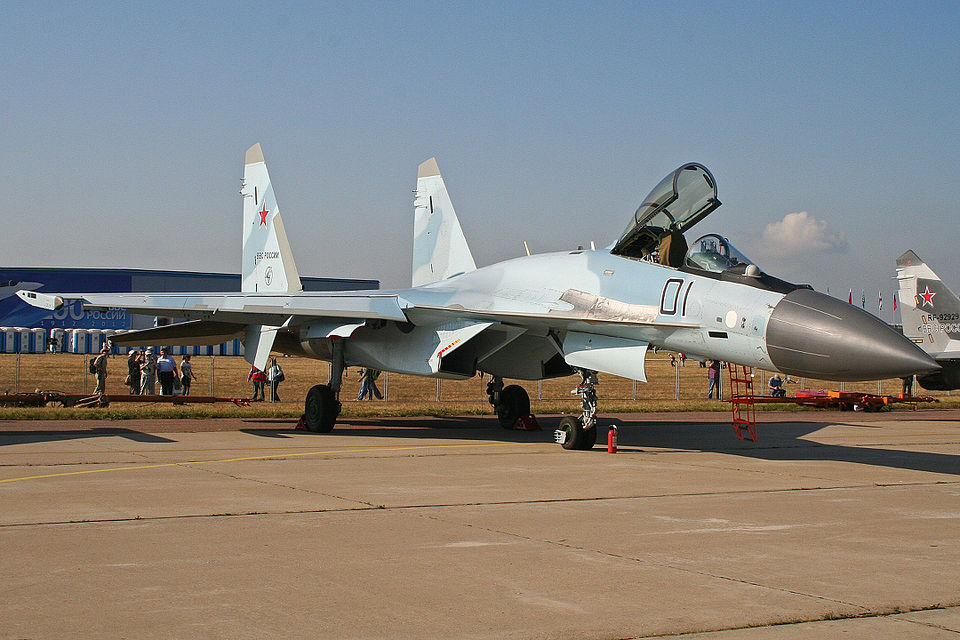
The Su-35S is the most capable non-stealth fighter Russia operates, and it remains a formidable threat even against modern platforms. The Su-35S builds on the famous Su-27 but adds thrust vectoring to make it extremely agile. It uses engines that allow the jet to fly faster than Mach 2.25. The Su-35S also features a powerful radar that can detect other planes from a very long distance. Even though it isn't a true fifth-generation fighter like the F-22 or J-20, its combination of speed and maneuverability keeps it on top among 4.5-generation jets.
Thrust vectoring is the Su-35S's defining feature. By directing engine exhaust in different directions, it can pull off maneuvers that appear to defy physics — including the famous Pugachev's Cobra, a high-angle-of-attack maneuver that was once thought impossible in operational conditions.
Pro Tip: Thrust vectoring doesn't just make a jet look impressive at air shows — it can bleed speed from a pursuing aircraft by forcing it to follow impossible turns, giving the Su-35S a real tactical edge in close combat.
The Su-35S is also one of Russia's primary export fighters, operating in several air forces around the world. It remains a serious, proven platform in any scenario where raw speed and agility are the deciding factors.
9. Chengdu J-10C (China)
The J-10C may not have the global profile of the F-22 or Su-57, but it has earned its place on this list — particularly after real-world events put it in the spotlight. As demonstrated in the India–Pakistan air conflict of May 2025, air superiority remains a decisive factor in conflict escalation, deterrence, and tactical response. The J-10C, operated by Pakistan, was reportedly involved in that conflict and attracted significant attention from defense analysts.
The J-10C is a 4.5th-generation single-engine multirole fighter equipped with an Active Electronically Scanned Array (AESA) radar and capable of carrying PL-15 long-range air-to-air missiles, which have a range that rivals or exceeds comparable Western weapons.
China has made the J-10C a cornerstone of its export strategy. Its performance has made other nations take China's domestic aviation industry more seriously than they did just a decade ago.
Why It Matters: The J-10C shows that feared fighter jets don't have to be fifth-generation or American. A well-designed 4.5th-gen jet with the right weapons and competent pilots can change the regional balance of power.
How These Jets Compare: A Quick Glance
| Jet | Generation | Top Speed | Stealth | Best Role |
| F-22 Raptor | 5th | ~Mach 2.25 | Excellent | Air superiority |
| F-35 Lightning II | 5th | ~Mach 1.6 | Excellent | Multirole |
| J-20 Mighty Dragon | 5th | ~Mach 2.0 | Very good | Long-range strike |
| Su-57 Felon | 5th | ~Mach 2.0 | Good (frontal) | Air combat / strike |
| Dassault Rafale | 4.5th | ~Mach 1.8 | Reduced RCS | Multirole |
| Eurofighter Typhoon | 4.5th | ~Mach 2.0 | Reduced RCS | Close air combat |
| F-15EX Eagle II | 4.5th | ~Mach 2.5 | Minimal | Heavy payload / strike |
| Su-35S | 4.5th | ~Mach 2.25 | Minimal | Agility / air combat |
| J-10C | 4.5th | ~Mach 2.0 | Reduced RCS | Multirole / export |
Note: Top speeds are approximate and vary by altitude and configuration.
The Technology Behind the Fear
Stealth: More Than Invisible
When people hear "stealth," they often think of invisible aircraft. The reality is more nuanced. A true stealth fighter combines low radar cross-section, infrared cross-section, acoustic reduction, visual signature reduction, and electromagnetic emissions management. Stealth is more accurately termed low observability and is much more than just radar cross-section.
The fighter jets with the lowest radar cross-sections are the F-22 Raptor and F-35 Lightning II, followed by the J-20 and J-35, and then the Su-57.
This matters because reducing radar signature buys the attacking pilot precious seconds — and in air combat, seconds are everything.
Sensor Fusion: The Pilot's Superpower
Modern fifth-generation jets don't just fly faster — they think faster. Sensor fusion is the ability to pull in data from radar, infrared sensors, electronic warfare systems, and datalinks, then present it all as one coherent picture in the cockpit. In fifth-generation fighters, all sensor information is integrated and presented in one comprehensive tactical picture, unlike fourth-generation fighters where you may have a separate radar scope, RWR, and datalink.
This reduces pilot workload and allows faster decisions — a significant combat edge.
Fun Fact: Some avionics-heavy fifth-generation jets are said to be so effective at gathering battlefield data that their pilots sometimes function more like battle managers than traditional fighter pilots.
Supercruise: Speed Without the Burn
Most jet fighters can fly supersonically — but only by using fuel-hungry afterburners. Supercruise is the ability to fly at supersonic speeds in dry thrust (no afterburner), which extends range and reduces thermal signature. The F-22 is one of the few jets capable of sustained supercruise.
Interested in aircraft built for maximum distance rather than maximum speed? Flying411 has you covered with guides to the best planes for long flights and best planes for transatlantic flights.
Fifth Generation vs. 4.5th Generation: Does It Really Matter?
This is one of the most debated questions in military aviation. The short answer: it depends on the mission.
Fifth-generation jets bring stealth and sensor fusion that 4.5th-generation jets can't fully match. But they typically carry fewer weapons, cost more to maintain, and aren't always the right tool for every job. Aircraft like the Su-35S or F-15EX can carry more weapons, cost less to maintain, and dominate in roles where stealth isn't essential.
A 4.5th-generation fighter like the Rafale or Eurofighter, flown by a skilled pilot in ideal conditions, can still be dangerous to stealth aircraft — as various exercise results have suggested over the years.
The real lesson? Generation labels are a starting point, not the final word.
Keep in Mind: Air forces rarely send a single fighter type into combat. The real threat comes from the combination — a stealth jet that clears the way, support aircraft that manage the battle space, and heavily armed fourth-gen jets that deliver the firepower.
For a broader look at aircraft that stand out for safety and reliability, check out Flying411's guide to the top safest planes in the world.
What Comes Next? The Future of Fighter Jets
The aircraft on this list won't be the last word. Nations are already developing the next generation of platforms. The U.S. is working on the Next Generation Air Dominance (NGAD) program, sometimes referred to as the F-47, which is said to incorporate even more advanced stealth and autonomous capabilities. The F-47 will supposedly come with a radar cross-section roughly comparable to that of an insect.
China and Europe are developing their own next-generation programs as well. Artificial intelligence is increasingly being discussed as part of cockpit systems, targeting, and even autonomous wingman aircraft that fly alongside piloted jets.
The arms race in the sky is far from over.
Curious about aircraft that push the performance envelope in a different way? Flying411's breakdown of planes that don't require a license and best planes for short flights explore the other end of the aviation spectrum.
Ready to go deeper into the world of aviation? Flying411 covers everything from military aircraft performance to practical flying guides — bookmark it and never stop learning.
Conclusion
The most feared fighter jets in the world aren't just machines — they're statements. Each one tells the world something about the nation that built it: its priorities, its doctrine, and its willingness to invest in the future of aerial power. From the unmatched stealth of the F-22 Raptor to the sheer agility of the Su-35S and the rising threat of the J-20, the list reflects a world where air superiority remains as contested — and as critical — as ever.
Understanding these aircraft isn't just for military enthusiasts. It's a window into geopolitics, engineering ambition, and the endless human drive to go faster, fly higher, and strike first.
For more aviation insight — from military hardware to practical flying knowledge — Flying411 is the place to start.
FAQ
What is the single most feared fighter jet in the world?
The F-22 Raptor is most consistently named as the most feared fighter jet in the world, particularly for its air-to-air combat capabilities and the combination of stealth, supercruise, and sensor fusion that no other jet fully replicates.
Is the F-35 more advanced than the F-22?
They serve different roles. The F-35 is a more versatile multirole platform with better ground attack sensors and broader allied integration. The F-22 is purpose-built for air superiority and is generally considered superior in a pure air-to-air fight.
What makes the Chengdu J-20 a threat to U.S. forces specifically?
Analysts believe the J-20 is built less for dogfighting and more for targeting the support aircraft — tankers, radar planes, command-and-control assets — that U.S. air power depends on. Its long range and stealth make it a strategic threat beyond just air-to-air combat.
Which fighter jet has the best combat record?
The F-15 Eagle platform, including the F-15EX, has a long-standing reputation for an undefeated air-to-air combat record spanning decades of real-world conflicts. It has accumulated more aerial victories without a single loss in air combat than any other modern jet.
Are any of these jets available for civilian viewing?
Several of these aircraft appear at air shows across the United States and Europe, including the F-22, F-35, and Eurofighter Typhoon. The F-22 in particular is known for dramatic airshow demonstrations that showcase its thrust vectoring and extreme agility.