Most people assume you need years of training and a stack of certifications before you can take to the sky. And for most aircraft, that's true. But there's a special category of flying machines that lets you skip the pilot's certificate entirely. These are planes that don't require a license — and they're more capable, more fun, and more accessible than most people realize.
In the United States, the Federal Aviation Administration (FAA) created a unique set of rules called FAA Part 103 that makes license-free flying legal. These rules cover a class of aircraft known as ultralight vehicles, and they're the key to getting airborne without a single hour of ground school.
Whether you're a curious beginner, a budget-conscious adventurer, or someone who just wants to feel the wind — this guide breaks down exactly what you need to know before you lift off.
Key Takeaways
Planes that don't require a license in the USA are called ultralight vehicles, regulated under FAA Part 103. No pilot certificate, no medical exam, and no aircraft registration is required as long as the aircraft meets specific weight, speed, and fuel limits. These aircraft must be single-seat, weigh no more than 254 pounds empty, carry no more than 5 gallons of fuel, fly no faster than 55 knots, and stall no faster than 24 knots. You can only fly them during daylight hours in uncontrolled airspace. Training is not legally required, but it is strongly recommended for safety.
| Takeaway | Details |
| Regulation | FAA Part 103 (14 CFR 103) |
| License required? | No — for qualifying single-seat ultralights |
| Registration required? | No — under Part 103 |
| Medical certificate needed? | No |
| Max empty weight (powered) | 254 lbs |
| Max empty weight (unpowered) | 155 lbs |
| Max top speed | 55 knots (about 63 mph) |
| Max stall speed | 24 knots (about 28 mph) |
| Max fuel capacity | 5 U.S. gallons |
| Max occupants | 1 (pilot only) |
| When can you fly? | Daytime only, VFR conditions |
| Airspace | Class G (uncontrolled) without restriction |
Flying411 is your go-to resource for all things aviation — from buying advice to aircraft comparisons and everything in between.
What Is FAA Part 103, and Why Does It Matter?
Before you start shopping for your first aircraft, it helps to understand the rule that makes all of this possible.
FAA Part 103, officially called 14 CFR Part 103, was adopted on July 30, 1982. It created a brand-new category of flying machine called the "ultralight vehicle." The rule was designed for recreational and sport flyers who wanted to take to the sky in small, simple aircraft without the burden of full aviation certification.
Here's the key insight: under Part 103, these vehicles are not classified as "aircraft" in the traditional FAA sense. They are treated more like powersport items — similar in regulatory spirit to a dune buggy or a jet ski. Because of that, the normal aircraft rules about airworthiness certificates, pilot certificates, and registration simply don't apply.
Good to Know: FAA Part 103 is often described as the most compact aviation regulation in existence. It's short, clear, and surprisingly easy to read. You can find the full text on the FAA's website.
The trade-off is that you accept full personal responsibility for safety on every flight. The FAA isn't inspecting your aircraft or verifying your skills. That freedom comes with accountability.
The FAA Part 103 Criteria — Does Your Aircraft Qualify?
Not every small plane qualifies as an ultralight vehicle. The FAA sets out specific limits that must all be met at the same time. Miss even one, and the aircraft becomes a regulated aircraft that requires a pilot certificate to fly.
Here are the requirements for a powered ultralight vehicle:
- Single seat — only one occupant (the pilot)
- Empty weight — no more than 254 pounds, excluding floats and safety devices
- Fuel capacity — no more than 5 U.S. gallons
- Top speed — no more than 55 knots (about 63 mph) in level powered flight
- Stall speed — no more than 24 knots (about 28 mph) power-off
For unpowered ultralights (like hang gliders):
- Single seat — one occupant only
- Empty weight — no more than 155 pounds
Heads Up: The empty weight limit doesn't include the pilot, fuel, or personal safety gear. But it does include everything structural — the airframe, wing, controls, engine, and landing gear. Always verify the manufacturer's listed empty weight before you buy.
What Happens If Your Aircraft Exceeds These Limits?
If your aircraft doesn't meet all of Part 103's criteria, it gets reclassified as either a Light-Sport Aircraft (LSA) or an Experimental Amateur-Built (EAB) aircraft. Both of those categories require a pilot certificate to fly — at minimum, an FAA Sport Pilot Certificate. The Sport Pilot Certificate is the easiest pilot license to obtain, requiring fewer flight hours than a Private Pilot Certificate, but it's still a formal certification process.
Operating Rules — What You Can and Can't Do
Owning a qualifying ultralight is one thing. Flying it legally is another. Part 103 comes with a set of operational rules every ultralight pilot must follow.
You CAN:
- Fly during daylight hours without a license
- Operate in Class G (uncontrolled) airspace freely
- Fly over open, unpopulated land without restriction
- Build or buy your aircraft without FAA airworthiness certification
You CANNOT:
- Fly at night
- Fly in instrument meteorological conditions (IMC) — clouds, fog, low visibility
- Fly over congested areas like cities, towns, or crowded events
- Carry passengers
- Fly in controlled airspace (Class B, C, D, or E) without prior Air Traffic Control (ATC) approval
Fun Fact: Ultralight vehicles are not required to have a radio, transponder, or any avionics equipment under Part 103 rules. However, many pilots carry a handheld radio for situational awareness and communication.
Do You Really Need No Training at All?
Legally? No. A pilot's license isn't required, and neither is any formal training. But here's the honest truth: skipping training is a bad idea.
The FAA, the United States Ultralight Association (USUA), and nearly every experienced ultralight pilot strongly recommend getting instruction before your first solo flight. Most beginners need somewhere between 10 and 20 hours of dual instruction to fly safely. That's still far less than the 40+ hours typically needed for a Private Pilot Certificate.
Pro Tip: Look for an FAA-authorized ultralight flight instructor in your area. Under a special FAA exemption, instructors can use a two-seat ultralight for dual training — even though two-seat ultralights are otherwise restricted. It's the safest and fastest way to build confidence.
Training matters because ultralight aircraft handle very differently from heavier general aviation planes. They're sensitive to wind, more susceptible to turbulence, and require good stick-and-rudder fundamentals to fly well. Getting those fundamentals from an experienced instructor isn't just smart — it could save your life.
The Best Planes That Don't Require a License
Now for the fun part. These are some of the most popular, well-regarded aircraft you can fly in the USA without a pilot's license, as long as they meet Part 103 criteria. Prices fluctuate, so always verify current pricing directly with manufacturers or dealers.
1. Aerolite 103
The Aerolite 103 is widely regarded as one of the benchmark ultralight aircraft on the market. It's a single-seat, high-wing, fabric-on-frame fixed-wing plane with tricycle landing gear. It weighs comfortably under the 254-pound limit and offers multiple engine options ranging from around 28 to 63 horsepower — including an electric option.
You can buy it as a quick-build kit or fully assembled and ready to fly. Assembly time for the kit is estimated at under 50 hours. Pricing generally starts in the mid-$20,000 range for fully assembled models, with kits available at a lower price point. Its stability, simplicity, and forgiving flight characteristics make it an excellent first ultralight.
2. Quicksilver MX103
The Quicksilver MX103 is another classic and trusted name in ultralight aviation. It features an open cockpit design and a straightforward strut-frame fuselage. The Quicksilver line has been around for decades and has earned a reputation for reliability and ease of maintenance.
It's a great choice for pilots who want a no-frills, proven design with a strong support community. Quicksilver also offers LSA-certified versions for pilots who want two seats and slightly more capability.
3. Phantom X1
The Phantom X1 is a tractor-configuration, high-wing ultralight that has been in production since the early 2000s. With over 2,000 aircraft built, it's one of the most popular Part 103 designs in the market. Factory options include brakes, a full airframe parachute system, and a range of Rotax engine choices from around 40 to 64 horsepower.
One of the Phantom X1's biggest selling points is its price. Fully-built units have historically been available in the $14,000 range, making it one of the more affordable entry points into Part 103 flying. Assembly time from a kit is estimated by the manufacturer at around 40 hours.
4. Quicksilver Sprint (and Sprint II)
The Sprint series from Quicksilver is a slightly more refined evolution of the classic MX design. It offers improved aerodynamics and a cleaner look while still meeting Part 103 specifications. It's a solid mid-tier option for pilots who want something slightly more polished than the basic open-frame designs.
5. Powered Parachute (PPC)
A powered parachute consists of a motorized cart (with a seat and engine) connected to a large parachute-shaped wing called a canopy. They are among the slowest and most stable Part 103 vehicles available, flying at speeds well under the legal 55-knot limit. Their low stall speed and inherent stability make them very forgiving for beginners.
PPCs are especially popular in rural areas with flat terrain. They require a clear, open launch area — typically a grass field or similar space — and land and take off at walking speed. Their biggest limitation is wind sensitivity: they generally shouldn't be flown in winds over about 12–15 mph.
If you're looking for an aircraft that feels relaxed and scenic rather than performance-focused, a PPC is hard to beat. They're also among the most affordable options, with some setups available in the low-to-mid five figures.
Why It Matters: Powered parachutes are widely considered one of the safest forms of powered flight. Their built-in stability and slow speeds give pilots significantly more recovery time in the event of an error compared to faster aircraft.
6. Paramotor (Powered Paraglider / PPG)
A paramotor is similar to a powered parachute but removes the wheeled cart entirely. The pilot wears the motor as a backpack and launches and lands on foot. The wing is a paraglider-style canopy. Paramotors are governed by FAA Part 103 just like other ultralight vehicles.
They are extraordinarily portable — you can fit the entire setup in the back of an SUV — and require no runway or airstrip. Their compact size and low cost (setups can be found starting in the low-to-mid five figures) make them one of the most accessible paths into aviation. However, they do require reasonable physical fitness for launch and landing.
If you're thinking about getting into paramotoring or powered parachutes, Flying411 has resources to help you compare aircraft types and understand your options.
7. Hang Glider (Powered)
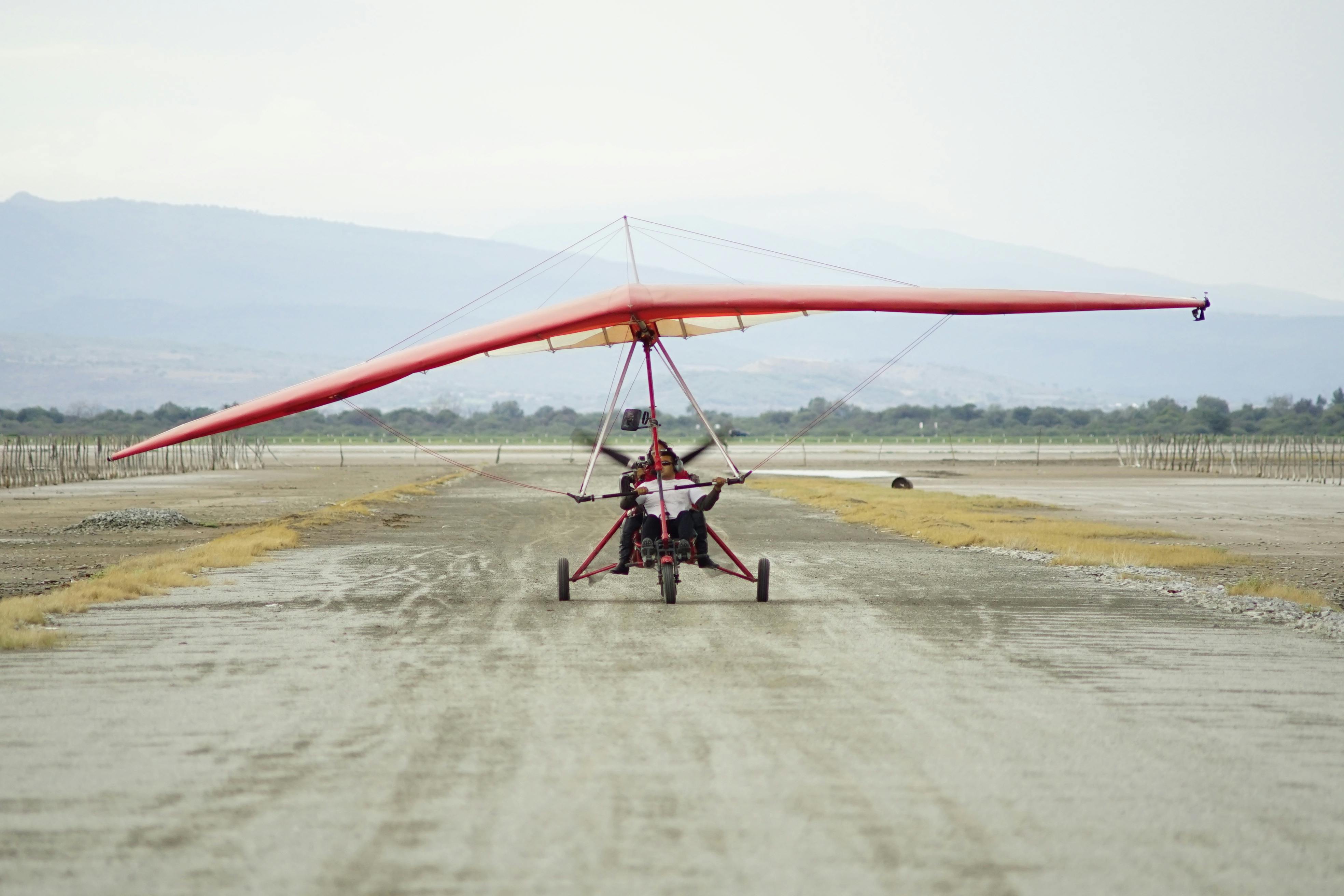
Traditional hang gliders are unpowered and fall under Part 103's unpowered category (155-pound weight limit). Powered hang gliders — also called foot-launched powered hang gliders (FLPHGs) or "trikes" — add an engine to the mix. The trike version seats the pilot in a wheeled carriage suspended under a rigid hang-glider wing.
Powered hang gliders offer a unique, open-air flying experience that feels like nothing else in aviation. The wing provides efficient glide performance, and the engine assists with climb and sustained level flight.
8. Hot Air Balloon (Small)
While not typically what people picture when they think of "planes," small hot air balloons can qualify as ultralight vehicles under Part 103 if they meet the single-seat and weight criteria. Balloon flight is one of the oldest and most peaceful forms of aviation. The experience is fundamentally different from powered flight — you go where the wind takes you, which means flights require a chase crew on the ground.
For most recreational balloon enthusiasts, commercially operated rides or certified LSA balloons are more practical. But for the true DIY aviator, a Part 103 balloon is a real option.
Keep in Mind: Hot air balloon flight requires careful weather planning, a chase crew, and a suitable landing area. Even though no license is required for a Part 103 balloon, the complexity of the operation means training is especially important.
9. Hummel UltraCruiser
The Hummel UltraCruiser is an all-metal ultralight aircraft that stands out for its more conventional airplane look. Unlike open-frame designs, the UltraCruiser has a traditional fuselage shape that gives it a look closer to a full general aviation plane. It's available as a plans-built kit, meaning the builder fabricates parts from scratch using the manufacturer's blueprints.
The all-metal construction makes it durable and long-lasting compared to fabric-on-frame designs. It's a popular choice for pilots who want the ultralight experience but prefer the feel and look of a conventional small airplane.
10. Weight-Shift Control Trike (Motorized)
A weight-shift control trike (often just called a "trike") pairs a hang-glider style wing with a wheeled carriage and engine. The pilot steers by shifting body weight rather than using conventional rudder and aileron controls. This makes the trike one of the more instinctive and natural-feeling aircraft to fly for many beginners.
Trikes that meet Part 103 criteria can be flown without a license. They're fast enough to be genuinely useful for local cross-country flying yet slow enough to stay within the legal speed limits.
Fun Fact: FAA Part 103 is often cited as one of the most permissive aviation regulations in the world. While many countries require at least a basic license or registration for ultralight aircraft, the U.S. system allows qualified ultralights to fly with almost no government paperwork at all.
How Much Does It Cost to Get Into Ultralight Flying?
Cost is one of the most appealing aspects of ultralight aviation. Here's a rough breakdown of what you might expect to spend:
| Category | Estimated Cost Range |
| New entry-level kit ultralight | ~$10,000–$20,000 |
| New ready-to-fly ultralight | ~$20,000–$35,000 |
| Used ultralight (good condition) | ~$4,000–$15,000 |
| Paramotor setup (new) | ~$10,000–$20,000 |
| Powered parachute setup (new) | ~$12,000–$25,000 |
| Ultralight flight instruction (10–20 hrs) | ~$1,000–$3,000 (varies widely) |
| Annual maintenance (DIY-friendly) | ~$500–$2,000/year |
Keep in mind these are general ballpark figures. Prices vary significantly by make, model, condition, and region. Always get a current quote from the manufacturer or a reputable dealer.
Quick Tip: If you're shopping for a used ultralight, bring along someone experienced in the specific make and model you're considering. Mechanical issues that aren't obvious to a beginner can be glaring to an experienced eye. Be cautious of deals that seem unusually cheap unless you're comfortable doing a full rebuild.
Ultralight vs. Light-Sport Aircraft — What's the Difference?
A lot of beginners confuse ultralights with Light-Sport Aircraft (LSAs). They're related but not the same thing.
| Feature | Ultralight (Part 103) | Light-Sport Aircraft (LSA) |
| License required | No | Yes (Sport Pilot Certificate minimum) |
| Passengers | None (pilot only) | Up to 1 passenger |
| Max seats | 1 | 2 |
| Max speed | 55 knots | ~120 knots |
| Max weight | 254 lbs (powered) | ~1,320 lbs (land plane) |
| Registration | Not required | Required |
| Airworthiness certificate | Not allowed | Required |
| Medical certificate | Not required | Valid driver's license accepted |
| Night flying | Not permitted | Permitted |
The LSA category was created by the FAA in 2004 to give recreational pilots more capability than ultralights while still keeping certification simpler than a full Private Pilot Certificate. If you find yourself wanting two seats, higher speeds, or the ability to fly at night, moving up to an LSA and getting a Sport Pilot Certificate is the logical next step.
For a closer look at some of the most reliable aircraft on the market today — including aircraft in the LSA category — Flying411 has a dedicated breakdown worth reading.
Where Can You Fly an Ultralight?
Location matters. Part 103 comes with clear airspace rules that every ultralight pilot must understand before taking off.
Class G airspace (uncontrolled airspace) is the home turf of ultralight aviation. In most rural areas of the United States, the airspace close to the ground is Class G, meaning you can fly there freely without talking to anyone or getting any permission.
Controlled airspace (Classes B, C, D, and E) requires prior ATC approval. This includes the airspace around busy airports. Getting that approval is possible, but it requires planning and communication.
Congested areas — cities, towns, stadiums, and crowded outdoor events — are off-limits under Part 103. Ultralight vehicles are specifically prohibited from flying over these areas.
Visibility and cloud clearance rules still apply. You must always fly with visual reference to the surface. Flying in clouds, fog, or below legal visibility minimums is prohibited even for ultralight pilots.
Good to Know: Even though no pilot certificate is required, ultralight pilots are still responsible for understanding and following FAA regulations. Ignorance of the rules is not a defense. The USUA and EAA both offer excellent resources and courses to help new ultralight pilots get up to speed.
If you're curious about how ultralight and light aircraft performance compares for shorter trips, this look at the best planes for short flights puts things in helpful perspective.
Safety: What You Need to Know Before You Fly
The freedom of Part 103 doesn't mean flying without consequences. Safety is entirely your responsibility as an ultralight pilot.
A few important truths:
- Ultralight accidents most often result from pilot error or mechanical failure. Regular self-inspection and a basic understanding of your aircraft's systems are essential.
- Lower speeds and lighter weight don't automatically mean safer. Ultralights are more exposed to weather effects than heavier aircraft. Turbulence that a Cessna would shrug off can be genuinely challenging in an ultralight.
- Maintenance is your job. There's no FAA-mandated inspection schedule for Part 103 vehicles. You set the standard. Most experienced ultralight pilots perform a thorough pre-flight inspection before every single flight.
- Training reduces risk significantly. Even if the law doesn't require it, investing in proper instruction from an experienced ultralight instructor is one of the best decisions a new pilot can make.
The FAA officially confirms that no pilot certificate is required to fly ultralight vehicles — but it also puts the full weight of personal safety responsibility on the operator.
For a broader look at how aviation safety compares across categories, Flying411's piece on the top safest planes in the world offers useful context on what makes an aircraft design genuinely safe.
Conclusion
Planes that don't require a license are a real, legal, and genuinely exciting gateway into the world of aviation. Thanks to FAA Part 103, anyone in the United States can get airborne in a qualifying single-seat ultralight without a pilot certificate, medical exam, or aircraft registration. From fabric-on-frame fixed-wings and motorized trikes to powered parachutes and paramotors, the options are wide and the entry costs are relatively modest compared to conventional aviation.
The key is understanding the rules, choosing the right aircraft for your goals, and investing in quality instruction even when the law doesn't require it. The sky is more accessible than most people think.
If you're ready to explore your options and find the right aircraft for your first flight, Flying411 is a great place to start your research, compare aircraft types, and get advice from people who are passionate about aviation.
FAQs
Do I need any training at all to fly an ultralight aircraft?
No formal training or certification is legally required under FAA Part 103. However, most aviation experts and the USUA strongly recommend getting at least 10–20 hours of instruction from an experienced ultralight flight instructor before flying solo.
Can I fly an ultralight at night?
No. FAA Part 103 strictly limits ultralight operations to daylight hours only. Night flying in an ultralight is not permitted.
Do I need to register my ultralight with the FAA?
Under FAA Part 103, qualifying single-seat ultralight vehicles are not required to be registered with the FAA. However, some local or state rules may vary, so it's worth checking with your local FAA Flight Standards District Office (FSDO).
Can I carry a passenger in an ultralight aircraft?
No. Part 103 ultralight vehicles are limited to a single occupant — the pilot. Carrying a passenger in a Part 103 ultralight is not permitted. If you want to fly with a passenger, you'll need to move up to a Light-Sport Aircraft and obtain a Sport Pilot Certificate.
How far can an ultralight aircraft fly?
Range depends on the specific aircraft, fuel capacity, and conditions, but many ultralights can cover roughly 100 miles on a full tank. Because fuel is capped at 5 gallons under Part 103, ultralights are best suited for local recreational flying rather than long cross-country trips.
What is the minimum age to fly an ultralight?
FAA Part 103 does not set a minimum age for operating ultralight vehicles. However, many ultralight flight instructors and clubs recommend that pilots be mature enough to handle the responsibility safely. Some organizations suggest a minimum age of 16 as a practical guideline.
Are ultralights allowed at all airports?
Not necessarily. While Part 103 vehicles can operate from many fields and open areas, some airports have specific local rules or grant-related restrictions that prohibit ultralight operations. Always check with the airport manager before attempting to use a controlled airport for ultralight operations.