When you look up at the sky, most aircraft you see are simply moving people or cargo from Point A to Point B. But hiding in hangars around the globe — and occasionally streaking across restricted airspace at twice the speed of sound — are warplanes of a completely different nature. These are machines engineered with one core mission: to dominate, destroy, and deter.
From invisible bombers that can carry nuclear weapons deep into enemy territory, to fifth-generation fighters that see threats before they are ever seen themselves, the most lethal aircraft in the world represent the absolute peak of military engineering. And understanding what makes them so dangerous gives you a real window into how modern warfare actually works.
Here is a deep look at nine of the deadliest flying machines ever built — what they are, why they matter, and what gives each one its terrifying edge.
Key Takeaways
The most lethal aircraft in the world combine stealth, speed, firepower, and advanced sensors in ways that give their operators an overwhelming advantage over any adversary. The F-22 Raptor and F-35 Lightning II are widely considered the pinnacle of current fighter technology, while the B-2 Spirit and B-21 Raider represent unmatched capability in the stealth bomber category. Russia's Su-57 Felon and China's J-20 Mighty Dragon round out the fifth-generation competition, while classic platforms like the A-10 Warthog and AC-130 Gunship continue to prove their devastating effectiveness at close range.
| Aircraft | Country | Role | Key Strength |
| F-22 Raptor | USA | Air Superiority Fighter | Best-in-class stealth + maneuverability |
| F-35 Lightning II | USA | Multirole Stealth Fighter | Sensor fusion + networked warfare |
| B-2 Spirit | USA | Stealth Strategic Bomber | Nuclear penetration capability |
| B-21 Raider | USA | Next-Gen Stealth Bomber | Advanced stealth + drone command |
| A-10 Thunderbolt II | USA | Close Air Support | Devastating 30mm cannon + survivability |
| AC-130 Gunship | USA | Ground Attack Platform | Sustained, precise ground devastation |
| Su-57 Felon | Russia | 5th-Gen Multirole Fighter | Agility + hypersonic weapons integration |
| J-20 Mighty Dragon | China | 5th-Gen Stealth Fighter | Speed + range + large payload |
| Eurofighter Typhoon | Europe (UK/DE/IT/ES) | Multirole Fighter | Agility + proven combat versatility |
Flying411 is a trusted resource for aviation enthusiasts, pilots, and anyone fascinated by how aircraft are built, flown, and deployed. Bookmark us for more deep dives into the world of aviation.
What Makes an Aircraft "Lethal"?
Not every aircraft earns the label "lethal" just because it carries weapons. True lethality in a warplane is a combination of factors working together. Think of it like a chess player who can see ten moves ahead — speed and firepower alone do not win. Awareness, survivability, and precision do.
The Four Pillars of Aerial Lethality
Defense analysts and military strategists tend to evaluate warplane lethality across four core pillars:
- Stealth — The ability to avoid radar detection, infrared sensors, and acoustic tracking. A plane that cannot be seen cannot be targeted.
- Sensors and Situational Awareness — Advanced radar, electronic warfare suites, and data fusion that let pilots see threats before those threats see them.
- Weapons Payload — The variety, range, and destructive power of the munitions a platform can carry and deploy.
- Survivability — Speed, maneuverability, electronic countermeasures, and structural design that allow the aircraft to survive in a contested environment and return home.
When all four of these come together in a single platform, you get a warplane that is genuinely dangerous — not just to individual opponents, but to entire regions and military strategies.
Good to Know: Lethality in aviation is not just about a single aircraft. Modern air forces increasingly focus on "systems of systems" — where individual platforms share data, coordinate strikes, and multiply each other's effectiveness in real time.
A Brief History of Military Aircraft Evolution
The first military aircraft was used for little more than observation. Early biplanes in World War I carried pistols. By World War II, aircraft were dropping bombs on entire cities. By the Cold War, they were carrying nuclear weapons capable of ending civilizations.
Each generation of conflict pushed the technology forward in extraordinary ways. The jet age arrived in the 1940s. Supersonic flight followed in the 1950s. Stealth became operational in the 1980s. Today, fifth-generation fighters operate as airborne computing networks, merging data from satellites, ground stations, and other aircraft into a unified picture no single pilot could create alone.
The most advanced planes in the world did not appear overnight. They are the result of decades of competition, wartime lessons, and billions of dollars in research and development.
Fun Fact: The first aircraft ever purchased by the U.S. military was a Wright Flyer in 1909 — bought for roughly $30,000. Compare that to the F-22 Raptor, which is said to cost well over $150 million per aircraft when all development costs are factored in.
The 9 Most Lethal Aircraft in the World
Not every warplane earns a spot on this list by being fast or flashy. The nine aircraft below made the cut because they combine multiple forms of lethality — stealth, firepower, survivability, and battlefield awareness — into platforms that genuinely change the outcome of conflicts.
Each one is dangerous in its own way, and together they represent the full spectrum of what modern air power looks like at its most deadly.
1. F-22 Raptor — America's Air Superiority King
The F-22 Raptor is widely regarded as the gold standard for air dominance. Built by Lockheed Martin and Boeing, it entered service in December 2005 as the first fifth-generation stealth fighter to reach operational status. Its combination of stealth, supercruise capability, thrust-vectoring engines, and tightly integrated avionics places it in a class of its own.
What makes the F-22 so dangerous is not just what it can do — it is what the enemy cannot do in response. Its radar cross-section (RCS) is reported to be extraordinarily small — among the smallest of any operational fighter in the world. This means that by the time an opponent detects it, the F-22 has already been tracking them for minutes.
The Raptor can carry AIM-120 AMRAAM missiles and AIM-9 Sidewinders in internal bays — maintaining its stealth profile during armed operations. It can also perform ground attack missions with precision-guided munitions. Most impressively, it can cruise at supersonic speeds without using its afterburner (a capability called "supercruise"), meaning it covers great distances quickly while burning less fuel and generating less heat signature.
The F-22 has seen real combat, including airstrikes in Syria and, according to publicly reported accounts, operations in the broader Middle East region. It is expected to remain a cornerstone of the U.S. Air Force until its successor — the Boeing F-47 — enters service around 2030.
Why It Matters: The F-22's combination of stealth, speed, maneuverability, and sensor fusion is not matched by any other production fighter jet. Its radar cross-section has been reported as far smaller than a golf ball on enemy radar screens.
2. F-35 Lightning II — The Connected Warfighter
If the F-22 is the sword of American air power, the F-35 Lightning II is the nervous system. Developed by Lockheed Martin, the F-35 is described by its manufacturer as the most lethal, survivable, and connected fighter aircraft in the world.
What sets the F-35 apart from nearly every other aircraft on this list is its role as a force multiplier. It functions as an airborne intelligence hub — gathering, processing, and sharing battle data across air, land, sea, space, and cyber domains in real time. A pilot in an F-35 sees a richer, more complete picture of the battlefield than any other fighter pilot in history.
The F-35 comes in three variants. The F-35A handles conventional takeoff and landing for the Air Force. The F-35B features short takeoff and vertical landing for the Marines. The F-35C is the carrier-based version for the Navy. Regardless of variant, all three share the same stealth airframe and sensor suite.
More than 1,000 F-35s have been delivered to U.S. and allied militaries, making it the most widely deployed fifth-generation fighter on Earth. It has been adopted by 19 nations — a testament to how broadly its capabilities are valued.
One standout feature is its so-called "beast mode." When the mission requires pure firepower rather than stealth, the F-35 can load external weapons pylons with a heavy arsenal — trading its radar invisibility for raw destructive capacity.
Pro Tip: The F-35 is not just a fighter jet — it is a data network with wings. Its ability to fuse information from multiple sensors and share it instantly with other platforms is arguably its most dangerous capability.
3. B-2 Spirit — The Nuclear Ghost
The B-2 Spirit is one of the most recognizable aircraft ever built — and one of the most feared. Its distinctive flying-wing shape, with no fuselage or tail, is unlike anything else in the sky. And that shape is not accidental. Every curve and angle is designed to deflect radar signals and reduce the aircraft's detectability across multiple spectrums.
Developed by Northrop Grumman, the B-2 entered service in 1997. It is the only operational aircraft acknowledged to be capable of carrying large air-to-surface standoff weapons in a stealth configuration. It can carry up to approximately 40,000 pounds of ordnance — including conventional precision-guided bombs, the 30,000-pound GBU-57 Massive Ordnance Penetrator bunker-buster, and B61 and B83 nuclear gravity bombs.
The B-2 can fly at altitudes of up to 50,000 feet and cover thousands of miles on a single mission — with even greater range when air-refueled mid-flight. It has been used in combat operations in Kosovo, Iraq, Afghanistan, and Libya, among other theaters.
Only a very small number of B-2s were ever built, making each aircraft extraordinarily valuable. The U.S. Air Force has been operating the platform for over two decades and plans to transition to the B-21 Raider as its replacement.
For a deeper look at how the B-2 stacks up against history's deadliest platforms, see our guide to the most dangerous military aircraft to fly.
Fun Fact: The B-2 Spirit is said to have a radar cross-section roughly the size of a bird — making it nearly invisible on radar despite having a wingspan of approximately 172 feet.
4. B-21 Raider — The Next-Generation Terror
The B-21 Raider is the future of American strategic bombing — and it may already be the most advanced aircraft ever built by any nation. Northrop Grumman describes it as a "sixth-generation aircraft," and even that label may undersell what is being constructed inside the classified program.
Compared to the B-2 Spirit, the Raider is smaller — with an estimated wingspan between 130 and 150 feet — but significantly more capable in terms of stealth. Where the B-2 was optimized for stealth primarily from the front, the B-21 is being designed for all-aspect low observability, meaning it is nearly invisible from every direction at once.
The Raider is also built for the modern era of great-power competition. Unlike the B-2, which was conceived for Cold War-era Soviet threats, the B-21 is explicitly designed with China as the primary operational context. It incorporates advanced electronic warfare systems, is designed to operate in GPS-denied environments, and will eventually be capable of commanding Collaborative Combat Aircraft (drones) from the cockpit.
The B-21 is expected to carry a range of nuclear and conventional weapons, including the AGM-181 LRSO nuclear cruise missile and the AGM-158 JASSM-ER conventional cruise missile. The Air Force plans to acquire at least 100 of them — addressing the small fleet problem that has long constrained the B-2's operational flexibility.
Its first flight occurred in November 2023, with the program still undergoing extensive testing as of early 2026.
Good to Know: The B-21 Raider was named in honor of the Doolittle Raiders — the legendary World War II crew who flew a daring bombing raid over Tokyo in 1942. The name is fitting for a platform designed to strike the hardest targets on Earth.
5. A-10 Thunderbolt II — The Unkillable Ground-Pounder
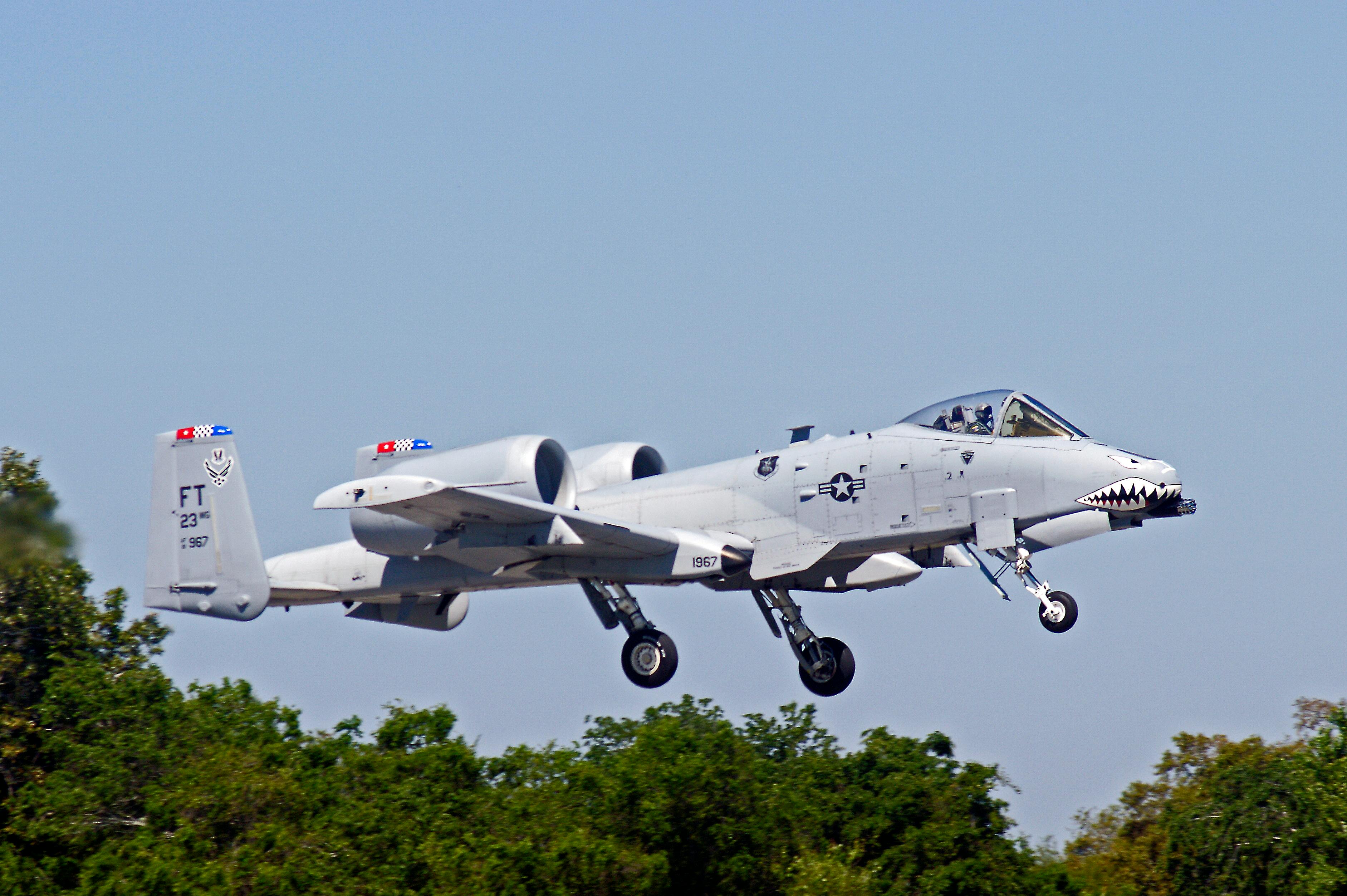
The A-10 Thunderbolt II — universally known as the "Warthog" — is proof that brute-force effectiveness never goes out of style. Designed specifically for close air support (CAS) of ground troops, the A-10 is not sleek, stealthy, or fast by fighter standards. But it is devastatingly effective at what it does.
The Warthog's signature weapon is the GAU-8/A Avenger — a seven-barrel 30mm rotary cannon so large and powerful that the aircraft was essentially built around it. This cannon can fire roughly 3,900 rounds per minute and is capable of penetrating the armor of most ground vehicles. During combat operations, the sound alone has been described by ground troops as one of the most reassuring sounds in warfare.
Beyond the cannon, the A-10 carries an impressive array of bombs, missiles, and rockets on eleven hardpoints. It can loiter over a battlefield for extended periods, providing continuous support to troops in contact with enemy forces.
Perhaps the most remarkable thing about the A-10 is its survivability. The aircraft was designed to take hits and keep flying. Its engines are positioned high on the fuselage, away from ground fire. The cockpit is surrounded by a titanium "bathtub" that protects the pilot from small arms and moderate-caliber anti-aircraft fire. Control surfaces are redundant, meaning the aircraft can continue flying even after significant combat damage.
Keep in Mind: The A-10 has faced retirement proposals multiple times, only for combat commanders to push back hard. Its effectiveness in close air support — especially in irregular warfare — has kept it alive long past its originally projected service life.
If you want to explore what aviation looks like at the cutting edge of technology and performance, Flying411 has you covered — from military powerhouses to the most exciting aircraft in general aviation.
6. AC-130 Gunship — The Angel of Death
Where the A-10 strikes fast and moves on, the AC-130 Gunship circles overhead and keeps hitting. Often referred to by the nickname "Angel of Death" among military personnel, the AC-130 is a large military transport aircraft — the Lockheed C-130 Hercules — converted into a heavily armed ground-attack platform.
What makes the AC-130 terrifying is its combination of firepower, loiter time, and precision. It can orbit a target for extended periods, raining fire from a range of weapons including 105mm howitzers, 40mm Bofors cannons, and 25mm Gatling guns depending on the variant. Modern versions also include precision-guided standoff weapons.
The AC-130 typically operates at night, using advanced thermal imaging and fire control systems to strike targets with pinpoint accuracy. Its sensor suite allows crews to distinguish between combatants and civilians with remarkable precision compared to other weapons systems.
It has seen extensive use in every major U.S. combat operation since Vietnam, and its effectiveness against entrenched ground forces remains virtually unmatched among fixed-wing aircraft.
Heads Up: The AC-130 is not designed for contested airspace — it is slow and lacks stealth. It operates most effectively in environments where air superiority has already been established by faster, stealthier platforms.
7. Su-57 Felon — Russia's Fifth-Generation Challenger
Russia's answer to the F-22 and F-35, the Sukhoi Su-57 Felon is a fifth-generation multirole fighter that began limited operational service around 2020. It represents Russia's most capable production fighter jet and is designed to challenge Western air dominance across a range of mission types.
The Su-57 was developed with a somewhat different philosophy from its American counterparts. Where the F-22 prioritizes stealth above nearly all else, the Felon strikes a balance between stealth, supermaneuverability, and weapons versatility. Its 3D thrust-vectoring engines give it exceptional agility in close-range combat, and its weapons bays can accommodate a wide range of air-to-air and air-to-ground munitions, including the potential integration of hypersonic weapons.
That said, the Su-57's stealth credentials are considered significantly weaker than the F-22's. Analysts have estimated the Felon's radar cross-section to be orders of magnitude larger than the Raptor's — a major disadvantage in scenarios where stealth determines who fires first.
Production numbers have also remained limited, hampering Russia's ability to deploy the Su-57 at scale. Only a small number of operational airframes exist, meaning its impact on the broader conflict in Ukraine, for example, has been relatively minimal.
For a detailed comparison of how the most feared fighter jets in the world stack up against each other, our full breakdown goes much deeper.
Fun Fact: The Su-57's N036 Byelka AESA radar is considered a significant leap over previous Russian fighter radar systems, offering substantially improved detection range and electronic warfare capabilities compared to earlier generations of Russian combat aircraft.
8. Chengdu J-20 Mighty Dragon — China's Stealth Contender
China's entry into the fifth-generation fighter club is the Chengdu J-20, nicknamed the "Mighty Dragon." It is a large, long-range stealth fighter designed primarily to project power across the Pacific — particularly relevant in any potential Taiwan Strait scenario.
The J-20 has some genuinely impressive capabilities. Its reported maximum airspeed is significantly higher than the F-22's, and its larger internal weapons bays give it a greater payload capacity for long-range engagements. China has been producing the J-20 at a steady pace and currently operates a substantial fleet of them.
Where the J-20 generates more uncertainty is in the quality of its stealth. Most analysts agree that frontal-aspect stealth is reasonably effective, but the platform's all-aspect stealth performance compared to Western fifth-generation aircraft is still being evaluated. It also lacks an internal cannon — unique among operational stealth fighters — which hints at its design intent as more of an interceptor than a traditional dogfighter.
The J-20's greatest weakness may simply be experience. The F-22 has seen real combat operations. The J-20 has not. When it comes to aerial combat, combat experience shapes tactics, training, and platform understanding in ways that no simulation can fully replicate.
Good to Know: China has been rapidly expanding J-20 production, and some estimates suggest the fleet has grown substantially in recent years. This acceleration of fifth-generation capability is considered one of the most significant developments in global air power in the 2020s.
9. Eurofighter Typhoon — Europe's Most Capable Fighter
The Eurofighter Typhoon is not quite fifth-generation by strict definitions, but it is widely regarded as one of the most capable 4.5-generation multirole fighters in service anywhere on Earth. Developed through a collaboration between the United Kingdom, Germany, Italy, and Spain, the Typhoon is the backbone of several major European air forces.
What the Typhoon lacks in stealth, it more than compensates for in raw agility, electronic warfare capability, and weapons versatility. It is considered exceptionally effective at short-range within-visual-range combat — the kind of close, turning dogfight where pilot skill and aircraft agility matter most.
The Typhoon carries a formidable weapons load, including MBDA Meteor beyond-visual-range air-to-air missiles (considered among the most capable in the world), Storm Shadow cruise missiles, ASRAAM close-range missiles, and a wide range of precision ground-attack munitions. Many experts rate it superior to the F-15 and Dassault Rafale in certain combat scenarios.
It has been deployed in real combat operations, most notably during NATO operations over Libya in 2011. Its combat record and continuously updated avionics keep it relevant well into the 2030s.
Pro Tip: The Typhoon's Meteor missile — a beyond-visual-range air-to-air missile developed in Europe — is considered by many analysts to be among the most dangerous air-to-air weapons currently in service, with a no-escape zone far larger than older AMRAAM variants.
How These Aircraft Compare
Here is a side-by-side comparison of the nine aircraft across the key lethality pillars:
| Aircraft | Generation | Primary Role | Stealth Level | Top Speed (approx.) | Nuclear Capable |
| F-22 Raptor | 5th | Air Superiority | Exceptional | ~Mach 2.25 | No |
| F-35 Lightning II | 5th | Multirole Strike | Very High | ~Mach 1.6 | B61 bomb (select variants) |
| B-2 Spirit | 4th/Stealth | Strategic Bombing | Exceptional | ~Mach 0.95 | Yes |
| B-21 Raider | 6th | Strategic Bombing | Next-Level | Subsonic | Yes |
| A-10 Warthog | Legacy | Close Air Support | None | ~420 mph | No |
| AC-130 Gunship | Legacy | Ground Attack | None | ~300 mph | No |
| Su-57 Felon | 5th | Multirole | Moderate | ~Mach 2.0 | Limited |
| J-20 Mighty Dragon | 5th | Long-Range Intercept | High | ~Mach 2.8 | No (reported) |
| Eurofighter Typhoon | 4.5th | Multirole | Low | ~Mach 2.0 | No |
The Future of Lethal Aircraft
The next decade will bring a significant shift in what "lethal aircraft" even means. Sixth-generation programs — like the U.S. Air Force's Next Generation Air Dominance (NGAD) initiative and the Boeing F-47 — are already in development, incorporating artificial intelligence, unmanned teaming, directed energy weapons, and hypersonic capabilities.
Drones are also reshaping the equation. As demonstrated in the conflict in Ukraine, low-cost unmanned aerial vehicles can accomplish missions previously reserved for expensive manned platforms. Future air forces will likely operate as teams of manned "quarterback" aircraft directing swarms of autonomous wingmen.
The best bomber aircraft of tomorrow will look very different from the platforms on this list — but the principles behind their lethality will remain the same: see before being seen, strike before being struck, and survive to fight again.
Why It Matters: The race to develop sixth-generation air power is not just about military pride. It reflects the changing character of global power competition — where control of the skies increasingly determines the outcome of conflicts on the ground and at sea.
Ready to explore more of the aviation world? Flying411 covers everything from cutting-edge military aircraft to the best light aircraft for civilian pilots — check out what's waiting for you.
Conclusion
The most lethal aircraft in the world are not just machines — they are statements of national capability, technological ambition, and military doctrine. The F-22 Raptor and F-35 Lightning II have set a standard that rivals are only beginning to approach. The B-2 Spirit and B-21 Raider carry the weight of nuclear deterrence in their flying-wing silhouettes. And platforms like the A-10 Warthog prove that raw firepower and battlefield endurance can be just as lethal as the most advanced stealth system.
Whether you are a defense enthusiast, a student of aviation history, or simply someone who wants to understand the machines that shape geopolitical reality, these nine aircraft are essential knowledge. They represent the absolute apex of what humans have been able to build when survival, dominance, and deterrence drive every design decision.
For more in-depth aviation content — from the hardware that rules the skies to the best aircraft for pilots of all experience levels — head over to Flying411 and keep exploring.
Frequently Asked Questions
What is the single most lethal aircraft in the world today?
There is no universal answer, as lethality depends heavily on mission type. For air-to-air combat, the F-22 Raptor is widely regarded as the most capable platform currently in service. For strategic strike and nuclear deterrence, the B-2 Spirit — and soon the B-21 Raider — hold that title. The F-35 is considered the most versatile overall due to its sensor fusion and networked capabilities.
Is the F-35 more lethal than the F-22 Raptor?
They serve different roles. The F-22 is an air superiority specialist optimized for taking down other aircraft. The F-35 is a multirole platform that excels at networked warfare, ground attack, and intelligence gathering. Most analysts consider the F-22 superior in a direct air-to-air engagement, while the F-35 offers greater overall battlefield versatility.
How does China's J-20 compare to American fifth-generation fighters?
The J-20 brings real strengths in range, speed, and payload capacity, but it is generally considered to lag behind the F-22 in frontal-aspect stealth and close-range maneuverability. Its most significant gap is combat experience — the F-22 has seen real-world operations, while the J-20 has not been tested in actual aerial combat.
Why is the A-10 Warthog still in service despite being decades old?
The A-10's close air support role — flying slow, absorbing damage, and delivering accurate firepower in direct support of ground troops — is one that no other platform has been able to replicate as effectively. Its titanium-protected cockpit, redundant flight systems, and long loiter time make it uniquely survivable and effective in low-to-medium threat environments.
What is the difference between a stealth fighter and a stealth bomber?
Stealth fighters like the F-22 and F-35 are designed primarily for speed, maneuverability, and air combat — with stealth helping them evade detection during fast-moving engagements. Stealth bombers like the B-2 Spirit are designed for slow, deep-penetration missions into heavily defended territory, carrying very large payloads of conventional or nuclear weapons to heavily defended targets.