There is something almost unreal about the aircraft flying today. Some can vanish from radar screens. Others can cruise at speeds that make a cross-ocean flight feel like a quick road trip. A few can do things no human pilot could survive without computer assistance. Aviation has always pushed the edge of what is possible, but the aircraft of the 2020s represent a genuinely different level — a fusion of stealth, speed, artificial intelligence, and materials science that would have seemed like science fiction just a generation ago.
So which aircraft deserve the title of most advanced planes in the world? That is not a simple question. "Advanced" means different things depending on what you are measuring. Raw speed? Stealth? Onboard computing power? The ability to talk to satellites, drones, and allied aircraft simultaneously while threading through enemy air defenses?
The planes on this list earn their spots across all of those dimensions. They are the machines pushing every known limit — and in several cases, redefining what a "limit" even means.
Key Takeaways
The most advanced planes in the world today combine stealth technology, supersonic or hypersonic speed, and sophisticated onboard computing that no previous generation of aircraft has matched. The F-35 Lightning II is widely regarded as the most capable multirole fighter in active service, while the B-21 Raider is considered the most advanced bomber ever built. Several fifth-generation fighters from the U.S., China, and Russia round out the list, alongside experimental and next-generation platforms that are rewriting the rules of what aircraft can do.
| Aircraft | Country | Key Distinction |
| F-35 Lightning II | USA | Most widely deployed fifth-gen fighter |
| F-22 Raptor | USA | Premier air superiority stealth fighter |
| B-21 Raider | USA | Most advanced stealth bomber ever built |
| Chengdu J-20 | China | China's primary fifth-gen stealth fighter |
| Sukhoi Su-57 | Russia | Russia's only fifth-gen fighter |
| F-15EX Eagle II | USA | Most advanced non-stealth fighter |
| Eurofighter Typhoon | Europe (Multi-nation) | Elite NATO multirole platform |
| Dassault Rafale | France | Advanced multirole with nuclear capability |
| Saab JAS 39 Gripen E | Sweden | Most cost-effective advanced fighter |
| Sukhoi Su-35S | Russia | Best 4th-gen fighter in service |
| SR-72 "Son of Blackbird" | USA | Next-gen hypersonic reconnaissance platform |
Flying411 covers the world of aviation from every angle — whether you are an enthusiast curious about the latest aircraft technology or a pilot exploring your next step. It is one of the best resources for staying current on what is happening in the skies.
What Makes a Plane "Advanced"?
Before jumping into the list, it helps to understand what sets these aircraft apart from everything else flying today.
Stealth is one of the biggest factors. A stealthy aircraft is not invisible — it simply reduces its radar cross-section (RCS) to a point where detection is drastically harder. Some of the aircraft below have an RCS described as roughly the size of a small bird or insect on radar screens.
Sensor fusion is another key differentiator. Modern advanced fighters do not just fly — they process enormous amounts of data from radar, infrared sensors, electronic warfare systems, and allied networks simultaneously. The pilot sees a synthesized, real-time picture of the battlefield rather than a collection of raw feeds.
Beyond those two pillars, advanced aircraft also stand out for:
- Supercruise ability — sustained supersonic flight without burning fuel in afterburner
- Open systems architecture — modular designs that can be updated quickly with new software or hardware
- Network-centric warfare — the ability to share targeting data with other aircraft, ships, and ground forces in real time
- Advanced propulsion — engines that push performance envelopes previously considered unachievable
Good to Know: The term "fifth-generation fighter" is not officially standardized across all militaries, but it generally refers to aircraft that combine stealth, supercruise, advanced sensors, and highly integrated avionics — all working together as a single system.
With that framework in mind, here is the full list.
The 11 Most Advanced Planes in the World
These eleven aircraft were chosen because they each represent a meaningful leap forward in what aviation technology can do — not just speed or firepower in isolation, but the full package of stealth, sensors, computing power, and adaptability. Some are in active service today.
One is still emerging from the shadows. All of them are rewriting what it means to fly at the edge of human capability.
1. Lockheed Martin F-35 Lightning II (USA)
The F-35 Lightning II is arguably the defining aircraft of the 21st century so far. It is a multirole stealth fighter that comes in three variants: the F-35A for conventional air force operations, the F-35B with short takeoff and vertical landing capability for the Marines, and the F-35C designed for aircraft carrier operations.
What makes the F-35 genuinely extraordinary is not any single feature — it is the integration. The aircraft's sensor suite, radar, electronic warfare systems, and communications all feed into a unified picture that gives pilots an awareness of the battlefield unlike anything seen before. Its Distributed Aperture System (DAS) essentially lets pilots "see through" the aircraft in any direction.
Key specs at a glance:
- Top speed: Around Mach 1.6
- Powered by the Pratt & Whitney F135 — widely considered the most powerful fighter engine ever produced
- Now in service with over a dozen allied nations
- More than 1,000 aircraft delivered as of 2025, with production continuing
The F-35 has seen real combat too. Israeli F-35s were used in complex air defense suppression operations in 2025, and Polish F-35s intercepted hostile drones — the first time the type was deployed in active European air defense. An Israeli pilot described it as "the best plane technologically now in the world."
Fun Fact: The F-35 program's 2025 production run was reportedly the most productive in the history of the program, with deliveries exceeding those of all other allied fighter jets combined.
The F-35 connects to the broader question of what makes aircraft truly reliable in high-stakes environments — something explored in depth in this guide to the most reliable aircraft.
2. Lockheed Martin F-22 Raptor (USA)
The F-22 Raptor holds a special place in aviation history as the world's first operational fifth-generation fighter. It entered service with the U.S. Air Force in 2005 and remains one of the most capable air-superiority platforms ever built.
Where the F-35 is a multirole jack-of-all-trades, the F-22 was designed with one thing in mind: dominating the skies against any threat. Its combination of stealth, supercruise, thrust-vectoring engines, and sensor fusion is still unmatched in the pure air-to-air role.
The F-22's twin Pratt & Whitney F119 engines each produce around 35,000 pounds of thrust, with thrust-vectoring nozzles that enable maneuvers at extreme angles of attack. Its supercruise ability allows it to sustain speeds above Mach 1.8 without afterburner — a meaningful tactical advantage that reduces both fuel burn and infrared signature.
Production of the F-22 ended at around 187 aircraft, largely due to costs that climbed well above $300 million per unit when development expenses are included. Congress also prohibited export, meaning only the U.S. Air Force flies it.
Pro Tip: The F-22's radar cross-section is often cited as being comparable in size to a bumblebee or small marble on radar screens, though these figures come from unclassified estimates rather than official data.
3. Northrop Grumman B-21 Raider (USA)
The B-21 Raider is the newest and arguably most mysterious aircraft on this list. Northrop Grumman describes it as the "world's first sixth-generation aircraft to reach the skies" — a claim that signals just how significant a technological leap it represents.
The B-21 is a stealth strategic bomber designed to penetrate the most contested airspace on earth. It made its first flight in November 2023 and has been in an active flight test program since. Its design is a further evolution of the flying-wing shape pioneered by the B-2 Spirit, but with next-generation stealth coatings, more advanced avionics, and what Northrop calls an "open systems architecture" — meaning the aircraft can be upgraded rapidly as new technologies become available.
Critically, the B-21 can be operated in either crewed or uncrewed configurations, making it one of the most versatile bombers ever conceived.
Each B-21 is estimated to cost around $692 million. The Air Force plans to acquire around 100 aircraft to eventually replace the aging B-1 and B-2 fleets.
Why It Matters: The B-21 was specifically designed with a potential conflict in the Indo-Pacific in mind, where the ability to penetrate advanced air defense networks over long ranges is considered essential. Unlike the B-2, which was designed around the Soviet threat, the B-21 reflects the realities of 21st-century strategic competition.
The B-21 also has the rare ability to carry both conventional and nuclear munitions, including next-generation nuclear gravity bombs.
4. Chengdu J-20 "Mighty Dragon" (China)
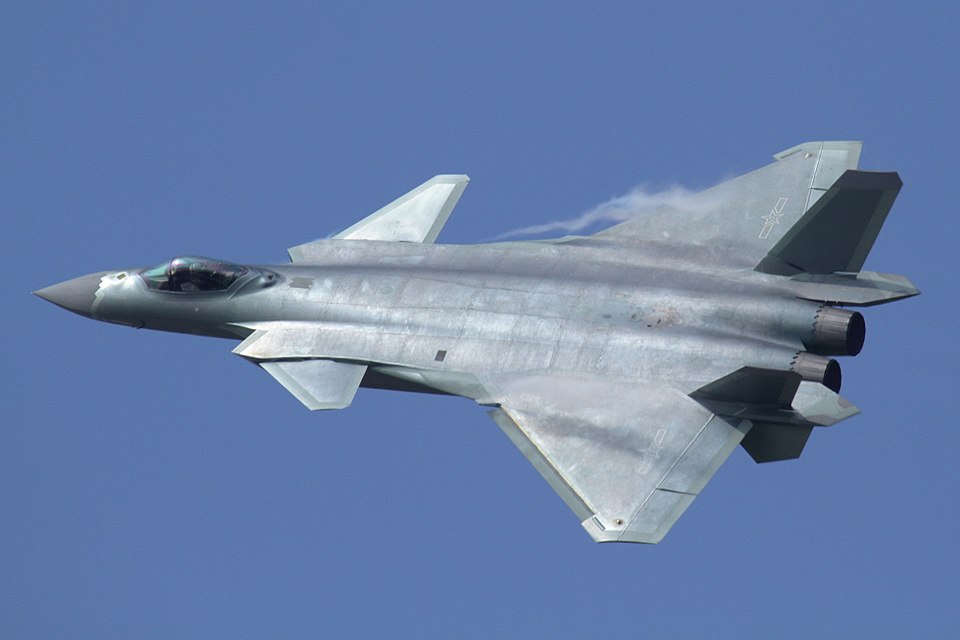
The J-20 is China's answer to the F-22 and the most capable fighter ever produced by the People's Liberation Army Air Force (PLAAF). It entered active service in 2017 and has since been produced in steadily growing numbers, making it the second most common fifth-generation fighter in the world after the F-35.
The J-20 is notably large for a fighter, which gives it an extended combat range — a deliberate design choice that reflects China's strategic priorities in the Pacific. Like the F-22, China maintains a strict export ban on the J-20.
The aircraft has seen significant upgrades since entering service. By 2025, both the J-20A and J-20S (a two-seat variant) had entered service, and reports suggested major improvements to the aircraft's radar systems. The J-20 is equipped with an array of radar-absorbent materials and internal weapons bays to maintain its low-observable profile.
Keep in Mind: China has not disclosed detailed specifications for the J-20, so many figures cited online are educated estimates from defense analysts rather than confirmed data.
5. Sukhoi Su-57 "Felon" (Russia)
The Su-57 is Russia's first and only operational fifth-generation fighter. It combines stealth features with the extreme agility Russia has long emphasized in its combat aircraft design philosophy.
Unlike American fifth-gen fighters, the Su-57 places significant weight on aerobatic performance and close-range maneuverability. It features advanced three-dimensional thrust vectoring and an impressive array of sensors and electronic warfare systems.
The Su-57's development has been plagued by delays and relatively low production numbers, which limits its operational impact compared to what Russia originally envisioned. Nevertheless, it represents a genuine fifth-generation capability that no other country outside the U.S. and China has fielded in meaningful numbers.
If supermaneuverability is your interest, Flying411's look at which jets can perform the Cobra maneuver is worth a read — the Su-57's lineage traces directly to that tradition of extreme agility.
6. Boeing F-15EX Eagle II (USA)
The F-15EX Eagle II proves that you do not always need stealth to be extraordinary. It is the most advanced non-stealth fighter in production today and a remarkable example of how a classic airframe can be transformed through modern technology.
Based on the legendary F-15, the Eagle II features a full suite of 21st-century upgrades: an AN/APG-82 Active Electronically Scanned Array (AESA) radar, a new digital fly-by-wire flight control system, advanced cockpit displays, and the Eagle Passive Active Warning Survivability System (EPAWSS) — a sophisticated electronic warfare suite.
Its most eye-catching attribute is raw payload capacity. The F-15EX can carry up to 22 air-to-air missiles in a single sortie using the Advanced Missile and Bomb Ejector Rack (AMBER) system — more than any other fighter currently in production. It reaches speeds around Mach 2.5, making it one of the fastest operational fighters flying today.
The U.S. Air Force plans to acquire around 144 F-15EX aircraft at roughly $87 million each to replace aging F-15C/D models, with a projected service life extending into the 2050s.
Fun Fact: The F-15EX is sometimes described as a "missile truck" that escorts stealthier jets — its role is less about sneaking in and more about sheer overwhelming firepower once the fight begins.
7. Eurofighter Typhoon (Multi-nation Europe)
The Eurofighter Typhoon is a joint achievement of British, German, Italian, and Spanish aerospace industries — and one of the world's most capable multirole fighters. Its distinctive delta wing and canard design give it exceptional agility at both subsonic and supersonic speeds.
The Typhoon has been continuously upgraded since entering service in the early 2000s. Modern variants carry an AESA radar, advanced beyond-visual-range missiles, and an extensive electronic warfare suite. It operates as both a highly capable air-to-air platform and a precision ground-attack aircraft.
The Typhoon is the backbone of several NATO air forces and has been exported to nations including Saudi Arabia, Kuwait, Qatar, and Oman. Its combination of performance, proven reliability, and strong industrial support network makes it one of the top operational fighters in the world today.
Good to Know: The Eurofighter Typhoon has racked up an impressive operational record across NATO missions, and its air-to-air performance has regularly outpaced expectations in simulated combat exercises against American F-15s and F-16s.
8. Dassault Rafale (France)
France's Dassault Rafale is a true multirole fighter in every sense of the phrase. It is the only aircraft on this list that serves simultaneously as a carrier-based naval fighter, a land-based air force fighter, and a nuclear-capable strike aircraft — all in the same airframe family.
The Rafale features an AESA radar, an advanced Spectra electronic warfare system, and the ability to carry the ASMP-A nuclear missile — France's primary airborne nuclear deterrent. It is also one of the most actively exported fighters in the world today, with orders from India, Egypt, Greece, Qatar, Croatia, Indonesia, and the UAE in recent years.
In combat, the Rafale has accumulated a strong track record across Libya, Mali, Iraq, Syria, and other theaters, validating its design across diverse mission types.
Flying411 has great resources for aviation enthusiasts looking to understand what makes aircraft like the Rafale tick — check out the Flying411 blog for deeper dives into aircraft performance and capability.
9. Saab JAS 39 Gripen E (Sweden)
The Saab JAS 39 Gripen E earns its place on this list not by being the most powerful aircraft here, but by being arguably the smartest design on the list relative to what it costs. It is single-engine, lightweight, and priced around $85 million per unit — far below most of its competitors — yet it carries an AESA radar, advanced avionics, and formidable beyond-visual-range missile capability.
The Gripen E is uniquely designed for "expeditionary" operations. It can operate from road bases, is quick to turn around between sorties, and has very low maintenance requirements compared to heavier platforms. For nations that need genuine air combat capability without a massive defense budget or logistics infrastructure, the Gripen E is the gold standard.
Sweden, Brazil, and South Africa are among its current operators, and Brazil's full-squadron activation in 2025 further validated its design.
Pro Tip: The Gripen E has a top speed around Mach 2 and carries a weapons payload of around 15,000 pounds — impressive numbers for a single-engine fighter of its size and cost.
10. Sukhoi Su-35S "Super Flanker" (Russia)
The Sukhoi Su-35S is the finest fourth-generation fighter in the world and one of the most formidable non-stealth combat aircraft ever produced. It earns its "Super Flanker" nickname through truly extraordinary agility, enabled by its AL-41F1S engines with three-dimensional thrust vectoring — a technology that allows the Su-35S to perform maneuvers that defy conventional aerodynamics.
The Su-35S features a powerful passive electronically scanned array (PESA) radar, an infrared search and track (IRST) sensor, and an extensive suite of electronic warfare systems. Its internal fuel load gives it a long combat range, and it can carry a weapons payload exceeding 17,000 pounds.
More than 100 Su-35S aircraft have been delivered to Russia, and the type has been exported to China and Egypt. While it lacks the internal weapons bays and full stealth profile of true fifth-generation fighters, it remains a dangerous adversary in the right hands — particularly in close-range, high-agility engagements.
For more on what makes certain aircraft exceptionally capable in demanding conditions, Flying411's breakdown of the best stealth aircraft offers a great companion read to this list.
11. Lockheed Martin SR-72 "Son of Blackbird" (USA)
The SR-72 occupies a unique spot on this list: it is the most advanced aircraft here that has not yet been confirmed as fully operational. What is known — or strongly suggested — about the program is extraordinary enough to include it.
Developed by Lockheed Martin's famous Skunk Works division, the SR-72 is envisioned as a hypersonic successor to the legendary SR-71 Blackbird. While the SR-71 could reach around Mach 3, the SR-72 is expected to exceed Mach 5 — possibly reaching Mach 6 — using a revolutionary turbine-based combined cycle (TBCC) propulsion system that merges a conventional turbofan engine with a scramjet. This dual-mode propulsion is necessary because no single engine type can efficiently operate across the full range from takeoff to hypersonic cruise.
The SR-72 is also expected to be unmanned and capable of autonomous operations. Its potential speed would allow it to traverse intercontinental distances in dramatically reduced timeframes compared to any current aircraft.
Lockheed Martin has acknowledged the program in broad terms, though many details remain classified or unconfirmed. Defense analysts suggest a demonstrator or operational version could emerge in the 2030s.
Heads Up: Much of the specific data circulating about the SR-72 online comes from analyst estimates and Lockheed's limited public statements — not official confirmed specifications. The program remains largely classified as of early 2026.
How Do These Aircraft Compare? A Quick Reference
| Aircraft | Generation | Top Speed | Stealth | Primary Role |
| F-35 Lightning II | 5th gen | ~Mach 1.6 | Yes | Multirole |
| F-22 Raptor | 5th gen | ~Mach 2.25 | Yes | Air superiority |
| B-21 Raider | 6th gen | Classified | Yes | Strategic bomber |
| Chengdu J-20 | 5th gen | ~Mach 2.55 | Yes | Air superiority/range |
| Sukhoi Su-57 | 5th gen | ~Mach 2 | Partial | Multirole |
| F-15EX Eagle II | 4.5th gen | ~Mach 2.5 | No | Multirole/payload |
| Eurofighter Typhoon | 4.5th gen | ~Mach 2 | No | Multirole |
| Dassault Rafale | 4.5th gen | ~Mach 1.8 | No | Multirole/nuclear |
| Saab Gripen E | 4.5th gen | ~Mach 2 | No | Multirole/expeditionary |
| Sukhoi Su-35S | 4th gen+ | ~Mach 2.25 | No | Air superiority |
| SR-72 (projected) | Next-gen | ~Mach 5–6 | Yes | ISR/Strike |
Note: Speed figures are approximate and based on publicly available estimates. Stealth capability refers to the presence of meaningful low-observable features in the aircraft's design.
What Comes Next: The Sixth Generation and Beyond
Why It Matters: The aircraft on this list represent the current peak of aviation technology — but the next generation is already in development. Understanding where things are headed helps put today's achievements in perspective.
Several nations are actively developing what are being called sixth-generation fighters. The United States has the Next Generation Air Dominance (NGAD) program, which aims to produce a crewed fighter that works alongside AI-controlled wingman drones called Collaborative Combat Aircraft (CCA). The B-21 Raider itself is sometimes described as the first sixth-generation aircraft to actually take flight.
In the United Kingdom and Europe, the Global Combat Air Programme (GCAP) — a joint effort by the U.K., Japan, and Italy — is developing a next-generation fighter intended to replace the Eurofighter Typhoon by around 2035. France and Germany are pursuing a separate effort under the Future Combat Air System (FCAS).
China, too, is reportedly working on sixth-generation platforms. In 2024, a mysterious Chinese aircraft prototype was observed in what appeared to be flight tests, featuring a tailless design that suggests an emphasis on reduced radar cross-section and extended range. Very little confirmed information is publicly available.
The defining characteristics of sixth-generation aircraft are expected to include even deeper integration with artificial intelligence, optional manned/unmanned operation, directed energy weapons, and hypersonic speed capability — pushing the definition of "advanced" even further.
If you are curious about the broader landscape of capable aircraft, Flying411's coverage of the top 10 safest planes in the world is a great complement to this look at the most advanced.
Advanced Technology Across All Types of Flying
It is worth noting that "advanced" aviation technology is not limited to military aircraft. Commercial aviation, private flying, and general aviation have all seen remarkable leaps forward in recent years.
Modern airliners use fly-by-wire systems, advanced composite materials, and highly efficient turbofan engines that would have been remarkable just two decades ago. Business jets now routinely feature synthetic vision systems, heads-up displays, and automation that rivals what military pilots had access to years ago.
For pilots interested in seeing how advanced technology shapes mission-specific aircraft, Flying411 has solid resources on the best planes for long flights, best planes for short flights, and even planes that don't require a license to fly — a reminder that the joy of flight comes in many forms.
For those interested in transatlantic capability, the guide to the best planes for transatlantic flights is well worth bookmarking.
Quick Tip: The principles that make military aircraft advanced — sensor integration, materials science, efficient propulsion — trickle down to general and private aviation over time. The avionics in a modern Cessna or Cirrus would have impressed engineers working on top-secret military programs just a couple of decades ago.
Flying411 is a great place to explore the full world of aviation — from the most elite military jets to the aircraft an everyday pilot can climb into. Browse the blog to find insights for every kind of flier.
Conclusion
The most advanced planes in the world represent the absolute summit of human engineering. From the networked situational awareness of the F-35 to the classified wonders of the B-21 Raider, from the hypersonic ambitions of the SR-72 to the razor-sharp agility of the Su-35S, these aircraft reflect decades of investment, invention, and audacious thinking. They are not just fast or powerful — they are genuinely intelligent systems, reshaping what air power means in the 21st century.
Whether you are a military aviation enthusiast, a private pilot, or someone who just loves the idea of what humans can build when they push hard enough, there has never been a more exciting time to follow the world of flight.
For more deep dives into aircraft performance, technology, and everything flying-related, Flying411 is your go-to resource.
Frequently Asked Questions
What is the most advanced plane in the world right now?
The F-35 Lightning II is widely considered the most advanced operational multirole aircraft in the world today, though the B-21 Raider is making a strong case as the most advanced platform of any type currently flying.
Is the F-22 or F-35 more advanced?
They are advanced in different ways. The F-22 is generally considered superior in pure air-to-air combat, while the F-35 has more advanced sensor systems and is far more versatile across mission types. Most analysts give the F-35 the edge overall due to its broader capability set and continuous upgrades.
Does China have a plane as advanced as the F-35?
China's J-20 Mighty Dragon is a genuine fifth-generation fighter with stealth features and advanced avionics, but most Western defense analysts still consider the F-35 to hold an overall technological edge, particularly in sensor fusion, software, and operational integration with allied forces.
What makes a stealth aircraft hard to detect on radar?
Stealth aircraft use a combination of aerodynamic shaping (angles that scatter radar waves away from the source), radar-absorbent materials, internal weapons bays to avoid external pylons, and in some cases active electronic warfare systems that can cancel or confuse incoming radar signals.
Will sixth-generation fighters replace all the aircraft on this list?
Not immediately. Fifth-generation fighters like the F-35 will likely remain in service well into the 2040s and beyond, receiving software updates and capability upgrades over time. Sixth-generation platforms are expected to supplement rather than immediately replace them, operating alongside autonomous drone wingmen as part of a networked force.