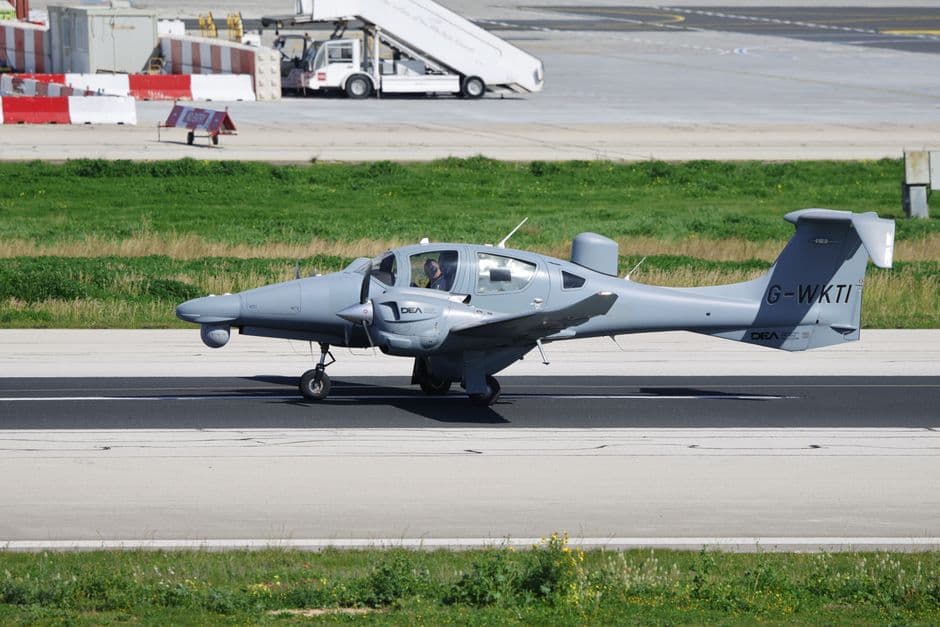
About 5.1 gallons an hour. That is what Diamond quotes for the DA40 NG at 60 percent power, compared with roughly 10 gallons an hour for the Lycoming-powered DA40 XLS at 75 percent power. The diesel offers a substantial fuel-efficiency advantage, but these published figures represent different cruise settings and speeds. Over 200 flight hours, the difference could approach 900 gallons under the stated assumptions, although actual savings depend on power setting, altitude and the speed you choose to fly.
At 2025 US pump prices that is around $6,000 a year left in your pocket — which is exactly why DA40 NG vs DA40 XLS is the question so many Diamond shoppers get stuck on. The catch is that the Austro AE300 diesel is not overhauled like a Lycoming. It is replaced, on a clock, and the reduction gearbox between the engine and the propeller has its own life limit. Budget those honestly and the picture gets more interesting than the brochure suggests.
What Actually Separates the Two Airplanes
Underneath, these are close cousins. Same composite airframe, same long thin wing, same sliding canopy and rear door, same four seats that are really two adults and two smaller people once you load fuel. The differences live forward of the firewall and in the structure built to carry it.
The DA40 XLS is the avgas model built from roughly 2007 through the early 2010s, powered by the Lycoming IO-360-M1A at 180 horsepower, with a constant-speed prop and a conventional throttle, prop and mixture setup. Garmin G1000 is standard, and the GFC 700 autopilot is common on later airframes.
The DA40 NG replaced it in Diamond's line and is still in production. It carries the Austro AE300, a 2.0-liter turbocharged common-rail diesel derived from a Mercedes automotive block, rated at 168 horsepower and burning Jet-A. It is FADEC controlled, which means one lever: push it forward, the computer sorts out fuel, prop and boost. Because the engine and its gearbox weigh more than a Lycoming, the NG got a beefier firewall-forward structure and a higher maximum takeoff weight.
Why It Matters: The NG is not a DA40 with a different engine bolted on. It is a different type certificate configuration with different limits, different parts and a different maintenance culture. Mechanics who know Lycomings do not automatically know Austros.
Fuel: Where the Diesel Wins, and By How Much
This is the diesel's whole case, and it is a strong one. The AE300 sips because compression ignition is simply more thermally efficient, and because Jet-A is denser, so each gallon carries more energy. Diamond publishes about 5.1 gph at economy settings and roughly 6.4 gph pushed harder. The XLS at 75 percent power is a 9.5 gph airplane, give or take a half gallon depending on how you lean.
Price adds to it. Through 2025, self-serve 100LL around the US has generally run in the $6 to $7 range, and Jet-A at the same field is usually a dollar or more cheaper. Put those together:
- DA40 XLS: 9.5 gph × $6.75 = about $64 per hour in fuel.
- DA40 NG: 5.5 gph × $5.75 = about $32 per hour in fuel.
Call it a $32 an hour advantage to the diesel in typical US conditions. Outside the US the gap widens dramatically — in much of Europe, Africa and Asia, avgas is both expensive and hard to find, while Jet-A is everywhere. That is the real reason the NG dominates international flight-school orders.
Keep in Mind: Jet-A availability cuts both ways. Jet-A is at nearly every airport with a turbine customer, but plenty of small grass and county fields stock 100LL only. Check the fuel on your home field and your usual $100-hamburger runs before you commit.
If you want the broader case for and against compression ignition, our rundown of diesel aircraft engine advantages and disadvantages covers ground this comparison assumes.
The Engine Reserve Question: TBR, Gearbox, and Real Dollars
The Lycoming Side
The IO-360-M1A traditionally carried a recommended overhaul interval of about 2,000 to 2,200 hours, depending on the applicable Lycoming guidance. However, Service Instruction 1009BF, issued July 20, 2026, allows eligible factory-new and factory-rebuilt IO-360 engines to qualify for a recommended TBO of up to 2,600 hours. Previously overhauled engines generally follow different intervals and eligibility requirements. For typical privately operated Part 91 aircraft, manufacturer TBO recommendations do not automatically become legal overhaul deadlines, although applicable airworthiness directives and limitations must still be followed.
As of 2025, a quality field overhaul on an IO-360 generally lands somewhere between the high $30,000s and the high $40,000s, with factory rebuilt units higher and the spread driven by cylinder decisions, accessories and shop rate. Our piece on why engine overhaul quotes differ by thousands explains where that range comes from. Add a propeller overhaul and reserve roughly $23 to $27 per hour.
The Austro Side
Here is the part buyers underestimate. The AE300 follows a manufacturer-controlled maintenance and overhaul program rather than the field-overhaul approach common with Lycoming engines. Austro received approval for an 1,800-hour time between overhaul (TBO) in 2015, although the applicable interval depends on current maintenance instructions and engine configuration. Owners may use manufacturer-supported overhaul or exchange arrangements, depending on availability and eligibility. The reduction gearbox and other components have separate scheduled replacement limits, so buyers must verify the remaining hours on each component instead of looking only at engine time.
That is the single most important thing to verify before you buy a used NG: pull the engine and gearbox records, note the serial numbers, and confirm against the current Austro service bulletins and the aircraft's maintenance manual exactly which hour and calendar limits apply to that specific unit. Two NGs on the same ramp can have different numbers.
Owners and dealers have reported exchange AE300s quoted in the $55,000 to $75,000 band in recent years before installation, and the gearbox is a five-figure item on its own when it comes due separately. Spread an engine replacement over 1,800 hours and you are reserving roughly $31 to $42 per hour — before the gearbox, before the prop.
Heads Up: Austro also publishes calendar limits alongside hour limits. An NG flown 60 hours a year can time out on the calendar long before it times out on the tach, and a calendar-driven replacement means you paid the full engine price while buying very little fuel savings.
Flying411 keeps DA40 listings, specifications and ownership guides in one place, so you can compare an NG's engine time against an XLS's before you call a broker.
Maintenance Beyond the Engine
The airframes are near-identical to maintain. Composite structure does not corrode, which is a genuine long-term advantage over aluminum singles, though paint and UV protection matter and delamination repairs need a shop that knows composites. Both models use the same canopy, the same trailing-link gear and the same G1000 family avionics.
Firewall-forward, the NG adds items the XLS does not have: dual FADEC channels with a dedicated backup battery that must be replaced on a published schedule, glow plugs, a high-pressure common-rail fuel system, and a coolant system with its own inspections. None of these are exotic, but they are all Austro parts on an Austro schedule, and there is no aftermarket the way there is for a Lycoming.
The XLS's advantage is boring, and boring is good: the IO-360 is one of the most common engines in general aviation, any A&P has worked on one, cylinders and magnetos are off-the-shelf, and field repairs at an unfamiliar airport are routine. The NG's advantage is that the diesel has no magnetos, no carburetor heat, no mixture to mismanage and no shock cooling worries — single-lever operation removes a whole category of pilot-induced engine damage.
Good to Know: An engine monitor is standard thinking on the Lycoming side and the data is worth real money at resale. If you are shopping an XLS without one, read our take on whether an engine monitor is worth the install cost before you negotiate.
Performance, Payload and Where You Fly
The XLS has 12 more horsepower and less weight to carry, and it shows in the climb — roughly 1,100 feet per minute at gross on a standard day, against about 730 fpm for the NG. Off a short field on a cool morning, the Lycoming airplane gets up and out faster.
Turn the altimeter up, though, and the turbo changes the story. The AE300 holds its power as the XLS loses it, so the NG is the better airplane on a hot day at a high-elevation field and the better airplane in the teens. Cruise speeds end up close: Diamond quotes about 154 KTAS maximum for the NG and the XLS is a solid 150 KTAS airplane at 75 percent.
Range is the NG's other headline. Burning half the fuel from similar tanks, it stretches to roughly 900-plus nautical miles with long-range tanks at economy cruise, against something near 700 nm for the XLS. The NG's higher max takeoff weight largely offsets the heavier engine, so useful load lands in the same neighborhood for both — think somewhere around 850 to 930 pounds depending on equipment. Neither airplane carries four adults and full fuel.
Pro Tip: Weigh the actual airplane you are buying, or at least read the current weight and balance. Fifteen years of avionics upgrades, paint and interior work can quietly cost a DA40 fifty pounds of useful load.
Resale and Who Buys Each One
The NG is current production, which supports used values but also means you are competing with new airplanes. Flight schools have driven NG demand hard, especially internationally and at academies that value single-lever simplicity for ab initio students — the same logic that makes the DA42 a fixture in multi-engine training fleets.
The XLS has a different buyer: the private owner who wants a modern composite four-seater without diesel-specific overhead, and who can have an engine shop anywhere in the country handle the big-ticket item. XLS values track engine time closely, the way most piston singles do. NG values track engine remaining time even more sharply, because a near-TBR Austro is a known, dated, non-negotiable bill.
Flying411 keeps aircraft-for-sale listings and ownership-cost articles in one place, so you can compare what an airplane costs to buy against what it costs to keep.
Key Takeaways
The diesel does save money, but roughly half to two-thirds of the fuel savings gets eaten by the higher engine reserve, so the honest figure is closer to $10 to $20 an hour than the $32 an hour the fuel pump suggests. That makes utilization the deciding variable: at 200-plus hours a year the NG pulls ahead and keeps pulling, while at 60 hours a year the calendar limits on the Austro turn the diesel's advantage into a disadvantage. Geography matters nearly as much — where avgas is scarce or heavily taxed, the NG is not a close call, it is the only sensible answer. The XLS wins on simplicity, on the on-condition flexibility that Part 91 gives a Lycoming past TBO, and on being repairable at any field in America. Buy the NG if you fly a lot, fly high, or fly where Jet-A is the only fuel; buy the XLS if you fly modestly and value a maintenance network you already understand.
| Dimension | DA40 NG (Austro AE300) | DA40 XLS (Lycoming IO-360-M1A) |
| Fuel | Jet-A / Jet A-1 / diesel | 100LL avgas |
| Rated power | 168 hp, turbocharged, FADEC | 180 hp, normally aspirated |
| Cruise fuel burn | about 5.1 gph economy, 6.4 gph high power | about 9.5 gph at 75 percent |
| Fuel cost per hour (2025 US prices) | roughly $32 at $5.75/gal Jet-A | roughly $64 at $6.75/gal 100LL |
| Engine life basis | Austro-approved overhaul interval; 1,800 hours published, subject to current engine-specific requirements; gearbox and other components have separate limits | Lycoming-recommended TBO depends on engine history; up to 2,600 hours for eligible factory-new/rebuilt engines; Part 91 flexibility subject to applicable requirements |
| Engine reserve per hour | roughly $31–$42 before gearbox and prop | roughly $23–$27 including prop |
| Max cruise | about 154 KTAS | about 150 KTAS at 75 percent |
| Rate of climb at gross | about 730 fpm | about 1,100 fpm |
| Range, long-range tanks | roughly 900+ nm at economy cruise | roughly 700 nm |
| Production | 2010 to present | roughly 2007 to the early 2010s |
| Parts and service network | Austro-specific, dealer-centered | Universal Lycoming support |
Making the Call on Your Own Mission
The clean way to settle DA40 NG vs DA40 XLS for yourself is arithmetic, not opinion. Take whatever price premium the NG carries on the day you shop, add the cost of any engine or gearbox replacement that falls inside your ownership window, and divide by your honest annual hours — not the hours you hope to fly. If that number comes out below the fuel savings, buy the diesel. If it does not, the Lycoming airplane is the cheaper airplane, full stop. And if you are still weighing the DA40 against other four-seaters entirely, our comparisons of the DA40 against the Cessna 172 and the DA40 against the Cirrus SR20 are the next two to read.
Flying411 keeps Diamond listings, engine guides and cost breakdowns in one place, so you can compare airframes and powerplants without opening six tabs.
When you are ready to compare listings, visitFlying411and see what is on the market today.
Frequently Asked Questions
Can the Austro AE300 be overhauled instead of replaced?
Not typically through an ordinary local engine shop. The AE300 follows Austro's approved maintenance and overhaul procedures, and owners may arrange an overhaul or exchange through the authorized support network. The engine's applicable TBO, component replacement limits and available service options should be verified with an Austro-authorized facility before buying. Unlike many privately operated Lycoming engines, the Austro's approved maintenance limitations can impose specific replacement requirements that owners cannot simply extend based on engine condition.
How many hours a year do I need to fly for the diesel to pay?
There is no fixed annual-hour threshold. The answer depends on the purchase-price difference, fuel costs, engine and gearbox maintenance requirements, and how long you plan to own the airplane. Higher annual utilization can help spread fixed costs and make the NG's fuel efficiency more valuable, but buyers should calculate the break-even point using current maintenance quotes and the specific aircraft's records.
Does the DA40 NG need a different pilot checkout?
Yes, and most insurers will require model-specific training. The single-lever FADEC removes mixture and prop management, but it adds items such as pre-start ECU tests, different engine-failure indications and distinct cold-weather starting procedures. Pilots usually find the NG simpler to fly and harder to learn to manage on the ground.
Is a high-time XLS a worse buy than a high-time NG?
Usually the opposite. A high-time Lycoming can legally continue on condition under Part 91 if the compressions, borescope and oil analysis support it, so the cost is negotiable. A high-time Austro has a fixed replacement date attached to it, so the bill arrives whether the engine runs beautifully or not. Price the NG's remaining engine and gearbox hours as cash, because that is what they are.