Some machines are built purely to work. Others manage to be beautiful while doing it. Airplanes sit in a rare category all their own — tools of transportation and war that somehow became art.
When engineers and designers get everything right, the result is an aircraft that turns heads on the tarmac just as easily as it commands the sky. The best looking planes don't just fly well. They make you stop and stare.
From the graceful curves of a 1930s airliner to the razor-edged silhouette of a Cold War spy plane, aircraft beauty has always come from a balance of form and function. Great designers rarely set out to make something pretty.
The good looks tend to follow when the engineering is honest and precise. This list celebrates fifteen of those moments — aircraft that achieved something rare in aviation history: they looked as extraordinary as they flew.
Key Takeaways
The best looking planes in aviation history include a mix of warbirds, classic airliners, and modern jets that earned their beauty through smart engineering and bold design. Aircraft like the Supermarine Spitfire, Lockheed Constellation, SR-71 Blackbird, and Concorde are widely regarded among the most visually stunning machines ever built. Beauty in aviation tends to come from coherent design — where the shape of a plane serves its purpose so well that it becomes naturally elegant.
| Aircraft | Era | Why It Stands Out |
| Supermarine Spitfire | WWII | Elliptical wings, sleek fuselage |
| Lockheed Constellation | 1940s–50s | Triple tail, dolphin-shaped body |
| SR-71 Blackbird | Cold War | Dart-like form, total aerodynamic elegance |
| Concorde | 1970s–2003 | Delta wing, supersonic rocket-ship silhouette |
| P-51 Mustang | WWII | Balanced, graceful fighter proportions |
| Beechcraft Staggerwing | 1930s | Art Deco biplane with reverse-stagger wings |
| Douglas DC-3 | 1930s–40s | Timeless proportions, swept-look wings |
| F-14 Tomcat | Cold War | Variable-geometry wings, predatory elegance |
| Boeing 747 | Jet Age | Unmistakable hump, majestic scale |
| Grumman F7F Tigercat | WWII | Lean, muscular twin-engine fighter |
| de Havilland Mosquito | WWII | Wooden masterpiece, perfectly integrated lines |
| Lockheed P-38 Lightning | WWII | Twin-boom silhouette, bold and unconventional |
| Piaggio Avanti | Modern | Pusher prop, futuristic Italian design |
| Boeing 757 | 1980s–present | Perfectly balanced narrow-body proportions |
| Hawker Hunter | Cold War | Swept-wing mid-century elegance |
At Flying411, we know that aviation passion runs deep. Whether you're researching aircraft history or exploring your options as a buyer or seller, Flying411 is here to guide you through every step of the journey.
What Makes an Airplane Beautiful?
Not every aircraft earns the label "beautiful." Plenty of planes are capable, reliable, or impressively powerful without being remotely attractive. So what separates the ones that make people pull out a camera from the ones that simply get the job done?
Aviation aesthetics tend to follow a few consistent principles.
Coherent identity is the first one. A beautiful aircraft looks like everything on it belongs there. Nothing feels bolted on as an afterthought. The wings, fuselage, tail, and nose all feel like parts of a single idea rather than a collection of compromises.
Proportion matters just as much. The way a wing sits relative to the body, the sweep of the tail, the length of the nose — when these elements are in balance, the eye naturally finds the design pleasing. Engineers who obsess over aerodynamics often stumble into this by accident.
Silhouette seals the deal. The best looking planes are instantly recognizable from a distance. You don't need to see the markings. The shape alone tells you what you're looking at. That is the mark of a truly great design.
Fun Fact: Many aviation designers have said that when faced with two equally functional solutions, they tend to choose the more visually elegant one. Beauty and efficiency in aircraft design are often the same thing.
A Look at Aircraft Aesthetics
Aviation moved fast in its first fifty years. The progress from the Wright Brothers' fabric-and-wire biplanes to the sleek metal airliners of the 1940s happened in roughly one generation. That speed of change produced some of the most stunning design work ever done in any field.
The 1930s are widely considered a golden age of aircraft aesthetics. The Art Deco movement influenced everything from buildings to automobiles to airplanes during this period. Designers embraced flowing, streamlined forms that felt modern, confident, and optimistic. Aircraft like the Douglas DC-3 and the Lockheed Constellation came out of this era, and they look like it in the best possible way.
The Wartime Design Explosion
World War II pushed aircraft development faster than any peacetime program could have. Designers had to solve difficult engineering problems under pressure, and that urgency often produced unexpectedly beautiful results. The Supermarine Spitfire's elliptical wing was an aerodynamic necessity. The P-51 Mustang's long, tapering fuselage was a functional choice. Both ended up as visual masterpieces.
The Cold War era brought a new aesthetic entirely. Jet propulsion changed what an aircraft could look like. Suddenly, designers had swept wings, pointed noses, and afterburners to work with. The results included some of the most dramatic-looking machines in history.
Good to Know: Aircraft beauty is not purely subjective. Most aviation historians and enthusiasts agree on a core group of aircraft that are widely considered the most attractive. The ones on this list appear consistently across collections, polls, and expert discussions spanning decades.
The 15 Best Looking Planes Ever Built
This list spans warbirds, airliners, business jets, and military aircraft. Some were designed before jet engines existed. Others pushed beyond the speed of sound. All of them share one quality: they look extraordinary.
1. Supermarine Spitfire
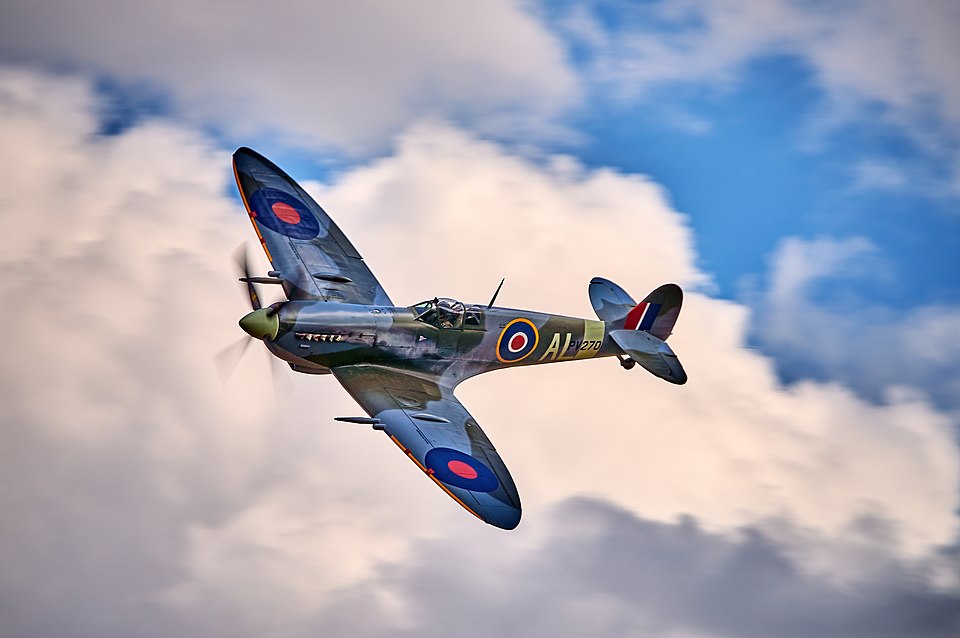
The Spitfire is the gold standard of beautiful fighter design. British engineer Reginald Mitchell gave it an elliptical wing that was not just visually distinctive but aerodynamically essential. The thin wing cross-section reduced drag dramatically, and those sweeping curves became one of the most recognizable silhouettes in aviation history. The Spitfire's sleek metal fuselage and flowing lines give it a grace that most fighters never approached. It looked fast standing still, and it was.
Fun Fact: The Spitfire's elliptical wing shape is often described as the most beautiful wing ever put on a fighter aircraft. Mitchell reportedly said he wanted the shape to suggest speed even on the ground.
2. Lockheed Constellation
Few aircraft generate the kind of reverence the "Connie" does among aviation fans. The Lockheed Constellation has a dolphin-shaped fuselage that curves and narrows in ways no other airliner has ever matched. Its triple tail design was not chosen purely for looks — it needed to fit inside hangars of the day — but the result was visually unforgettable. The Constellation has long been regarded as one of the most beautiful airliners ever built, and it holds that status comfortably today.
If you're curious about the legacy of great aircraft choices across different categories, the best private planes to own share some of the same design DNA that made the Constellation so enduring.
3. SR-71 Blackbird
The SR-71 Blackbird looks like something that arrived from the future and never quite left. Designed by the legendary Kelly Johnson at Lockheed's Skunk Works, the Blackbird's dark, dart-like profile is the product of engineering pushed to its absolute limits. It was built to fly faster than Mach 3 at altitudes above 85,000 feet, and every curve on the airframe serves that mission. The chined fuselage, the blended nacelles, the dark titanium skin — all of it adds up to something that still looks decades ahead of its time.
Pro Tip: The SR-71's dark color was not cosmetic. The black paint helped radiate heat generated by the extreme aerodynamic friction of flying at those speeds.
4. Concorde
Concorde is the most mythic aircraft on this list, and possibly the most beautiful commercial airplane ever built. Its delta wing and needle-like fuselage were designed for supersonic flight, and the result is a silhouette that looks like a rocket ship wearing airline paint. Even retired, sitting in museums, Concorde draws crowds. It flew passengers across the Atlantic in roughly three hours, cutting the London-to-New York journey by more than half. The aircraft retired in 2003, and nothing has replaced it in the air or in terms of visual impact.
5. North American P-51 Mustang
The P-51 Mustang is a classic study in aerodynamic honesty producing great beauty. Its fuselage tapers cleanly from a prominent radiator scoop to a graceful tail. The wings have a gentle elliptical quality without copying the Spitfire's more dramatic curve. Everything about the Mustang feels balanced. It was described by a U.S. Senate committee in 1944 as "the most aerodynamically perfect pursuit plane in existence," and visually, that reputation has only grown in the decades since.
Good to Know: The P-51 Mustang originally had a different engine that limited its performance. When engineers swapped in the Rolls-Royce Merlin engine, it transformed both the aircraft's capabilities and its reputation.
6. Beechcraft Staggerwing
The Beechcraft Model 17 Staggerwing is one of the most striking aircraft ever to come out of general aviation. Its reverse-stagger configuration — where the lower wing sits ahead of the upper wing — gives it a profile unlike any other biplane. The 1930s Art Deco lines, the rounded nose, and the enclosed cockpit made it look like a private aircraft from a science fiction story of the era. For anyone interested in what elegant general aviation design looks like, the Staggerwing is a benchmark.
If you want to see how modern aircraft balance performance and payload in single-engine designs, the best useful load single-engine planes carry on a tradition of practical elegance that the Staggerwing helped establish.
7. Douglas DC-3
The Douglas DC-3 may be the most important aircraft ever built, and it happens to be a beautiful one. Its wings have a sweep that gives the DC-3 a sense of forward motion even when parked. The stubby, confident nose, the broad fuselage, and the way everything flows together make it instantly identifiable. Designer Arthur Raymond and his team created something that looked right in a way that is hard to analyze but impossible to miss. The DC-3 is said to have carried the majority of the world's airline passengers by the time World War II began, and it remained in commercial service for decades afterward.
8. Grumman F-14 Tomcat
The F-14 Tomcat introduced the world to variable-geometry wings — wings that sweep back for high-speed flight and extend forward for slower speeds. This design gives the Tomcat a shape that transforms as you watch it, which adds to its visual drama. The twin tail fins, the powerful engines, and the wide fuselage combine into a silhouette that reads as powerful and predatory from every angle. The F-14's cultural fame grew enormously after its starring role in the 1986 film Top Gun, but aviation enthusiasts had already recognized it as one of the best looking fighters ever built.
Why It Matters: The F-14 Tomcat's variable-geometry wing was designed for carrier operations, where aircraft need to handle both high-speed interception and slow carrier landings. Form followed function, and the result was unforgettable.
9. Boeing 747
The Boeing 747 earned the nickname "Queen of the Skies" partly because of scale and partly because of proportion. Its distinctive upper-deck hump gives it a profile that no other commercial aircraft has ever replicated. The 747 looks enormous because it is — but the designers at Boeing managed to give it a gracefulness that purely functional aircraft rarely achieve. The gentle curve of the fuselage, the wing sweep, and the way the upper deck blends into the nose create a silhouette that has defined commercial aviation's visual identity for more than fifty years.
For those who appreciate the best Boeing aircraft have had to offer across their history, the best Boeing planes span an impressive range of design eras and capabilities.
10. Grumman F7F Tigercat
The Tigercat is a less famous aircraft than most others on this list, but it deserves its place here. Grumman designed a twin-engine heavy fighter that manages to look simultaneously lean and powerful. The clean lines, the wide fuselage, and the muscular engine nacelles give it a physical presence that turns heads at every airshow it attends. It saw limited combat service but has endured as one of the most visually compelling propeller-driven fighters ever produced.
Fun Fact: A small number of Grumman F7F Tigercats were converted for use as aerial firefighters after their military service, flying in that role from the 1960s through the 1980s.
11. de Havilland Mosquito
The de Havilland Mosquito holds a special place in aviation history for being built almost entirely of wood at a time when metal construction was becoming standard. What makes it beautiful is how seamlessly the design comes together. The twin engines sit cleanly on the wings, the fuselage tapers with purpose, and the overall effect is one of speed and efficiency. Nothing looks wasted. The fact that such aesthetic coherence came from stressed-skin wood construction makes it even more remarkable.
For pilots and enthusiasts who appreciate multi-engine capability paired with great design, the best twin-engine planes continue a tradition the Mosquito helped define.
12. Lockheed P-38 Lightning
The P-38 Lightning broke every visual convention of its era. Its twin-boom configuration — two tail booms extending from the engine nacelles to the tail, with the cockpit sitting in a central pod between them — gave it a silhouette unlike any other fighter of World War II. Col. Robin Olds, who flew the P-38 in the Pacific, called it "the most beautiful plane of our generation." It also had a distinctive rounded nose and twin propellers flanking the cockpit that complete a visual impression of power and originality. It was Lockheed's first military aircraft, and the company swung for something bold.
Keep in Mind: The P-38 Lightning was not just beautiful. Its twin-engine design gave it range and performance that single-engine fighters of the era could not match, making it a critical asset in the Pacific theater.
13. Piaggio Avanti
The Piaggio Avanti is the most unconventional aircraft on this list. Its pusher propellers sit behind the cabin rather than in front, its canard wings sit at the nose, and the fuselage has a sculpted, almost automotive quality. Italian designers at Piaggio brought a distinctly European sensibility to general aviation, and the result is an aircraft that looks like nothing else in the sky. The Avanti is fast, quiet inside, and turns heads at every airport it visits. It represents what happens when designers are willing to reject convention entirely.
For pilots looking at efficient and capable options in the six-seat category, the best 6-passenger planes include some modern designs that carry a bit of that same unconventional spirit.
14. Boeing 757
The Boeing 757 may be underappreciated on beauty lists, but aviation enthusiasts consistently rank it among the most proportionally satisfying commercial aircraft ever produced. In an era when most airliners started to look alike, the 757 stood out with its narrow fuselage, long body, and wing proportions that simply looked right. It has been described as having "perfectly balanced proportions and simple clean lines." More than two hundred 757s remain in service today, and they still draw admiring glances at airports across the country.
Pro Tip: Aviation photographers often seek out the 757 specifically because its proportions photograph exceptionally well from almost any angle, unlike wider-body aircraft that can look disproportionate in certain shots.
15. Hawker Hunter
The Hawker Hunter represents the best of mid-century jet fighter design. Its swept wings, slender fuselage, and clean overall silhouette give it a timeless elegance that remains striking today. A prototype broke the world air speed record in 1953, which tells you how serious the engineering was beneath the beautiful surface. The Hunter served with dozens of air forces around the world and became a standard-setter for what a beautiful jet fighter should look like.
Good to Know: The Hawker Hunter's aesthetic has influenced jet trainer design for decades. Its proportions were considered so well-balanced that later aircraft designers used it as a visual reference point.
What General Aviation Pilots Can Learn from Beautiful Design
Beauty in aircraft design is not just a visual reward. It often signals deeper qualities — efficiency, aerodynamic integrity, and engineering honesty. Pilots who develop an eye for aircraft aesthetics tend to develop a sharper sense for evaluating aircraft overall.
A plane that looks clean and well-integrated usually flies cleaner, too. Drag tends to show up visually before it shows up in the performance data. When something looks like it was added as an afterthought, it often creates aerodynamic penalties in proportion to how awkward it appears.
This is one reason experienced pilots often speak positively about aircraft like the Beechcraft Bonanza or the Cirrus SR22 — both of which have clean, coherent designs that perform well and look like it. The visual impression matches the flight experience.
For those exploring rugged but purposeful designs at the other end of the spectrum, the best bush planes show how function-first engineering can still produce aircraft with a compelling visual character of their own.
Comparing Beauty Across Aircraft Categories
| Category | Standout Example | Defining Visual Feature |
| WWII Fighter | Supermarine Spitfire | Elliptical wing |
| Cold War Jet | SR-71 Blackbird | Chined fuselage, dark titanium skin |
| Classic Airliner | Lockheed Constellation | Triple tail, dolphin fuselage |
| Supersonic | Concorde | Delta wing, needle nose |
| General Aviation | Piaggio Avanti | Pusher props, canard design |
| Business Jet | Beechcraft Staggerwing | Reverse-stagger biplane wings |
| Modern Commercial | Boeing 757 | Narrow-body balance and proportion |
How Beauty and Performance Connect in Aviation
It is worth noting that virtually every aircraft on this list was also excellent at its job. This is not a coincidence. Great aircraft design tends to produce both things at once — performance and elegance — because the principles that guide one often guide the other.
Aerodynamic efficiency requires smooth, uninterrupted airflow. That means minimizing unnecessary protrusions, blending components cleanly, and allowing the shape of the aircraft to guide the air where it needs to go. These same principles produce surfaces that catch light well, create compelling silhouettes, and hold together as a unified visual statement.
The Spitfire's wing was designed to minimize drag. The SR-71's fuselage was shaped to manage heat and supersonic shock waves. The Constellation's fuselage curve was driven by structural and aerodynamic needs. In every case, solving the engineering problem produced something beautiful as a byproduct.
Why It Matters: Understanding the connection between aerodynamic efficiency and visual appeal helps pilots and enthusiasts evaluate aircraft more critically. A clean-looking airplane is often a clean-flying one.
If you're ready to take your passion for aviation to the next level, Flying411 is the resource built for pilots, buyers, and enthusiasts who want real guidance. Connect with the Flying411 team and make your next aviation decision with confidence.
Conclusion
The best looking planes in aviation history are not beautiful by accident. They are the product of engineers and designers who pushed hard against physical limits and came out the other side with something that also happened to be extraordinary to look at. From the Spitfire's elliptical wing to Concorde's delta silhouette to the Constellation's triple tail, each aircraft on this list tells a story about what happens when human ambition, engineering skill, and a little bit of aesthetic courage all point in the same direction.
Great aircraft design teaches something worth carrying beyond aviation. When the fundamentals are right, beauty tends to follow. That truth holds whether you're evaluating a vintage warbird, a modern business jet, or a backcountry bush plane. Train your eye on the best looking planes, and you'll start to see performance hiding inside the shape.
Ready to explore the world of aircraft ownership with a guide who actually knows aviation? Flying411 is your trusted partner for buying, selling, and understanding the aircraft market — beautiful machines and practical ones alike.
FAQs
What is the most beautiful airplane ever built?
The Supermarine Spitfire and the Lockheed Constellation are two aircraft that appear at or near the top of almost every "most beautiful" list in aviation. The Spitfire is often cited for its elliptical wings and fighter-perfect proportions, while the Constellation earns praise for its uniquely elegant fuselage and triple-tail design.
Are military planes or civilian planes generally more beautiful?
This comes down to personal taste, but many aviation enthusiasts argue that the pressure of wartime engineering produced some of the most visually compelling aircraft ever built. Military aircraft like the Spitfire, P-51 Mustang, and F-14 Tomcat regularly outrank civilian designs on beauty lists.
What makes the SR-71 Blackbird look so unique?
The SR-71 Blackbird's appearance comes entirely from its engineering requirements. Its chined fuselage, blended nacelles, and dark titanium skin were all designed to manage the enormous heat and aerodynamic forces generated by Mach 3-plus flight. The result is a silhouette that looks unlike any other aircraft in history.
Is Concorde still considered the most beautiful commercial airliner?
Many aviation experts and enthusiasts rank Concorde as the most visually stunning commercial airliner ever built. Its delta wing and needle-like nose give it a silhouette that reads as futuristic even decades after its retirement in 2003.
Can you own one of the beautiful planes on this list?
Some of the aircraft on this list, particularly warbirds like the P-51 Mustang and the Spitfire, do appear on the private aircraft market from time to time. They require significant investment in purchase price, maintenance, and operational costs. Others, like the SR-71 and Concorde, are exclusively in museum collections and are not available for private ownership.