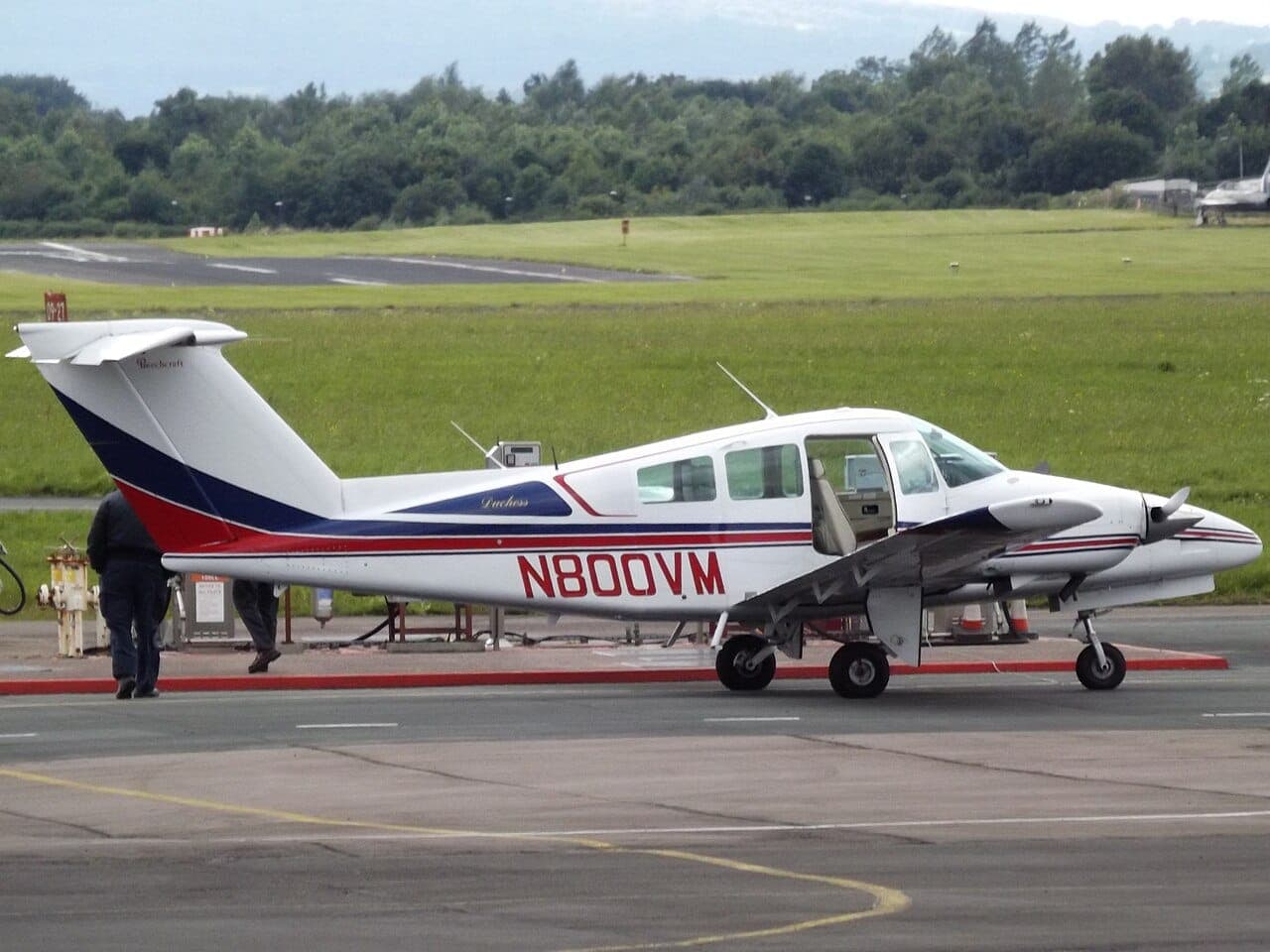
Beechcraft built roughly 437 Duchesses, then closed the line in 1982 and never reopened it. Piper has built the Seminole in three separate runs since 1979 and is still delivering new ones in 2026. That single difference — a dead production line versus a live one — shapes almost everything that follows: what you pay at purchase, how long you wait for a wing rib, what an insurer thinks of you, and what the airplane is worth when you sell it.
The Beechcraft Duchess 76 vs Piper Seminole question comes up constantly because the two airplanes were designed for the same job at the same moment in history. Both are four-seat, T-tail, all-metal light twins with counter-rotating 180-horsepower Lycoming engines. The Duchess and early Seminoles use carbureted O-360s, while later Seminoles use fuel-injected IO-360s. On paper they are near twins of each other. In an owner's checkbook they are not.
Get this choice right and you can train a multi-engine rating, build time, and fly a family of four on weekends for a predictable annual number. Get it wrong and you own a hangar queen waiting on a part that one supplier in the country still stocks.
Key Takeaways
The Seminole is the safer ownership decision for most buyers, mainly because Piper still builds it and still sells parts for it, and because flight schools keep demand — and resale — firm. The Duchess usually costs less to buy for the same hours and condition, gives you two cabin doors instead of one, and climbs noticeably better on a single engine, which matters on a hot day with four aboard. The Seminole's lower minimum control speed of 56 KIAS makes Vmc demonstrations gentler and is one reason instructors like it. Operating costs are close enough that fuel burn should not decide this: both drink roughly 16 to 19 gallons an hour in cruise and both aircraft use Lycoming 360-series engines, but the recommended overhaul interval depends on the engine model and its history. Under Lycoming's July 2026 guidance, qualifying factory-new or factory-rebuilt engines can have a 2,600-hour TBO, while overhauled engines generally retain a 2,000-hour baseline, subject to applicable conditions and extensions.. Pick the Duchess if you found a clean, well-documented one at a real discount and have a shop that knows Beech; pick the Seminole if you want the airplane with the deepest parts supply and the easiest exit.
| Specification | Beechcraft Model 76 Duchess | Piper PA-44-180 Seminole |
| Type certificate | A29CE | A19SO |
| Production | 1978–1982, about 437 built | 1979–1982, 1989–1990, 1995–present |
| Engines | Lycoming O-360-A1G6 / LO-360-A1G6, 180 hp each, carbureted | Early models: Lycoming O-360-A1H6 / LO-360-A1H6, 180 hp each, carbureted; later models: IO-360-B1G6 / LIO-360-B1G6, 180 hp each, fuel-injected |
| Counter-rotating props | Yes | Yes |
| Recommended TBO | Up to 2,600 hours for qualifying factory-new/rebuilt engines; generally 2,000 hours for overhauled engines | Up to 2,600 hours for qualifying factory-new/rebuilt engines; generally 2,000 hours for overhauled engines |
| Maximum takeoff weight | 3,900 lb | 3,800 lb |
| Typical empty weight | About 2,460 lb | About 2,400 lb (early), about 2,700 lb (current glass-panel) |
| Fuel capacity | 100 gallons | 110 gallons total, 108 usable |
| Typical cruise burn (both engines) | About 16–18 gph | About 17–19 gph |
| Maximum cruise | About 158 knots | About 162 knots |
| Climb, both engines | About 1,250 fpm | About 1,200–1,340 fpm depending on model year |
| Climb, one engine out | About 235 fpm | About 210 fpm |
| Single-engine service ceiling | About 6,170 ft | About 4,000 ft |
| Vmc (minimum control speed) | 65 KIAS | 56 KIAS |
| Service ceiling | About 19,650 ft | About 15,000 ft |
| Cabin doors | Two, one per side | One, right side over the wing |
| Landing gear actuation | Hydraulic, electrically driven pump | Hydraulic, electrically driven pump |
| Still in production | No | Yes |
Buying: One Is Discontinued, One Is in the Catalog
This is the heart of it. Buying a Duchess is like buying a discontinued car model. The car itself is fine — it may even be better built than its replacement — but the parts counter is a different story. With fewer than 500 airframes ever made and nearly all of them now 44 to 48 years old, you are shopping a small, finite fleet. Good ones exist, they are just not on every ramp.
The Seminole fleet is far larger, because Piper kept going. You will find 1979–1982 airframes, a handful of 1989–1990 models, and a long continuous run from 1995 to today. Current production aircraft come from the factory with a Garmin G1000 NXi flight deck. That means the used Seminole market stretches from steam-gauge, round-dial 1980 airplanes to late-model glass twins that still smell new.
Because flight schools buy Seminoles in blocks, a used one almost always has a buyer waiting. That is good news when you sell and bad news when you buy — you are bidding against training operators with financing already arranged.
Why It Matters: A twin that sells quickly is a twin you can get out of. Multi-engine pistons are a thin market, and "how long will this take to sell" belongs in your purchase math right next to the overhaul reserve.
Flying411 keeps light twin listings from across the market in one place, so you can compare Duchess and Seminole asking prices, total times and engine times side by side instead of chasing them one broker at a time.
What to Watch in the Logbooks
For the Duchess, look hard at corrosion. Beech used bonded honeycomb construction in control surfaces of that era, and bonded panels that have lived outdoors in a coastal climate can hide trouble that a quick walk-around will not reveal. Ask whether the airplane has been hangared its whole life and get a straight answer, in writing.
For an early Seminole, look at how it earned its living. A 1980 airframe with 9,000 hours of touch-and-goes and eight different school operators has been through more gear cycles than a privately owned airplane sees in a lifetime. That is not automatically disqualifying — school airplanes get flown regularly, which engines love — but gear, brakes, engine mounts and interiors all show it.
On both types, ask for a current airworthiness directive compliance list signed by the inspecting mechanic, and check that propeller overhauls and the engine-driven accessories are tracked against calendar limits, not just hours. A set of props that has gone 14 years without an overhaul is a bill waiting to land on you.
Flying Them: Vmc, Climb and What Your Instructor Thinks
Both airplanes do the same trick: counter-rotating propellers, so neither engine is the critical engine. Lose one and the yaw problem is the same either way. That is the entire reason both exist — they were built to make the multi-engine rating survivable for students and instructors alike.
Where they split is at the two ends of the envelope. The Seminole's published Vmc is 56 KIAS. The Duchess sits at 65 KIAS. Nine knots sounds small, but in a Vmc demonstration it changes the character of the maneuver. In the Seminole, the airplane tends to run out of wing before it runs out of rudder, so the exercise feels more like an approach to a stall with asymmetric thrust. Instructors who teach the rating every week often prefer that, because it gives them a more forgiving margin to work with.
Climb goes the other way. With one engine feathered, a Duchess at gross will hold roughly 6,170 feet and climb about 235 feet per minute at sea level. A Seminole holds around 4,000 feet and climbs about 210 fpm. Neither number is impressive — light piston twins do not climb on one engine so much as descend slowly — but 2,000 feet of extra single-engine ceiling is real if you live in Denver, Albuquerque or Reno. On a July afternoon at a 5,000-foot field, the Duchess still has somewhere to go and the Seminole may not.
Heads Up: Those single-engine numbers assume a feathered propeller, the gear up, the right bank into the good engine and a pilot flying blue line precisely. Miss any of them and both airplanes become gliders with expensive fans on the front. That is why multi-engine currency is a flying habit, not a checkbox.
Speed is close to a wash. Both do about 155 to 162 knots true in cruise. The Seminole has 10 more gallons of fuel; the Duchess has a bit more useful load in its early years and a higher gross weight. Neither will out-run a well-tuned single such as a Bonanza, which is worth saying out loud before anyone buys a twin expecting a speed upgrade. If speed per dollar is your actual goal, our comparison of the Bonanza and the Piper Saratoga covers that ground.
Handling and Feel
Owners who have flown both usually describe the Duchess as the heavier, more settled airplane in the air, with the solid control feel Beech was known for, while the Seminole feels lighter and a touch more responsive in roll. These are preferences, not deficiencies. Fly both before you decide if you possibly can. Most multi-engine instructors in the US have time in a Seminole; fewer have Duchess time, which itself is a practical argument if you plan to train in your own airplane.
Cost to Run: Where the Money Actually Goes
Fuel is the obvious line and the least interesting one, because the two airplanes are nearly identical. Plan on 16 to 19 gallons per hour total in cruise for either. At the avgas prices most owners saw through 2025, that is well north of $100 an hour in fuel alone before you touch anything else.
Engines are the line that decides your budget. Both aircraft have two Lycoming 360-series engines, with recommended overhaul intervals that depend on engine model and history. Lycoming's July 2026 Service Instruction No. 1009BF allows up to 2,600 hours for qualifying factory-new or factory-rebuilt engines, while overhauled engines generally have a 2,000-hour baseline; the 12-year calendar guidance also applies. Field overhauls on an O-360 have commonly run in the $30,000 to $45,000 range per engine in recent years, with factory rebuilt and factory new options above that. Call it $70,000 to $100,000 to do a pair, and set aside something close to $20 per flight hour per engine so the bill does not arrive as a surprise.
Keep in Mind: The calendar matters more than the tach for most private owners. An owner flying 80 hours a year will hit the 12-year mark long before 2,000 hours, and corrosion inside a little-flown engine does more damage than honest use. If you only fly a few dozen hours a year, a twin is an expensive way to grow rust.
Propellers add a cost that single-engine owners forget. Two constant-speed props, two governors, and overhauls typically scheduled on a six-year or 2,000-hour cycle, depending on the propeller model and the manufacturer's service letters. Budget several thousand dollars per propeller when the cycle comes due.
Annual inspections on a clean, well-kept example of either type commonly land in the $3,000 to $6,000 range when nothing unexpected turns up. Twins have two of nearly everything, so the inspection alone takes longer than it would on a Cherokee, and a retractable gear system has to be jacked, swung and rigged.
Insurance is the line where the Duchess and the Seminole genuinely diverge, and not because of the airplanes. Underwriters are comfortable with the Seminole because thousands of pilots train in them, loss history is well understood and the model is in current production. A low-time pilot buying any light twin should expect a serious premium and a dual-instruction requirement written into the policy. Get a real quote in writing before you sign a purchase agreement — not after.
Flying411 keeps specifications, ownership guides and current listings for light twins in one place, so you can line up what an airplane costs to buy against what it costs to keep.
Parts and Maintenance Support
Textron Aviation still supports the Beech Model 76 through its parts network, and the type club community keeps a lot of institutional knowledge alive, but the reality for a 1979 airframe with 437 siblings is that some parts are slow, some are expensive, and a few are salvage-yard items. Cowlings, windshields, interior plastics and specific gear components are the usual pain points on any out-of-production light Beech.
Piper, by contrast, is building Seminoles right now. The factory makes the parts because it needs them for the assembly line. That does not make Piper parts cheap, but it does make them available, and availability is what keeps an airplane flying rather than sitting on jacks for six weeks.
There is one subtlety worth knowing: the current-production Seminole has evolved. Cowlings, panels, interiors and systems on a 2024 airplane are not all interchangeable with a 1980 one. If you buy an early Seminole, you are closer to the Duchess situation than the sales pitch suggests — though still better off, because the fleet is bigger and the salvage supply is deeper.
Good to Know: The gear systems differ. TBoth aircraft use electrically driven hydraulic pumps to retract and extend their landing gear, and both provide emergency extension procedures. Their hydraulic layouts, actuators and maintenance requirements differ, so buyers should have a mechanic familiar with the specific model inspect the system. Both are reliable when maintained and both are expensive when neglected. Whichever you buy, have the prebuy shop swing the gear on jacks and watch the emergency extension work.
One more caution for shoppers: Piper also built a small number of PA-44-180T Turbo Seminoles in 1981 and 1982, with turbocharged Lycoming TO-360 engines. They are interesting airplanes, but the engines and turbo system are rarer and more costly to support than the normally aspirated versions. Unless you specifically need the high-altitude capability and have a shop that knows the type, the standard Seminole is the simpler ownership story.
Cabin, Doors and Living With the Airplane
Both are four-seat airplanes with modest baggage space, and neither is a six-seat family hauler. If you need the back row, you are shopping a Seneca, a Baron or a Cessna 310, and our Duchess versus Baron comparison spells out what that step up really costs.
The Duchess wins the door argument outright. It has two cabin doors, one on each side, so the pilot and the front passenger each get their own entry and nobody climbs across a seat. For a flight school, that means instructor and student board independently. For a family, it means the person in the right seat does not clamber over the wing walk in a skirt or a suit.
The Seminole has a single door on the right side, over the wing, in the Piper tradition. Everyone goes in the same way. It works, thousands of students do it every day, and it is simply less convenient.
Useful load deserves honesty. Useful load varies considerably by airframe and equipment. Some earlier examples offer roughly 1,300 pounds or more, but a current-production Seminole has a published standard useful load of approximately 1,191 pounds, so buyers should check the actual aircraft's weight-and-balance records rather than rely on a model-wide estimate. Fill the tanks — 100 gallons in the Duchess, 108 usable in the Seminole — and you have burned 600 to 650 pounds of that on fuel alone. Four adults plus full fuel does not work in either airplane. Later glass-panel Seminoles may have less useful load than some earlier examples, although Piper lists a standard empty weight of 2,625 pounds for its current model and actual weights depend on installed equipment.
Pro Tip: Run a real weight-and-balance on the exact airplane you are considering, using its current equipment list, before you make an offer. Two Seminoles of the same model year can differ by 150 pounds empty depending on avionics, air conditioning and interior.
Training Economics and Resale
If your main goal is a multi-engine rating and the time-building that follows, think about the exit before the entry. Buying an airplane to train in can work beautifully, as we covered in our guide on buying an airplane for flight training, but it only works if you can sell the airplane afterward without a long, painful listing.
Here the Seminole has a structural advantage. Flight schools and university programs buy used Seminoles because they already have the maintenance tooling, the parts inventory and the instructor pool. That gives a well-kept Seminole a reliable pool of buyers. The Duchess has a devoted owner following and a reputation for being the nicer airplane to own privately, but the buyer pool is smaller simply because the fleet is smaller.
There is a third option a lot of buyers look at and then reject on price: the Diamond DA42, which burns jet fuel and has become common in airline-track programs. We put the numbers side by side in our DA42 versus Seminole cost comparison, and the short version is that the diesel twin wins on fuel and loses on acquisition price and gearbox maintenance. If you want to see how both stack up against the wider field, our roundup of the best light twin aircraft is a good next read, along with our broader guide to small twin-engine prop planes.
Fun Fact: The Duchess shares its design lineage with the Beechcraft Skipper, the two-seat trainer Beech developed alongside it. Both used the T-tail and the same training-market thinking of the late 1970s, which is why they look like relatives. We compared the Skipper with its Piper rival in our piece on the Skipper and the Tomahawk.
Flying411 keeps trainers and light twins from across the used market in one place, so you can compare a Duchess, a Seminole and a DA42 on hours, equipment and condition in the same session.
Making the Call
On the Beechcraft Duchess 76 vs Piper Seminole question, the honest answer depends on two things about you: where you fly and how long you plan to keep it.
Buy the Seminole if you want the lowest-friction ownership experience. Parts are available because the factory still makes them, instructors everywhere know the airplane, insurers are comfortable with it, and when you sell, there is a buyer. The low 56-knot Vmc makes it a gentler platform for the training maneuvers that scare people, and that counts for something if you are earning the rating in your own airplane.
Buy the Duchess if you found a hangared, corrosion-free example at a genuine discount, you have a mechanic who has worked on light Beeches, and you value the two doors and the extra 2,000 feet of single-engine ceiling. Owners who fly from high-elevation or hot-climate airports should weigh that climb advantage seriously; it is the one performance number where the gap is wide rather than cosmetic.
What should not decide it: a few knots of cruise speed, a gallon an hour of fuel burn, or which paint scheme you like. Those differences disappear next to a $40,000 engine or a six-week parts wait. Get a thorough prebuy from a shop that knows the type, get an insurance quote in writing before you commit, and price the overhaul reserve into your hourly cost from day one.
When you are ready to compare listings, visitFlying411 and see what is on the market today.
Frequently Asked Questions
Is the Duchess or the Seminole cheaper to own?
Year to year, operating costs can be similar because both aircraft use two 180-horsepower Lycoming engines, although applicable TBO intervals now vary by engine configuration and history. The Seminole usually wins on total cost because parts are easier to source from a factory that is still building the airplane, which keeps downtime and shipping surcharges down. A Duchess bought at a real discount can close that gap, provided it is a clean airframe and you have a shop that knows Beech.
Which one is better for earning a multi-engine rating?
The Seminole, for practical reasons more than aerodynamic ones. It is the most common multi-engine trainer in the US, so instructors know it, examiners expect it, and checkride procedures are familiar. Its published Vmc of 56 KIAS also makes the Vmc demonstration a more forgiving exercise. The Duchess is a perfectly good trainer — that is exactly what Beech designed it for — but you may have to hunt for an instructor with current time in type.
Can either airplane carry four adults and full fuel?
No. With roughly 1,300 to 1,450 pounds of useful load in typical examples, and 600 pounds or more of that consumed by full tanks, you are choosing between people and fuel. Plan on four adults with partial fuel for short legs, or two people and bags with the tanks topped off for a long cross-country. Run the numbers on the specific airplane, because equipment differences move empty weight by a hundred pounds or more.
Are parts still available for the Beechcraft Duchess?
Yes, through Textron Aviation's parts network, type club channels and the salvage market, but availability is uneven and lead times can be long on airframe-specific items such as cowlings, windshields and interior pieces. Engine and propeller parts are not a concern — the Lycoming O-360 is one of the most widely supported piston engines in aviation. Before you buy, ask a shop that has worked on the type what its recent experience sourcing Model 76 parts has actually been.