The usual pitch on the Sierra is that it is the cheap way into a Beechcraft, a baby Bonanza with the gear tucked up and a Beech badge on the panel for Cherokee money. That is not what it is. The Beechcraft Sierra B24R vs Piper Arrow II question is really a question about a Musketeer with retractable gear versus a Cherokee with retractable gear, and once you accept that, the comparison gets a lot more honest and a lot more useful.
Both airplanes do the same job: carry four adults who packed lightly about 130 to 140 knots, burning around 10 gallons an hour, on a 200-horsepower Lycoming. They were built within a few years of each other, they compete for the same buyer, and they often sit on the same ramp. Where they differ is in the places that cost you money after the sale closes: parts availability, cabin size, fuel capacity, and how easy it is to find a mechanic who has seen one before.
Get this choice wrong and you are not out a few thousand dollars. You are out the difference between an airplane you can keep flying and an airplane that sits for six weeks waiting on a part nobody stocks.
What You Are Actually Comparing
The Piper Arrow II is a PA-28R-200. Piper took the original Arrow, stretched the fuselage five inches, added two feet of wingspan, and sold it from roughly 1972 through 1976. Underneath, it is a Cherokee: same constant-chord wing family, same stabilator, same single door on the right side, same basic structure that Piper built by the thousand. The Arrow line went on to the Arrow III and the T-tail Arrow IV, and if you are weighing those later versions instead, we cover that split in Piper Arrow IV vs Arrow III.
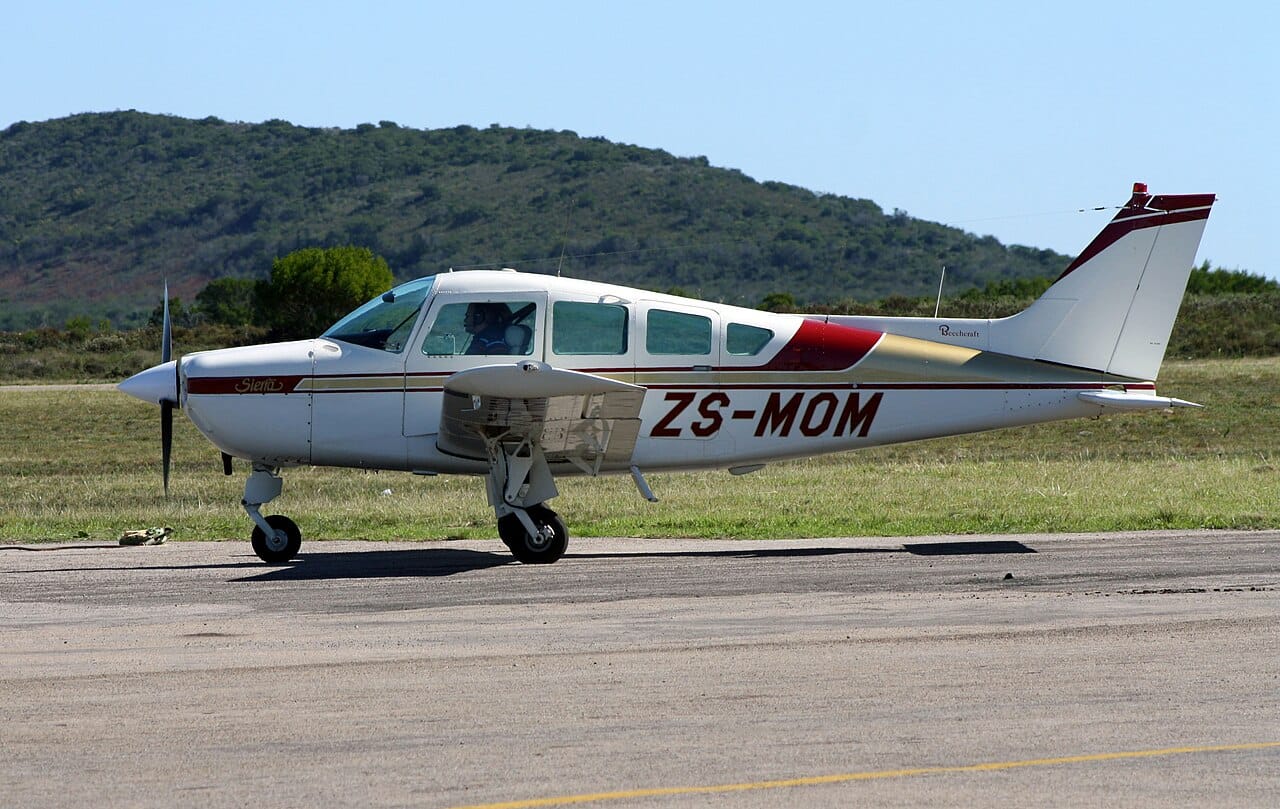
The Beechcraft Sierra is a Model 24R. It grew out of the Musketeer family, the same airframe that gave us the Sport and the Sundowner. Beech added retractable gear, a 200-hp fuel-injected Lycoming, and a constant-speed prop. The A24R came first, the B24R followed for roughly 1973 to 1976, and the C24R ran to 1983. If the Musketeer side of the family tree is new to you, our piece on the Sundowner compared with the 172 and Cherokee fills in the fixed-gear background.
Here is the part that surprises people: both airplanes use an angle-valve 200-horsepower Lycoming IO-360. The Sierra runs an IO-360-A1B6, the Arrow II an IO-360-C1C. Lycoming Service Instruction 1009BF lists up to 2,600 hours for qualifying factory-new or factory-rebuilt IO-360-A and IO-360-C series engines on their first overhaul cycle, while the listed interval after overhaul is generally 2,000 hours, subject to the notes and eligibility requirements in the current instruction. So the single biggest maintenance event in either airplane's life costs about the same. That is unusual in a head-to-head, and it means the real differences live in the airframe.
Good to Know: Beech built fewer than a thousand Sierras across all three variants in thirteen years. Piper built Arrows by the thousand across the full PA-28R and PA-28RT run. That ratio shows up in every parts quote, every pre-buy, and every resale conversation you will have.
What They Cost to Buy
Arrows are easy to shop because there are always some for sale. As of October 2026, Flying411 had 5 Piper Arrow aircraft listed across all variants, with asking prices from $100,000 to $153,000 and a median of $143,000, on model years spanning 1968 to 1979 and a median total time of 7,150 hours. Those are asking prices on live listings, not sale prices and not an appraisal, but they tell you the neighbourhood you are shopping in and they tell you that a straight 1970s Arrow is no longer a $50,000 airplane.
Sierras are a different shopping experience. We did not have one listed when we pulled those numbers, and that is the normal state of affairs rather than a blip. With under a thousand built and a good share of those retired or parted out, you may watch the market for months before a clean B24R with decent avionics and a mid-time engine surfaces. When one does, it typically asks less than a comparable Arrow, because the buyer pool is smaller and everyone in it knows about the parts situation.
Why the Cheaper Sticker Is Not Automatically the Cheaper Airplane
Buying the Sierra for its lower asking price is like buying a well-built European sedan from a brand that pulled out of the country. The car is fine. The parts counter is the problem. A Sierra that needs a gear actuator, a windshield, a wing-tip, or an interior panel will cost you more and keep you waiting longer than an Arrow needing the same thing, because Textron supports the type at Beechcraft prices and the aftermarket never built much PMA volume for a run that small.
That does not make the Sierra a bad buy. It makes the pre-buy inspection more important. On a Sierra, the money is in finding one that is already complete, already corrosion-free, and already flying regularly. On an Arrow, you have more freedom to buy a project and fix it, because the fixing is cheaper.
Heads Up: Neither airplane should be bought without a gear swing on jacks as part of the pre-buy, with the mechanic watching rigging, door sequencing, limit switches and emergency extension. A retract system that works fine on the ramp can still be out of rig enough to cost you a gear door, or worse. Budget $400 to $800 for this on top of a normal pre-buy.
Flying411 keeps four-seat retractable singles from both Beech and Piper in one place, so you can compare asking price, total time and engine time on live listings instead of guessing from memory.
The Numbers Side by Side
| Spec | Beechcraft Sierra B24R | Piper Arrow II (PA-28R-200) |
| Production years for this variant | About 1973 to 1976 | 1972 to 1976 |
| Engine | Lycoming IO-360-A1B6, 200 hp | Lycoming IO-360-C1C, 200 hp |
| Recommended TBO (Lycoming SI 1009BF) | Up to 2,600 hr factory-new/rebuilt; generally 2,000 hr after overhaul | Up to 2,600 hr factory-new/rebuilt; generally 2,000 hr after overhaul |
| Maximum gross weight | 2,750 lb | 2,650 lb |
| Book useful load (typical) | About 1,040 lb | About 1,010 lb |
| Usable fuel | 52 gallon | 48 gallons |
| Full-fuel payload (book, approximate) | About 725 lb | About 720 lb |
| Owner-reported cruise, 75% power | 130 to 135 kt | 135 to 140 kt |
| Cruise fuel burn | 10 to 11 gph | 10 to 11 gph |
| Still-air range, 45-minute reserve | Roughly 600 nm | Roughly 550 nm |
| Book rate of climb, sea level | About 900 fpm | About 900 fpm |
| Landing gear system | Hydraulically actuated, electrically driven power pack | Hydraulically actuated, electric power pack |
| Cabin doors | Two front cabin doors plus a large left-side rear cargo/passenger door | One right-side cabin door over the wing |
| Cabin width | Roughly 44 in | Roughly 41.5 in |
| Seats | Four, with optional fifth and sixth | Four |
| Approximate number built, all variants | Under 1,000 (Model 24R, 1970–1983) | Several thousand (PA-28R/RT series) |
Read that table and the pattern is clear. The Arrow is slightly faster and slightly better on full-fuel payload. The Sierra carries slightly more usable fuel, has a wider cabin, and offers substantially better cabin and baggage access. Neither airplane wins by enough to settle the argument on performance alone, which is exactly why the running costs and parts sections below matter more than the speed row.
Cost to Run
Fuel and the Hourly Math
Both airplanes burn about 10 to 11 gallons an hour at a normal cross-country power setting. At self-serve 100LL prices in the $6.00 to $6.75 a gallon range typical through 2025, that is roughly $63 to $74 an hour in gas alone. Lean of peak with good engine instrumentation and injector balancing, owners of both types report pulling that down toward 9.5 gph with a few knots of speed given up.
Add an engine reserve and the picture fills in. A field overhaul of an angle-valve IO-360 ran roughly $40,000 to $55,000 in 2025, with a factory engine and installation pushing the top of that range higher. Spread over 2,000 hours, that is $20 to $28 an hour you should be setting aside whether you feel like it or not. Prop overhaul on the constant-speed unit adds another $3,500 to $6,000 every six to ten years depending on the manufacturer's service letter and how the blades look.
Insurance
This is where both airplanes cost more than the fixed-gear four-seaters they resemble. A retractable 200-hp single is a complex airplane, and underwriters price it accordingly. Owners of either type commonly report annual premiums in the $1,800 to $3,500 range as of 2025 for a private pilot with an instrument rating, a few hundred hours total, and some retractable time. Low-time or no-retract-time buyers get quoted higher, or get a training requirement attached: typically 10 hours dual in make and model and a minimum of retractable experience before solo.
There is no meaningful insurance penalty for the Beech over the Piper or the other way around. What moves your premium is your logbook, your hull value, and whether you have gear-up history.
Annual Inspection
Expect $2,500 to $4,500 for a clean annual on either airplane at a shop that knows the type, with the gear system accounting for a meaningful share of the labour. The Sierra's figure drifts higher when something needs replacing, because of parts cost rather than hours. The Arrow's figure drifts higher when the shop finds corrosion in the usual Cherokee spots: the wing root, the battery box area, and the aft fuselage.
Keep in Mind: At 100 hours a year, hangar, insurance, annual and the engine reserve together will land most owners of either type somewhere around $220 to $260 an hour all in. Fly 50 hours instead of 100 and that number nearly doubles, because the fixed costs do not care how much you fly. The cheapest complex single is the one that leaves the hangar often.
Maintenance, Parts and the Paperwork You Must Check
The Arrow's biggest paperwork item is Airworthiness Directive 2020-26-16, issued by the FAA after the 2018 in-flight wing separation of a PA-28R-201 used in flight training. It requires owners of affected PA-28 and PA-32 serial numbers to calculate a factored service life that weights hours flown in a 100-hour-inspection environment more heavily than private-use hours, and once that figure passes 5,000 hours, to perform an eddy-current inspection of the lower main wing spar bolt holes. Any Arrow with a training past needs its applicability checked against the AD and its compliance documented in the logs before you write a cheque. An airplane that cannot prove where its hours came from is an airplane with an open question attached.
The Arrow's other recurring discussion point is the automatic gear extension system, the backup device that lowers the gear on its own at low airspeed. Many have been deactivated under the approved Piper procedure, which is legal and common. Find out which configuration your candidate has, make sure the logbook entry matches, and make sure the pilot's operating handbook supplement on board matches too.
On the Sierra, the recurring themes are the electrically driven hydraulic power pack, hydraulic actuators and hoses, landing gear rigging, and parts availability. Have your mechanic pull the full AD list against the specific serial number rather than assuming a generic list applies, because the 19/23/24 Musketeer family accumulated its own set over the years and compliance records on low-production types are often thinner than they should be.
Type Clubs Are Not Optional on These Airplanes
The Beech Aero Club exists specifically for the Musketeer, Sport, Sundowner and Sierra family, and for a Sierra owner it is closer to a utility bill than a hobby expense. It is where you find the member who has a spare gear door, the shop in your region that has actually rigged a 24R, and the accumulated knowledge of what breaks. On the Piper side, the Piper Owner Society and the Cherokee Pilots Association serve the same purpose, though with vastly more airplanes flying you also have the option of simply calling three shops and getting three quotes.
Pro Tip: Before you make an offer on a Sierra, call a parts supplier and price three things: a main gear door, a windshield, and a gear actuator. Do the same for the Arrow. The spread between those two sets of quotes is the real, honest price difference between these airplanes, and it is not reflected in the asking price.
Flying411 keeps complex single listings and the ownership guides that go with them in one place, so you can compare an airframe against what it actually costs to keep flying.
Flying Them: Cabin, Load and the Feel
The Sierra's best feature is the thing you notice before the engine starts. The cabin is about three inches wider than the Arrow's, and there is a second door at the rear on the right side. Loading two adults into the back seats of a Cherokee means everyone climbs the wing walk and folds themselves through one door. In the Sierra, the back-seat passengers get their own entrance. If you fly with your family, with older passengers, or with anybody who has a knee that complains, that door is worth real money to you.
Beech offered optional fifth and sixth seats in the Sierra. Treat them as a place for a child and a flight bag, not as a six-seat airplane. With 57 gallons of fuel aboard you have roughly 700 pounds of cabin load, and that is four adults with modest luggage, not six of anything.
In the air, the Arrow is the slightly faster of the two and feels like what it is: a Cherokee that goes about 25 knots quicker than the fixed-gear version. Stable, predictable, a touch heavy in roll, and completely unremarkable to land once you have the sight picture. The Sierra flies with the characteristic Musketeer solidity, a gentle stall, and a little less speed for the same fuel burn. Pilots who moved to a Sierra from a Sundowner describe it as the same airplane with the brakes taken off.
The B24R Sierra's roughly four-gallon usable-fuel advantage gives it some additional endurance, but the difference is much smaller than the later C24R's fuel capacity would suggest. On a 500-nautical-mile trip, the Arrow arrives maybe ten minutes earlier but with a thinner reserve and more reason to plan a stop. On a 250-mile weekend hop, neither difference matters at all.
Why It Matters: A 200-hp retractable is a transition airplane for most buyers, usually coming out of a 172 or a Cherokee 180. Both of these will teach you gear management, cowl flaps where fitted, and constant-speed prop discipline at about the same cost. If your real goal is a bigger step up in speed and load, look at a Comanche 250 or a Bonanza instead, and accept the higher running costs that come with them.
Resale: The Quiet Deciding Factor
Resale is the dimension most first-time buyers skip, and on these two airplanes it may be the one that decides the question. When you sell an Arrow, you are selling into a deep market where buyers already know the type, mechanics already know the type, and insurers already have a rate card. Listings move. When you sell a Sierra, you are looking for one of a small number of people actively shopping that specific airframe, and the search can take a while.
That cuts both ways. A smaller market means a longer sale, but it also means you bought in at a discount. If you fly a Sierra for ten years and keep it clean, the gap between what you paid and what you get back can be narrower than it would have been on an Arrow bought at the top of the market. The risk is concentrated in time, not necessarily in dollars.
What genuinely hurts resale on either type is damage history, especially gear-up damage, and incomplete logs. Both are common on 1970s retractables that have passed through many hands. A Sierra with complete records and no gear history will outsell a scruffy Arrow, small market or not.
Fun Fact: Beech marketed the Sierra against the Arrow directly in period brochures, leaning hard on the second door and the wider cabin rather than on speed. Beech knew the airplane was not going to win a race with the Piper, so it sold the cabin instead. Fifty years later, that is still the most honest case for the airplane.
Flying411 keeps Beechcraft and Piper singles side by side in one place, so you can compare what the market is actually asking before you commit to a type that only comes up for sale a few times a year.
So Which One Should You Buy?
Buy the Piper Arrow II if you want the lower-risk ownership experience. Parts are available, mechanics know the airplane, there is a PMA aftermarket, and you can sell it when you are done. It is faster by a few knots and has a marginally better full-fuel payload. The price is that you will pay more up front than you would for the Beech, and you must do the AD 2020-26-16 homework on any airframe with time in a flight school.
Buy the Beechcraft Sierra B24R if the wider cabin and the second door solve a real problem for how you fly, if you have a mechanic who is genuinely willing to learn the type, and if you can accept slower parts sourcing in exchange for a lower entry price. Join the Beech Aero Club before you buy, not after. If you need a cheap retractable now and cannot wait for the right airframe to appear, the Sierra is the wrong answer, because the right Sierra appears on its own schedule.
For a buyer who is genuinely undecided and has no strong feeling about the cabin, the Arrow is the safer call, and we will say that plainly. For a buyer who sat in both and climbed out of the Beech thinking "this one fits," the Sierra is a fine airplane that has been unfairly cheapened by comparison to a Bonanza it was never trying to be. The Beechcraft Sierra B24R vs Piper Arrow II decision comes down to whether you are buying an airplane or buying a support network, and there is no wrong answer as long as you know which one you are doing. If neither feels right, our round-up of affordable small aircraft worth owning covers the fixed-gear alternatives that cost less to insure.
When you are ready to compare listings, visitFlying411and see what is on the market today.
Frequently Asked Questions
Is the Beechcraft Sierra really slower than the Piper Arrow II?
Yes, but only by a little. Owners of both types report cruise speeds within about five knots of each other at the same power setting, with the Arrow II typically at 135 to 140 knots and the Sierra at 130 to 135. On a two-hour flight that is about eight minutes. The Sierra's larger 57-gallon fuel capacity gives back more than the Arrow's speed takes away on longer legs.
Do the Sierra and the Arrow II use the same engine?
Not the same part number, but the same family and the same output. The Sierra uses a Lycoming IO-360-A1B6 and the Arrow II an IO-360-C1C, both 200-hp angle-valve fuel-injected fours with a 2,000-hour recommended TBO per Lycoming Service Instruction 1009. Overhaul cost and fuel burn are effectively the same between the two airplanes.
What does AD 2020-26-16 mean for an Arrow buyer?
It applies to certain Piper PA-28 and PA-32 serial numbers and requires calculating a factored service life that counts hours flown in a 100-hour-inspection environment more heavily than private hours. Once the factored figure exceeds 5,000 hours, an eddy-current inspection of the lower main wing spar bolt holes is required. Verify applicability against the specific serial number and confirm compliance in the logs before purchase.
Can a low-time private pilot insure either of these?
Usually yes, with conditions. Underwriters commonly require an instrument rating or a set number of dual hours in make and model, often around 10, plus a minimum of retractable-gear time before solo. Expect a higher premium in the first year that drops once you have 100 hours in type. Rates are broadly similar between the two aircraft.
Are Sierra parts actually hard to get?
Some are. With under a thousand Model 24R airframes built, there was never enough volume to attract a wide PMA aftermarket, so structural and gear-system parts often come from the factory at factory prices or from the used market through the Beech Aero Club. Consumables, tyres, brakes and the engine itself are no harder to source than on any other type.
Which one holds value better?
The Arrow sells faster because the buyer pool is far larger, which matters when you want out. Neither type is appreciating in a way you should count on. Condition, damage history and completeness of logs move the price on both of these far more than the badge on the tail does.