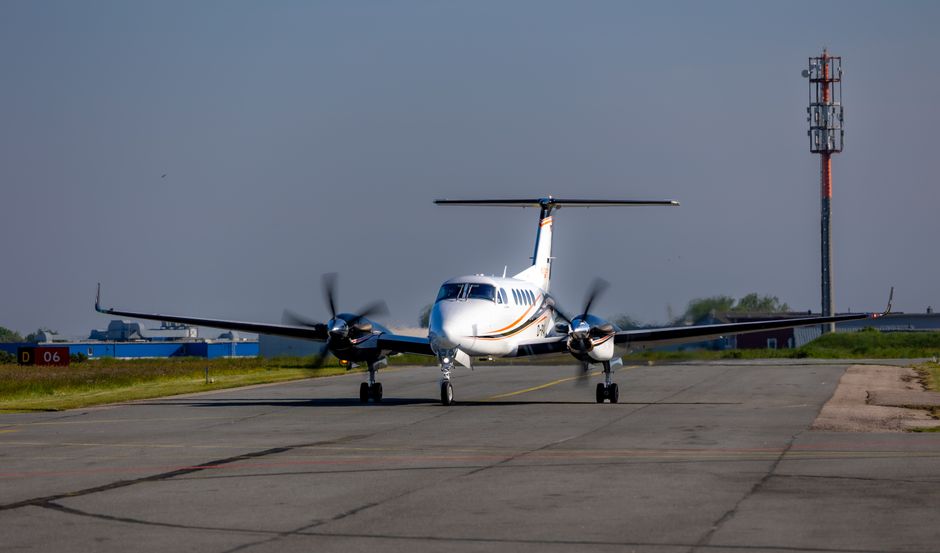
Most buyers read the F90 as the newer, bigger brother of the C90 — the next rung up the Beechcraft ladder. The lineage actually runs the other way. Beechcraft built the F90 from 1979, and the C90A came after it, staying in production until 1992 while the F90/F90-1 line ended after the 1985 model year.
That matters, because the King Air F90 vs C90A decision is not a question of old versus new. It is a question of whether you want the fast parts-bin hot rod or the mainstream airplane that the factory kept building for another three decades in one form or another. The F90 borrowed the King Air 100's shorter, harder-working wing and the Super King Air 200's T-tail, bolted them to the familiar 90-series fuselage, and hung 750-shaft-horsepower engines on it. The C90A kept the long wing, the conventional tail and the smaller engines.
Both carry the same six to eight people in the same cabin. What separates them is how fast they get there, what that speed costs per hour, and how easy the airplane is to keep flying in year eight of your ownership.
The Short Answer
If you fly 300-plus nautical mile legs on a schedule and you value getting there 25 to 30 knots sooner, the F90 is the better airplane and you should buy the best-maintained one you can find. If you fly shorter legs, operate out of shorter or higher fields, or you simply want the cheapest route into a pressurized twin turboprop with the broadest parts and training support in the business, the C90A is the smarter buy — and it will be easier to sell when you are done with it.
Design and Lineage: Why They Fly Differently
The C90A is a straight development of the 90 series Beechcraft had been refining since 1964. Fifty-foot-three-inch wing, conventional tail, two Pratt & Whitney Canada PT6A-21 engines flat rated to 550 shaft horsepower each, 10,100 lb maximum takeoff weight. It is a forgiving, low-wing-loading airplane that climbs well out of hot and high fields and lands slowly.
The F90 is a different animal wearing the same suit. Beechcraft took the King Air 100's wing — nearly four and a half feet shorter in span — added the T-tail from the 200, and fitted PT6A-135 engines rated at 750 shaft horsepower each, turning four-blade propellers. Fifty-foot-three-inch wing, conventional tail, two Pratt & Whitney Canada PT6A-21 engines flat rated to 550 shaft horsepower each, 10,100 lb maximum takeoff weight. The later F90-1, built from 1983, moved to -135A engines and the 200-style nacelles.
Think of it like two cars on the same floorpan: one has the touring suspension and the economy engine, the other has stiffer springs, wider tires and a lot more under the hood. Neither is wrong. They just reward different driving.
Why It Matters: The shorter wing is the single biggest difference between these two airplanes, and it shows up everywhere — approach speed, climb rate at gross weight, runway requirement, and how the airplane feels on a gusty day. Buyers who only compare cruise speeds miss it entirely.
Edge: Draw — the F90's wing buys speed, the C90A's wing buys short-field manners.
Speed, Climb and Altitude
The F90 wins this one outright. Published maximum cruise is roughly 267 knots for the original F90 and as high as about 279 knots for the later F90-1, while typical cruise planning numbers vary with altitude, weight and power setting. The C90A tops out around 240 to 247 knots and realistically plans at 220 to 230. Certified maximum operating altitude is 31,000 feet for the F90 against 30,000 for the C90A, and the F90's extra 200 shaft horsepower per side — 400 horsepower total — gets it up there noticeably faster, especially heavy or warm.
On a 300-nautical-mile leg that difference is around eight minutes. On an 800-mile day with a fuel stop it is closer to half an hour. Whether that is worth the premium depends entirely on whether anyone in the back is counting.
Single-engine performance is where the horsepower earns its keep. Both airplanes sit under 12,500 lb, so neither needs a type rating, and both are routinely flown single-pilot. But an engine failure at gross weight on a hot day is a meaningfully calmer event in the F90.
Edge: F90, clearly — faster, higher, stronger on one engine.
| Specification | King Air F90 / F90-1 | King Air C90A |
| Years built | 1979–1983 (F90); 1983–1985 (F90-1) | 1984–1992 |
| Engines | 2 × P&WC PT6A-135 (-135A on F90-1) | 2 × P&WC PT6A-21 |
| Power, each | 750 shp | 550 shp (flat rated) |
| Propellers | Four-blade | Three-blade |
| Wingspan | 45 ft 10.5 in (King Air 100 wing) | 50 ft 3 in |
| Tail | T-tail (Super King Air 200 type) | Conventional |
| Max takeoff weight | 10,950 lb | 9,650 lb or 10,100 lb, depending on serial number |
| Usable fuel | 470 US gal (about 3,149 lb) | 384 US gal (about 2,573 lb) |
| Max cruise speed | About 267 kt (F90); up to about 279 kt (F90-1) | About 240–247 kt |
| Typical cruise fuel burn | About 90–100 gph total | About 72–80 gph total |
| Max operating altitude | 31,000 ft | 30,000 ft |
| Typical full-fuel payload | Roughly 650–900 lb (equipment dependent) | Roughly 500–700 lb (equipment dependent) |
| Cabin | Identical 90-series fuselage — about 4 ft 9 in high, 4 ft 6 in wide, 12 ft 7 in long | |
| Type rating required | No, both under 12,500 lb; high-altitude endorsement under FAR 61.31(g) applies |
Keep in Mind: Those full-fuel payload figures are the reason King Air 90 owners rarely fill the tanks. With everything topped off you are carrying roughly three adults and their bags. Both airplanes are far more useful when you load fuel for the leg you are actually flying plus reserves.
Fuel, Engines and Cost Per Hour
Here the C90A pushes back hard. At planning numbers the F90 burns something like 90 to 100 gallons an hour against the C90A's 72 to 80. With Jet A running roughly $6 to $7 a gallon at the average US FBO through 2025 — lower on contract fuel — that is well over $100 an hour in straight fuel cost.
Per mile the gap narrows but does not close. An F90 at 250 knots and 95 gallons an hour burns about 0.38 gallons per nautical mile. A C90A at 225 knots and 76 gallons an hour burns about 0.34. Call it roughly 12 percent more fuel for every mile flown, in exchange for arriving sooner.
Engines are the bigger number. Both the PT6A-21 and the PT6A-135 family carry published overhaul intervals in the 3,600-hour neighbourhood under Pratt & Whitney Canada's schedules, with hot section inspections at roughly the midpoint. Shops quote PT6A overhauls in the mid six figures for a pair, and the higher-rated -135 generally costs more to overhaul than the -21. Owners typically budget somewhere between $175 and $275 per hour as an engine reserve for the pair, with the F90 sitting at the top of that band. If you want to see how PT6A reserve math works on a simpler airframe, our look at R-1340 versus PT6A costs on the Air Tractor AT-401 lays out the same arithmetic.
For a full line-by-line picture of what an F90 year actually looks like, we broke it down separately in King Air F90 Operating Cost: What to Budget.
Flying411 keeps King Air listings from across the market in one place, so you can compare engine times, hot section status and total airframe hours side by side rather than hunting them down one broker at a time.
Edge: C90A — meaningfully cheaper per hour and per year.
Maintenance, Parts and Support
Both airplanes are maintained on Textron Aviation's phased inspection program, where the work is split into phases run at regular hour intervals rather than one annual blowout. That smooths cash flow, and any decent King Air shop knows the drill on either model.
Where they separate is fleet size. Beechcraft built roughly 200 F90s plus about 30 of the later F90-1 — a small population. The C90 family, by contrast, ran in one form or another from 1971 all the way through the C90GTx, which means well over a thousand airframes and a factory that kept producing compatible parts for decades after your C90A left Wichita. Common items are easier to source, shop familiarity is deeper, and the training pipeline is wider.
Neither airplane escapes the paperwork. Textron has issued supplemental inspection requirements and service bulletins across the King Air line covering structure such as wing spar and pressure vessel items, and these drive real shop hours on high-time airframes. Ask any seller for documented compliance status before you spend money on a pre-buy, and have the logbooks reviewed by someone who knows King Airs specifically.
Pro Tip: On any King Air of this vintage, the two numbers that move the price most are time since engine overhaul and whether the avionics have been brought current. A clean WAAS-capable panel with modern autopilot integration can be worth more than a hundred hours of engine time to the next buyer.
Edge: C90A — the broader fleet means better parts availability and more shops who see the model weekly.
Payload, Range and Runway
With about 470 usable gallons against the C90A's 384, and up to roughly 1,300 pounds more maximum takeoff weight depending on which C90A serial number is being compared, the F90 carries substantially more fuel and offers greater long-range flexibility. Long-range cruise range runs to roughly 1,200 to 1,300 nautical miles with reserves, against something nearer 1,000 for the C90A — though in both cases you trade payload for every mile past the comfortable number.
Runway tells the opposite story. The C90A's longer, lightly loaded wing gets it off shorter strips, out of higher-elevation airports and off hot-day pavement with less drama, and it brings the airplane down final noticeably slower. Both will operate from fields under 3,000 feet at sea level, but the margin shrinks faster for the F90 as you add elevation and temperature.
Good to Know: If your home base is a 3,500-foot strip at 5,000 feet elevation, the C90A's wing is worth more to you than the F90's extra 25 knots. Density altitude is unimpressed by horsepower when the wing runs out first.
Flying411 keeps twin-turboprop and cabin-class piston listings in one place, so you can compare what a King Air really costs against the step below it before you commit.
Edge: Split — F90 on range and payload, C90A on field performance.
Which One Should You Buy?
The owner-flown business traveller doing 400 to 700 nm legs. Buy the F90. The speed is real on those legs, the single-engine margin is reassuring when you are the only pilot, and the extra fuel capacity means fewer stops. Budget for the higher fuel and engine reserve and accept that you are in a smaller fleet. Get model-specific recurrent training — insurers will want it regardless.
The first-time turboprop buyer stepping up from a cabin-class piston twin. Buy the C90A. It is the most supported, most instructed, most liquid airplane in the category, the hourly cost is lower, and the handling is more forgiving while you learn the systems. If you are still weighing whether to make the jump at all, our piece on the Beechcraft Duke B60 is a useful reality check on what a complex piston twin really costs, and the Baron B55 versus B58 comparison covers the rung below.
The charter, part-time commercial or flight-department operator. C90A, almost every time. Dispatch reliability depends on parts being on a shelf somewhere near you, maintenance quotes come in lower, and resale is broader when the airplane comes off the certificate. The F90 is the better airplane on paper and the harder airplane to monetise.
Heads Up: Brokers consistently report that F90s ask less than comparable-year C90As despite the performance advantage, precisely because the fleet is smaller and buyers are fewer. That discount is genuinely attractive going in — and it works against you going out. Plan to keep an F90 a long time.
Making the Call on King Air F90 vs C90A
The honest framing of King Air F90 vs C90A is that you are choosing between performance and liquidity. The F90 gives you more airplane for the money up front and will finish most trips sooner. The C90A gives you lower running costs, easier support and a much deeper buyer pool on the day you sell. Neither choice is a mistake; buying either one with soft logbooks, unknown spar inspection status or engines near TBO is.
Whichever way you lean, spend the money on a thorough pre-buy with a King Air specialist and price the next hot section into your offer. It is the cheapest insurance in turboprop ownership.
Flying411 keeps King Air F90 and C90A listings in one place, so you can compare engine time, avionics and asking price without jumping between a dozen broker sites.
When you are ready to compare listings, visitFlying411and see what is on the market today.
Frequently Asked Questions
Do I need a type rating to fly a King Air F90 or C90A?
No. Both have a maximum takeoff weight under 12,500 lb, so no type rating is required. You will need a multi-engine rating, and because both are pressurized with service ceilings above 25,000 feet, FAR 61.31(g) requires a high-altitude training endorsement. Insurers will almost always add their own requirement for initial and annual recurrent simulator training.
Is the F90 faster enough to justify the extra fuel burn?
On legs under about 250 nautical miles, probably not — the time saved is a few minutes. On 500-mile and longer legs, the F90 saves meaningful time and can sometimes skip a fuel stop the C90A would need. Work out your actual annual mission before paying for speed you will not use.
Which has better resale value?
The C90A, by a clear margin, simply because more buyers are shopping for it and more shops support it. The F90 typically costs less to buy and takes longer to sell. If you expect to own the airplane under five years, that difference deserves real weight in the decision.
Can a C90A be upgraded to F90-like performance?
Partly. Supplemental type certificates exist that fit higher-rated PT6A variants to C90-series airframes, and aerodynamic packages are available that improve climb and cruise. They add speed, but they do not change the wing span or the maximum takeoff weight, so the C90A's field performance character stays. Price the modification against the cost of simply buying an F90 before committing.