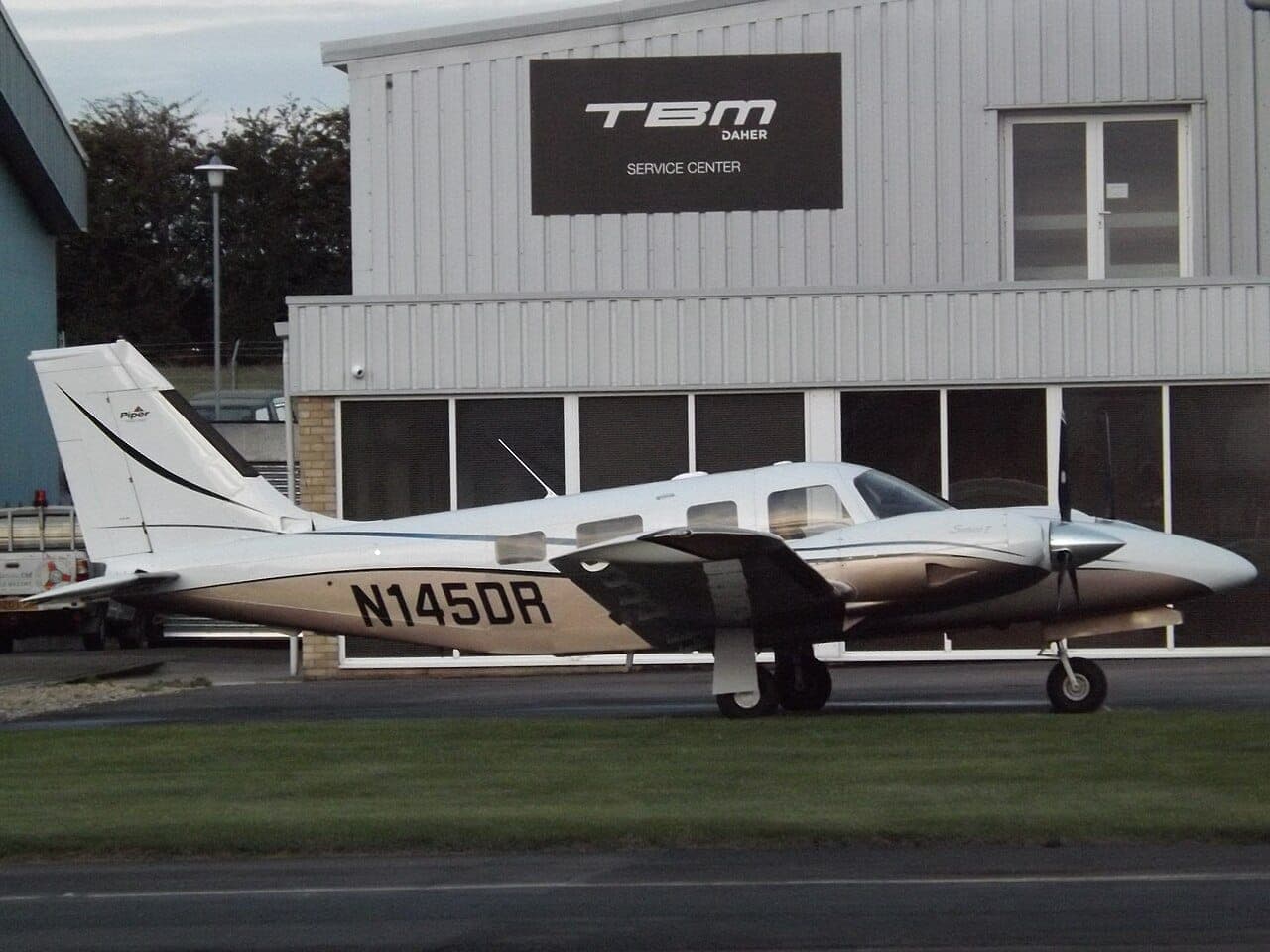
You are looking at a Baron or a Seneca and wondering whether that second engine actually buys you a margin the single does not have. The short answer: a piston twin is safer than a single in some situations, particularly when its remaining engine provides enough performance to continue safely after a failure. But that advantage depends heavily on pilot proficiency, aircraft performance, loading and operating conditions. The accident data do not support a blanket claim that either configuration is always safer.
That is not an opinion handed down at the hangar door. It is the pattern accident investigators and the AOPA Air Safety Institute have found over decades of general aviation records, and it should shape how you shop, not just how you fly.
Does a second engine make the airplane safer?
Not by itself. A second engine adds redundancy only if the pilot can use it in the few seconds available, and only if the airplane has the performance to climb away on the power that is left.
Think of the second engine as a spare tire you have to fit while the car is still rolling at 70 mph. The spare is genuinely useful. The procedure for installing it is what kills people. In a single, an engine failure turns the airplane into a glider and the pilot's job becomes picking a field and flying a stabilized approach to it — a task most pilots have practiced since their first ten hours. In a twin, the same failure leaves you with full power on one side, a dead or windmilling propeller on the other, and an airplane that wants to roll and yaw toward the dead engine while you are low, slow, and busy.
The redundancy is real at altitude, in cruise, over water or rough terrain. It is thin to nonexistent in the first few hundred feet after liftoff on a hot day at gross weight.
What does the accident data actually say?
It says engine failures in singles are usually survivable, and engine failures in twins are usually survivable too — right up until the pilot loses control. That last part is where the fatality gap comes from.
AOPA Air Safety Institute accident reports show why comparing piston twins and singles requires more than counting engine failures. Multiengine accidents involving engine-out loss of control can be especially dangerous, while many single-engine forced landings are survivable when the pilot maintains control. However, the overall safety comparison depends on accident rates per flight hour, aircraft type, operating conditions and accident cause. These reports do not establish that every piston twin is less safe than a comparable single-engine airplane. The mechanism is not mysterious. A single that quits lands under control at roughly 1.3 times stall speed. A twin that quits can depart controlled flight before it ever touches anything.
Two more findings matter for a buyer. First, most engine stoppages in piston airplanes are not mechanical at all — fuel exhaustion, fuel starvation, carb ice and induction problems account for a very large slice, and twins have more complex fuel systems with crossfeeds, tip tanks and aux tanks to mismanage. Our rundown of the 7 common causes of engine failure is worth reading before you sign anything. Second, the twin accident records are full of pilots who were legally current but had not flown a real engine-out drill in a year or more.
Why It Matters: The safety difference between twins and singles is mostly a pilot-skill difference, not a hardware difference. That means it is something you can buy your way into with training — or lose by flying 40 hours a year.
Why is an engine failure in a twin so hard to handle?
Because asymmetric thrust tries to roll and yaw the airplane toward the dead engine, and below a speed called Vmc the rudder can no longer stop it. Vmc is the red line on the airspeed indicator. Under the certification rules that applied to most light twins, Vmc may not exceed 1.2 times the stall speed in that configuration, which means red line and stall speed sit uncomfortably close together.
That closeness is the trap. After an engine failure, allowing airspeed to decay below the published best single-engine climb speed (Vyse) reduces available performance, while slowing toward minimum control speed (Vmc) increases the risk of losing directional control. However, crossing below Vyse does not automatically cause an uncontrollable roll, and actual Vmc varies with power, configuration, weight and other conditions. Pilots must maintain control, establish the appropriate airspeed and follow the aircraft's approved engine-failure checklist, including securing and feathering the failed engine when appropriate. A slight bank toward the operating engine can improve performance and directional control.
Some twins remove the problem. Counter-rotating propellers, used on the Piper Seminole, the Beech Duchess and the Seneca II and later, mean neither engine is the "critical" one. The Cessna 337 Skymaster goes further with centerline thrust: one engine in front, one behind, no asymmetric yaw at all.
How much climb do you really get on one engine?
Far less than most buyers assume — typically 150 to 400 feet per minute at sea level, at gross weight, on a standard day, with a clean airplane and a feathered propeller. Lose any of those conditions and the number goes to zero or negative.
Here is the part that surprises first-time twin shoppers: for piston airplanes at or below 6,000 pounds with a stall speed of 61 knots or less, the older Part 23 rules required only that the single-engine climb gradient at 5,000 feet be determined and published. It did not have to be positive. Plenty of light trainers and four-seat twins legally cannot hold altitude on one engine on a warm day at weight.
| Light twin | Approx. single-engine climb (sea level, gross) | Approx. single-engine service ceiling | Notes |
| Piper PA-44-180 Seminole | About 210 fpm | Roughly 3,800 ft | Counter-rotating props, no critical engine |
| Beechcraft BE76 Duchess | About 235 fpm | Roughly 6,000 ft | Counter-rotating props |
| Piper PA-30/39 Twin Comanche | About 260 fpm | Roughly 7,000 ft | Light, slick, unforgiving when slow |
| Beechcraft Baron 58 | About 390 fpm | Roughly 7,000 ft | Real single-engine performance, higher costs |
| Cessna 337 Skymaster | About 300 fpm | Roughly 7,000 ft | Centerline thrust, no Vmc roll |
Treat every number above as a book figure from a new airplane with a sharp propeller and a test pilot flying it. Owners report that a 40-year-old airframe with aged engines and a few antennas delivers noticeably less. Density altitude eats the rest: on a 90-degree day at a 4,000-foot field, a trainer twin's single-engine climb can simply be gone.
Flying411 keeps light twins and high-performance singles in one place, so you can compare single-engine climb figures, engine times and equipment side by side instead of chasing specs across a dozen tabs.
Doesn't two engines just double your chance of an engine failure?
Having two engines creates more opportunities for an individual engine or its associated systems to fail. If two engines have equal, independent failure probabilities, the chance of at least one failing is approximately twice that of a single engine when individual failure probabilities are very small. However, actual aircraft reliability also depends on engine condition, maintenance, fuel systems and failures that can affect both engines. The second engine can reduce the consequences of a single-engine failure when the airplane has sufficient remaining performance and the pilot maintains control.
In cruise at 8,000 feet over farmland, that extra failure rate barely matters, because either airplane gets you somewhere survivable. At night over the Appalachians, or in solid IMC with a 600-foot ceiling, the twin's ability to limp to an airport is worth a great deal and the single's glide is worth very little. The question to answer before you buy is not "which is safer" but "what percentage of my flying actually happens in conditions where a glide is not good enough?"
For a pilot flying 80 hours a year of daytime VFR cross-countries, that percentage is close to zero. For an owner commuting 300 hours a year in weather, it is substantial. The honest shopper's version of this question is answered by looking at a year of real flight logs, not by imagining the worst trip you might take someday.
What training and currency does a twin really demand?
More than the multiengine rating checkride, and more than most owners budget. The rating itself can be added in 10 to 15 hours, but the proficiency that makes a twin safer than a single has to be renewed on a schedule.
A A workable training plan includes an initial checkout with a qualified multiengine instructor and recurrent training every 6 to 12 months, adjusted to the aircraft and pilot's experience. Training should cover engine failures at safe altitudes, takeoff decision-making, single-engine approaches and the limitations of single-engine go-arounds. Whether a go-around is possible depends on the airplane's published performance, configuration, weight, density altitude and available terrain clearance. Pilots should establish their decision criteria before flight and practice the appropriate procedures with an instructor. Expect your insurer to require a named-pilot warranty, minimum total and multi time, and annual training — twin hull and liability quotes have been tight through 2025, and training compliance is the main lever you control.
Pro Tip: Write your own takeoff briefing and say it out loud every time. Below a stated altitude, the engine failure is handled by closing both throttles and landing more or less straight ahead. Above it, you clean up and fly. Pilots who decide that number on the runway, not at 300 feet, are the ones who survive.
What does the extra safety cost to own?
Roughly double the engine-related expense of a comparable single, plus a higher insurance premium and a fatter annual. Two engines mean two overhauls, and piston TBOs generally run from about 1,400 hours on some turbocharged Continentals to 2,000 hours on common Lycoming four-cylinders — the manufacturer's service instructions give the figure for your exact model.
As of 2025, shops are quoting well into five figures per engine for a factory-reman or field overhaul on typical 180 to 300 horsepower powerplants, and you will need both. Add two propellers on calendar overhaul cycles, two turbochargers if fitted, retractable gear, a heated windshield, boots to replace, and 20 to 30 gallons per hour of fuel. The reserve math is unforgiving and it is the single biggest reason owners sell twins.
None of that is an argument against buying one. It is an argument for buying one you can afford to fly 150 hours a year, because the under-flown twin is the dangerous twin. Our list of the best twin-engine piston aircraft is a good place to match mission to budget, and the long-distance twins roundup covers the airplanes where the second engine earns its keep.
Flying411 keeps asking prices, engine times since overhaul and avionics details for piston twins in one place, so you can compare what you are really buying before the reserve math bites.
Are there other ways to buy redundancy?
Yes, and for many missions they are a better fit than a second engine. Centerline thrust, whole-airframe parachutes and modern single-engine reliability all attack the same problem from different directions.
The Skymaster's in-line engines remove the Vmc roll entirely, which is why it carried its own limited rating for years. Cirrus airframes carry CAPS, the ballistic parachute, and the manufacturer reports well over 200 survivors from in-envelope deployments — a number that changed how the industry talks about single-engine risk. A well-maintained modern single with engine monitoring, a second alternator and a backup attitude source removes several of the failure modes that used to justify a twin in the first place. Our comparison of the Cirrus SR22 and Cessna 172 shows how much that equipment gap has widened, and the broader question of aircraft size and safety is covered in are small planes safer than big planes.
Keep in Mind: A turbine single changes the conversation again, because turbine engines fail far less often than pistons. If your real need is dispatch reliability in weather rather than two of everything, a single-engine turboprop may be the cheaper answer per hour than a cabin-class piston twin.
At a Glance
The data does not show that a piston twin is safer than a single in any automatic sense. It shows that twin-engine redundancy introduces both opportunities and risks: an individual engine failure may still allow continued flight, but handling an engine failure close to the ground can be demanding and dangerous. Aircraft performance, operating conditions and recent engine-out proficiency all influence the outcome. Accident statistics must be interpreted carefully before drawing conclusions about which configuration is safer overall. Single-engine climb in most light twins is a modest 150 to 400 feet per minute under ideal conditions and often nothing at all on a hot day at weight, so check the book figures for the exact model and loading you plan to fly. Buy the twin if your missions genuinely include night, weather, water or mountains and your budget supports 150 hours a year plus recurrent training every six to twelve months. Buy the single, or a parachute-equipped single, if most of your flying is daytime cross-countries where a glide to a field is a perfectly good plan.
When you are ready to compare listings, visitFlying411and see what is on the market today.