Most people shopping a Pilatus P-3 assume the purchase price is the hard part. It usually isn't. The airplane itself can be had for less than a decent used Bonanza, and then the geared Lycoming up front, the exhibition paperwork, and the thin spares pipeline quietly set the real budget for the next ten years.
The second assumption worth correcting: the Pilatus name on a military trainer does not mean a turbine. The P-3 is a 1950s piston design, the airplane the PC-7 eventually replaced in Swiss service, and it flies and costs like a heavy, complex, aerobatic piston single rather than like a warbird jet.
What exactly is a Pilatus P-3-05?
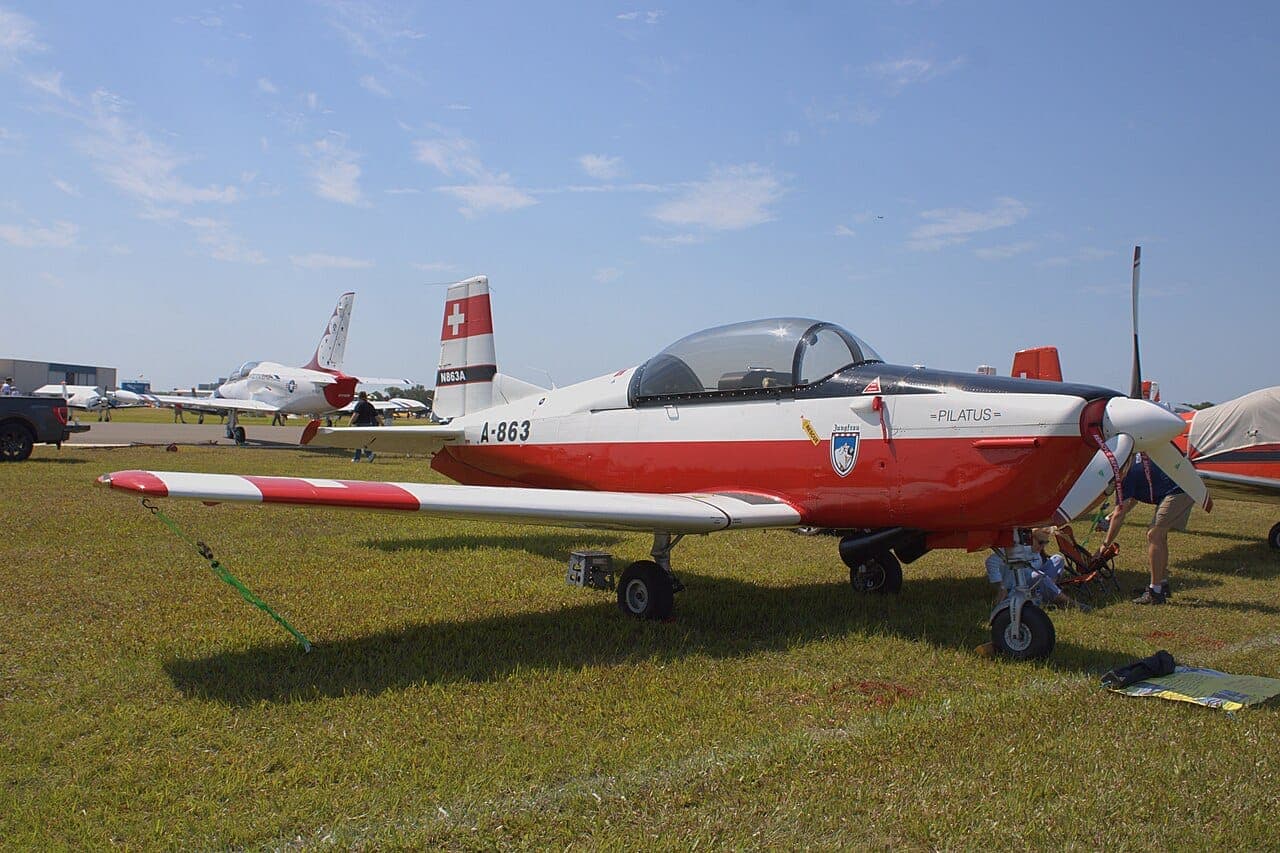
The P-3-05 is the main production version of a tandem two-seat, all-metal Swiss military primary trainer that first flew in 1953 and served the Swiss Air Force from the mid-1950s until the 1990s. Fewer than 100 were built in total. The bulk went to Switzerland, with a small batch delivered to Brazil, which makes this one of the rarer ex-military trainers you can realistically buy and fly.
Unlike the tailwheel Pilatus P-2 that came before it, the P-3 has retractable tricycle landing gear, which was the whole point: Switzerland wanted a trainer whose handling and ground manners matched the jets its students would move on to. The airplane is stressed for aerobatics and spins, carries two underwing hardpoints that the Swiss used for practice gun and rocket pods, and has a sliding canopy over two tandem cockpits with full dual controls.
Performance is modest by warbird standards and that is part of its appeal. Expect a maximum speed in the neighborhood of 165 to 170 knots, a comfortable cruise around 130 to 140 knots, a service ceiling near 18,000 feet, maximum takeoff weight around 3,300 pounds, and still-air range on the order of 400 nautical miles. It is not a cross-country machine so much as a local aerobatic and formation airplane that happens to be able to travel.
Fun Fact: When Switzerland retired the fleet, the aircraft were sold off as government surplus along with warehouse quantities of spares. That single decision is the reason the type is still flyable today, and why spares inventories move with individual airframes at sale.
What does a Pilatus P-3 cost to buy in the United States?
Flyable P-3-05s have generally traded in the five-figure to low six-figure range, roughly $90,000 to $200,000 as of 2025, with condition, engine time, paint, and avionics driving most of the spread. Project airframes and aircraft with run-out or timed-out engines come in well below that, sometimes under $60,000, and those are exactly the ones that end up costing the most.
Treat any price range for this type with care, because the comparables are thin. Only a handful of P-3s sit on the U.S. registry, and in a given year you may see one or two offered publicly in North America. European listings are more common, which means import cost, de-registration from the prior country, shipping or ferry, and a U.S. airworthiness certificate all land on your side of the ledger.
The pricing logic here is closer to the homebuilt warbird world than to the certified market. A well-sorted Titan T-51 Mustang and a well-sorted P-3 both sell on documentation, engine condition, and the seller's reputation rather than on a published book value. There is no price guide that covers this airplane with any authority.
Flying411 keeps ex-military trainers and piston warbirds listed alongside the rest of general aviation, so you can compare what a P-3 actually asks against the Yaks, Marchettis and T-34s people cross-shop it with.
How is a P-3 registered and certificated in the U.S.?
Almost every P-3 in the United States flies on an FAA experimental airworthiness certificate issued for exhibition under 14 CFR 21.191(d). There is no U.S. type certificate for the P-3, so the standard category is not available, and that single fact shapes how you may use the airplane.
An exhibition certificate comes with operating limitations written for your specific aircraft. In practice those limitations require a program letter describing the airshows, flyovers, static displays and demonstrations you intend to support, usually renewed annually with your local FSDO. Flight is permitted for those events, for travel to and from them, and for crew proficiency and maintenance test flights. What is not permitted is carrying people or property for compensation or hire, and some limitations restrict operations over densely populated areas or within certain airspace without coordination. FAA Order 8130.2 is the document inspectors and designated airworthiness representatives work from when they issue and renew these certificates.
The upside of experimental status is maintenance and upgrade freedom. The annual inspection becomes a condition inspection, which an A&P mechanic can sign off without an inspection authorization, and you are not locked into TSO'd avionics. Owners routinely fit modern GPS navigators, electronic ignition on some installations, ADS-B Out, and glass engine monitors that would be a paperwork project on a certified airplane.
Heads Up: Under FAA rules effective December 2, 2024, an owner may generally receive flight instruction in their own experimental aircraft and pay the instructor without obtaining a Letter of Deviation Authority (LODA), provided the aircraft itself is not furnished for compensation and the operation meets 14 CFR Section 91.326. A LODA may still be required for certain other compensated training operations. Before arranging instruction in a P-3, confirm that the flight also complies with the aircraft's experimental-exhibition operating limitations.
What does it cost to insure a Pilatus P-3?
Budget somewhere between about $4,000 and $9,000 a year for hull and liability on a $120,000 to $180,000 agreed value, assuming you are a reasonably experienced pilot who completes the training the underwriter asks for. Liability-only coverage, which some owners choose on lower-value airframes, typically runs a few thousand dollars.
Underwriters who write warbird and experimental exhibition business generally quote hull rates in the low single digits as a percentage of agreed value for this class of aircraft, with the percentage falling as your retractable-gear and in-type time build. A 200-hour private pilot with no complex time will either be declined or quoted at a rate that makes the airplane pointless. A 1,500-hour pilot with tailwheel, aerobatic and formation experience will be quoted near the bottom of the band.
Three things move the number more than anything else. First, time in type and time in similar aircraft, which for a rare airplane usually means the underwriter accepts an approved checkout with a named mentor pilot instead. Second, whether you intend to fly aerobatics and formation, which some policies exclude or surcharge. Third, where it lives, because a hangared airplane in a low-claims state prices better than one tied down on a coastal ramp.
Pro Tip: Get the insurance quote before you sign anything. On a type this rare, an underwriter's training requirement can add 10 to 20 hours of dual with a mentor pilot who may live three states away, and that cost belongs in your purchase math, not your surprise column.
What does it actually cost per hour to fly one?
Based on the planning figures below, direct operating costs for a Pilatus P-3 range from approximately $163 to $252 per flight hour. Fixed annual expenses total roughly $10,600 to $26,100, adding another $212 to $522 per hour when flying 50 hours annually. That produces an illustrative all-in budget of approximately $375 to $775 per flight hour, excluding acquisition, financing, depreciation and major unexpected repairs. Actual costs depend heavily on aircraft condition, insurance, hangar rates and annual utilization.
The table below is a planning framework rather than a quote. Fuel is priced at the $6 to $8 per gallon band common at U.S. self-serve pumps through 2025, which varies enormously by region.
| Cost item | Typical range | Notes |
| Fuel | $85–$120 per hour | Roughly 13–15 gph of 100LL in cruise |
| Oil and filters | $8–$12 per hour | Geared engines consume oil; plan on it |
| Engine overhaul reserve | $40–$60 per hour | Based on a $50k–$70k overhaul over ~1,200 hours |
| Propeller reserve | $5–$10 per hour | Constant-speed, overhauled on calendar and hours |
| Unscheduled maintenance | $25–$50 per hour | Higher than a Cessna because parts are hunted, not ordered |
| Hangar | $3,600–$9,600 per year | Canopy and paint make outdoor storage a poor idea |
| Insurance | $4,000–$9,000 per year | Hull plus liability, agreed value |
| Annual condition inspection | $2,500–$6,000 per year | Before any discrepancies are fixed |
| Registration, charts, misc. | $500–$1,500 per year | Includes program letter renewal effort |
Two honest warnings about that table. The unscheduled maintenance line is the one that blows up, because a part that is a $300 overnight order for a Piper may be a six-week search for a P-3. And the annual condition inspection number assumes a shop that has seen the type or at least seen ex-military metal. A general-aviation shop learning your airplane on your dime will bill considerably more hours the first year.
Flying411 keeps operating-cost guides for warbirds, pistons and turbines in one place, so you can compare what an exhibition-category trainer really demands against the certified single you might buy instead.
What is the geared Lycoming GO-435 like to own?
The P-3-05 is powered by a 260-horsepower Lycoming GO-435-C2A2, a six-cylinder horizontally opposed engine with a reduction gearbox between the crankshaft and the propeller, and it rewards a pilot who treats power changes gently. Lycoming's published recommended time between overhauls for the GO-435 family is in the 1,200-hour range; check the current revision of Lycoming Service Instruction 1009 rather than relying on a figure in an old logbook.
The gearbox is the part owners learn to respect. Because the propeller turns at roughly two-thirds crankshaft speed, the gear train sees reversing loads whenever the propeller drives the engine instead of the other way around. That means no snapping the throttle closed, no long idle-power descents, and no letting the engine windmill its way down from altitude. The same discipline applies to the geared Continental in a Cessna 175, and the ownership lessons translate almost exactly, which is why the discussion in our piece on whether to keep the GO-300 or convert a Cessna 175 is worth reading even if you never go near a 175.
Two more practical points. The GO-435 is a low-compression engine originally designed around lower-octane avgas, so running it exclusively on 100LL invites lead fouling in the plugs and lead sludge in the oil. Aggressive leaning on the ground and in cruise, frequent oil changes and attention to plug condition are routine maintenance here, not optional diligence. Experimental-exhibition certification can provide more flexibility for aircraft modifications, but owners should not assume that every unleaded aviation fuel is suitable for the installed engine and fuel system. Before switching fuels, verify compatibility with the Lycoming GO-435's configuration, the aircraft's fuel-system materials and operating limitations, and the applicable engine and fuel-manufacturer guidance.
Overhaul is where the type's rarity bites. There is no queue of shops competing for GO-435 work. Owners who have been through it describe a $50,000 to $70,000 event, and report that cylinder, gear and accessory availability, not labor, is what determines how long the airplane sits.
Do you need a type rating or special training to fly a P-3?
No type rating is required, because the P-3 is well under 12,500 pounds and is piston powered. What you do need under 14 CFR 61.31 is a high-performance endorsement, since the engine exceeds 200 horsepower, and a complex endorsement for the retractable gear, flaps and controllable-pitch propeller.
That is the legal floor, and it is not the practical one. Insurance will set the real standard: a formal checkout with a pilot who knows the type, a minimum number of hours before solo in the airplane, and usually recurrent training each year. Add aerobatic and formation instruction if you plan to use the airplane the way it was designed to be used, because formation flying at airshows is a learned discipline with its own standards and card systems, not something you pick up by following a friend.
Transition pilots consistently say the P-3 is honest and conventional to fly, with heavier controls than a Decathlon and better visibility than almost anything with a cabin roof. If you want context on where it fits among the airplanes designed for exactly this job, our overview of the best military trainer aircraft and the broader look at small military planes both set the stage.
What should you check before buying one?
Start with the paperwork chain, because on an imported ex-military airplane that is where deals die. You want proof of de-registration from the previous country, a clean bill of sale history, import documentation, the current FAA registration, the experimental exhibition airworthiness certificate with its operating limitations attached, and the most recent program letter. Keeping and organizing those records matters long after closing; our guide on how long to keep an aircraft bill of sale is only useful if the file is complete to begin with.
The airframe
Swiss aircraft were well maintained, but these airframes are now 60 to 70 years old. Look hard at corrosion in the wing spar area, around the gear wells, under the cockpit floors and anywhere water collects. Check canopy rails and plexiglass condition, since replacement transparencies are specialty items. Have the gear retraction rigging checked on jacks, and confirm that any removed military equipment, hardpoints and wiring was dealt with cleanly rather than cut and taped.
The engine and the logs
Get a borescope and a compression check, and ask specifically about gearbox inspection history and any metal found in filters. Original Swiss logbooks are typically in German or French and may use military rather than civil formats, so budget for translation or for a pre-buy inspector who can read them. Hours since overhaul mean less than who did the overhaul and when; a 400-hour engine overhauled in 2004 and flown twice a year is not a 400-hour engine.
The spares that come with it
Ask what goes with the airplane and get it in the sale agreement. A P-3 that comes with a pallet of Swiss surplus spares, a spare prop, and a serviceable cylinder set is worth meaningfully more than an identical airframe sold bare, and the difference will not show up in any valuation guide.
Flying411 keeps listings, specs and ownership guides in one place, so you can compare a rare exhibition-category trainer against the certified alternatives before you commit to a thin parts market.
At a Glance
A flyable Pilatus P-3 generally asks somewhere between about $90,000 and $200,000 as of 2025, and almost always arrives on a U.S. experimental exhibition certificate that requires an annual program letter and limits you to exhibition, proficiency and maintenance flying rather than anything for hire. Insurance is estimated at $4,000 to $9,000 annually for hull and liability coverage, subject to the pilot's qualifications and the aircraft's condition. The 260-horsepower geared Lycoming GO-435 has a published 1,200-hour recommended overhaul interval, while overhaul costs depend heavily on parts and shop availability. Based on the illustrative expenses in this guide, an owner flying 50 hours annually could spend approximately $375 to $775 per flight hour overall. No type rating is required, but high-performance and complex endorsements are, and your insurer will ask for more than the regulations do. Buy the airplane with the best logbooks, the best corrosion history and the biggest spares pile, not the lowest price.
When you are ready to compare listings, visitFlying411and see what is on the market today.