The kit price is the number everybody repeats, and it is the number that gets first-time builders into trouble. Ask around a fly-in and you will hear that a Titan T-51 Mustang costs somewhere in the fifties or sixties. That figure is the airframe kit. It is not an airplane, any more than a pile of lumber is a house.
A finished, painted, flying 3/4-scale Mustang with an engine, a propeller, a usable panel and an airworthiness certificate costs roughly two to three times the kit invoice. The gap is not hidden fees or dealer games. It is the engine package, the prop, the instruments, the paint, and several hundred small purchases that nobody budgets for individually.
The other half of the story is what happens after the first flight. Fuel is cheap on this airplane because it drinks premium auto gas, not 100LL. Insurance is the expensive surprise, and for some pilots it is not available at any price until they log time in other tailwheel retractables.
Key Takeaways
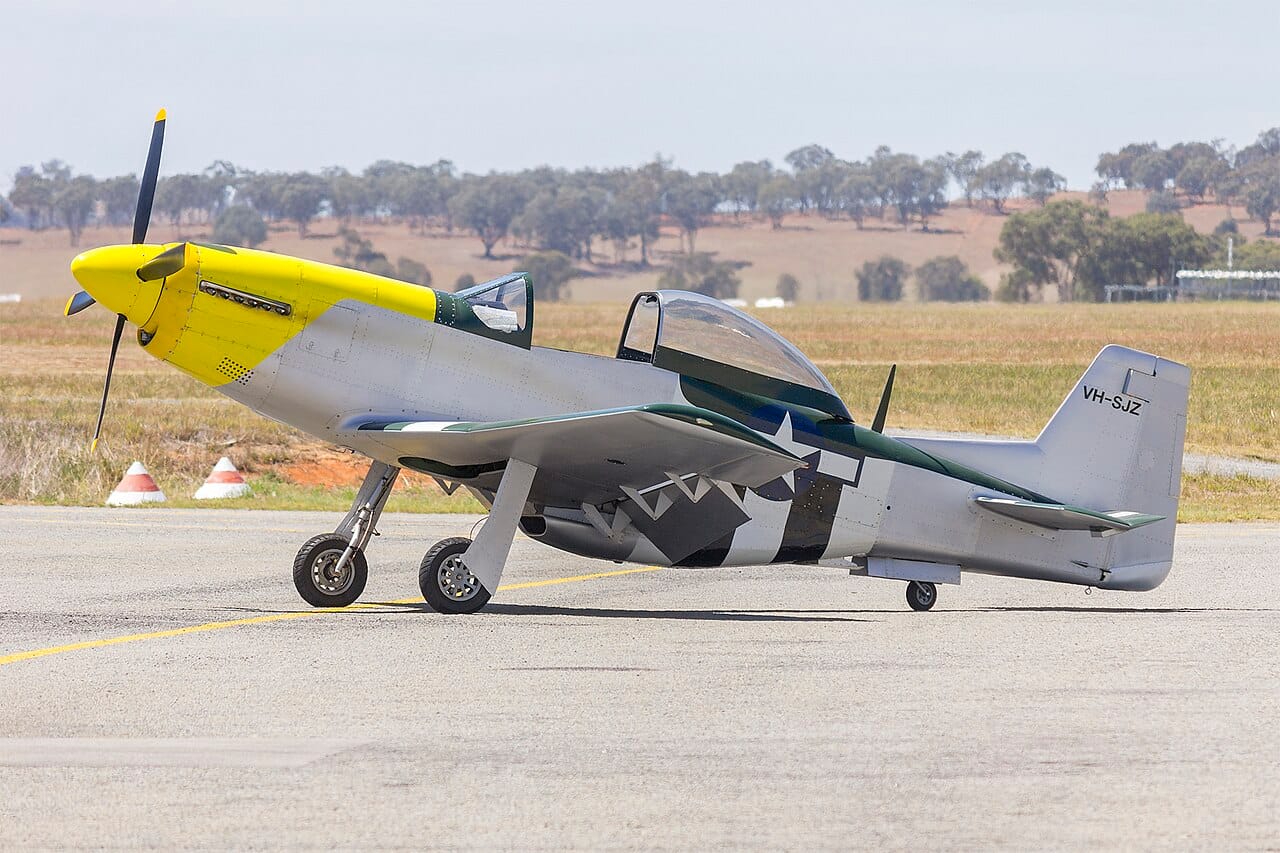
The Titan T-51 is an amateur-built experimental replica of the P-51D sold as a kit by Titan Aircraft. Individual aircraft use several different powerplants, including Rotax engines and automotive conversions from Suzuki and Honda; Titan’s published T-51D material prominently uses a 245-hp Honda 3.5-liter V-6 installation. Based on builder reports and listings through 2025 and 2026, a complete new build generally lands somewhere between about $130,000 and $200,000 depending on panel and paint, with 1,500 to 2,500 hours of your own labor on top. Flying one costs far less than it looks: plan on roughly $60 to $90 an hour in fuel, oil and reserves if you hangar it modestly and do your own condition inspections. Hull insurance is the real constraint, because underwriters treat a tailwheel retractable warbird replica as a high-risk hull and many low-time applicants get liability-only or a flat decline. Buying a finished example saves years but costs you the repairman certificate, which only the original builder can hold.
What the Titan T-51 Actually Is
Titan Aircraft, best known for the Tornado series of light aircraft, introduced the T-51 in the early 2000s as a scaled-down P-51D for the amateur-built market. It is a tandem two-seater with retractable gear, flaps, a bubble canopy and the unmistakable Mustang planform. It is certificated in the United States as experimental amateur-built, which means the person who assembled it did the major portion of the work and the FAA issued a special airworthiness certificate with operating limitations attached.
How big is it compared with a real P-51?
Smaller than the "3/4-scale" label suggests. A genuine P-51D spans 37 feet and weighs about 7,600 pounds empty. The T-51's wing is in the neighborhood of 24 to 25 feet, with an empty weight around 1,000 pounds and a gross weight in the 1,500 to 1,650 pound range depending on how the builder configured it. Cruise lands near 150 to 170 mph on 8 to 10 gallons an hour.
Good to Know: Run the arithmetic and the span works out closer to two-thirds of a real Mustang than three-quarters. The proportions were chosen to look right from twenty feet away and to fly well on a 200-horsepower engine, not to satisfy a scale-model judge.
What engine goes in it?
T-51s have been built with several engine packages, including Suzuki and Honda automotive conversions and Rotax installations, so buyers need to identify the exact engine and reduction-drive configuration on the individual aircraft. Builders have also fitted other powerplants, including radials for a different look. The auto conversion is the single biggest fork in the road for your budget and your insurance quote, because it is not a type-certificated engine. That changes your flight test requirement, it changes who will underwrite the hull, and it changes how you plan for overhaul.
If you are still weighing powerplants, our comparison of the Rotax 912 and Continental O-200 walks through the certificated-versus-non-certificated tradeoff in plainer terms, and our guide to what aircraft engines cost gives you the broader price map.
What It Costs to Build
Think of the airframe kit as the flour and eggs. The cake costs more. Titan sells the T-51 in sub-kits so you can pay as you go, which is kind to cash flow and brutal to budgeting, because the total only becomes obvious around year three.
Where the money actually goes
The airframe kit is the largest single invoice but rarely more than about 40 percent of the finished cost. The engine and reduction drive package is the second big line. A constant-speed composite propeller, a modern touchscreen panel with an engine monitor, a scale paint scheme, upholstery, wiring, hardware, hoses, brakes, tires, tools and shipping fill in the rest. Builders consistently report that the last 10 percent of the project consumes 25 percent of the money.
Heads Up: Paint is the line item people underestimate most. An invasion-stripe Mustang scheme with nose art is not a one-color spray job. Professional work on a small warbird replica routinely runs five figures, and a cheap paint job on a composite-and-aluminum airframe shows every flaw.
Pro Tip: Confirm current kit and engine pricing directly with Titan Aircraft before you build a spreadsheet. Kit prices move with material costs, and a number you read on a forum from three years ago is not a quote.
How many hours of your own labor?
Figure 1,500 to 2,500 hours for a first-time builder, spread across two to five calendar years. That is a part-time job. If you value your time at even $25 an hour, your labor is worth more than the kit. Most people who finish treat the build as the hobby and the flying as the bonus. The ones who quit usually did the math backward. Our step-by-step guide to building your own airplane from a kit covers the workshop, inspection and paperwork sequence in detail.
Flying411 keeps experimental and replica aircraft listings in one place, so you can compare what finished T-51s are actually asking against what a new build would cost you from a crate.
Buying One Already Flying
Finished T-51s change hands a few times a year. Because every one is a one-off, asking prices scatter widely based on engine time, avionics generation, paint quality and the builder's reputation. A well-sorted example with a modern panel and low time on the engine can ask near what it cost to build. A tired one with an aging auto conversion and a steam-gauge panel sells for considerably less, and the discount is usually smaller than the money you will spend fixing it.
The repairman certificate trap
Under 14 CFR 65.104, the FAA issues a repairman certificate for an experimental amateur-built aircraft only to the primary builder, and only for that one airplane. Buy a finished T-51 and the original builder’s Experimental Aircraft Builder repairman certificate does not transfer. The aircraft still requires a condition inspection every 12 calendar months, which may be signed off by an appropriately rated A&P or, when permitted by the aircraft’s operating limitations, by a qualified light-sport repairman exercising the expanded privileges adopted under MOSAIC. That is not expensive, but you have to find a mechanic willing to sign off an auto-converted engine he did not install. Line that up before you buy, not after.
Keep in Mind: If you buy a partially completed project, you still have to satisfy the FAA that the major portion was built for education or recreation and that you can document who did what. A project that is 80 percent finished by someone else can fail the 51 percent test and end up uncertifiable as amateur-built. Get the builder's log with the airframe, every time.
What It Costs to Fly Per Hour
This is the happy part. The Suzuki conversion runs on premium automotive gasoline, which at most airports and every gas station is meaningfully cheaper than 100LL. At 8 to 10 gallons an hour, fuel is roughly $35 to $45 per flight hour as of 2026 in most of the country.
What else goes in the hourly number?
Oil and filters are car-parts cheap. The reserve that matters is the engine and reduction drive. Auto conversions do not carry a published TBO the way a Lycoming does, and prudent owners budget for a rebuild somewhere in the 1,000 to 1,500 hour range, setting aside $10 to $15 an hour against it. Add a small airframe reserve for tires, brakes, hoses and the retractable gear system, which has more moving parts than a fixed-gear trainer and deserves respect.
Hangar is the fixed cost that swings most: anywhere from about $150 a month at a rural field to $600 or more near a metro airport. A T-51’s metal-skinned structure, steel fuselage framework, finishes, canopy and systems are all better protected by indoor storage.
Fun Fact: A real P-51D burns on the order of 60 to 90 gallons of avgas an hour in cruise. The T-51 does the Mustang impression for about a tenth of that, which is the entire reason the design exists.
Flying411 keeps asking prices for homebuilt, replica and warbird-style aircraft in one place, so you can compare hourly running costs across the whole category before you commit to one airframe.
Insuring a 3/4-Scale Mustang
Here is where plans die. Insurers do not care that the T-51 is small and slow by warbird standards. They see a tailwheel airplane with retractable gear, a non-certificated engine, a one-off airframe with no fleet loss history, and often a pilot whose last tailwheel landing was a Citabria rental years ago.
What coverage is realistically available?
Liability-only coverage is usually obtainable and relatively inexpensive. Hull coverage is the hard part. Agencies that specialize in experimental aircraft report that hull rates on warbird-style replicas commonly run several percent of the insured value per year, and that low-time applicants are frequently quoted liability-only or declined outright. On a $150,000 hull, a few percent is thousands of dollars annually, which can exceed your fuel bill. Some carriers also exclude hull coverage during Phase I flight testing or require a named, qualified test pilot.
For scale, our Cessna 172 insurance price guide shows what a fixed-gear certificated trainer costs to cover. A T-51 is a different animal to an underwriter, and the premium gap reflects that.
What gets you a better quote?
Three things, in order. Tailwheel time, logged and recent, well past the endorsement required by 14 CFR 61.31(i). Retractable-gear time, also real, with the complex endorsement under 61.31(e). And a documented transition plan with an instructor who knows the type. Several hundred total hours with 50-plus in tailwheel aircraft moves you from "declined" to "quoted" faster than anything else you can do.
Why It Matters: Under the traditional Phase I rules, an aircraft with a non-type-certificated engine, propeller, or engine/propeller combination requires a minimum 40-hour test period rather than 25 hours. However, current FAA operating limitations may instead authorize completion through the task-based flight-test program in AC 90-89C. That is 40 hours of solo flying in a restricted test area in an airplane nobody has flown before, under the operating limitations issued with your airworthiness certificate. Budget the fuel, and be honest about whether you should be the one doing it.
Quick Tip: Call an experimental-aircraft insurance broker during your build, not after. If the answer is "not until you have 50 hours of tailwheel," you have two years to go get it.
The Numbers in One Place
| Line item | Typical range | Notes |
| Airframe kit (complete, all sub-kits) | $55,000 – $80,000 | Confirm current pricing with Titan Aircraft; sold in stages |
| Engine package (V-6 conversion + redrive) | $25,000 – $40,000 | Roughly 160–200 hp; not type-certificated |
| Propeller | $7,000 – $16,000 | Ground-adjustable to constant-speed composite |
| Avionics and panel | $10,000 – $45,000 | Biggest single variable in the budget |
| Paint and finish | $10,000 – $25,000 | Scale warbird schemes cost more than solid colors |
| Upholstery, hardware, consumables, tools | $8,000 – $20,000 | Hundreds of small purchases, easy to underestimate |
| Finished build, total cash | $130,000 – $200,000 | Plus 1,500–2,500 hours of builder labor |
| Used flying example (2025–26 asking prices) | Widely variable; inspect individually | Each airframe is a one-off; condition drives price |
| Fuel in cruise | 8 – 10 gph premium mogas | Roughly $35–$45/hr at 2026 pump prices |
| Engine/redrive reserve | $10 – $15 per hour | Plan rebuild around 1,000–1,500 hours |
| Hangar | $150 – $600 per month | Indoor storage strongly recommended |
| Annual condition inspection | Varies by inspector and aircraft condition | Builder repairman privilege does not transfer; qualified A&P or eligible light-sport repairman may inspect as permitted by the operating limitations |
| Insurance, liability only | Several hundred to ~$1,500/yr | Usually obtainable |
| Insurance, hull | Several percent of hull value per year | Often declined for low tailwheel/retract time |
| Phase I flight test | Traditionally 40 hr with a non-TC engine/prop combination | Task-based testing may be authorized by the aircraft’s operating limitations |
Flying411 keeps listings, specifications and ownership-cost guides in one place, so you can compare a replica warbird against a certificated retractable before you spend three years in the garage.
Is the Trade Worth It?
The honest case for a Titan T-51 Mustang is not that it is cheap. It is that for roughly the price of a nice used Bonanza you get a two-seat warbird silhouette that burns auto fuel, fits in a T-hangar, and you understand down to the last rivet because you installed it. The honest case against is that you will spend years building, you will pay more than you planned, and the insurance market may tell you no until you go earn the hours.
Decide which of those two paragraphs sounds like you before you order the first sub-kit. Builders who went in knowing the full number almost always finish. The ones who priced the airframe kit and stopped there are the ones selling unfinished projects.
When you are ready to compare listings, visitFlying411and see what is on the market today.