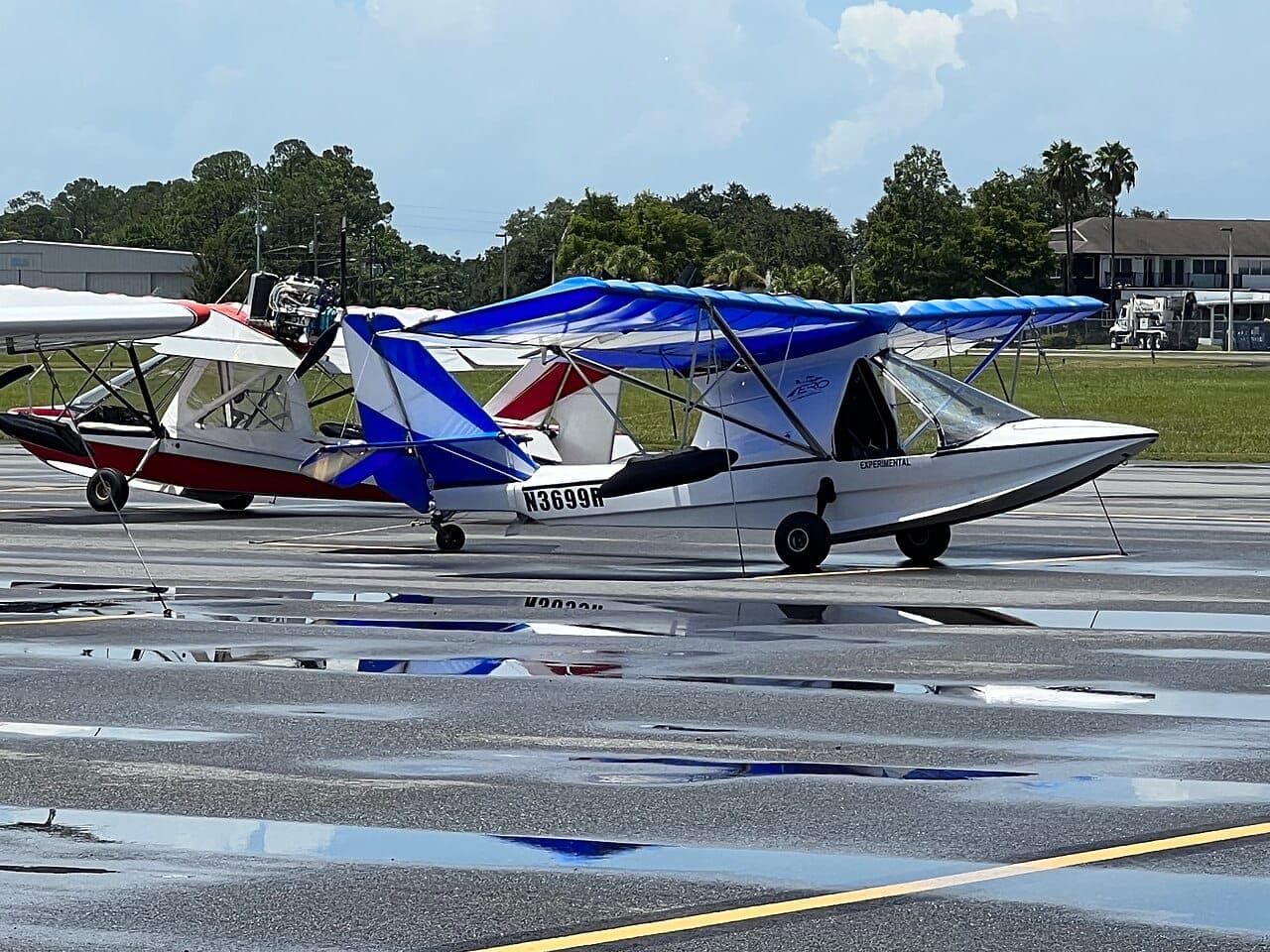
"What does an Aventura II actually cost me, all in?" For a two-seat amphibian like the Aero Adventure Aventura II, a realistic planning number is somewhere between the mid-$30,000s for a tired, two-stroke used example and roughly $90,000 for a new, Rotax 912-powered airplane you finish yourself with decent instruments and paint. Then budget another $3,000 to $8,000 a year in fixed costs before you burn a drop of fuel. Those are planning ranges as of late 2025 and early 2026, not quotes, and the spread between the low and high end is almost entirely about three decisions: which engine, who built it, and whether an underwriter will cover the hull.
This is a checklist for working out your own number, item by item, the same way a careful buyer would walk the airplane. The Aventura is a fiberglass-hulled flying boat with fabric-covered wings, a pusher Rotax on a pylon, and manually retracting gear, so it rewards close inspection in places a Cessna buyer never looks.
What You Are Actually Buying: Certificate, Not Marketing
The phrase "light sport" gets used two ways, and the difference costs money. Nearly every Aventura II flying in the United States is registered Experimental Amateur-Built — the owner or a previous owner assembled it from a kit and the FAA issued a special airworthiness certificate. That is not the same as a factory-built Special Light-Sport Aircraft (S-LSA) that comes with a manufacturer's statement of compliance. The Aventura happens to sit inside light-sport size and speed limits, which is what makes it flyable on sport pilot privileges, but the certificate in the glovebox is what determines who may inspect it, where it may fly, and what an insurer will say.
- Read the airworthiness certificate and the operating limitations together. Good: a clean special airworthiness certificate with operating limitations that have been amended out of Phase I flight testing. Bad: an airplane still carrying Phase I restrictions, or operating limitations that are missing entirely — those are part of the airworthiness certificate, and without them the airplane is not legally airworthy.
- Ask who holds the repairman certificate. Good: the seller built it, holds a Repairman Experimental Aircraft Builder certificate under 14 CFR 65.104, and will show you the logbook entries they signed. If the original builder does not hold the aircraft-specific repairman certificate, a certificated A&P mechanic can perform the annual condition inspection. Under the MOSAIC changes effective October 22, 2025, appropriately rated light-sport repairmen may also perform condition inspections on eligible Experimental Amateur-Built aircraft, subject to the aircraft's operating limitations.
- Confirm the build met the major portion rule. Good: builder's log with dated photos, receipts, and a kit that appears on the FAA's National Kit Evaluation Team accepted list. Bad: a "professionally assembled" airplane with a thin log. A shaky 51% story is a title problem, not a maintenance problem, and it follows the airframe forever.
- Check the registration against the FAA database before you drive anywhere. Good: registration current, N-number matches the data plate, make and model read as the kit manufacturer intended. Bad: expired registration, or a model name on the certificate that does not match what the seller is advertising.
Good to Know: The Aventura's family tree runs back to the Advanced Aviation Buccaneer of the 1980s. The design has passed through more than one company and more than one Florida address since then, which is why parts support is a question you ask out loud rather than assume.
The Purchase Number: Kit, Finished, or Somebody Else's Project
There are three ways to end up with an Aventura II, and they produce very different bills. Buying new from the kit manufacturer means an airframe kit price that looks cheap, plus an engine, propeller, instruments, upholstery, paint and several hundred hours of your own time. Buying somebody's finished airplane means paying for their labor but inheriting their workmanship. Buying a half-finished project is the cheapest entry and the most expensive mistake.
- Price the kit the honest way: airframe plus firewall-forward plus panel. Good: a written quote from the manufacturer that itemizes what is and is not included. Bad: a single headline kit number with "engine not included" in small type. A new Rotax 912 ULS alone has been running in the mid-$20,000s to around $30,000 as of 2025, and a composite or ground-adjustable propeller adds low four figures.
- For a finished used airplane, compare like for like. Good: a 912-powered, low-time, hangared example with a clear builder's log and a recent condition inspection. Bad: a 582-powered airplane with engine time unknown, priced as if the engine were fresh. Two Aventuras with the same asking price can be $15,000 apart in real value once you adjust for engine type and time remaining.
- Treat an unfinished project as a parts purchase. Good: complete kit inventory checked against the manufacturer's packing list, with the builder present. Bad: boxes in a garage and a promise that "it is all there." Missing hardware from a long-out-of-production batch can idle a project for months.
- Add the finishing costs most buyers forget. Fabric covering materials, paint, a basic VFR panel with a com radio and transponder, ADS-B Out if you plan to enter airspace that requires it, a BRS-style parachute if the airplane is plumbed for one, and a trailer if you intend to tow rather than hangar. Budget $8,000 to $20,000 across those depending on taste.
Flying411 keeps light-sport and experimental amphibian listings in one place, so you can compare engine type, hours and equipment side by side instead of guessing which asking price is the fair one.
If you are still deciding between an amphibian and a landplane, our broader look at how much a small amphibious aircraft really costs sets the Aventura against heavier options like the Searey and the Icon A5.
Engine Choice: The Single Biggest Cost Lever
Aventuras have flown behind the two-stroke Rotax 582 and the four-stroke Rotax 912 series. The Rotax 582 is lighter and can offer a lower purchase price on the used market, but production ended in 2021, making long-term replacement-engine and parts availability an important consideration. The four-stroke Rotax 912 costs more upfront but offers longer recommended overhaul intervals, broader ongoing manufacturer support and potentially lower operating costs. Think of it as the difference between a chainsaw engine and a small car engine: both work, but one wants attention on a schedule most people find exhausting.
Rotax 582 (two-stroke, about 65 hp)
- Check both engine hours and calendar age. Rotax specifies a 300-hour or five-year overhaul interval for the 582 UL, whichever comes first, subject to the applicable engine documentation. Good: a documented overhaul with both hours and dates recorded. Bad: an engine with only 100 hours but eight years since its last overhaul, or one approaching 300 hours without a documented rebuild.
- Look at the gearbox and the exhaust springs. Good: clean gearbox with correct free play, intact springs with safety wire. Bad: cracked springs, oil weeping from the gearbox case.
- Ask about oil injection versus premix. Good: consistent practice documented by the owner. Bad: a mix of both, or an injection pump nobody has checked.
Rotax 912 UL / 912 ULS (four-stroke, 80 or 100 hp)
- Check hours and calendar age. Rotax lists up to 2,000 hours or 15 years between overhauls for qualifying 912 UL and 912 ULS engines, but older engines may have shorter intervals depending on serial number and applicable service bulletins. Buyers should verify the specific engine's TBO eligibility, modification history and calendar age before calculating overhaul reserves. Good: 600 hours and eight years. Bad: 400 hours and 16 years — low time, but the clock has already run out.
- Ask when the rubber was last replaced. Rotax service instructions call for replacing hoses and rubber components on a five-year cycle. Good: a dated logbook entry and new-looking coolant and fuel lines. Bad: original hoses with a decade on them, hardened at the clamps.
- Verify the fuel the airplane actually drinks. Good: ethanol-free premium mogas, which the 912 prefers and which keeps lead out of the gearbox and valve train. Bad: exclusively 100LL with no record of more frequent oil changes.
Why It Matters: On reserves alone, a 912 at 2,000-hour TBO sets aside roughly $8 to $10 an hour toward overhaul. A 582 at 300 hours sets aside $12 to $17 an hour toward a far cheaper rebuild. Fly 50 hours a year and the difference is small. Fly 150 and the four-stroke has paid for part of itself.
Owners weighing Rotax variants in other airframes face the same arithmetic; our comparison of the Rotax 912 versus the turbocharged 915iS walks through how TBO, fuel burn and purchase price trade off.
Hull, Gear and Fabric: The Water Tax
Every amphibian pays a tax that landplanes do not: water finds things. The Aventura's fiberglass hull is simple and repairable, but it lives a hard life between hull steps, dock bumps and the salt that eats aluminum fittings. This is the part of the inspection where you get your hands wet and your knees dirty.
- Beach it and look inside the hull with a flashlight. Good: dry bilge, no standing water, no staining along the keel seam. Bad: a waterline of silt inside the hull, or a bilge pump that the owner describes as "needed after every flight."
- Press and tap the hull bottom around the step. Good: solid, uniform sound and no soft spots. Bad: dull, hollow tapping, crazing in the gelcoat, or a patch repair with no logbook entry explaining it.
- Cycle the landing gear by hand, both directions, twice. Good: smooth travel, positive locks, clear up-and-down indication the pilot can confirm visually. Bad: binding, play in the pivots, or a gear position indicator that only works sometimes. A gear-down water landing in an amphibian is the single most common way these airplanes get destroyed, so indication is a safety item, not a convenience.
- Inspect every steel and aluminum fitting that touches spray. Good: clean hardware, intact anti-corrosion coatings, cables with no rust bloom. Bad: white powder on aluminum, pitted bolts, or a seller who mentions saltwater operations without mentioning a fresh-water rinse routine.
- Check the fabric with a punch tester if the seller allows it. Good: fabric within a few years of recovering, with a logbook entry naming the system used. Bad: chalky, sun-faded fabric on a 15-year-old covering job. A recover is a four-figure job in materials and a lot of hours.
- Look hard at the pylon, engine mount and prop. Good: no cracks at the mount welds or attach points, prop blades free of spray erosion on the leading edges. Bad: nicks and erosion from water spray, which on a pusher is normal wear and a recurring cost.
Heads Up: Ask whether the airplane has ever operated in salt water, and then verify the answer with your own eyes rather than the seller's word. Freshwater lake airplanes and saltwater bay airplanes age at completely different rates, and the price difference rarely reflects it.
Insurance: Get a Quote Before You Get Excited
This is where amphibian deals fall apart, and it is the item most first-time buyers leave until last. Underwriters look at three things that all point the wrong way on an Aventura: it is experimental, it is an amphibian, and it is a pusher with a short production history. Low-time pilots sometimes find that hull coverage simply is not offered at any price.
- Call a broker before you make an offer, with the N-number in hand. Good: a written indication naming the hull value, the deductible, and the pilot qualifications required. Bad: a verbal "that should be fine."
- Read what is covered while the airplane is on the water. Good: hull coverage that includes taxi and step-taxi. Bad: a policy that covers the hull "not in motion" only, which means a nose-over during a step taxi is your money. Many amphibian policies carve water operations out, and you have to ask specifically.
- Find the open-pilot warranty and the time-in-type requirement. Good: a number you can actually reach, like 10 to 25 hours in make and model with dual available from a qualified instructor. Bad: a requirement for 100 hours in type on an airplane with a small fleet and almost no instructors.
- Budget realistically. As a planning figure for 2025–2026, liability-only on an experimental amphibian commonly lands in the high hundreds to low thousands per year, and adding hull coverage on a $70,000 airplane can push the premium into the $2,500 to $5,000 range for a pilot without much seaplane time. Those numbers fall as your logged seaplane hours climb.
- Price the dual you will need anyway. Good: a plan to buy 10 to 15 hours of seaplane instruction regardless of what insurance demands. Bad: assuming a land-based checkout transfers to glassy-water landings.
Flying411 gathers amphibians, floatplanes and light-sport singles in one searchable place, so you can see what the realistic field of candidates looks like before you spend a broker's time on quotes.
Who Can Legally Fly It
The Aventura's appeal is that it is small enough to fly on sport pilot privileges, which keeps the medical question simple. But "sport pilot" and "seaplane" interact in a way that trips people up, and the rules changed recently.
- Sport pilots need a logbook endorsement, not a class rating. A sport pilot adds sea privileges through training and a proficiency check with an authorized instructor, endorsed in the logbook. Good: you have a local instructor who can do this. Bad: you buy the airplane first and then discover the nearest qualified instructor is three states away.
- Private and higher certificates need the ASES class rating. Good: you already hold single-engine sea, or you have budgeted a weekend rating course. Bad: assuming your ASEL privileges cover water.
- Understand what MOSAIC changed. The FAA's Modernization of Special Airworthiness Certification rule, finalized in July 2025, replaced the old light-sport weight caps — 1,320 pounds on land and 1,430 pounds for seaplanes — with performance-based limits, and widened what a sport pilot may fly. The Aventura sat comfortably inside the old limits and sits inside the new ones too, so the practical effect for this airplane is more about what else you can step up to later. Our guide to which planes a sport pilot can fly under MOSAIC covers the detail.
- Remember the experimental restrictions. An amateur-built aircraft may not be flown for compensation or hire. Good: you fly it for your own recreation. Bad: a plan to rent it out or run sightseeing flights, which is not legal in this category.
The Yearly Bill: Fixed Costs and Hourly Costs
Separate the two. Fixed costs happen whether the airplane moves or not. Hourly costs only happen when you fly. Amphibians distort the usual picture because storage is more flexible — the wings fold for trailering on most Aventuras — but maintenance is fussier.
- Storage. Good: a trailer and a garage, or a shared hangar at a small field. A tiedown is cheapest, but UV and weather are hard on fabric and gelcoat, and the economics are not as simple as the monthly rate suggests — see our breakdown of hangar versus tiedown costs. Figure anywhere from $600 a year for a tiedown to $4,000-plus for a hangar depending on region.
- Annual condition inspection. Good: you hold the repairman certificate for the airplane and do it yourself with an occasional A&P second opinion, for the price of parts. Bad: paying $600 to $1,200 a year to a shop that has never seen a pusher amphibian and bills the learning curve to you.
- Insurance. As above. Call it $800 liability-only or $2,500 to $5,000 with hull.
- Registration, state fees and any sales or use tax. Varies widely by state and is often the surprise on a cross-state purchase.
- Fuel. A 912 ULS burns roughly 4 to 5.5 gallons an hour in cruise. On ethanol-free premium mogas at pump prices, that is often $20 to $28 an hour. The same hour on 100LL costs noticeably more.
- Engine reserve. Set it aside monthly, not mentally. $8 to $10 an hour for a 912, $12 to $17 for a 582.
- Consumables and the water tax. Oil, filters, spark plugs, prop leading-edge tape, hull touch-up, cable and fitting replacement. A couple hundred dollars a year on a landplane; plan on more here.
Quick Tip: A useful sanity check is total cost per hour at your real flying rate. Fifty hours a year with hull insurance and a hangar puts an Aventura II somewhere near $100 an hour all in. Hundred-plus hours a year with a trailer and liability-only coverage can bring it under $60. The airplane did not change — your utilization did.
The Checklist at a Glance
| What to check | What good looks like | Red flag |
|---|---|---|
| Airworthiness certificate and operating limitations | Both present, Phase I complete, limitations amended | Missing operating limitations or unresolved Phase I restrictions |
| Builder's log and 51% compliance | Dated photos, receipts, kit on the FAA accepted list | Thin log, "professionally assembled," vague build history |
| Repairman certificate | Builder's certificate or access to an appropriately qualified inspector confirmed | Inspection privileges or operating-limitations compatibility not verified |
| Engine type and time | Engine hours, calendar age and applicable TBO verified against serial number and maintenance records | Rotax 582 approaching 300 hours or five years, or an older 912 exceeding its applicable TBO |
| Rotax rubber replacement | Hoses replaced within the last five years, logged | Original hardened hoses, no entry anywhere |
| Hull interior | Dry bilge, clean keel seam, no silt line | Standing water, undocumented patch repairs, soft spots at the step |
| Landing gear and position indication | Smooth manual cycling, positive locks, reliable indication | Binding gear or intermittent position indication |
| Corrosion on fittings and cables | Coated hardware, no pitting, documented fresh-water rinse habit | White powder on aluminum, rust bloom on cables, saltwater history |
| Fabric condition | Recover within the last several years, system named in logs | Chalky, faded fabric with unknown recover date |
| Propeller and pylon | Clean leading edges, no cracks at mount welds | Heavy spray erosion, any crack near the engine mount |
| Insurance quote | Written indication including hull coverage in motion on water | Hull coverage declined, or "not in motion" only |
| Pilot credentials and training access | Sea privileges held or a nearby instructor identified | No seaplane instructor within reasonable distance |
Before You Sign
Walk away from three things without negotiating. A missing or incoherent builder's log, because it is a problem you can never fix and the next buyer will discover it too. A hull with undocumented structural repairs at or near the step, because you cannot price what you cannot see. And a deal where no underwriter will write hull coverage at a premium you can live with, because an amphibian you are afraid to put on the water is an expensive lawn ornament.
Get a professional opinion on two specific things even if you are mechanically confident. First, have a mechanic who knows Rotax do the engine portion — compression or differential checks as applicable, gearbox inspection, and a careful read of the service instruction compliance record. Rotax publishes a lot of time-based and calendar-based guidance, and it is easy for an owner to miss a line item for years. Second, if the airplane has any composite repair history, pay a shop that works in fiberglass to look at the hull. Both inspections together cost less than one bad landing.
Finally, price the airplane against its alternatives honestly. If you mostly want to fly off a lake on weekends, an amphibious ultralight may do the job for less, and if you want speed and cross-country range, something from our roundup of the best light-sport aircraft will beat an amphibian handily on both. The Aero Adventure Aventura II earns its keep for one specific mission — cheap, slow, grinning fun off water and grass with a two-stroke's purchase price and a four-stroke's option — and the budget only works if that is genuinely the flying you want to do.
Flying411 tracks amphibians, light-sport singles and experimental kits together, so you can line up the Aventura against a SeaRey, a SportCruiser or a used floatplane and see which one fits your money.
When you are ready to compare listings, visitFlying411and see what is on the market today.