Rotax has a funny reputation in the flying world. The engines are small, light, and quiet, yet they fly thousands of aircraft every single day. For a long time, people thought of Rotax as the brand for tiny ultralights and weekend fun flyers. That picture is now badly out of date. The newest engines pull serious power, climb fast, and keep working hard even at high altitude.
If you have been comparing the most powerful Rotax engines, you have probably noticed the numbers jumping around. One engine makes 65 horsepower. Another makes 160. They share a name and a maker, but they fly very different missions. Knowing which is which can save you money, weight, and a lot of head-scratching at the hangar. The gap between the strongest Rotax and the gentlest one is wider than most pilots ever stop to measure.
Key Takeaways
The most powerful Rotax aircraft engine you can buy new today is the Rotax 916 iS, which makes about 160 horsepower for takeoff. After that, the power steps down through the 915 iS, the turbocharged 914, the 100-horsepower 912 family, the 80-horsepower 912 UL, and finally the two-stroke 582 and 503. Each one is built for a different kind of plane and a different kind of flying.
| Engine | Approx. Max Power | Type | Cooling | Best Suited For |
| Rotax 916 iS | ~160 hp | Turbo four-stroke | Liquid and air | High-performance two to four seat aircraft |
| Rotax 915 iS | ~141 hp | Turbo four-stroke | Liquid and air | Heavier two-seaters and gyrocopters |
| Rotax 914 | ~115 hp | Turbo four-stroke | Liquid and air | Hot and high-altitude flying |
| Rotax 912 ULS / 912 iS | ~100 hp | Four-stroke | Liquid and air | Most light sport aircraft |
| Rotax 912 UL | ~80 hp | Four-stroke | Liquid and air | Lighter ultralights and trainers |
| Rotax 582 | ~65 hp | Two-stroke | Liquid | Ultralights, trikes, and gyros |
| Rotax 503 | ~50 hp | Two-stroke | Air | Classic ultralights (no longer made) |
Flying411 is an aviation marketplace where pilots and owners buy, sell, and research aircraft, engines, and parts. It is a handy place to start when you want to see what these Rotax engines look like in the real world.
A Quick Look at Rotax and Why Its Engines Punch Above Their Weight
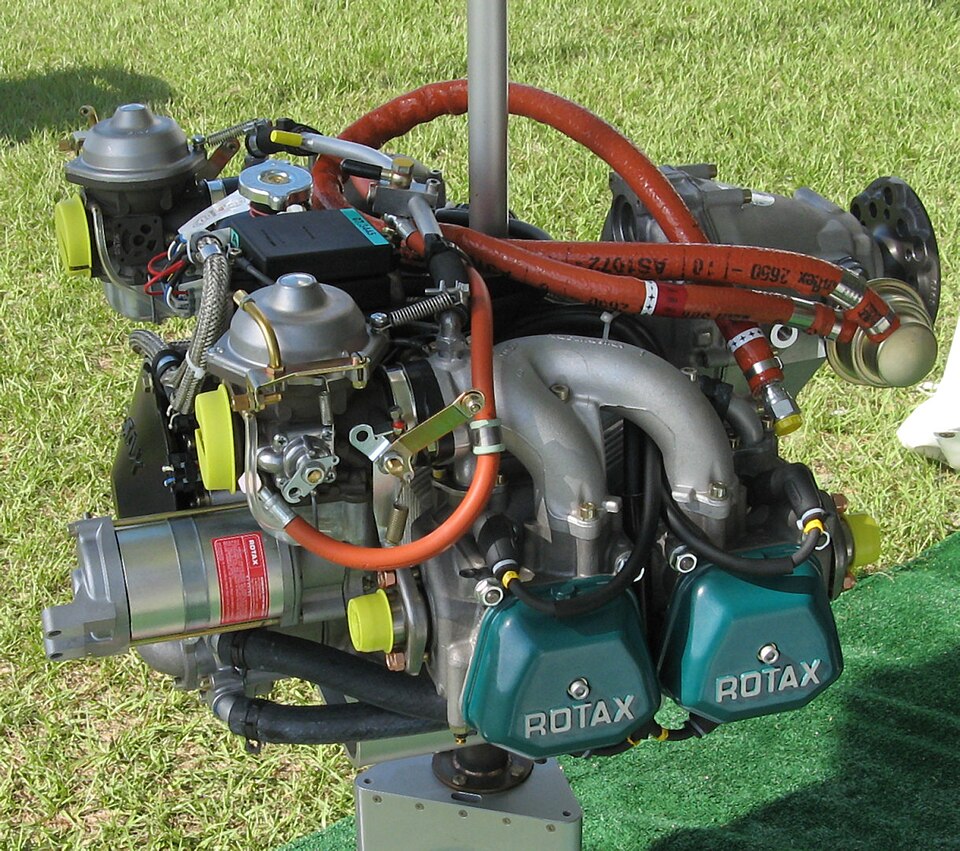
Rotax is a brand made by BRP-Rotax, a company based in Gunskirchen, Austria. It is owned by Bombardier Recreational Products, the same company behind Ski-Doo snowmobiles and Sea-Doo watercraft. That family tree matters more than it sounds. Rotax learned how to build small, high-revving engines for snow and water long before it built them for the sky.
Since the 1990s, Rotax has been the leading engine maker for ultralight and light sport aircraft. Over about 40 years, the company has sold a huge number of aircraft engines, with the four-stroke 912 family alone passing 50,000 units back in 2014. When you see a small modern plane at a local airfield, there is a good chance a Rotax is bolted to the front of it.
Fun Fact: Rotax engines started life powering snowmobiles and motorcycles. The aviation side grew out of that, which is part of why these engines spin so fast and weigh so little compared to older airplane engines.
How Rotax Gets Big Power From Small Engines
Old-school airplane engines, like the ones from Lycoming and Continental, are big and slow-turning. Rotax took a different road. Its four-stroke engines have small cylinders that spin very fast, often above 5,000 rpm. A propeller cannot spin that fast safely, so Rotax adds a small set of gears called a reduction gearbox. This gearbox slows the spinning down to a speed the propeller likes, usually around 2,400 rpm.
This trick lets a tiny engine make solid power without weighing a ton. It is a big reason Rotax engines have such a strong power-to-weight ratio. You get the muscle of a much heavier engine in a package that keeps your plane light.
Rotax four-strokes also cool themselves in a clever two-part way. The cylinder heads are cooled by liquid, like a car. The cylinder bodies are cooled by air rushing past them. This mix keeps the hot parts cool and the rest simple. Most of these engines also run on regular automobile gasoline, even fuel with some ethanol in it, which can save money over avgas.
Good to Know: Because Rotax engines spin fast and use a gearbox, they need the right propeller and a proper install. The engine, gearbox, and prop work as a team, so swapping parts around is not as simple as it might seem.
The Most Powerful Rotax Engines Ranked by Horsepower
Here is the heart of the matter. Below are seven Rotax aircraft engines, lined up from strongest to gentlest. Power numbers are approximate because real output changes with altitude, temperature, and setup. Still, this ranking shows you exactly where each engine sits in the lineup.
Rotax 916 iS: The Current Power King
The Rotax 916 iS sits at the very top. It makes around 160 horsepower for takeoff and about 137 horsepower for steady cruising. It is a turbocharged, four-cylinder, four-stroke engine with a displacement of roughly 1,352 cc. Rotax introduced it in March 2023, and it first flew in the CubCrafters Carbon Cub UL.
What makes this engine special is how much power it squeezes from so little weight. It tips the scales at about 189 pounds, including the gearbox, turbo, and exhaust. That gives it an excellent power-to-weight ratio, which is a big deal in light aircraft where every pound counts. It also has a target time between overhauls of 2,000 hours, which is strong for an engine this powerful.
Key things to know about the 916 iS:
- Power: about 160 hp for takeoff, about 137 hp continuous
- Layout: turbocharged four-cylinder four-stroke
- Smart control: full electronic engine control with fuel injection
- Altitude: holds full takeoff power up to roughly 15,000 feet, with a ceiling near 23,000 feet
- Best for: high-performance two-seaters and four-seat aircraft
The turbo is the secret sauce. As you climb, the air gets thin and most engines lose power. The turbo on the 916 iS packs in extra air, so the engine keeps making strong power far higher than a normal engine would. For pilots flying in hot weather or from high mountain airports, that steady power is a real gift. Curious owners often line up the 916 against a Titan 340 piston engine to see how the turbo math plays out against a bigger, traditional powerplant.
Why It Matters: A turbocharged engine like the 916 iS keeps making near-full power as you climb. A normal engine slowly fades. On a hot day at a high airport, that difference can be the line between a safe takeoff and a scary one.
The 916 iS is also the priciest engine in the current Rotax lineup, which makes sense given the power and tech inside it. For many buyers, though, the climb rate and high-altitude muscle are worth the extra cost. Some owners also compare it head to head with the Lycoming IO-360 family when deciding between modern light power and proven traditional power.
Rotax 915 iS: The High-Altitude Workhorse
Just below the 916 sits the Rotax 915 iS. This engine makes about 141 horsepower at peak and around 135 horsepower for steady flight. It is also a turbocharged four-cylinder four-stroke, and it shares a lot of its design with the 916. In fact, the 916 grew out of the 915, with a beefed-up crankshaft, a stronger gearbox, and new software.
Rotax first showed the 915 iS back in 2015 and started building it in 2017. It opened the door to bigger, heavier light aircraft, larger gyrocopters, and even some small helicopters. Before it arrived, light planes mostly topped out around 100 to 115 horsepower. The 915 changed what builders thought was possible in this class.
Like the 916, the 915 holds full takeoff power up to about 15,000 feet and can climb to a ceiling near 23,000 feet. Its time between overhauls now reaches 2,000 hours, though early versions started lower. If you want strong, steady power for a heavier two-seat plane or a gyro, the 915 is a proven pick. The step up from the older turbo to this one is worth reading about on its own, since the jump from the 914 to the 915 brought a big change in both power and price.
Rotax 914: The Turbo That Started the High Power Push
Before the 915 and 916, the turbocharged aircraft engine that carried the Rotax flag was the 914. It makes about 115 horsepower for short takeoff bursts and around 100 horsepower for steady cruising. It is built on the smaller 1,211 cc version of the engine, with a turbo bolted on.
The 914 is special because the turbo lets it hold sea-level power well past 10,000 feet. That makes it a favorite for mountain flying and hot climates. A normal engine would gasp for air up there, but the 914 keeps pulling. Pilots flying gyrocopters in tough terrain have long trusted the 914 for exactly this reason.
Pro Tip: A turbo engine like the 914 needs a short cool-down at low power before you shut it off. This lets the turbo bearing cool slowly and protects it from oil trouble. Skipping this step is one of the most common turbo care mistakes.
The trade-off is that the 914 has more parts than a simple engine. It uses carburetors, extra wiring, and turbo controls that ask a bit more from the pilot and the mechanic. For many flyers, the high-altitude power is well worth that extra fuss.
Rotax 912 ULS and 912 iS: The 100 HP Best-Sellers
Now we reach the engines that made Rotax famous. The Rotax 912 ULS and its fuel-injected cousin, the 912 iS, both make about 100 horsepower. These are naturally aspirated engines, meaning they have no turbo. They breathe normal air, so they slowly lose power as you climb. For most light flying, that is perfectly fine.
The 912 ULS uses carburetors and is one of the best-selling light aircraft engines in history. It powers a huge share of the light sport fleet. It does ask for higher-octane premium fuel to run its best, so that is worth keeping in mind at the pump.
The 912 iS adds electronic fuel injection and a smart eco mode. Below a certain throttle setting, it leans out the fuel mix and sips gas. Pilots flying the iS often report very good fuel numbers, which adds up over many hours. Here is how the two 100-horsepower options stack up at a glance:
- 912 ULS: carbureted, simple, proven, needs premium fuel
- 912 iS Sport: fuel injected, very efficient, smarter electronics
Both engines have a long track record and a time between overhauls of 2,000 hours. They are reliable, light, and easy to find parts for. If you want to see how this engine holds up against rival brands, the comparison of the 912 against the UL Power 350i is a good place to look, and so is the look at the 912 versus the Jabiru 3300.
If you are shopping for a 100-horsepower engine, the Flying411 marketplace lists new, used, and overhauled aircraft engines from major makers, so you can compare real options side by side instead of guessing.
Rotax 912 UL: The 80 HP Original
The Rotax 912 UL is where the four-stroke story began back in 1989. It makes about 80 horsepower from a 1,211 cc engine. It is smaller and lighter than the 100-horsepower models, with a slightly smaller bore.
For light, simple aircraft, 80 horsepower is plenty. Many trainers, motor gliders, and lighter ultralights use this engine happily. It is often called the least fussy of the bunch, which makes it a friendly choice for owners who want low drama and easy upkeep. It paved the way for every powerful Rotax that came after it.
Rotax 582: The Two-Stroke Favorite
Stepping away from four-strokes, the Rotax 582 is a two-stroke engine that makes about 65 horsepower at 6,500 rpm. It is a two-cylinder, liquid-cooled engine with a displacement near 580 cc. It weighs only about 110 pounds, which makes it a darling of the lightweight crowd.
The 582 has powered a huge number of ultralights, weight-shift trikes, and gyrocopters over the years, with well over 30,000 units sold. It is loved for being simple, affordable, and easy to work on. Production of the 582 wound down in late 2021, but it remains common, and parts and support are still around.
Heads Up: Rotax's own manual warns that the two-stroke 582, by its design, can stop suddenly. The maker advises never flying it over ground where you could not make a safe landing without power. This is normal language for two-stroke aircraft engines, and it is worth taking to heart when you plan a flight.
Two-stroke engines also need more frequent care. The 582 has a much shorter time between overhauls, around 300 hours, compared to the 2,000 hours of the four-strokes. They run a bit louder and burn more fuel too. For the right light aircraft, though, the 582 hits a sweet spot of low weight and low cost. If you are torn between the simple two-stroke and the long-lived four-stroke, the breakdown of two-stroke and four-stroke power lays out the real trade-offs.
Rotax 503: The Classic Lightweight
Last on the list is the Rotax 503, a two-cylinder, air-cooled two-stroke that makes roughly 50 horsepower. Rotax stopped building it around 2010 to 2011, but more than 33,000 were made during its long run, and many are still flying.
The 503 is prized in the classic ultralight world for being feather-light and dead simple. It powered trikes, small homebuilts, and weekend flyers for decades. Because it is no longer made, parts depend on remaining stock and third-party suppliers, so buyers need to shop with care. For a vintage ultralight or a light restoration project, the 503 still has plenty of fans.
Keep in Mind: Time between overhauls tells you a lot about an engine's life. The four-stroke 912 and 915 families aim for 2,000 hours. The two-stroke 582 and 503 sit near 300 hours. That gap shapes both your long-term cost and how often the engine comes apart for service.
How the Most Powerful Rotax Engines Compare to Traditional Engines
It helps to see where Rotax sits next to the old guard. For years, small planes used engines from Lycoming and Continental. Those engines are larger, heavier, and slower-spinning. They have no gearbox because the crankshaft turns the prop directly.
Rotax went the other way with a small, fast, geared four-stroke aircraft engine. The result is less weight for similar power, plus the option to burn regular gas. The trade is that Rotax engines have more moving parts up front, like the gearbox and the cooling system, and they ask for their own service routine.
Neither path is wrong. They simply fit different planes and different pilots. Owners weighing a classic powerplant often study how two well-known traditional engines stack up, like the Continental O-200 and Lycoming O-235, before deciding if a modern Rotax is the better fit for their build.
One more point worth noting: an independent look at U.S. accident data in 2022 found that the Rotax 912 family had a very low rate of engine failure among common engines used in homebuilt aircraft. That kind of track record is a big reason builders keep choosing Rotax.
How to Pick the Right Rotax Engine for Your Aircraft
The strongest engine is not always the right engine. The best choice depends on your plane, your flying, and your budget. Here is a simple way to think it through.
First, match power to mission:
- Short trips, light plane, low altitude: an 80 or 100-horsepower 912 is often plenty
- Heavy two-seater or frequent climbs: the 914 or 915 earns its keep
- Hot, high airports or four-seat plans: the 916 iS shines
- Bare-bones ultralight on a budget: a two-stroke 582 may be all you need
Second, think about the long game. A four-stroke costs more upfront but runs longer between overhauls and sips fuel. A two-stroke costs less to buy but needs care more often. Add up the hours you plan to fly, and the cheaper engine on day one may not be the cheaper engine over ten years.
Quick Tip: Before you buy any used engine, get a pre-purchase inspection from someone who knows Rotax. Logbooks, hours, and gearbox condition tell the real story. A clean engine on the outside can still hide an expensive surprise inside.
Third, remember the whole package. The engine, gearbox, propeller, radiator, and exhaust all work together. Make sure the parts match and that the install was done right. A great engine bolted up wrong is no bargain.
Flying411 also connects owners with certified aviation pros, including A&P mechanics and engine specialists, so you can line up a trusted inspection before you commit to a purchase.
Take your time, ask questions, and lean on people who fly the same setup. The Rotax community is friendly and full of folks happy to share what they have learned.
Ready to see what is out there? Browse current engine and aircraft listings on Flying411 and compare real prices, hours, and conditions before you make your move.
The Bottom Line on Rotax Power
The most powerful Rotax engines prove that small and light does not mean weak. The 916 iS leads the pack at about 160 horsepower, with the 915 and 914 close behind and the trusty 912 family forming the backbone of the light aircraft world. Down at the lighter end, the two-stroke 582 and 503 still earn their place for simple, low-cost flying.
The right engine for you comes down to the plane you fly and the missions you dream about. Pick the power that fits your flying, keep up with the service, and a Rotax can reward you with years of smooth, reliable hours.
When you are ready to compare engines, find parts, or list your own aircraft, Flying411 makes the whole search a lot easier, so you can spend less time hunting and more time flying.
Frequently Asked Questions
Is the Rotax 916 iS certified for instrument and commercial flying?
Rotax offers the 916 iS in versions suited to instrument flight rules and commercial use, such as flight school and charter work. The exact rules depend on your country and the aircraft it is installed in.
Can a Rotax engine really run on regular car gasoline?
Yes, most Rotax aircraft engines are built to run on automobile gasoline, including fuel with up to about 10 percent ethanol. They can also use aviation fuel, though the higher-power models perform best on quality premium-grade gas.
Why do Rotax engines spin so much faster than older airplane engines?
Rotax uses small cylinders that make power by spinning fast, then a reduction gearbox slows that speed down for the propeller. This design keeps the engine light while still producing strong power.
Do I need a special propeller for a Rotax engine?
In most cases, yes. The engine and its gearbox are tuned to work with certain props, and the more powerful turbo engines often call for a constant-speed propeller to use their full power well.
Are two-stroke Rotax engines like the 582 still worth buying?
For light, low-cost recreational flying, a two-stroke can still make sense thanks to its low weight and simple design. Just plan for shorter service intervals and follow the maker's safety guidance closely.