If you've been shopping for a light aircraft engine, chances are you've already landed on two names: the Rotax 912 and the Rotax 582. Both engines come from the same Austrian manufacturer, both have powered countless kit planes and ultralights across the United States, and both have loyal fans who will happily argue their case over a cup of coffee at the local airfield.
But these engines are built around completely different philosophies. The 582 is a lean, lightweight two-stroke that packs solid punch into a small, simple package. The 912 is a refined four-stroke with a longer service life, smoother operation, and a price tag to match. Neither is wrong — they're just built for different pilots, different aircraft, and different kinds of flying.
So when it comes to Rotax 912 vs 582, which one actually belongs on your aircraft? The answer depends on what you're building, where you're flying, and how much you're willing to spend upfront versus on the back end.
Key Takeaways
The Rotax 912 is the better long-term investment for pilots who want a more reliable, longer-lasting engine with higher fuel efficiency and a much longer TBO — typically around 1,500 to 2,000 hours compared to roughly 300 hours for the 582. The 582 wins on upfront cost, lower weight, and raw power-to-weight ratio, making it a smart pick for ultralight and budget-minded builders flying locally in good weather. Here's a quick side-by-side snapshot:
| Feature | Rotax 582 | Rotax 912 UL / ULS |
| Engine Type | Two-stroke, 2-cylinder | Four-stroke, 4-cylinder |
| Horsepower | ~65 hp | ~80 hp (UL) / ~100 hp (ULS) |
| Dry Weight | ~110 lb (with electric start) | ~132 lb (with electric start) |
| TBO | ~300 hours | 1,500–2,000 hours |
| Fuel Burn (cruise) | ~5–6 gal/hr | ~3–4 gal/hr |
| Fuel Type | Premium unleaded or avgas | Regular unleaded, mogas, or avgas |
| Cooling | Liquid-cooled | Air + liquid-cooled (hybrid) |
| VFR Only Restriction | Yes (by design) | No |
| Upfront Cost | Lower | Higher |
| Long-Term Operating Cost | Higher per hour | Lower per hour |
Flying411 is your trusted source for aircraft listings, resources, and guidance to help you find and fly the right plane for your needs — explore what's available at Flying411.
A Quick Background on Both Engines
To understand why these two engines are so different, it helps to know a little about where they came from.
BRP-Rotax is an Austrian company with deep roots in powersports. Their aviation division has been producing engines for ultralight and experimental aircraft since the early 1980s. Over the decades, they built a reputation for compact, efficient engines that punch well above their weight class.
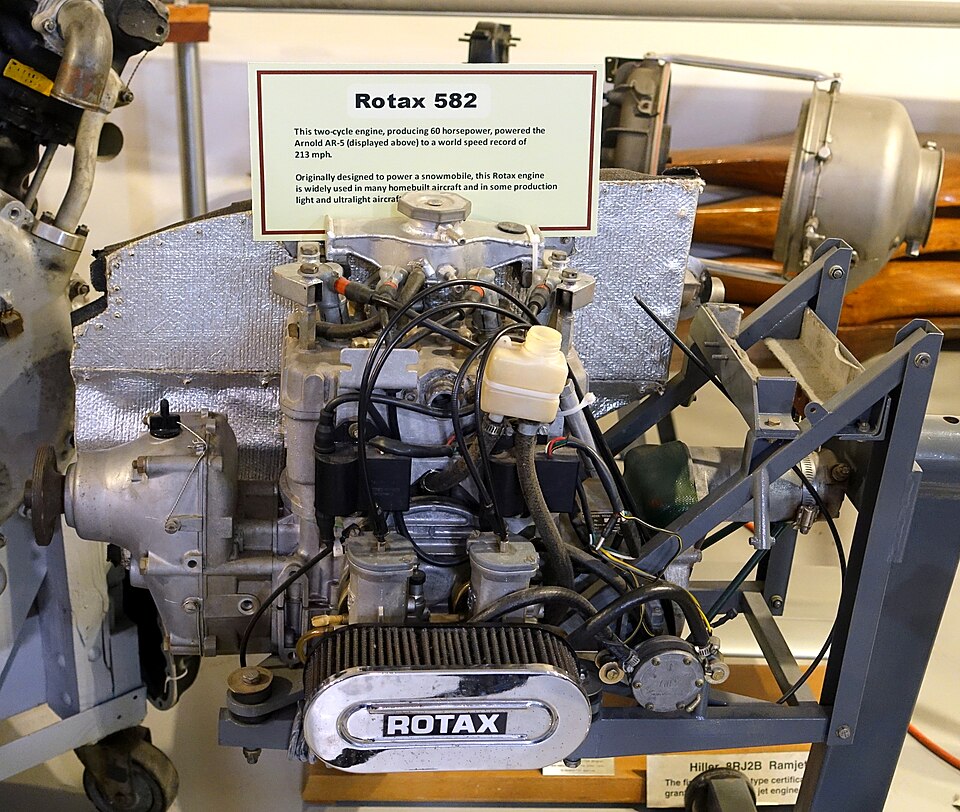
The Rotax 582 first appeared in the late 1980s as a successor to the air-cooled 532. It brought liquid cooling into the two-stroke world and quickly became one of the most popular ultralight engines in history — with over 30,000 units sold worldwide. It's a two-cylinder, two-stroke engine rated at around 65 horsepower, and it uses a rotary valve intake design that's central to how two-stroke aviation engines generate power.
The Rotax 912 launched in 1989 and took a completely different path. It's a four-cylinder, four-stroke engine with a hybrid cooling system — liquid-cooled cylinder heads paired with air-cooled cylinders. It received FAA certification in 1995, and its TBO has climbed steadily over the years, eventually reaching 2,000 hours on newer fuel-injected models. Today, the 912 series dominates the Light Sport Aircraft market.
Fun Fact: The Rotax 912 crossed the milestone of 50,000 units produced by 2014 — a remarkable achievement for a niche aviation engine that has since powered everything from sport planes to military drones.
Understanding the Core Difference: Two-Stroke vs Four-Stroke
This is really the heart of the whole comparison. The stroke count changes almost everything about how an engine behaves, how long it lasts, and how much it costs to operate.
How a Two-Stroke Engine Works
A two-stroke engine fires on every revolution of the crankshaft. That means it produces a power pulse every single rotation. The result is a high power output relative to the engine's size and weight. Two-strokes are mechanically simpler — no valves, no complex valve train, no separate oil reservoir in the same way four-strokes use one. Lubrication comes from oil mixed into the fuel or injected automatically.
The tradeoff? Two-strokes run harder and burn their components faster. They require more frequent inspections and overhauls, and they're more sensitive to things like lean fuel mixtures and cooling interruptions.
How a Four-Stroke Engine Works
A four-stroke engine fires every other revolution. Each cylinder goes through four distinct phases: intake, compression, power, and exhaust. This cycle is less aggressive, generates less heat per cycle, and puts less stress on internal components. Four-strokes also have dedicated oil systems that do a much better job of lubricating and cooling moving parts.
The payoff is longevity. The Rotax 912's TBO — the manufacturer's recommended time between overhauls — is dramatically longer than the 582's. It's also more fuel-efficient and runs more smoothly at cruise power settings.
Good to Know: The 582's Rotax manual includes a frank warning that the engine "is subject to sudden stoppage" and recommends never flying it over terrain where a forced landing can't be made safely. This is common language for two-stroke aircraft engines, but it's worth taking seriously when planning your flying.
Rotax 912 vs 582: The Key Differences That Matter
Here's where things get practical. Let's walk through every major category pilots care about when comparing these two engines.
Power and Performance
At face value, the numbers look closer than you'd expect. The 582 produces around 65 horsepower. The base 912 UL produces around 80 hp. The more popular 912 ULS steps up to 100 hp — a significant jump that makes it a genuinely different engine in terms of climb performance and cruise speed.
Where things get interesting is the power-to-weight ratio. The 582 weighs around 110 pounds with electric start, while the 912 tips the scales at roughly 132 pounds. That 22-pound difference matters on a 500-pound ultralight. In a pure power-to-weight calculation on paper, the lighter 582 holds its own against the base 80 hp 912. But bump up to the 100 hp 912 ULS and the four-stroke pulls decisively ahead.
Climb performance is often where the debate gets heated. On lighter aircraft, the 582 can actually match or edge out the base 80 hp 912 on climb rates simply because the airframe is carrying less total weight. Step up to the 912 ULS, and that advantage flips.
Pro Tip: If you're building a light aircraft under 600 lbs gross and primarily fly locally at lower altitudes, the 582 may give you better climb performance than the base 912 UL — at a lower cost. If you're building heavier or plan to fly cross-country, the 912 ULS changes the equation entirely.
Weight
This is one category where the 582 wins cleanly. At roughly 110 pounds with starter and accessories, it's around 22 pounds lighter than the 912. In ultralight aviation, where every pound affects performance, that gap matters.
On a heavier kit plane or Light Sport Aircraft where total weight is already well-managed, 22 pounds is less critical. But on a minimal ultralight or a powered parachute trike, lighter means better climb, better glide, and more payload for fuel or passengers.
Reliability
This is where the 912 builds a strong case.
The 582, as a two-stroke, is mechanically simpler in some ways — but it's also more finicky. It's sensitive to:
- Lean fuel mixtures that can cause piston seizures
- Cooling system issues that can lead to rapid overheating
- Crank failures, which have been reported by pilots who pushed the engine hard
- Carbon buildup on pistons and rings from two-stroke combustion
With proper maintenance and careful operation, the 582 is a dependable engine. But it requires attentive flying and consistent care. The phrase "well-maintained two-stroke" carries real weight — the emphasis is on "well-maintained."
The 912, by contrast, behaves more like a traditional aircraft engine. It's tolerant of a wider range of operating conditions, runs on a dedicated oil system, and doesn't require the same level of constant attention during flight. The gearbox has proven to be largely trouble-free, and the engine has accumulated an impressive track record of reliability over decades of service.
Why It Matters: Most engine failures in both the 582 and 912 trace back to improper installation or deferred maintenance — not inherent design flaws. Choosing the right engine also means committing to the right maintenance habits.
TBO (Time Between Overhauls)
This is one of the biggest differences between the two engines, and it has real financial implications.
- Rotax 582: Rotax recommends teardown and inspection every 150 hours and a full overhaul at around 300 hours. Some pilots report getting more time if the engine runs lightly loaded, but 300 hours is the benchmark.
- Rotax 912 UL / ULS: TBO is 1,500 hours. The fuel-injected 912 iS stretches to 2,000 hours.
That's a 5-to-1 difference in overhaul intervals. An active pilot flying 100 hours per year would overhaul a 582 every three years versus overhauling a 912 roughly every 15 to 20 years. That gap changes the long-term cost math considerably.
Fuel Burn and Fuel Cost
The 912 burns significantly less fuel than the 582, and it runs on cheaper fuel.
The 582 burns roughly 5 to 6 gallons per hour at cruise power. The 912 burns closer to 3 to 4 gallons per hour in similar conditions — sometimes less on the fuel-injected iS variant.
Beyond consumption, the fuel types matter. The 912 is certified to run on regular mogas (automotive gasoline), which is cheaper and more widely available than avgas. The 582 requires premium unleaded or avgas. Over hundreds of hours, the combination of lower burn rate and cheaper fuel makes the 912 significantly less expensive to run.
Keep in Mind: Fuel costs add up fast. At 100 hours of flying per year, the difference in fuel burn between the 582 and 912 can easily amount to several hundred dollars annually — before you factor in the gap in fuel price between mogas and avgas.
Maintenance and Parts
Both engines are well-supported, but they're supported differently.
The 582 is mechanically straightforward. An experienced owner comfortable with two-stroke mechanics can perform many inspections and overhaul tasks themselves with basic tools and a relatively modest parts budget. Overhaul parts costs are manageable, and the global community of 582 owners and mechanics is large.
The 912 requires more technical precision during maintenance. Rotax strongly recommends having major work performed by authorized service centers, and the parts cost for a full TBO overhaul is substantially higher than for a 582 rebuild. That said, routine maintenance like oil changes (every 50 hours or annually) is straightforward, and the longer intervals between major services offset the higher cost per event.
For US pilots, parts availability for both engines is generally good through authorized Rotax dealers and online suppliers.
Heads Up: The Rotax 912 has had Service Bulletins (SBs) issued over its production life, some of which involve important updates to the engine. If you're buying a used 912, check that all applicable SBs have been complied with — this is a critical part of the pre-purchase process.
Cost: Upfront vs Long-Term
Here's the honest breakdown:
- The 582 costs less upfront — sometimes significantly less, especially in the used market.
- The 912 costs more to buy, but its longer TBO, better fuel economy, and lower per-hour operating cost mean it can be more economical over a full service life.
Older analysis suggests that the per-hour operating cost of the 582 (factoring in overhauls) could approach or exceed that of the 912 when you run the numbers over a realistic flight schedule. The 912 spreads its higher initial cost over far more flight hours. The 582 hits you with overhauls more frequently, even if each individual overhaul costs less.
If you're on a tight budget today and plan to fly fewer than 100 hours per year locally, the 582 can make financial sense. If you're building for the long haul and want to minimize total lifetime cost, the 912 often wins.
Fun Fact: The Rotax 912 is one of the few small aircraft engines approved for use in certified aircraft in parts of the world under the JAR-22 certification framework — an unusual distinction for an engine that most US pilots use in experimental or Light Sport aircraft.
Aircraft Compatibility
The 582 is designed specifically for:
- Ultralight aircraft
- Powered parachutes and trikes
- Gyrocopters and autogyros
- Very light experimental kit planes
- Applications where weight savings are critical
It carries a VFR daytime-only restriction by design. Rotax's own documentation warns against flying the 582 anywhere a safe forced landing can't be made — a reflection of the two-stroke's higher risk of sudden stoppage.
The 912 powers a wider range of aircraft and has no equivalent daytime-only restriction. You'll find it on:
- Light Sport Aircraft (LSA) including certified SLSA
- More capable experimental kit planes
- Two-seat trainers
- Motorgliders
- Cross-country capable light aircraft
The 912 is the only choice if you want to fly a certified SLSA or a heavier kit plane. The 582, while ASTM-certified for SLSA and ELSA, is limited to lighter, simpler applications.
Pilot Experience and Operational Demands
Flying behind a two-stroke requires more active monitoring. The 582 is less tolerant of mistakes in fuel mixture management, cooling, and power transitions. Pilots who are hands-on, mechanically inclined, and primarily flying locally in good conditions tend to do well with the 582.
The 912 is more forgiving. It behaves more like a conventional aircraft engine — start it, monitor your temps and pressures, and fly. The dual electronic ignition system provides redundancy, and the engine doesn't demand the same level of in-flight vigilance as a two-stroke.
For student pilots or those new to experimental aviation, the 912 is generally the more forgiving choice.
How to Choose Between the Rotax 912 and 582
Still not sure which engine is right for you? These questions can help narrow it down:
Choose the Rotax 582 if:
- Your aircraft is very light (ultralight or minimal kit plane)
- Budget is the primary constraint and you're comfortable with more frequent maintenance
- You fly locally, in good weather, and always within glide distance of a landing spot
- You're mechanically experienced with two-stroke engines
- Cross-country range and cruise speed aren't priorities
Choose the Rotax 912 if:
- You want longer service life and fewer major overhauls
- Your aircraft qualifies as a Light Sport or heavier experimental
- You plan to fly cross-country or over terrain where a forced landing is not always possible
- You prefer lower per-hour fuel costs and mogas compatibility
- You want a more forgiving, less maintenance-intensive engine experience
- You're newer to aviation or prefer a more conventional engine character
For pilots building kit planes and weighing all their options, it's also worth reading up on how the Rotax family compares to other popular engine choices — including a broader look at Lycoming vs Continental vs Rotax aircraft engines for context on where these engines fit in the bigger picture.
If you're considering the higher-end four-stroke options in the Rotax lineup, comparing the Rotax 916 iS against the Lycoming IO-360 offers useful insight into how the modern Rotax family stacks up against traditional certified engines.
The 912 Family: Knowing Your Variants
If you're leaning toward the 912, it helps to know the key variants:
| Variant | HP | TBO | Notes |
| 912 UL | ~80 hp | 1,500 hrs | Base model, widely used |
| 912 ULS | ~100 hp | 1,500 hrs | More popular, slightly larger bore |
| 912 iS | ~100 hp | 2,000 hrs | Fuel-injected, FADEC, best efficiency |
| 912 iSc | ~100 hp | 2,000 hrs | Certified version of the iS |
The 912 ULS is by far the most popular version in the US experimental and LSA market. The 912 iS offers the longest TBO and best fuel efficiency, though it comes at a premium and requires more complex electrical systems.
For pilots weighing the 912 ULS against other comparable four-stroke options, this comparison of the Rotax 912 and ULpower 350i is a worthwhile read. And if you're evaluating Lycoming options at a similar power output, the Lycoming O-360 vs IO-360 breakdown and the IO-540 vs IO-390 comparison give you solid reference points for understanding where these engines sit in the broader market.
Real-World Verdict: What Pilots Actually Say
Pilots who've flown both engines often say something like: "The 582 is fun and capable, but the 912 lets you relax." That kind of peace of mind matters when you're flying cross-country over mountains or forests.
On the other hand, pilots in the ultralight community who build simple, light aircraft and fly locally often report years of trouble-free service from a well-maintained 582 — at a fraction of the upfront cost. They're not wrong. The 582 is a proven engine when treated with respect.
The honest truth is this: the 912 is the better engine for most pilots in most situations. It's more forgiving, lasts longer, burns less fuel, and carries fewer operational restrictions. But "most situations" isn't all situations. If you're weight-limited, budget-constrained, and disciplined about maintenance, the 582 can be a smart, capable choice.
Ready to find an aircraft powered by either of these engines? Flying411 makes it easy to search listings, compare options, and get the information you need to buy with confidence.
Conclusion
The Rotax 912 vs 582 debate comes down to what you're building, how you plan to fly, and what tradeoffs you're willing to make. The 582 offers a lighter, simpler, lower-cost entry into powered flight — but you'll earn that savings with more frequent maintenance, a shorter service life, and a more demanding operational profile. The 912 costs more upfront but rewards you with dramatically longer TBO, lower fuel costs, and an engine character that's more forgiving and more capable across a wider range of flying conditions.
For most US pilots building or buying a Light Sport or kit aircraft, the Rotax 912 ULS is the engine that makes the most sense — it's well-supported, thoroughly proven, and a strong long-term value. The 582 earns its place for ultralight builders who know what they're signing up for and are committed to the maintenance it demands.
Whichever engine you choose, knowing your aircraft inside and out is what keeps you flying safely. If you're ready to take the next step — whether you're buying, building, or just researching — Flying411 is the resource to have in your corner. Explore listings, dig into aircraft specs, and connect with the information you need to make a confident decision.
Frequently Asked Questions
Is the Rotax 912 more reliable than the Rotax 582?
Generally, yes. The 912 is a four-stroke engine with a much longer TBO and a more tolerant operating envelope. The 582 can be reliable with diligent maintenance, but it's more sensitive to heat and fuel mixture issues, which increases the risk of in-flight problems.
Can the Rotax 582 be used in a certified aircraft?
The 582 is ASTM-certified for use in SLSA (Special Light Sport Aircraft) and ELSA (Experimental Light Sport Aircraft), but it carries a daytime-VFR-only restriction by design. It is not approved for use in FAA type-certificated aircraft.
How often does the Rotax 582 need an overhaul?
Rotax recommends a teardown and inspection every 150 hours and a full overhaul at approximately 300 hours. This interval can vary based on operating conditions and load, but 300 hours is the standard reference point.
What fuel does the Rotax 912 run on?
The 912 is certified to run on regular unleaded automotive gasoline (mogas) with at least 87 octane (AKI), as well as premium unleaded, and it can tolerate 100LL avgas, though that's not the preferred fuel. This flexibility makes it less expensive to fuel than many other aircraft engines.
Is the Rotax 582 still in production?
As of the most recent information available, Rotax continues to produce the 582 UL Mod 99 variant, though the product line has narrowed over time. The 582 is widely supported through the used market, overhaul shops, and online parts suppliers, even if new unit availability has become more limited compared to the peak of production.