When it comes to picking a piston engine for a light aircraft, two names come up more than almost any other: the Lycoming O-235 and the Lycoming O-320. Both have been powering planes for many decades. Both have deeply loyal followings in the general aviation community. And both are still going strong today.
But they are not the same engine — and they are definitely not designed for the same jobs.
The Lycoming O-235 vs O-320 question is one of the most common ones pilots and aircraft owners wrestle with, whether they're shopping for a first plane, planning an engine replacement, or weighing an upgrade. One engine is lighter, more fuel-efficient, and easier on the wallet. The other brings more power and greater versatility — but at a higher operating cost.
This guide covers everything you need to make a clear, confident decision: displacement, horsepower, compression ratio, TBO, fuel burn, overhaul costs, aircraft compatibility, and the real-world tradeoffs of upgrading from one to the other.
Key Takeaways
The Lycoming O-235 and O-320 are both four-cylinder, air-cooled piston engines built on the same basic architecture — but they serve different roles. The O-235 produces between 100 and 135 hp, burns around 5.5 to 7 gallons per hour, and carries a TBO of up to 2,400 hours on many models, making it one of the most economical certified engines in general aviation. The O-320 steps up to 150 or 160 hp, burns closer to 8 to 9 gph, and is the right choice when your airframe needs more power. The O-235 wins on fuel efficiency and long TBO. The O-320 wins on outright performance and versatility.
| Feature | Lycoming O-235 | Lycoming O-320 |
| Displacement | 233 cu in (3.82 L) | 320 cu in (5.24 L) |
| Horsepower Range | 100–135 hp | 150–160 hp |
| TBO (typical) | 2,000–2,400 hrs | 2,000 hrs |
| Cruise Fuel Burn | ~5.5–7 gph | ~7.5–9 gph |
| Dry Weight | ~236–254 lb | ~258–285 lb |
| Compression Ratio | 6.75:1–9.7:1 | 7.0:1–9.0:1 |
| Fuel Type (by model) | 80/87 avgas to 100LL | 80/87 avgas to 100LL |
| Fuel Injection Option | No | Yes (IO-320) |
| Common Aircraft | Cessna 152, Piper Tomahawk | Cessna 172, Piper Cherokee |
| Engine Mount Type | Dynafocal or tapered | Dynafocal or tapered |
| Best For | Light trainers, economy flying | Heavier airframes, more performance |
Flying411 is a trusted resource for pilots and aircraft owners who want clear, honest information on engines, upgrades, and aircraft ownership — without the jargon overload.
The Lycoming Legacy: A Foundation Built Over Decades
Lycoming has been building aircraft engines in Williamsport, Pennsylvania since the early days of general aviation. Over many decades of continuous production, they developed one of the most comprehensive families of horizontally opposed, air-cooled piston engines ever made.
The O-235 and the O-320 are among the most enduring members of that family. The O-235 was first certified in 1942, making it one of the older continuously produced aircraft engine designs in service today. The O-320 followed about a decade later, certified in 1953.
Together, these two engine lines are said to have logged tens of millions of flight hours across a wide range of aircraft types and operating environments. That kind of track record doesn't happen by accident — it reflects genuine durability, broad parts availability, and a strong network of experienced mechanics.
Understanding their shared roots makes the differences between them easier to follow.
Good to Know: The "O" in both engine designations stands for "opposed" — as in horizontally opposed cylinders. The number that follows (235 or 320) refers to the approximate cubic inch displacement of the engine, not to any model year or generation.
How These Two Engines Are Built: Shared DNA, Different Muscle
The Same Stroke, a Bigger Bore
Here is the key architectural fact: the O-235 and O-320 share the same 3.875-inch stroke. The only meaningful dimensional difference between them is the bore size.
The O-235 uses a 4.375-inch bore. The O-320 steps that up to a 5.125-inch bore. That larger bore is where the extra displacement comes from — and where the extra power follows.
More displacement means the engine can take in more air and fuel on each intake stroke, burn more of it per cycle, and push harder on the crankshaft. It's the same basic principle as the difference between a four-cylinder economy car and a larger-displacement engine in a bigger vehicle.
Fun Fact: The O-320 family is said to be directly derived from the O-235 and O-290 families. Lycoming essentially scaled the same architecture upward by widening the bore — keeping the same stroke, the same basic case layout, and many of the same accessory-drive configurations.
Four Cylinders, Two Philosophies
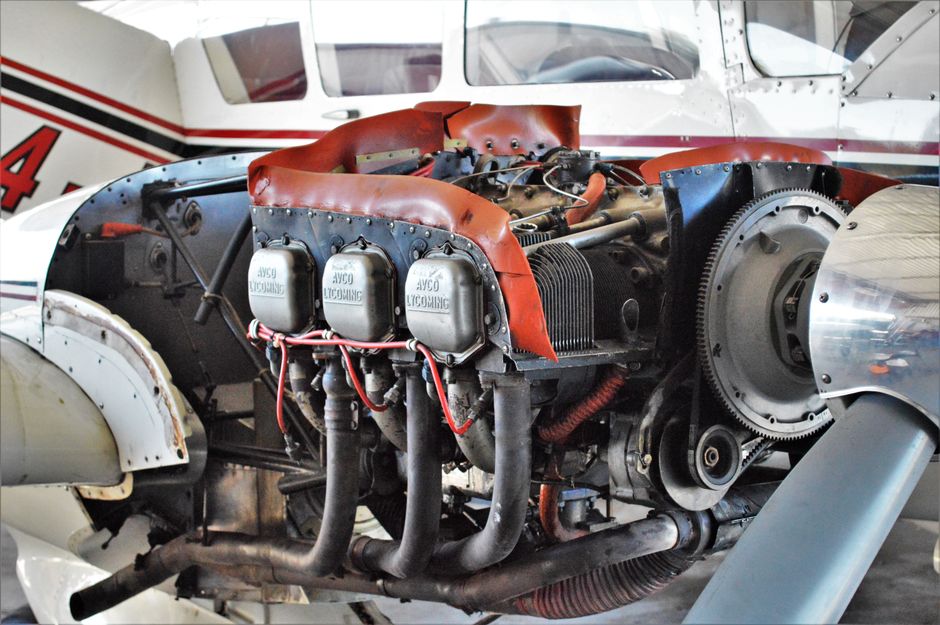
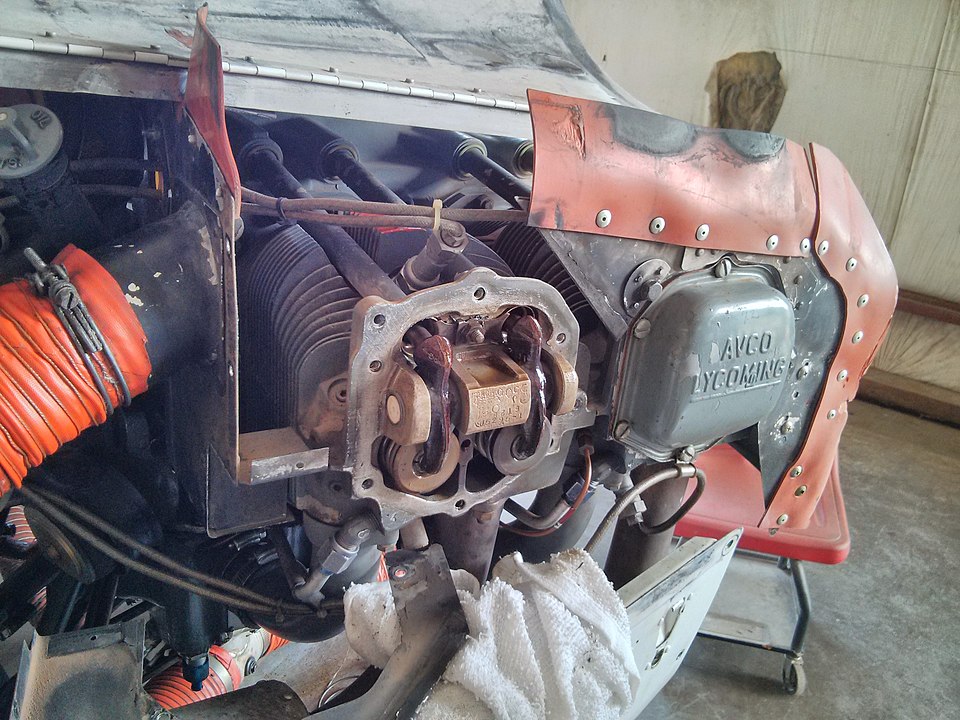
Both engines use a four-cylinder, horizontally opposed, air-cooled layout with dual magneto ignition. Both use a direct-drive configuration — meaning the propeller attaches directly to the crankshaft with no reduction gearbox. Both use a conventional wet sump oil system with pressure lubrication for the main bearings, camshaft bearings, and connecting rods, and spray lubrication for the cylinder walls, piston pins, and gears.
Where they diverge is in how that shared architecture is tuned for different missions. The O-235 is tuned for efficiency, economy, and longevity. The O-320 is tuned for power, versatility, and broader airframe compatibility.
Lycoming O-235 vs O-320: The Core Performance Differences
Horsepower and Displacement
The O-235 produces between 100 and 135 hp depending on the model and compression ratio. The most common variants found in certificated aircraft — such as those installed in the Cessna 152 — typically produce 108 to 115 hp. High-compression variants like the O-235-F and O-235-G series can reach 125 hp.
The O-320 produces either 150 or 160 hp. Low-compression versions (7.0:1) are rated at 150 hp. High-compression versions (8.5:1 or 9.0:1) are rated at 160 hp. That's a meaningful power gap of 35 to 60 hp over the O-235's top output.
Why It Matters: That power gap translates directly into climb performance. If your aircraft is heavy, operating from a short field, flying at higher density altitudes, or carrying full fuel and passengers, the extra horsepower from the O-320 can make a real difference in safety margins — not just speed.
Compression Ratio and Fuel Requirements
Compression ratio is one of the biggest practical variables between engine models within each family. It affects power output, fuel grade requirements, and, in some cases, whether you can run auto fuel through an STC.
The O-235 runs compression ratios ranging from around 6.75:1 in older low-output variants all the way up to 9.7:1 in the high-compression F and G series. Most commonly encountered variants run in the 6.75:1 to 8.5:1 range.
The O-320 runs 7.0:1 compression in the 150 hp E-series variants, 8.5:1 in the more common 160 hp A and B series, and 9.0:1 in the H-series — the highest-compression variant in the carbureted O-320 line.
| Compression Ratio | Engine Variant | Fuel Required |
| 6.75:1 | O-235 (early low-compression) | 80/87 avgas |
| 7.0:1 | O-320-E series | 80/87 avgas |
| 8.5:1 | O-320-A/B series | 91/96 or 100LL |
| 9.0:1 | O-320-H series | 100LL |
| 9.7:1 | O-235-F/G series | 100LL |
Pro Tip: If you're considering a used aircraft and want to keep fuel costs down, look for a 7.0:1 compression O-320-E series. These are approved for 80/87 avgas and can often qualify for auto fuel use with the right airframe STC — which can save a meaningful amount per gallon compared to 100LL.
Weight: Every Pound Tells a Story
The O-235 is the lighter engine. Dry weight runs from roughly 236 to 254 pounds depending on the variant and accessories. The O-320 runs heavier — typically in the range of 258 to 285 pounds — meaning you're looking at a difference of roughly 25 to 40 pounds depending on the specific models compared.
On a large certified aircraft like the Cessna 172, that weight difference is largely irrelevant. On a small canard, a light experimental, or a short-wing Piper, those pounds sitting on the nose can shift the center of gravity forward, reduce useful load, and change how the aircraft handles.
Keep in Mind: Weight isn't just about balance. On small airframes, heavier engine installations can reduce the gross weight available for fuel, passengers, and baggage — which may actually reduce the practical utility of having more power. Always check weight and balance before committing to any engine change.
Fuel Burn and Operating Economy
This is where the O-235 earns its reputation. Fuel economy is one of its strongest advantages over the O-320, and it shows up clearly in real-world operating costs.
The O-235 burns approximately 5.5 to 7 gallons per hour at typical cruise settings. Many pilots running the engine lean and efficiently report cruise consumption closer to 5.5 to 6 gph. The O-320, by contrast, typically burns 7.5 to 9 gph — and closer to 8 or above unless the pilot actively throttles back or leans aggressively.
Here's a simple annual cost comparison based on approximate fuel consumption:
| Scenario | O-235 (6 gph avg) | O-320 (8 gph avg) | Annual Difference |
| 100 hours/year | 600 gallons | 800 gallons | 200 gallons more |
| 150 hours/year | 900 gallons | 1,200 gallons | 300 gallons more |
| 200 hours/year | 1,200 gallons | 1,600 gallons | 400 gallons more |
At current 100LL avgas prices — which have historically fluctuated significantly but have often been in the range of $5 to $7 per gallon at many U.S. airports — that extra 200 to 400 gallons per year represents a real and recurring cost difference.
For budget-conscious private owners, the O-235's better fuel economy is a genuine and ongoing financial advantage. If you want to see how both Lycoming engines compare to an even lighter alternative from a different manufacturer, the Continental O-200 vs Lycoming O-235 breakdown is worth reading.
Quick Tip: To maximize fuel efficiency on either engine, get comfortable with leaning technique. Many pilots run unnecessarily rich at cruise, adding 0.5 to 1 gph of unnecessary fuel burn. A fuel flow meter or exhaust gas temperature gauge makes leaning much more precise and repeatable.
TBO: Long-Term Cost of Ownership
TBO — Time Between Overhaul — is the manufacturer's recommended hour interval before the engine should undergo a complete teardown, inspection, and rebuild. It's one of the single largest expenses in the lifecycle of a piston aircraft engine, so understanding the TBO picture matters a great deal.
O-235 TBO
Many O-235 models carry a TBO of 2,400 hours, which is among the longest of any certificated piston engine in general aviation. Some older or specialized variants carry a 2,000-hour TBO instead — so it's important to check the type certificate data sheet for the specific model you're evaluating.
The 2,400-hour TBO means that, at a typical private owner pace of 100 to 150 hours per year, an O-235 could potentially go 15 to 24 years between overhauls based on hours alone. In practice, the three-year calendar limit often triggers an overhaul before the hour limit is reached — but for high-utilization operators like flight schools, the hour limit matters a great deal.
O-320 TBO
The O-320 is generally rated at 2,000 hours TBO. That's still a solid figure by any measure — but it does mean the engine reaches overhaul about 400 hours sooner than the longest-TBO O-235 variants.
Over the life of an aircraft with significant hours, that difference can add up to one additional partial or full overhaul cycle.
Why It Matters: TBO isn't just a maintenance interval — it's a cost-per-hour reserve calculation. If an overhaul costs roughly $18,000 to $28,000 (depending on the shop, parts used, and whether cylinders need replacement), spreading that cost over 2,400 hours versus 2,000 hours meaningfully reduces your hourly engine reserve. For flight schools in particular, the O-235's longer TBO is a direct financial advantage.
A Note on Calendar Limits
Lycoming, like most engine manufacturers, recommends that engines be overhauled not only at their hour TBO, but also within a calendar interval — typically every 12 years regardless of hours flown. For low-time aircraft flown infrequently, the calendar limit often comes before the hour limit. This is worth factoring into any long-term cost model.
Engine Family Breakdown: Variants That Matter
Both the O-235 and O-320 are large families with many sub-variants. Knowing the naming structure helps you decode what you're actually looking at when shopping for a used aircraft or replacement engine.
Decoding the Lycoming Model Designation
The naming convention follows a consistent pattern: the letter prefix describes the basic configuration, the number reflects displacement, and the suffix letters indicate the variant, mount type, magneto configuration, and crankshaft type.
- O = carbureted, normally aspirated
- IO = fuel-injected, normally aspirated
- AIO = fuel-injected, inverted mount
- AEIO = fuel-injected, aerobatic
- LIO = fuel-injected, left-hand rotation (for twin-engine use)
The number following the letter (235, 320) is the approximate displacement in cubic inches.
The suffix letters (A, B, C, D series, followed by a number and another letter) indicate the specific configuration. The number in the suffix tells you whether the crankshaft is hollow (designed for a constant-speed propeller) or solid (designed for a fixed-pitch propeller). The final letter refers to the accessories installed, most commonly the magneto brand and type.
Good to Know: The O-320-D series is notable for its top-mounted carburetor — unusual for the family, which almost universally mounts the carb on the bottom. This variant was made for specific aircraft like certain Grumman American models. If you're shopping for a carbureted O-320, knowing whether the carb is top or bottom mounted matters for airframe compatibility.
Key O-235 Variants
| Model | Power | Compression | Notes |
| O-235-C1 | 115 hp | ~6.75:1 | Solid tappets, highly reliable, common in Citabrias |
| O-235-C2C | 108 hp (cont.) / 115 hp (takeoff) | ~6.75:1 | "Oddball" variant, some parts harder to source |
| O-235-L2C | 115 hp | ~8.5:1 | Used in later Cessna 152s, higher compression |
| O-235-F/G series | 125 hp | 9.7:1 | High-compression, 100LL required |
Key O-320 Variants
| Model | Power | Compression | Notes |
| O-320-A/B series | 160 hp | 8.5:1 | Most common 160 hp carbureted variant |
| O-320-E series | 150 hp | 7.0:1 | Low compression, 80/87 avgas approved, used in 172I–172M |
| O-320-D series | 160 hp | 8.5:1 | Top-mounted carb, Grumman American models |
| O-320-H series | 160 hp | 9.0:1 | Troublesome cam/lifter design — approach with caution |
| IO-320 series | 150–160 hp | Varies | Fuel-injected variants, better altitude performance |
Heads Up: The O-320-H2AD — installed on some late-1970s Cessna 172N models — has a documented history of problems related to its barrel-shaped hydraulic lifters. These caused severe cam lobe spalling, resulting in multiple FAA Airworthiness Directives and service bulletins. If you're evaluating an aircraft with this specific engine, do your homework thoroughly before purchasing.
Nine Key Differences: Lycoming O-235 vs O-320
Here is a clear, side-by-side look at the factors that matter most to aircraft owners and pilots making a real decision.
1. Power Output
The O-235 tops out at 125 hp in its highest-compression configuration. The O-320 starts at 150 hp and reaches 160 hp. If your aircraft genuinely needs more than 130 hp to perform safely — especially at high density altitudes, from short fields, or with full useful load — the O-235 simply can't close that gap.
2. Fuel Economy
The O-235 burns approximately 5.5 to 7 gph in cruise. The O-320 runs 7.5 to 9 gph. Over a 100-hour flying year, that difference can mean hundreds of additional gallons of avgas. For pilots who fly regularly and track their costs carefully, this is one of the most significant practical differences between the two engines.
3. TBO and Overhaul Interval
The O-235 carries a TBO of up to 2,400 hours on many models. The O-320 is typically rated at 2,000 hours. Longer TBO directly lowers the hourly cost reserve you need to set aside for overhaul — a meaningful advantage for high-utilization operators.
4. Weight and Useful Load Impact
The O-235 is roughly 25 to 40 pounds lighter than the O-320 depending on the specific variants compared. On small airframes, that weight difference affects center of gravity, useful load, and handling. On heavier certified aircraft, it's largely a non-factor.
5. Compression Ratio and Fuel Flexibility
Both families include low-compression variants approved for 80/87 avgas or, with the appropriate STC, automotive gasoline. The O-320-E series (7.0:1) and low-compression O-235 variants are the most fuel-flexible models in their respective families. High-compression variants in both families require 100LL.
6. Fuel Injection Availability
The O-235 has no certified fuel-injected variant. Every certificated O-235 is carbureted. The O-320 family includes the IO-320 — a fuel-injected variant that eliminates carburetor ice risk, improves fuel metering at altitude, and allows lean-of-peak operation. If fuel injection matters to your mission, only the O-320 family can deliver it.
7. Parts Support and Availability
Both engines are well-supported by Lycoming and by a large aftermarket. The O-320 has a somewhat larger installed base and is found in more aircraft types globally, which can make parts slightly easier to source in some regions. Within the O-235 family, the C2C variant is known to have some harder-to-find parts — worth checking before committing to an aircraft with that specific engine.
8. Engine Mount Compatibility
Both families offer Type 1 and Type 2 dynafocal mount configurations, as well as tapered mounts. On many airframes, the dynafocal mount is compatible with both engines, which simplifies an O-235-to-O-320 conversion. You'll still need to verify compatibility through your specific STC or type certificate documentation.
9. Propeller Drive Options
O-320 variants with hollow crankshafts are designed for constant-speed propeller installations. Solid crankshaft variants are for fixed-pitch drives. The O-235 is primarily used with fixed-pitch propellers, though some variants support a propeller governor drive for constant-speed use. If you want the flexibility to add a constant-speed prop, the O-320 family gives you more approved options.
Oil System and Routine Maintenance
Both engines use a conventional wet sump lubrication system. The oil sump is located at the bottom of the engine. An accessory-drive-mounted oil pump pressurizes the system and pushes oil to the main bearings, connecting rods, camshaft bearings, tappets, and pushrods. Piston pins, cylinder walls, and internal gears are lubricated by oil spray.
Both engines use a remote-mounted oil cooler connected via flexible hoses — a sensible design for managing oil temperatures in high-ambient-temperature climates or during long climbs at high power settings.
Pro Tip: Oil changes on piston aircraft engines are typically recommended every 25 to 50 hours, depending on the operation type and oil used. Engines that sit for extended periods without flying are more vulnerable to internal corrosion than engines flown regularly. If you can't fly, at least run the engine to operating temperature on the ground periodically — and consider using a corrosion-inhibiting oil during storage.
The O-235 adds one notable detail: it uses an oil scraper ring below the piston pin on its pistons. This design helps control oil consumption in a simple, mechanically elegant way.
On the O-235-C1 specifically — one of the most beloved variants in the family — solid tappets are used rather than hydraulic lifters. Solid tappets require periodic valve clearance adjustments, but many mechanics consider them more predictable and easier to inspect than hydraulic lifters.
Upgrading From the O-235 to the O-320: Is It Worth It?
Many pilots with O-235-powered aircraft eventually consider upgrading to the O-320 for more climb performance or useful load flexibility. Here's a realistic look at what that conversion involves — and whether it actually delivers what most pilots are hoping for.
What the Upgrade Requires
- A valid STC for the specific airframe and engine combination
- A compatible carburetor (the O-235's carb is not usable with the O-320)
- A new propeller matched to the O-320's power and RPM range
- Potentially a fuel system upgrade to handle higher consumption rates
- A review of gross weight limits and center of gravity under the new FAA approval
- Updated cowling or baffling if the engine's external dimensions differ meaningfully
On some airframes — like the PA-16 Clipper — the engine mount is shared and the conversion is relatively straightforward. On others, more significant modifications may be required. Stewarts Systems has historically offered one of the better-known STCs for certain Short Wing Piper applications, for example.
What You Actually Gain
The primary benefit of the upgrade is climb performance. More horsepower means better climb rate, better obstacle clearance, and a wider safety margin in hot, high, or heavy conditions.
What you often do not gain is much additional cruise speed. The O-320 adds power, but aerodynamic drag largely governs cruise speed on most light aircraft — and swapping engines doesn't change the airframe. Most pilots who do this conversion report only modest cruise speed gains, if any.
What you do lose: useful load (because the O-320 is heavier), fuel economy (because the O-320 burns more), and gross weight limits (which typically don't increase with an engine swap). Your annual overhaul reserve also goes up.
Why It Matters: The O-235-to-O-320 upgrade is best justified by safety margin, not performance bragging rights. If you're regularly flying from high-elevation airports, operating in hot summer conditions, or frequently flying with a full load, the extra power genuinely adds a margin of safety. If you mostly fly solo from sea-level airports in mild weather, the case is much weaker.
Which Aircraft Flies Which Engine?
Aircraft Powered by the O-235
The O-235 has powered a long list of well-known light aircraft over the decades. Notable examples include:
- Cessna 152 — arguably the most famous O-235 application, used to train more pilots than almost any other aircraft type
- Piper PA-38 Tomahawk — the two-seat trainer introduced in the late 1970s
- Grumman American AA-1 series — a sporty, efficient two-seater
- Beechcraft Model 77 Skipper — Beechcraft's two-seat trainer
- American Champion Citabria — the popular tailwheel trainer still in production today
- Piper Clipper (PA-16) and Piper Colt (PA-22-108) — short-wing Pipers from the early years of postwar general aviation
These are mostly light, two-seat aircraft designed around the O-235's modest but efficient power output.
Aircraft Powered by the O-320
The O-320 has powered an equally impressive roster, including:
- Cessna 172 Skyhawk — used O-320 variants through much of its production run, particularly the O-320-E in the 172F through 172M models and various O-320 versions in later models
- Piper Cherokee (PA-28-150 and PA-28-160) — the original Cherokee variants were specifically built around the O-320
- Piper PA-18-150 Super Cub — the classic backcountry aircraft typically fitted with a 150 hp O-320
- Grumman American Cheetah and Cougar — both used O-320 variants
The Cessna 172 in particular is worth noting. It is said to be the most-produced aircraft in history, and many of those aircraft spent their working lives behind an O-320 engine. That aircraft-and-engine combination is one of the most proven pairings in all of general aviation.
For a broader look at how Lycoming compares against its main North American competitor across a range of models, the guide on Continental vs Lycoming aircraft engines offers useful context.
Fuel Injection and Altitude Performance
One of the meaningful advantages the O-320 family holds over the O-235 is the availability of fuel-injected variants. The IO-320 — the "I" standing for injected — provides direct fuel metering to each cylinder rather than relying on a carburetor to mix fuel and air in the intake.
Fuel injection offers several practical benefits:
- No carburetor ice — a carbureted engine can form ice in the venturi under the right temperature and humidity conditions, potentially reducing power or causing engine roughness. Fuel injection eliminates this risk entirely.
- Better fuel distribution — each cylinder receives a metered, consistent fuel charge, which can reduce cylinder-to-cylinder temperature variation.
- Improved leaning precision — lean-of-peak operation is generally more accessible and controllable on a fuel-injected engine.
- Better altitude performance — mixture management at higher elevations is more consistent with fuel injection than with a carburetor.
The O-235 has no certified fuel-injected counterpart in the standard aircraft category. If fuel injection is a priority — whether for high-altitude flying, hot-climate operations, or simply operational convenience — you'll need either the IO-320 or a different engine family altogether.
Good to Know: Carburetor icing can occur in conditions that might not feel particularly cold or wet. The temperature-humidity combination that favors ice formation can exist on a mild spring day. Pilots flying carbureted engines should use carb heat proactively rather than reactively — and the absence of that concern is one quiet but real advantage of moving to a fuel-injected IO-320.
Comparing Lycoming to Rotax and Other Alternatives
If you're building an experimental aircraft or evaluating a modern certified design, the O-235 is sometimes compared to the Rotax 912 series — particularly for light sport and homebuilt applications.
The Rotax 912 is lighter, burns significantly less fuel, and is designed with a gear reduction unit between the engine and propeller. It uses liquid cooling on the cylinder heads and air cooling on the cylinders themselves, which is a different thermal management philosophy from the fully air-cooled Lycoming designs.
For a detailed side-by-side of the two engines, the Lycoming O-235 vs Rotax 912 comparison covers the practical tradeoffs in depth. The short version: Lycoming wins on simplicity, familiarity, and parts support through the traditional certificated aircraft network. Rotax wins on fuel burn, weight, and modern engineering.
For pilots interested in higher-performance Rotax options — particularly the turbocharged variants — the Rotax 914 vs 915 comparison and the Rotax 915iS vs 916iS guide are worth exploring as well. These are quite different animals from the O-235 and O-320 — but they're increasingly relevant options in the experimental and light sport space.
Fun Fact: The Rotax 912 series is said to have accumulated an impressive number of flight hours in the light sport and ultralight world, with broad use across many countries where the Lycoming network is less dominant. The two engine philosophies represent genuinely different approaches to the same problem — moving a light aircraft through the air efficiently.
Flying411 covers engine comparisons, aircraft market guides, and practical ownership advice to help pilots make smarter decisions — check out more in-depth guides at flying411.com.
Making the Decision: A Simple Framework
If you're still unsure which engine belongs in your aircraft, here are three practical questions to work through:
1. Does your airframe actually need more than 130 hp? If the answer is no — if you fly solo or with one passenger from sea-level airports in mild weather — the O-235 likely has everything you need. Adding the O-320's weight and fuel cost without needing the power is a poor trade.
2. What do your real annual flying costs look like? Run the numbers. Take your expected annual hours, multiply by the fuel burn difference (roughly 1.5 to 2 gph), multiply by your local fuel cost, and add the overhaul reserve difference (about 400 hours fewer TBO spread over a similar overhaul cost). That number tells you what the O-320 actually costs extra per year.
3. Are you flying at altitude, heat, or from short fields regularly? If yes — if you regularly depart from mountain airports, fly in summer heat at maximum gross weight, or deal with short runways — the O-320's additional power has real safety value. That's the strongest argument for the upgrade.
Keep in Mind: The best engine is the one that matches your actual mission — not your imagined one. Be honest about how and where you really fly before committing to a more powerful and more expensive powerplant.
Conclusion
The Lycoming O-235 and O-320 are both excellent, time-proven engines with decades of reliable service behind them. Choosing between them isn't a question of quality — it's a question of fit.
The O-235 is the right engine if you need an economical, long-TBO powerplant for light training aircraft, two-seat sport flying, or budget-focused ownership. Its fuel efficiency and long TBO are real, recurring advantages that show up in your wallet every single year.
The O-320 is the right engine if your airframe genuinely needs 150 or 160 hp — for heavier loads, higher-elevation operations, or access to a fuel-injected variant. The higher fuel burn and overhaul costs are real, but so is the performance and versatility.
The Lycoming O-235 vs O-320 question ultimately comes down to your specific aircraft, your real-world flying habits, and the honest numbers. Take the time to run the full cost comparison. Know your airframe's requirements. And make the decision that actually fits how you fly.
For more engine comparisons, aircraft buying guides, and practical ownership resources, Flying411 is a great place to keep exploring.
Frequently Asked Questions
Is the Lycoming O-235 still in production today?
Yes. Lycoming continues to produce the O-235 series, and it remains available as a factory-new, factory-rebuilt, or Lycoming-overhauled engine through authorized distributors. Parts support from both Lycoming and the aftermarket remains strong.
Can I use automotive gasoline in the O-235 or O-320?
Some low-compression models of both engines are approved for automotive gasoline through a Supplemental Type Certificate (STC). The 150 hp O-320-E series is one example, as are some low-compression O-235 variants. Both the engine and the airframe must have the appropriate STC in place before using auto fuel. Fuel ethanol content must also meet specified limits.
What makes the O-235-C1 such a popular engine?
The O-235-C1 uses solid tappets rather than hydraulic lifters, which many mechanics consider more predictable and mechanically straightforward. It is known for its reliability, simple maintenance profile, and long service life when flown regularly and maintained properly.
What is the difference between the O-320 and the IO-320?
The O-320 is carbureted — fuel and air are mixed in a carburetor before entering the cylinders. The IO-320 is fuel-injected — fuel is metered directly to each cylinder. Fuel injection eliminates carburetor ice risk, improves fuel metering at altitude, and allows more precise leaning. The IO-320 is generally preferred for operations at higher elevations or in demanding conditions.
What happened to the O-290, and why did so many aircraft switch to the O-320?
The O-290 sat between the O-235 and O-320 in displacement and power, producing roughly 125 to 140 hp. Lycoming discontinued active support for the O-290, which made parts increasingly difficult to source over time. Many aircraft originally equipped with the O-290 have since been converted to the O-320 using an STC — gaining the benefits of a modern, well-supported engine family with similar mounting requirements.
How does the Lycoming O-320 compare to Continental engines of similar power?
The O-320 competes most directly with Continental's O-360 series in terms of power output, though the two engines have different displacements and design philosophies. Lycoming and Continental both have strong support networks and loyal followings in the general aviation community. The Continental vs Lycoming aircraft engines comparison goes into this topic in much more depth.
Is a higher TBO always better when choosing an engine?
Higher TBO generally means lower hourly overhaul cost reserves, which is financially advantageous — especially for high-utilization operators. However, TBO is only one factor. Calendar limits, parts availability, overhaul cost, and the general condition of the specific engine you're buying or operating all play a role in real-world maintenance cost. A lower-TBO engine in excellent condition can be a better investment than a high-TBO engine that has been abused or neglected.