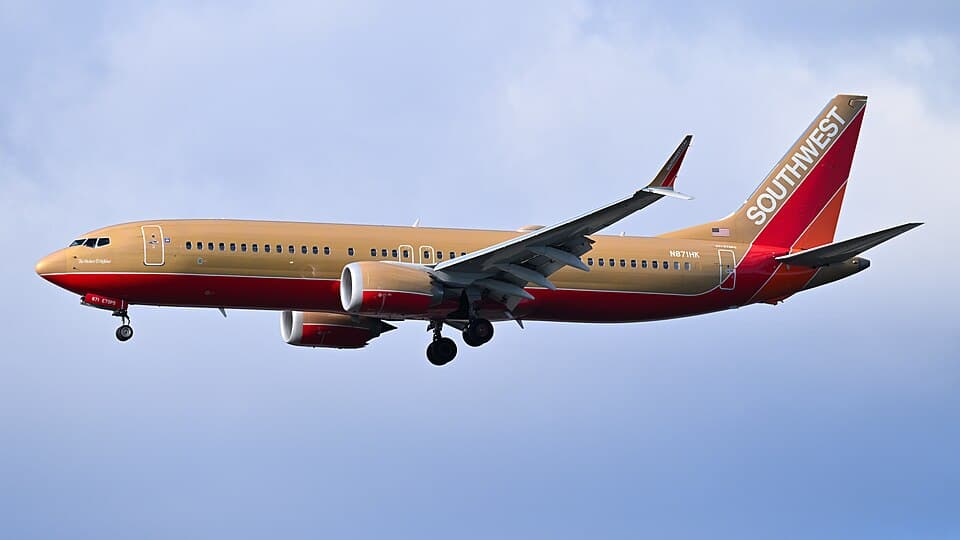
The Boeing 737 has been flying passengers since the 1960s, and the family keeps getting reinvented. The newest chapter is the MAX, a narrow-body airliner built around bigger engines, reshaped wings, and a long list of small refinements that add up to real savings. Understanding the Boeing 737 MAX specifications helps make sense of why airlines order these jets by the hundreds, and why one variant sells far better than the rest.
Numbers tell the story here better than marketing ever could. A few inches of extra fan diameter, a few feet of extra fuselage, and a few thousand pounds of extra weight decide which routes a jet can serve and which ones it cannot. Those trade-offs are where the MAX gets interesting.
The engines that made this airplane possible almost did not fit under the wing.
Key Takeaways
The Boeing 737 MAX is a family of four single-aisle jets that share the same wingspan, the same CFM LEAP-1B engines, and the same basic cockpit, but differ in length, seating, weight, and range. The MAX 7 is the shortest and flies the farthest. The MAX 8 is the middle child and the best seller. The MAX 9 and MAX 10 carry the most people but give up range to do it. All four cruise around Mach 0.79 and top out near 41,000 feet.
| Variant | Approx. Length | Typical Two-Class Seats | Max Certified Seats | Approx. Range |
| 737 MAX 7 | 116 ft 8 in (35.6 m) | 138–153 | Around 172 | About 3,800 nm |
| 737 MAX 8 | 129 ft 8 in (39.5 m) | 162–178 | 189 | About 3,500 nm |
| 737 MAX 8-200 | 129 ft 8 in (39.5 m) | Around 197–200 | 210–212 | About 3,400 nm |
| 737 MAX 9 | 138 ft 4 in (42.2 m) | 178–193 | 220 | About 3,300 nm |
| 737 MAX 10 | 143 ft 8 in (43.8 m) | 188–204 | 230 | About 3,100–3,300 nm |
Figures are approximate and vary by configuration, engine rating, and customer options.
Flying411 keeps a running eye on the commercial and general aviation markets, from airframes and engines to certified parts. It is a handy place to start when specs turn into shopping.
What the Boeing 737 MAX Is, in Simple Terms
The MAX is the fourth generation of the 737. It followed the Next Generation series, often shortened to 737 NG, which included the popular 737-700, 737-800, and 737-900ER.
Boeing built the MAX to answer one question. How do you make a 50-year-old airframe burn far less fuel without starting over from scratch?
The answer came in three main pieces:
- New engines. The CFM International LEAP-1B replaced the CFM56-7B.
- New wingtips. Split-tip winglets replaced the blended winglets of the NG.
- New structure and systems. A reinforced fuselage, stronger landing gear, updated avionics, and a redesigned tail cone all came along for the ride.
Everything else stayed familiar on purpose. Same fuselage cross-section. Same six-abreast economy cabin. Same basic pilot type rating, which saves airlines a fortune in training costs.
Good to Know A single type rating across a fleet means pilots can move between variants with minimal extra training. For a large operator, that flexibility is worth as much as the fuel savings.
The MAX 8 entered service in 2017. The MAX 9 followed. Two more variants, the MAX 7 and the MAX 10, have taken far longer to reach the finish line.
The Four MAX Variants at a Glance
Think of the family as four sizes of the same jet. Every variant shares a wingspan of about 117 feet 10 inches, or roughly 35.9 meters, including those distinctive split-tip winglets.
Here is the quick version:
- 737 MAX 7 — The short one. Fewest seats, longest range, best hot-and-high performance.
- 737 MAX 8 — The workhorse. The most ordered variant by a wide margin.
- 737 MAX 8-200 — A high-density version of the MAX 8 with an extra pair of exit doors.
- 737 MAX 9 — A stretch aimed at the old 737-900ER market.
- 737 MAX 10 — The longest of the family and Boeing's answer to the Airbus A321neo.
That is five entries for four core airframes, since the 8-200 is a seating variation of the MAX 8 rather than a separate size.
Fun Fact The 8-200 gets its name from its high-density seating target, and Boeing earned the higher count by adding an extra set of exit doors near the rear of the cabin.
Boeing 737 MAX Specifications, Variant by Variant
This is the heart of the matter. The Boeing 737 MAX variants share more than they differ, so the smartest way to read the numbers is category by category rather than jet by jet. Below are eight specification areas that shape how each aircraft performs.
1. Length and Fuselage Dimensions
Length is the single biggest difference across the family. The MAX 7 measures roughly 116 feet 8 inches. The MAX 10 stretches to about 143 feet 8 inches, which is around 27 feet longer.
The fuselage width does not change. Cabin width stays close to 11 feet 7 inches, which is what gives you three seats on each side of the aisle.
That extra length on the 737 MAX 10 dimensions created a real engineering headache. A longer body means a higher risk of scraping the tail during rotation on takeoff. Boeing solved it with a semi-levered main landing gear that extends about 9.5 inches during rotation, then folds back into the same wheel well the other variants use.
2. Wingspan and Wing Design
Every MAX carries the same wing. Span is about 117 feet 10 inches with winglets, which keeps the jets inside the airport gate categories operators already use.
Key wing features include:
- Split-tip winglets that curve both up and down, cutting drag by a small but meaningful margin
- A redesigned wing-to-body fairing for smoother airflow
- Fly-by-wire spoilers, a first for the 737 line, which saved weight compared to older mechanical systems
Wing area sits close to 1,370 square feet across the family. Since the wing stayed the same while the fuselage grew, the larger variants carry more weight on the same lifting surface. That single fact explains most of the range differences you will read about next.
3. Range by Variant
Here is the part that surprises people. The smallest MAX flies the farthest.
- MAX 7: roughly 3,800 nautical miles
- MAX 8: roughly 3,500 nautical miles
- MAX 8-200: roughly 3,400 nautical miles
- MAX 9: roughly 3,300 nautical miles
- MAX 10: roughly 3,100 to 3,300 nautical miles, depending on configuration
The logic is simple. Stretching a fuselage adds structural weight and more passengers without adding much fuel capacity. Every extra pound has to be lifted and carried, so the 737 MAX range drops as the airplane grows.
Why It Matters Range decides route maps. A MAX 7 can open thin long-haul domestic routes that a MAX 10 cannot touch, while the MAX 10 crushes per-seat costs on busy short flights. Neither is better. They are different tools.
4. Seating Capacity and Cabin Layouts
Seating figures come in two flavors, and mixing them up causes endless confusion.
Typical two-class layout reflects what airlines really install, with business and economy sections. Maximum certified capacity reflects the highest number the exits and safety rules allow.
| Variant | Two-Class (typical) | Maximum Certified |
| MAX 7 | 138–153 | Around 172 |
| MAX 8 | 162–178 | 189 |
| MAX 8-200 | 197–200 | 210–212 |
| MAX 9 | 178–193 | 220 |
| MAX 10 | 188–204 | 230 |
The MAX 8 seating capacity of 189 in a single-class layout matches the old 737-800 exactly, which made fleet transitions easy for airlines already flying the NG. If you are curious how the two generations line up in day-to-day service, the older and newer 737 side by side makes the differences clear.
5. Weights and Payload
Maximum takeoff weight, or MTOW, climbs steadily with size:
- MAX 7: around 177,000 lb (about 80 tonnes)
- MAX 8: around 181,200 lb (about 82 tonnes)
- MAX 9: around 194,700 lb (about 88 tonnes)
- MAX 10: around 197,900 lb (about 90 tonnes)
Operating empty weight rises along the same curve. The MAX 8 came in roughly 6,500 pounds heavier than a 737-800, mostly because of the bigger engines and the reinforced structure needed to hang them.
Payload capacity follows. Cargo hold volume grows with fuselage length, giving the MAX 9 and MAX 10 a useful advantage on routes where belly freight pays part of the bills.
6. Speed, Altitude, and Basic Performance
These specs barely move across the family:
- Typical cruise speed: Mach 0.79, which works out to roughly 450 knots true airspeed at altitude
- Maximum operating speed: Mach 0.82
- Service ceiling: 41,000 feet
- Typical takeoff run at MTOW: in the range of 7,000 to 8,500 feet, depending on variant, weight, and conditions
The MAX cruises slightly higher than most 737 NG operations thanks to improved engine efficiency at altitude. Higher cruise means thinner air, less drag, and better fuel numbers.
Quick Tip When comparing jets, always check the cruise Mach number alongside range. A jet that flies slightly slower but much farther often wins on total trip economics.
7. Fuel Capacity and Burn
Standard fuel capacity across the family sits close to 6,820 US gallons, or about 25,800 liters. That number stays remarkably steady from the MAX 7 to the MAX 10.
Since the tanks did not grow but the airplanes did, fuel burn per hour rises with size while range falls. Boeing has stated the MAX family delivers around a 20 percent reduction in fuel use and CO2 emissions compared to the original Next Generation jets it replaced.
Per-seat efficiency tells a different story. The MAX 10, packed with up to 230 passengers, delivers some of the lowest per-seat costs in the single-aisle world on short sectors.
8. Landing Gear and Ground Handling
The larger LEAP-1B engines needed more ground clearance. Boeing raised the nose by extending the nose landing gear about eight inches on the MAX 8 and MAX 9.
Main gear track and wheelbase grow slightly with fuselage length. Turning radius grows too, which matters at tight regional airports.
The MAX 10's semi-levered gear, mentioned earlier, was one of the most complex mechanical additions to the entire program. A steel shrink link pulls the inner cylinder closed during retraction so the taller assembly still fits the standard wheel well.
Heads Up Ground clearance under a LEAP-1B nacelle is tighter than crews used to CFM56 engines might expect. Foreign object damage risk goes up on poorly maintained ramps.
The LEAP-1B Engine Specifications That Changed Everything
The LEAP-1B engine is the reason the MAX exists. Built by CFM International, a joint venture between GE Aerospace and Safran, it replaced the CFM56-7B that powered the NG family.
Core specifications:
| Specification | LEAP-1B | CFM56-7B (for comparison) |
| Fan diameter | 69.4 in (176 cm) | 61 in (155 cm) |
| Bypass ratio | About 9:1 | About 5.1:1 |
| Overall pressure ratio | Around 40:1 | Around 28:1 |
| Fan blades | 18 woven carbon fiber | 24 titanium |
| Thrust range | Roughly 23,000 to 29,000 lbf | Roughly 19,500 to 27,300 lbf |
The efficiency gain is widely cited at around 15 percent over the CFM56-7B. That comes from a larger fan moving more air at lower speed, a hotter and more efficient core, ceramic matrix composite turbine shrouds, and the TAPS II combustor design that cuts nitrogen oxide emissions.
A few details worth knowing:
- The engines mount higher and further forward on the wing than on the NG, since the larger fan would not clear the ground otherwise.
- The chevron pattern on the exhaust nozzle smooths the mixing of fan and core airflow, which cuts noise.
- The LEAP-1B performs a bowed rotor motoring routine at start, gently spinning the shafts to straighten any thermal bow before ignition.
If you are tracking how these powerplants differ from what came before, the engine generation shift on the 737 is worth a closer look.
Flying411 lists overhauled and serviceable aviation engines alongside certified parts and avionics, so operators tracking LEAP-era maintenance cycles can source what they need in one place.
Flight Deck, Systems, and the MCAS Story
The MAX cockpit looks familiar to any 737 pilot, with four large display screens replacing the older six-panel arrangement. Boeing kept the layout close to the NG on purpose so type rating differences training stays short.
Notable systems on the MAX include:
- Boeing Sky Interior cabin with sculpted sidewalls and LED lighting
- Larger primary flight displays with an integrated crew alerting function
- Fly-by-wire spoiler control, replacing cables and mechanical linkages
- Electronic bleed air system for improved efficiency
Then there is MCAS, the Maneuvering Characteristics Augmentation System. Because the larger engines sit higher and further forward, the airplane's pitch behavior at high angles of attack differed from the NG. MCAS was designed to nudge the nose down in those conditions so handling felt consistent between generations.
Two fatal accidents in 2018 and 2019 were linked to the system's original design, which relied on a single angle-of-attack sensor. The global fleet was grounded for roughly 20 months. The redesigned system now compares both AOA sensors, activates only once per event, and can be overridden by the flight crew using normal control column inputs.
Keep in Mind Every MAX flying today operates under the revised flight control software and updated crew training requirements. The specifications you read for current production jets already reflect those changes.
Fuel Burn, Emissions, and Noise Numbers
Environmental performance sits near the top of most airline order decisions now. The MAX delivers on three fronts:
- Fuel and CO2: around 20 percent lower per flight than the aircraft it replaces, per Boeing figures
- NOx emissions: substantially lower than earlier engines under ICAO standards
- Noise: the LEAP-1B meets ICAO Chapter 14 noise limits, the strictest tier currently in force
The noise reduction is easy to notice from the ground. High-bypass engines move air more gently, and the chevrons on the nacelle trailing edge smooth the exhaust mixing that generates much of the roar.
Airport noise budgets and night curfews put real money behind these numbers. Quieter jets get more slots at more airports.
How the MAX Stacks Up Against the A320neo Family
The single-aisle market is a two-horse race, and the specifications line up closely.
| Metric | 737 MAX 8 | A320neo | 737 MAX 10 | A321neo |
| Length | 129 ft 8 in | 123 ft 3 in | 143 ft 8 in | 146 ft |
| Typical two-class seats | 162–178 | 150–180 | 188–204 | 180–220 |
| Approx. range | 3,500 nm | 3,400 nm | 3,100–3,300 nm | 4,000 nm |
| Engines | LEAP-1B | LEAP-1A or PW1100G | LEAP-1B | LEAP-1A or PW1100G |
The MAX 8 and A320neo trade blows fairly evenly. The MAX 10 and A321neo do not. The Airbus jet carries a similar load considerably farther, which has pushed many airlines toward the A321neo for transcontinental single-aisle flying.
Boeing's counterargument centers on commonality, per-seat cost on shorter sectors, and maintenance simplicity across a single-type fleet. For a carrier already deep in 737s, those advantages carry weight.
Comparison shopping across manufacturers is a normal part of fleet planning, and the same instincts apply to widebody matchups like the A350 and 777 when operators move up a size class.
Where the MAX 7 and MAX 10 Stand Today
Two of the four variants are still working toward certification. Both have faced years of delay tied to the engine anti-ice system and a revised crew alerting system mandated by Congress after the MAX accidents.
As of mid-2026:
- The MAX 7 has been reported as nearing FAA approval, with certification targeted for the summer and first deliveries expected in 2027.
- The MAX 10 is in the final phase of certification flight testing, with approval anticipated before the end of 2026 and deliveries in 2027.
- Combined orders for the two variants run into the thousands, with Southwest holding the bulk of MAX 7 commitments and United, Ryanair, Alaska, and WestJet among the largest MAX 10 customers.
Certification timelines have slipped before, so treat any date as a target rather than a promise. What is clear is that both airplanes have moved from open-ended limbo into measurable final steps.
Pro Tip If you follow fleet planning, watch the launch customers rather than the manufacturer press releases. Airlines adjust their schedules based on real delivery expectations, and their guidance often tells you more than official targets.
What the Specs Mean for Buyers, Operators, and Parts Sourcing
Specifications turn into money fast. A few practical takeaways:
For value and resale. Range and seating capacity drive lease rates and appraisal figures. A MAX 8 with a common configuration sells more easily than an oddly specified airframe. The broader forces behind what a commercial jet is worth apply squarely to the MAX family.
For pricing expectations. Published list prices and real transaction prices diverge widely in commercial aviation. Reading up on how list prices compare to real deals prevents sticker shock in both directions. The strength of the used narrow-body market also explains why secondhand 737s hold their value better than many expect.
For maintenance and parts. LEAP-1B components carry strict traceability requirements. Knowing how to read Boeing part numbers and how to confirm that a part is airworthy protects both safety and resale value. Life-limited engine components deserve extra attention, since tracking parts with hard time limits affects the value of an entire engine.
For documentation. Cross-border transactions frequently hinge on release paperwork. The distinction between European and US release certificates can determine when a part is usable and where.
For depreciation planning. New-generation efficiency helps residual values, but the curve is still steep in the early years. Understanding how quickly aircraft lose value sets realistic expectations for any ownership horizon.
Ready to move from research to real listings? Browse aircraft, engines, and certified parts on Flying411 and connect with vetted aviation professionals in one place.
Conclusion
The Boeing 737 MAX specifications tell a story of careful trade-offs. Boeing kept the fuselage cross-section, the wingspan, and the pilot type rating, then changed the engines, the wingtips, and enough structure to make a decades-old design competitive again. The result is four jets that look almost identical from a distance and behave quite differently on a route map.
Read the numbers as a set rather than one at a time. Length drives seating. Seating drives weight. Weight eats range. Once that chain clicks, every specification in the table starts making sense.
Specs are the easy part. Finding the right airframe, engine, or certified part at the right moment takes a marketplace built for it, and Flying411 has been quietly doing exactly that.
Frequently Asked Questions
How many 737 MAX aircraft has Boeing delivered so far?
Boeing has delivered well over a thousand MAX aircraft since the type entered service in 2017, with deliveries continuing at a monthly rate that has been climbing through 2026. Exact totals shift every month, so check Boeing's published delivery data for current figures.
Can 737 NG pilots fly the MAX without a new type rating?
Yes. The MAX shares a common type rating with the 737 NG, though pilots must complete differences training that now includes simulator work covering the revised flight control systems.
Is the 737 MAX allowed to fly transatlantic routes?
Some operators fly MAX aircraft on transatlantic sectors, typically on shorter northern routings from the eastern United States and Canada to Europe. Range limits and payload trade-offs make these flights sensitive to winds and seasonal conditions.
What is the difference between the 737 MAX 8 and the 737-8?
They are the same airplane. Boeing uses 737-8 in official certification and marketing documents, while 737 MAX 8 remains the more common name in everyday use and among airlines.
How long is the 737 MAX expected to stay in production?
Boeing has given no end date and continues to expand production capacity, including additional assembly lines. Single-aisle demand suggests the family will remain in production well into the 2030s, though nothing in commercial aviation is guaranteed.