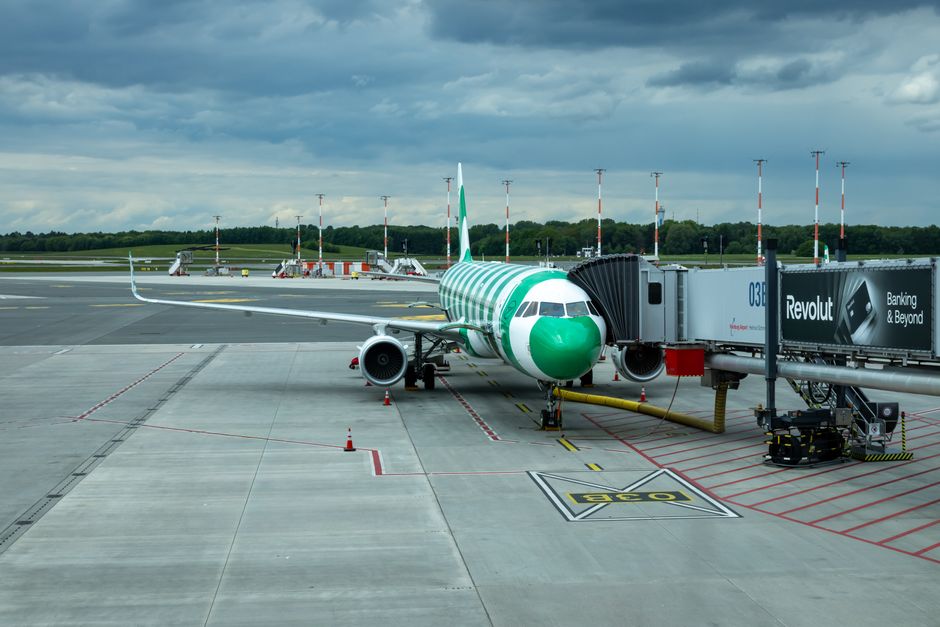
Park an Airbus A319 next to an A320 on the same ramp and most people walk right past the difference. Same nose, same flight deck windows, same wing, same engines hanging in the same place, same paint scheme wrapping the same cabin windows. Stand at the wingtip and look down the fuselage, though, and the A320 keeps going for about twelve more feet. Look again at the wing root and you will notice the A320 has a pair of overwing exits on each side while the A319 usually has one.
That is essentially the whole physical story. Airbus built the A319 by shortening the A320 fuselage by seven frames, removing sections both ahead of and behind the wing while leaving most of the wing, systems and cockpit architecture unchanged. It is the same trick a truck manufacturer uses when it offers a short-bed and a long-bed version of the same pickup. The chassis, engine, cab and dashboard carry over; the box on the back changes.
But the Airbus A319 vs A320 question is not really about twelve feet of aluminum. It is about what those twelve feet do to your payload, your runway numbers, your cost per seat, your maintenance bill and, eventually, what a buyer will pay you for the airplane. A shorter airplane climbs better out of a hot, high airport and costs less to fly on any given leg. A longer one carries thirty more paying passengers for almost the same crew, the same fuel flow per hour and the same landing fee.
If you are shopping a used narrowbody, leasing one, or just trying to understand why one airline flies both, this is the breakdown that matters.
Key Takeaways
The A319 and A320 share a wing, engines, landing gear, systems, cockpit and a single pilot type rating, so the operational differences come almost entirely from fuselage length and weight. The A319 is roughly 3.7 meters (about 12 feet) shorter, carries around 30 fewer passengers, weighs about two tonnes less empty, and with the same fuel tanks it flies noticeably farther and gets off short or high-altitude runways with less trouble. The A320 wins on economics: it spreads nearly the same trip cost across many more seats, which is why airlines that can fill it almost always prefer it. Parts interchangeability is very high but not total — fuselage panels, floor structure, door and exit arrangements, and some thrust ratings differ. On the used market the A320 has held value better, partly because it has a passenger-to-freighter path and the A319 largely does not.
| Item | A319 (ceo) | A320 (ceo) |
| Overall length | About 33.8 m (111 ft) | About 37.6 m (123 ft 3 in) |
| Wingspan | 34.1 m, or 35.8 m with sharklets | Same |
| Typical two-class seating | Around 124 | Around 150 |
| Maximum certified seating | Up to 156, 160 with added exits | Up to 180 |
| Typical operating empty weight | Roughly 40,800 kg | Roughly 42,600 kg |
| Common maximum takeoff weight | 64,000 kg standard, options to 75,500 kg | 73,500 kg standard, options to 78,000 kg |
| Standard usable fuel capacity | About 23,860 L in common configurations | About 23,860 L in common configurations |
| Published range | Roughly 3,700 nm | Roughly 3,300 nm |
| Lower-deck cargo volume | About 27.6 m³ (975 cu ft) | About 37.4 m³ (1,320 cu ft) |
| Engines | CFM56-5B or IAE V2500, lower thrust ratings | CFM56-5B or IAE V2500, higher thrust ratings |
| Pilot type rating | Shared across A318/A319/A320/A321 |
Good to Know: The FAA covers the A318, A319, A320 and A321 on a single type certificate data sheet, A28NM. EASA does the same under TCDS A.064. That one document is the clearest evidence of how much these airplanes have in common — regulators treat them as variations on one design, not four designs.
What Airbus Actually Changed
How much shorter is the A319?
The A319 fuselage is about 3.73 meters shorter than the A320's, achieved by removing two frame sections forward of the wing and two aft. Everything about the cross-section is identical: the same 3.95-meter external diameter, the same cabin width, the same seat rails, the same galley and lavatory monuments, the same overhead bins.
Because the wing, engines and landing gear did not change, the A319 ends up with more wing per pound of airplane. Pilots feel that immediately. The A319 climbs harder, holds altitude better in the cruise on a hot day, and floats a bit more on landing if you carry extra speed. Airline crews who fly mixed fleets often describe the A319 as the sporty one in the family.
Why does the A319 fly farther on the same fuel?
In common ceo configurations, both airplanes carry roughly 23,860 liters of usable fuel, although exact capacity varies slightly with engine and modification status. The A319 is lighter and carries fewer passengers, so that fuel goes farther. Airbus has published a range of roughly 3,700 nautical miles for the A319 against about 3,300 for the A320, and the A319 can add center tanks for even more. That is why the A319 became the basis for the ACJ319 corporate jet, where extra fuel tanks in the cargo hold turn a regional workhorse into a genuine intercontinental airplane.
Why It Matters: If your mission is thin long-haul — a 2,800-nautical-mile leg that only fills 110 seats — the A319 is not the compromise version, it is the right airplane. Range and payload always trade against each other, and the A319 simply starts the trade from a lighter place.
What about the overwing exits?
Here is a difference that surprises people. The A320 normally has four main doors plus four overwing exits, two per side. A standard A319 has four main doors plus one overwing exit per side and was originally certificated for up to 145 passengers. Higher-density A319 configurations can use additional overwing exits and approved cabin modifications to raise the maximum capacity to as many as 160 passengers.
The Economics: Trip Cost vs Seat Cost
Which one is cheaper to fly?
Both, depending on how you measure. On a given leg, the A319 burns less fuel — operators generally report something in the range of five to eight percent less per flight hour, since it is lighter and usually has lower-rated engines. Its landing fees are lower where fees scale with weight. Its cabin crew requirement can be lower too, because U.S. rules under 14 CFR 121.391 set one flight attendant per 50 seats, so a 150-seat A319 needs three where a 180-seat A320 needs four.
But the A320 carries roughly 20 percent more people for that modest cost increase. Divide total cost by seats and the A320 almost always wins on cost per available seat mile. This is the single most important number in narrowbody fleet planning, and it explains why A320 production dwarfed A319 production — Airbus built somewhere around 1,500 A319s against several thousand A320s.
| Cost driver | Advantage | Why |
| Fuel per flight hour | A319 | Lighter airframe, lower thrust ratings |
| Fuel per seat | A320 | Same wing and engines carrying more payload |
| Cabin crew cost | A319 | Can stay under seat thresholds for one fewer attendant |
| Weight-based landing fees | A319 | Lower MTOW options available |
| Maintenance per flight hour | Roughly equal | Same systems, same engines, same check intervals |
| Maintenance per seat | A320 | Same work, more seats to absorb it |
| Cargo revenue potential | A320 | About a third more lower-deck volume |
| Hot-and-high payload | A319 | Better thrust-to-weight, shorter field length |
Pro Tip: Do not evaluate these airplanes on cost per seat mile alone. Cost per seat mile only counts if you sell the seats. On a route where your average load is 110 passengers, the A320's extra 30 seats are dead weight you are hauling around and paying to maintain. Run the numbers on cost per passenger mile using your real load factors, not the brochure.
Flying411 keeps narrowbody listings, specifications and market context in one place, so you can compare an A319 and an A320 on the numbers that drive your operation rather than the ones in a sales sheet.
Where the A319 earns its keep
Three missions favor the shorter jet. High-altitude airports, where thrust-to-weight decides how much payload you can lift — the A319 has long been a favorite in the Andes and at other elevated fields. Short runways, where published takeoff field length at maximum weight runs roughly 1,900 to 2,000 meters for the A319 against about 2,100 meters for the A320 under standard sea-level conditions. And thin long routes where the A320's extra seats would fly empty.
There is also the corporate and government market. A used A319 airframe converted to a VIP interior is one of the more common large-cabin private conversions, and Airbus Corporate Jets still builds the ACJ319neo new, advertising a range near 6,750 nautical miles with auxiliary tanks. That second life is not available to most A320 airframes at anything like the same rate.
Parts Interchangeability: How Common Is Common?
What parts swap directly between the two?
A great many, and this is the family's central selling point. The wing is the same structure with the same area on both. Landing gear, wheels, brakes and tires are common. The flight deck is identical down to the sidestick, the ECAM displays and the flight control computers. Hydraulic, electrical, pneumatic and fuel system components are largely shared. Auxiliary power units, cabin monuments, seats, overhead bins, doors and door mechanisms interchange. Engines come from the same two families — CFM56-5B and IAE V2500 on the ceo, CFM LEAP-1A and Pratt & Whitney PW1100G on the neo.
For an operator this is enormous. One spares pool, one set of ground support equipment, one tooling inventory, one maintenance planning document, one set of mechanic training. A shop that can C-check an A320 can C-check an A319 without retraining anyone.
What does not interchange?
Fuselage skin panels and frames in the plug areas are variant-specific, as is the floor beam structure in those bays. Wiring harness lengths differ where they run the length of the cabin. Overwing exit hardware and surrounding structure differ with the exit configuration. Engines are physically the same models but are usually delivered at different thrust ratings — an A319 commonly flies with lower-rated CFM56-5B variants, and while many ratings are software-selectable within a family, the certified rating on the aircraft's documents is what governs. Maximum takeoff weight options also differ, and those are recorded on the airworthiness paperwork, not just in the manual.
Heads Up: "Interchangeable" in a sales conversation and "interchangeable" on an illustrated parts catalog are two different claims. Before you count on a spare fitting either airframe, check the part number against the IPC for the specific MSN and effectivity. Airbus service bulletins routinely apply to some serial ranges and not others within the same variant.
Does one type rating really cover both?
Yes. Pilots hold a single A320 type rating that covers the A318, A319, A320 and A321, and can fly all four in the same duty period with only differences training. That is unusual and valuable. It means an airline can flex an A319 onto a route in the morning and an A320 in the afternoon with the same crew, and it means a buyer's crew costs do not change if the fleet mix does. If you are weighing the family against its rival, our comparison of the A320 and the Boeing 737 covers how Boeing approaches the same problem across the 737 family.
Maintenance and Life Limits
Is the A319 cheaper to maintain?
Slightly, and mostly for boring reasons. Check intervals come from the same Airbus maintenance planning document, and the systems being inspected are identical. What differs is the amount of airframe. There is less fuselage to inspect, fewer cabin monuments to service, fewer seats to overhaul, less paint to strip and reapply. Heavy check labor hours on an A319 tend to run a little below an A320 of similar age and utilization, but the gap is smaller than the seat-count difference suggests, because so much of the work is systems and engines rather than structure.
Engine maintenance is where the real money sits on either airplane, and there the A319's typically lower thrust ratings help. Lower-rated engines generally run cooler turbine temperatures, which tends to stretch time on wing and reduce shop visit severity.
Keep in Mind: Both variants were designed against the same original service goal of roughly 48,000 flight cycles and 60,000 flight hours, with Airbus offering extended service programs beyond that. Because the A319 often flies shorter sectors in dense schedules, a given A319 may be far closer to its cycle limit than its hours suggest. Always read the cycle count, not just the calendar age.
Cycle-driven components deserve close attention on any used narrowbody. Our explainer on life limited parts walks through what has to come off the airplane regardless of condition, and why those parts drive the back half of an airframe's economic life.
Flying411 keeps maintenance guides, ownership cost explainers and aircraft listings in one place, so you can price a heavy check and a shortlist of airframes in the same sitting.
Values, Resale and Second Lives
Which holds its value better?
The A320, and by a clear margin at comparable ages. There are three reasons. First, demand — more airlines want more seats, so the pool of buyers for a used A320 is deeper. Second, freighter conversion. Passenger-to-freighter programs exist for the A320 and, more prominently, the A321, giving those airframes a second career after airline service. The A319 has no comparable volume conversion program, so once it leaves passenger service the main options are corporate conversion, part-out or storage. Third, fleet simplification: when airlines trim types, the subfleet with the worst seat-mile cost usually goes first, and that has often been the A319.
That same dynamic is exactly what drives early retirements across the industry. Our piece on why airlines retire aircraft early explains how an airframe with plenty of structural life left can still be worth more in pieces than in service.
Does the neo generation change the answer?
It widens the gap. The A320neo has taken the overwhelming majority of new-generation family orders, while the A319neo has drawn only a small fraction — enough that it is effectively a niche product, with the A319neo's real growth coming through the ACJ corporate variant. Fewer new A319neos means a thinner future support base and a smaller operator community, which feeds back into residual values.
On the other hand, delivery delays on new-build neos have kept older ceo airframes in service and propped up their lease rates. That is a market condition, not a permanent feature, but it is worth understanding when you are timing a purchase. We cover it in more detail in our look at the A320neo supply chain crisis, and the generational comparison sits in Boeing 737 MAX vs Airbus A320neo.
Fun Fact: The A319 is the only member of the mainline A320 family that regularly gets a full private-jet conversion. Head of state and corporate operators like it for the same reason airlines sometimes do not — it flies a long way with a light load, and a light load is exactly what a VIP interior is.
Choosing Between Them
When the A319 is the right buy
Choose the A319 if your routes run long relative to their demand, if you operate from high-elevation or short-field airports, if you are building toward a corporate or special-mission conversion, or if acquisition price matters more to you than seat-mile cost. Used A319s generally cost less to buy and less to lease than comparable A320s, and in a low-utilization operation that upfront saving can outweigh the efficiency gap.
When the A320 is the right buy
Choose the A320 if you can consistently fill more than about 130 seats, if belly cargo is part of your revenue picture, if you want the broadest possible resale and lease market, or if you want the freighter conversion option available down the road. For most scheduled passenger operations, the A320 is the default and the A319 is the exception you justify.
Quick Tip: If you genuinely cannot decide, remember that the shared type rating lets you operate both. Plenty of carriers do exactly that — A319s on the thin and high routes, A320s on the trunk routes, one pilot pool, one spares pool. That flexibility is the real product Airbus sold.
Flying411 keeps aircraft comparisons, specification pages and current listings in one place, so you can move from "which variant" to "which airframe" without leaving the site.
Conclusion
The honest summary of Airbus A319 vs A320 is that you are choosing between range and revenue. The A319 gives you a lighter, longer-legged, better-climbing airplane that costs less per flight and less to buy. The A320 gives you thirty more seats and a third more cargo hold for a marginal increase in operating cost, which is why it dominates the fleet count and the resale market. Everything else — cockpit, wing, engines, systems, type rating, spares — is close enough to identical that the decision genuinely comes down to how many people you can put in the back and how far you need to take them.
Run your own route economics before you shop. Then check the cycles, the exit configuration, the MTOW option and the engine thrust rating on any specific airframe, because within each variant those choices matter more than the twelve feet of fuselage that separate the two models. For broader context on the two manufacturers behind these airplanes, see our Boeing vs Airbus comparison and our roundup of the Airbus models that changed commercial aviation.
When you are ready to compare listings, visitFlying411and see what is on the market today.
Frequently Asked Questions
Can a pilot fly both the A319 and A320 without a new type rating?
Yes. A single type rating covers the A318, A319, A320 and A321. Operators provide differences training where needed, but a qualified pilot can fly all four variants in the same duty period. This is one of the strongest arguments for staying inside the family when you expand a fleet.
Is the A319 actually a better performer than the A320?
In climb rate, field length and range, yes. It uses the same wing and same engine families on a lighter airframe, so it has more thrust and more lift per pound. In cost per seat it is clearly worse, because it spreads a similar cost base over fewer passengers.
How many seats does each aircraft hold?
Airbus lists the A319 at around 124 seats in a typical two-class layout and up to 156, or 160 with an additional exit arrangement. The A320ceo is typically around 150 two-class and certified to a maximum of 180. Actual counts vary widely by operator and seat pitch.
Are A319 and A320 parts interchangeable?
Most systems, avionics, landing gear, engines, doors and cabin components are common. Fuselage panels and frames in the stretched sections, floor structure in those bays, some wiring harnesses and the overwing exit structure are variant-specific. Always verify part numbers against the illustrated parts catalog for the specific serial number.
Why do airlines keep retiring A319s before A320s?
Seat-mile economics and fleet simplification. When capacity needs to come out, the subfleet with the highest cost per seat usually goes first, and the A319 has fewer second-life options than the A320 and A321 because there is no mainstream freighter conversion program for it.
Does the A319 have better hot-and-high performance?
Generally yes. The combination of a full-size wing, standard thrust levels and lower operating weights means the A319 can lift more useful load out of high-elevation or high-temperature airports than an A320 under the same conditions, which is why it has been popular with carriers operating in mountainous regions.