Just picture ordering a brand-new car, paying for it years in advance, and then watching it sit in the parking lot with no engine. That is exactly what is happening to airlines right now. The Airbus A320neo supply chain crisis has turned one of aviation's biggest success stories into a costly mess. And it is hitting airlines, passengers, and the whole industry hard.
Right now, somewhere in the world, an A320 family jet is taking off or landing every two seconds. It is the most delivered commercial jet in history. Airlines rushed to buy it because it burns less fuel, carries more passengers, and flies farther than the older jets it replaced. Airbus filled its order books for years ahead.
Then things started breaking down. Not on the plane itself, but in the massive global network of factories and suppliers that build it. The problems are still happening today. They explain why flights are more crowded, fares are higher, and some airlines are still flying jets that should have been retired long ago.
Let's look at what makes the A320neo so important first. Then we can follow the trail to see exactly where things went wrong.
Key Takeaways
The Airbus A320neo supply chain crisis started with engine defects, parts shortages, and supplier failures. These problems have slowed production and delayed jet deliveries since 2022. Pratt & Whitney found a serious manufacturing defect in its GTF engines in 2023. That grounded hundreds of A320neo aircraft. The other engine supplier, CFM International, cannot fill the gap. The result: Airbus cannot fill thousands of orders, airlines are stuck flying older jets, and the global aviation industry is losing over $11 billion per year.
| Topic | Key Detail |
| Main Cause | Pratt & Whitney GTF engine powder metal defect (found July 2023) |
| Aircraft Grounded at Peak | 600 to 835 A320neo-family jets simultaneously |
| Engine Inspection Time | 250 to 360 days per engine shop visit |
| Cost to RTX (P&W Parent) | $5.4 billion total |
| Cost to Airlines (2025 est.) | $11+ billion (IATA) |
| Airbus Delivery Target Cut | ~800 to ~770 in 2024; ~820 to 793 in 2025 |
| Production Rate 75 Goal | Pushed from 2025 to 2026 to 2027 |
| Airbus Order Backlog | 12,000+ A320-family aircraft (12 to 14 years of production) |
| Global Commercial Aircraft Backlog | Record 17,000 aircraft (2024) |
The A320neo Is the Backbone of Modern Air Travel
To understand the crisis, you need to know what is at stake. The A320neo, short for "new engine option," is the best-selling commercial jet on the planet. It comes in several versions: the A319neo, A320neo, A321neo, A321LR, and the new A321XLR. Together, the A320neo family makes up roughly 80% of all Airbus deliveries every year. That is a big deal. When the A320neo program runs into trouble, all of Airbus runs into trouble.
Airlines love this jet for one simple reason: it saves money. The new engines are about 15 to 20% more fuel-efficient than the older A320 models they replaced. For an airline flying hundreds of routes every day, that adds up to hundreds of millions of dollars saved over a jet's life. Longer range and a quieter cabin made it even more attractive.
How popular is it? As of mid-2025, Airbus has a backlog of more than 12,000 A320-family orders. That is roughly 12 to 14 years of production at current build rates. The global record backlog of commercial aircraft across all makers hit a historic high of 17,000 jets in 2024. Airlines are not just buying. They are waiting in line, sometimes for years.
Here is what makes the crisis so frustrating. Demand is not the problem. Demand is stronger than ever in the history of aviation. The problem is that Airbus cannot build and deliver jets fast enough to meet all those orders. And the reason goes back to something most passengers never think about: the global network of suppliers that builds every part of the plane before it even gets to Airbus's factory.
Why Building a Modern Jetliner Is Harder Than It Looks
A commercial jet is not built in one place. A modern aircraft like the A320neo has millions of parts. They come from hundreds of companies spread across dozens of countries. Airbus puts the final product together. But the engines come from one company, the fuselage panels from another, the seats from another, and the electronics from yet another. It is a massive global puzzle.
The system that manages all of this is called just-in-time manufacturing. Parts arrive right when they are needed. No one stores huge piles of extra inventory. That keeps costs low, until something goes wrong. When one key part is late or defective, the whole assembly line slows down or stops. There is nothing to fall back on.
Then COVID hit. The aviation industry nearly shut down in 2020. Airlines grounded their jets. Airbus cut production. Suppliers laid off workers. Factories scaled back. When air travel bounced back faster than expected, the industry tried to ramp up again. But it had lost years of trained workers, supplier relationships, and production capacity. Those things do not come back overnight.
The aerospace supply chain has been recovering, but it is not there yet. A 2025 Roland Berger survey found that 65% of aerospace companies still list labor shortages as their top problem. Nearly 64% are still dealing with active supply chain disruptions. These are not quick fixes. And the A320neo program sits right in the middle of all of them.
- Labor shortages are still the number one challenge across the aerospace sector
- Just-in-time manufacturing leaves no cushion when a key supplier fails
- COVID wiped out workers and factory capacity that takes years to rebuild
- Shipping costs from China to Europe rose fivefold due to Red Sea rerouting and Panama Canal drought
"Gliders" in the Desert: What Happens When a Jet Has No Engine
Picture dozens of brand-new Airbus A320neo jets sitting on tarmacs with no engines. They have wings, fuselages, cockpits, landing gear, and interiors. Everything except the one thing that makes them fly.
Inside the aviation world, these jets have a name. They are called gliders. It is a dark joke. But it fits. Airbus finishes the airframe and then just waits. The engines are not ready.
By July 2025, the number of these engineless jets at Airbus facilities had doubled in just a few months. Airbus was carrying about 1 billion euros in extra costs just to store and maintain them. That is 1 billion euros tied up in jets that make zero money for anyone. Not for Airbus, not for the airlines waiting for them, and not for the passengers who need seats.
The glider problem comes directly from the engine shortage. Two engine programs supply the A320neo, and both are in trouble at the same time. The bottleneck is not in Airbus's factory. It is at the engine makers. And that is a problem Airbus cannot fix on its own.
- Each grounded airframe is a delivery Airbus cannot complete
- Airlines are still flying older, less efficient planes instead of their new jets
- Some completed jets sit in storage for months before they can be handed over
- Boeing faces the same upstream problems, showing this is a crisis across the entire fleet renewal cycle
Why the Airbus A320neo Supply Chain Crisis Keeps Getting Worse
The problems hitting the A320neo program did not show up all at once. They built up slowly, one on top of another. There are four main failure points. Each one makes the others harder to solve.
The Pratt & Whitney GTF Engine Meltdown
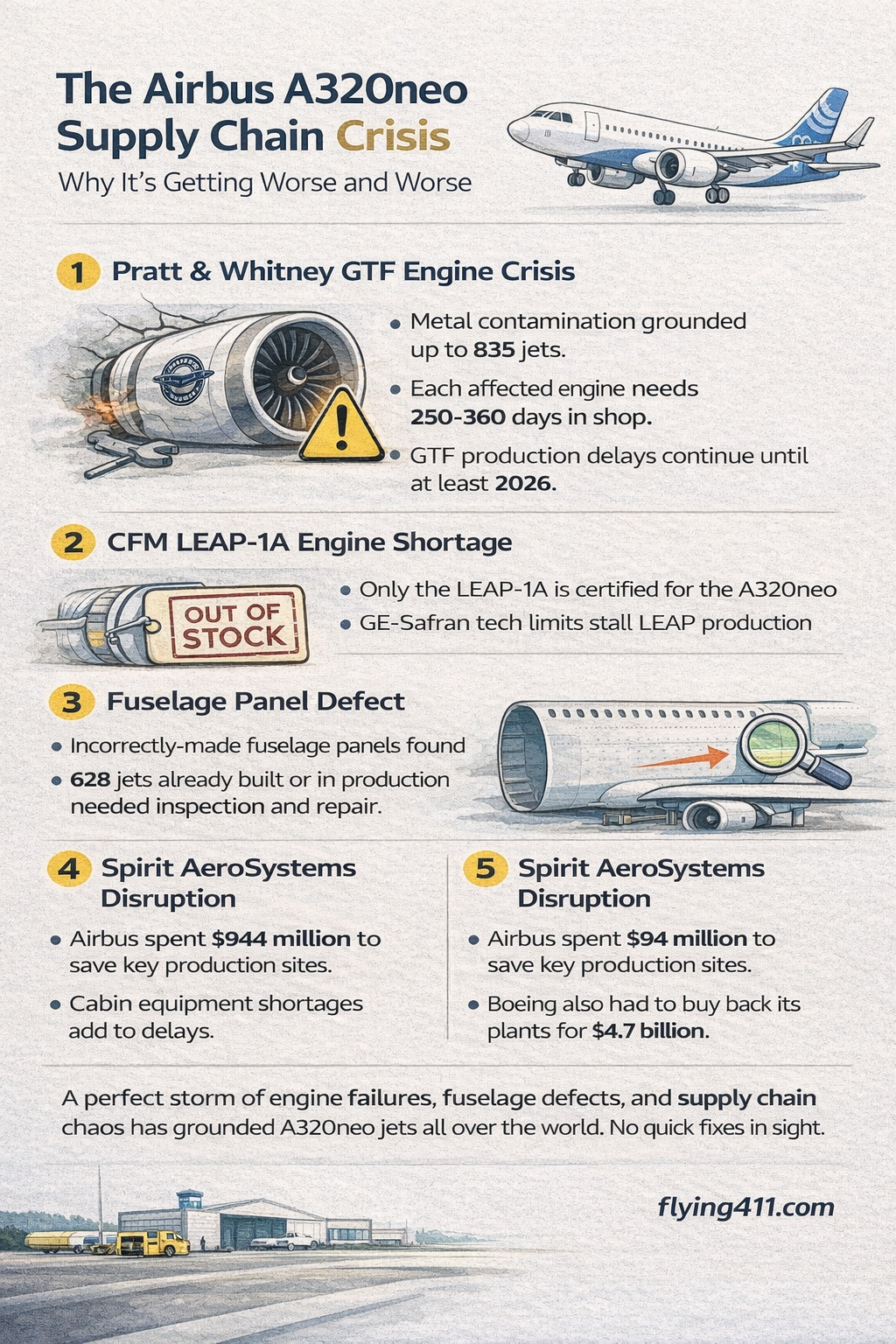
On July 25, 2023, RTX, the parent company of Pratt & Whitney, revealed a serious defect in its PW1100G-JM Geared Turbofan engine. A rare contamination in the powder metal used to make turbine and compressor discs was found. That contamination could cause tiny cracks to form inside the engine. If the cracks grew large enough, a disc could fail. Pieces of the engine could break outward with enough force to pierce the fuselage. This is one of the most dangerous failure modes in commercial aircraft design. Regulators and airlines had to act immediately.
The scale of the problem was huge:
- Affected engines were made between October 2015 and September 2021
- Up to 3,000 engines were flagged
- Between 600 and 835 A320neo-family jets were grounded at the same time, roughly half the entire GTF-powered global fleet
- Each inspection takes 250 to 360 days per engine, nearly a full year
- Maintenance shops worldwide were overwhelmed, with wait times growing from 60 days to over 300
- RTX took a total hit of $5.4 billion and its stock fell to a two-year low
Airlines felt the damage right away. Wizz Air cut capacity by 10% and grounded about 45 jets. IndiGo had dozens of planes sidelined. Hawaiian Airlines had all 18 of its A321neos affected. India's Go First went bankrupt and blamed Pratt & Whitney for grounding nearly half its fleet. Spirit Airlines, JetBlue, Cebu Pacific, Volaris, VivaAerobus, Air Baltic, Air New Zealand, and Air Transat were all hit. Over 40 airline operators and lessors were affected globally.
The shortage pushed airlines into desperate moves. Some carriers began pulling engines off newly delivered A320neos sitting in Europe and shipping them back to the U.S. to reactivate grounded jets. That practice used to only happen with old planes at the end of their lives. Now it was happening with brand-new ones. Some lessors even began parting out A320neos as young as six years old. A working GTF engine had become worth more than the entire airframe.
As of early 2026, Pratt & Whitney is still the biggest bottleneck in the A320neo program. Airbus CEO Guillaume Faury has publicly called out P&W by name. He said engines are arriving "very, very late" and the problem will run well into 2026. Airbus has threatened legal action to enforce its contracts, which is a very unusual move for the company.
CFM LEAP-1A: The Backup That Is Not Available
You might expect the other engine to pick up the slack. The CFM LEAP-1A, made by CFM International, a joint venture between GE Aerospace and Safran, has a better reliability record than the GTF. But it is also in short supply. It cannot absorb the volume that P&W is failing to deliver.
In late 2025, CFM said publicly it would not increase LEAP-1A deliveries to cover P&W's gap. GE and Safran are each contributing roughly equally to the production limits. CFM has announced a new LEAP assembly plant in Casablanca, Morocco. It will produce up to 350 engines per year. The first engine comes off that line in 2028. Full capacity is not expected until around 2030.
That is good news for the future. For the next two years, it does not help much. Airbus has two engine programs running below what the production plan needs. There is no third option. The A320neo family can only fly with these two engine types. Certifying a new engine takes years and costs hundreds of millions of dollars. The supply chain has no backup plan.
The Fuselage Panel Defect Nobody Planned For
Just as the engine problems were already straining deliveries, a new quality issue appeared. In late 2024, EASA ordered inspections of fuselage panels on A320-family jets. A production defect was found at Sofitec, a Spanish supplier. Panels near the front of the plane had the wrong thickness. That was a safety concern that needed immediate action.
- The directive covered 177 aircraft in service and 451 jets still on the production line
- Airbus had to slow its delivery pace in late 2024
- This helped push Airbus's 2024 total to 793 aircraft, short of the original target of about 820
- Fix work continued into the first half of 2025
This shows how fragile the current aerospace system is. One supplier, one quality issue, and hundreds of jets are suddenly caught in the problem. Just-in-time manufacturing has no buffer for surprises.
Spirit AeroSystems and the Cabin Equipment Crunch
Spirit AeroSystems makes major structural parts for multiple aircraft programs. When Spirit ran into financial and production trouble, A350 fuselage deliveries dropped to just one unit in May 2025. For an aviation program already behind schedule, that was a serious blow.
Airbus invested $94 million directly in Spirit and acquired five of its production sites. Boeing made a similar move, buying its own Spirit AeroSystems assets for $4.7 billion. Both of the world's two biggest commercial aircraft makers are now rebuilding key parts of their supplier base directly.
Cabin equipment created its own set of delays too:
- Seat shortages, galley delays, and inflight entertainment backlogs held up final deliveries on finished jets
- Lufthansa received an A350 that entered service with economy seats in the first class cabin because the real seats were not ready
- Airbus CEO Faury called interiors and seats a mid-term problem, meaning it will not be solved quickly
- Business class seat deliveries from Safran dropped from 592 units in Q3 2024 to 428 units in Q3 2025
All four problems together, the GTF crisis, the LEAP shortage, the fuselage panel defect, and the Spirit AeroSystems disruption, are what make the A320neo supply chain situation so hard to fix. Each problem is solvable on its own. Solving all of them at once while trying to ramp up production to meet a record backlog is a much harder task.
To see just how much money is tied up in the jets at the center of all this, check out our look at the 7 Most Expensive Passenger Planes in the World. And for a different angle on these same jets, our guide to the 9 Easiest Commercial Aircraft to Fly breaks down what pilots think about the aircraft that airlines everywhere are waiting to receive.
A Scorecard of Missed Targets
Airbus has cut its delivery targets in 2022, 2024, and again in 2025. Each time, the story was the same: a key supplier failed to deliver what was needed, when it was needed.
| Year | Original Target | Actual Deliveries | Gap |
| 2022 | ~720 | ~661 | ~59 aircraft short |
| 2024 | ~800 | 793 | Short after revision to 770 |
| 2025 | ~820 | ~793 | Short of original goal |
| 2026 | 907 (analyst forecast) | 870 (Airbus guidance) | ~37 below expectations |
The Rate 75 production target tells the same story. Rate 75 means building 75 A320neo jets per month. Here is how that goal has shifted:
- Original goal: Rate 75 by 2025
- First revision: Pushed to 2026
- Second revision: Pushed to 2027
- Current status (early 2026): Targeting Rate 70 to 75 by end of 2027, only if P&W delivers
That is a two-year slip on one of the most important production goals in modern aviation. Every month of delay means more airlines waiting, more old jets in service, and more revenue Airbus cannot collect.
What This Crisis Is Costing Everyone
IATA estimates that slow commercial aircraft deliveries are costing the airline industry more than $11 billion in 2025 alone. That breaks down into four areas:
- Extra fuel costs (~$4.2 billion): Airlines fly older, less efficient jets instead of the newer A320neos they ordered
- Higher maintenance costs (~$3.1 billion): Older aircraft need more repairs, and parts are also in short supply
- Aircraft on ground costs: Revenue lost while jets sit grounded during engine inspections
- Capacity limits: Airlines cannot grow their route networks, which limits revenue
The global fleet is aging fast. The average age of commercial aircraft worldwide has risen to a record 15.1 years. Passenger jets average 12.8 years old. Cargo aircraft average 19.6 years. Older jets cost more to fly and more to fix.
Meanwhile, passengers are filling every seat. Air travel demand rose 10.4% in 2024, but capacity only grew 8.7%. Load factors hit a record 83.5%. Planes are packed. Fares are up. And airlines cannot add enough capacity until new jets start arriving on schedule.
What Airbus Is Doing to Fix It
Airbus is taking real action. Here is what the company has done:
- Acquired Spirit AeroSystems production sites for the A220 and A350 programs to control key manufacturing directly
- Invested $94 million in Spirit to stop further production collapses
- Advanced cash to suppliers across the supply chain to help smaller makers fund their own ramp-ups
- Publicly pressured Pratt & Whitney and threatened to enforce delivery contracts through legal means
- Supported CFM's Morocco factory investment to build long-term LEAP-1A capacity
- Adopted AI and digital tools for quality checks and supply chain tracking
Despite the ongoing problems, Moody's upgraded Airbus's credit rating to A1 with a stable outlook in September 2025. That shows the financial world still believes in Airbus's long-term position.
When Will the Airbus A320neo Supply Chain Crisis End?
The short answer: not soon, but recovery is on the way.
Pratt & Whitney is still the biggest wildcard. The GTF inspection program runs through 2026. New engine deliveries are still arriving late. Airbus CEO Faury says P&W is the main reason the A320neo family ramp-up has stalled.
On the CFM side, things look slightly better. CFM raised its LEAP delivery guidance for 2025 to more than 20% above 2024's total of 1,407 units. The Morocco plant adds long-term capacity. But CFM will not cover P&W's failures.
Here is what the 2025 Roland Berger aerospace survey found:
- 70% of aerospace companies now feel ready for the production ramp-up, up from about 35% in 2024
- Very severe supply chain disruptions have dropped compared to 2024
- But 49% of companies now cite financial pressure as a growing problem, up from 41% in 2024
Airbus is targeting 70 to 75 aircraft per month for the A320neo program by end of 2027. Most analysts say that timeline works only if P&W holds up its end. Some had forecast more than 900 commercial aircraft deliveries from Airbus in 2026. The official guidance of 870 shows there is still a real gap between what the aviation industry needs and what the supply chain can deliver right now.
The good news: the backlog is not going anywhere. With 12,000-plus orders on the books, Airbus has 12 to 14 years of work ahead. Every airline in line still wants its jets. The question is when the supply chain finally catches up. Right now, the most honest answer is: sometime around 2027, if things go reasonably well.
Conclusion
The Airbus A320neo supply chain crisis is one of the most complex stories in modern aviation. It did not start with a bad airplane. The A320neo is genuinely excellent. It started with a global manufacturing system pushed far beyond what it was built to handle. And it has taken years to start unwinding.
From Pratt & Whitney's powder metal defect to CFM's capacity limits, from Spanish fuselage panels to missing cabin seats, the delays have stacked up. Airlines are flying older jets. Passengers are sitting in more crowded planes. Airbus is managing a billion-euro inventory of jets that are ready but cannot be delivered. The cost is real: more than $11 billion to airlines in 2025 alone.
Recovery is coming. The supply chain is getting better. New production capacity is being built. But the full fix is still years away. The industry is learning hard lessons about what happens when the world's most important commercial aircraft program runs short of its most critical parts.
If you want to stay current on what is happening in aviation, from fleet updates to aircraft ownership, buying guides, and market trends, Flying411 has you covered. Explore our full library of aviation resources and get the information you need to make smart decisions about aircraft.
Frequently Asked Questions
How does the A320neo supply chain crisis affect regular airline passengers in the U.S.?
U.S. passengers feel the crisis through higher ticket prices and fewer available seats. Airlines keep flying older planes that cost more to operate because new jets are not arriving on schedule. Those extra costs get passed on through fares. Load factors hit a record 83.5% in 2024.
What is the difference between the Pratt & Whitney GTF and CFM LEAP-1A engines on the A320neo?
Both are modern, fuel-efficient engines for the A320neo family. Airlines choose one when ordering their jets. The GTF uses a gear system to spin the fan at a different speed than the turbine to improve efficiency. The LEAP-1A uses a more traditional design with advanced materials and a strong reliability record.
Why can't Airbus just use a different engine supplier to solve the shortage?
The A320neo is certified to fly with only two engine options: the Pratt & Whitney PW1100G and the CFM LEAP-1A. Certifying a new engine for an existing jet takes years and costs hundreds of millions of dollars. There is no quick swap, which is why both shortfalls are so damaging at the same time.
What is Spirit AeroSystems and why does it matter to Airbus?
Spirit AeroSystems is a U.S. company that makes major structural parts like fuselage sections for multiple aircraft programs. When Spirit ran into financial and production trouble, it threatened deliveries on both Airbus and Boeing programs. Airbus bought key Spirit production sites to bring that work under direct control.
Are other Airbus aircraft programs affected by the same supply chain problems?
Yes. The A350 widebody and A220 narrowbody have both faced delays from the same pressures, including Spirit AeroSystems issues, cabin equipment shortages, and engine constraints. However, the A320neo program is by far the most affected because of its high production volume and its dependence on both troubled engine programs at the same time