Something big is happening in aviation right now. Electric aircraft are no longer drawings on paper. They are flying. They are being tested. Regulators around the world are working fast to make them official. The year 2025 has been one of the most important years yet for electric aircraft certification. The last time regulators had to write brand new aircraft rules from scratch was for helicopters, nearly 80 years ago.
The aircraft being certified now do not fly like a Cessna, do not run on avgas, and do not sound like anything you have heard at your local airport. NASA testing confirmed that the Joby Aviation S4 registers just 45.2 dBA in overhead flight, roughly the sound level of a quiet library. A typical helicopter sits closer to 100 dBA. That gap alone shows how different this generation of aircraft really is.
For general aviation pilots and aircraft owners, this matters. New rules affect what aircraft get built, how pilots train, and what routes open up. If you have been watching the electric aviation space and asking when these aircraft will show up at your local airport, the picture is getting clearer right now.
The work done in 2025 will decide how fast the first certified electric aircraft reaches service. Knowing where things stand today helps make sense of what is coming next.
Key Takeaways
In 2025, the FAA and EASA both made big moves toward clear rules for certifying electric aircraft. The FAA put out a new advisory circular in July. It laid out how powered-lift aircraft and eVTOL designs can earn type certification. EASA updated its own rules to line up with the FAA. Manufacturers like Joby Aviation, Archer Aviation, and Beta Technologies all hit key testing goals. No US electric aircraft has a full type certification yet. The first one could come as early as 2027.
| Topic | Key Takeaway |
| FAA Advisory Circular AC 21.17-4 | Released July 18, 2025 — first major powered-lift aircraft certification framework in nearly 80 years |
| EASA SC-VTOL Issue 2 | Updated to raise max takeoff weight to ~12,500 lbs and align with FAA standards |
| MOSAIC Rule | Finalized July 2025 — opens light sport category to electric and powered-lift aircraft designs |
| Five-Nation Roadmap | FAA, UK CAA, CASA, Transport Canada, and NZ CAA targeting aligned standards by January 2027 |
| Joby Aviation | Entered FAA Stage 4 / TIA phase in late 2025 — most advanced US eVTOL in certification |
| Archer Aviation | FAA type certification about 15% complete as of mid-2025 |
| Beta Technologies | Passed 100,000 nm of flight testing in 2025 |
| First Full eVTOL Type Cert | China's EHang is the only maker with a full eVTOL type certification so far |
| US Timeline | First US eVTOL type certification not expected before 2027 |
What Makes Certifying an Electric Aircraft So Difficult?
Certifying any aircraft takes a lot of work. Certifying an electric aircraft is even harder. To see why, look at what the current rules were built around and how different electric aircraft really are.
The FAA's airworthiness rules were built over many decades. Most of them were written for piston and turbine engines. Those engines burn fuel, spin a propeller or push through a jet, and act in ways engineers have studied for a long time. The rules for certifying those aircraft, like Part 23 for small planes or Part 27 for rotorcraft, were written with that kind of propulsion in mind.
Electric aircraft break many of those assumptions. Here is what makes the certification process so much harder:
- Battery systems do not act like fuel tanks. They can overheat, catch fire in odd ways, and lose power over time. The FAA has to check thermal management, containment, and failure tolerance for each battery design.
- Electric motors can run at different speeds and spread across the aircraft. A single piston engine never worked that way. Some eVTOL designs use six, eight, or more rotors, each with its own motor.
- Transition flight means moving from a vertical takeoff to forward cruise. No existing rule category fully covers that shift.
- High-voltage electrical systems carry risks that standard aircraft wiring rules were not written to handle.
- Software and automation now play a large role. That raises new questions about cybersecurity, fail-safe systems, and pilot workload.
The FAA has worked through these problems one at a time. Often, that work happens in real time as manufacturers bring new designs in. Regulators and engineers are solving problems together, not following a finished guide.
Safety targets are also higher for electric aircraft that fly over cities. The FAA has built a tiered system tied to passenger count and public risk. More passengers means stricter rules.
This takes time. Joby Aviation found early on that the FAA needed to review its aircraft almost system by system. That is not a flaw. It is the process doing its job for something this new.
A New Kind of Aircraft Needs a New Kind of Rulebook
Regulators saw early on that electric vertical takeoff and landing aircraft could not fit into old certification boxes. They had two choices. Stretch the old rules, or build new ones. The answer was a mix of both. In 2025, that new structure finally came into focus.
The FAA used a "special class" designation under Federal Aviation Regulation 21.17(b). This lets the FAA write custom airworthiness rules for aircraft that do not fit normal, utility, or transport categories. A six-rotor electric air taxi does not need to meet rules written for a Cessna 172 or Bell helicopter. The FAA builds a specific basis just for that design.
On July 18, 2025, the FAA made that process official with Advisory Circular AC 21.17-4. Here is what it did:
- Created a path for certifying powered-lift aircraft that use both vertical lift and forward flight
- Removed the need for the FAA to post new criteria for every single eVTOL project in the Federal Register
- Set baseline rules for battery safety, structure, flight controls, and crashworthiness
- Set up performance tiers based on passenger count and type of operation
The regulatory framework in AC 21.17-4 was the first full guidance of its kind since the helicopter category was created. Aviation had gone nearly 80 years without needing something this new.
Around the same time, the FAA finished the MOSAIC rule. MOSAIC stands for Modernization of Special Airworthiness Certification. It updates the Light Sport Aircraft (LSA) category. The old weight limit is gone. Performance standards took its place. Under MOSAIC:
- Electric and hybrid propulsion systems are now eligible for LSA certification
- Aircraft with up to four seats can qualify as light sport
- Powered-lift aircraft designs, including eVTOL aircraft, now fall under the LSA category
- The old 1,320-pound cap is removed
This opens a faster, lower-cost path for smaller electric aircraft. They do not need to go through the full type certification process to reach the market.
The aerospace industry needed this. Manufacturers had been building and testing without a clear finish line. Now that line exists and the distance to it can be measured.
Why the FAA and EASA Are Working Together on This
Writing new certification rules is hard for one agency. Doing it across two agencies on two continents is even harder. So why are the FAA and EASA doing this together?
The short answer is market access. For a company like Archer Aviation or Beta Technologies to build a real business, it has to fly in more than one country. An air taxi that only works in the US is a much smaller market than one that flies in the US, Europe, and the UK. If FAA and EASA standards differ too much, makers have to do double the work. That costs more and slows things down.
Here is how the two agencies aligned in 2025:
- EASA updated its SC-VTOL rules to match the FAA's framework. It raised the maximum certified takeoff mass from 7,000 pounds to about 12,500 pounds, the same cap the FAA uses.
- Both agencies agreed on new rules for electrical wiring systems (EWIS). These systems carry data and signals across the aircraft.
- Both updated their safety emphasis items. These are the design and operation issues that get the most review during the advanced air mobility certification process.
The FAA called the joint effort important progress in aligning rules between the US and the European Union.
Five nations went even further. On June 17, 2025, the FAA, UK CAA, Australia's CASA, Transport Canada, and New Zealand's CAA put out a joint roadmap for advanced air mobility type certification. Their goal is fully aligned standards by January 2027. Once that is done, a maker with certification in one of those five countries will have an easier path to approval in the other four.
One key gap still needs work. The FAA's guidance is performance-based. It sets the goal and lets makers decide how to reach it. EASA's rules are more detailed and spell out specific steps.
For makers working through pilot training, flight testing, and systems checks on both sides of the Atlantic, that gap matters. A result that works for one agency may not work for the other. The 2027 target is designed to close it. The work done in 2025 shows both agencies know what is at stake.
How Far Has Electric Aircraft Certification Actually Come in 2025?
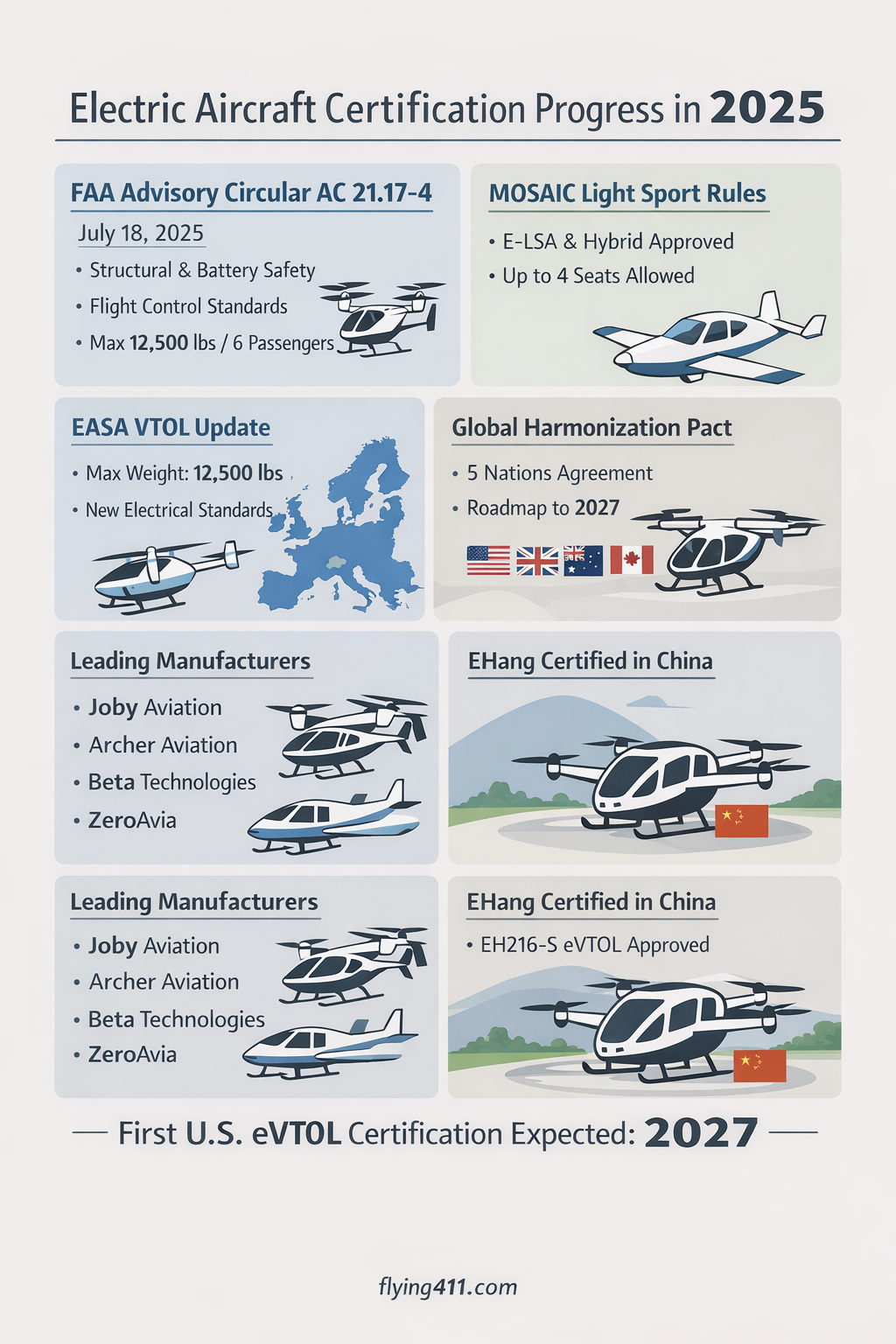
The honest answer is: further than most people thought, but not as far as some makers hoped. That is okay. It means the work is being done right. The milestones from 2025 are real and they matter. Here is what happened.
The FAA's Big Move: Advisory Circular AC 21.17-4
The biggest regulatory event of the year came on July 18, 2025. The FAA published Advisory Circular AC 21.17-4. This gave makers a clear, repeatable path for certifying powered-lift aircraft under the special class designation in 14 CFR 21.17(b).
Before this, every eVTOL maker had to work out its own certification basis with the FAA through a separate public comment process. That was slow and expensive. AC 21.17-4 fixed that by giving everyone a shared starting point. Here is what it covers:
- Structural integrity and crashworthiness standards for new airframe types
- Battery safety rules including thermal containment and failure tolerance
- Flight control systems for aircraft that move from vertical hover to forward cruise
- Performance tiers based on passenger count and public risk
- A max certified takeoff weight of 12,500 pounds and a six-passenger cap
This is the regulatory framework the aerospace industry had been waiting for. Makers still have to build their own compliance plans. But now they all start from the same foundation.
MOSAIC: Opening the Door for Electric Light Sport
The MOSAIC rule came out that same week at EAA AirVenture Oshkosh. It updated the Light Sport Aircraft category from the ground up and tackled a different part of the electric aircraft certification picture.
The old LSA rules capped aircraft at 1,320 pounds and required a single piston engine. Those limits are gone. Electric and hybrid propulsion systems are now eligible for LSA certification. Up to four seats can qualify. Powered-lift aircraft including eVTOL designs are now in the category.
Pilots who want to know what this means for their options should read Hybrid-Electric Aircraft Explained: The Future of Aviation? since new certification paths and hybrid designs are moving forward together.
Sport pilot changes took effect October 22, 2025. New aircraft certification standards under MOSAIC follow on July 24, 2026. That is when makers can start building to the new standard. They can bring electric light sport designs to market through a simpler Statement of Compliance process instead of a full type certification.
EASA Updates Its VTOL Standards
EASA kept moving in 2025. It published Issue 2 of its Special Condition for VTOL aircraft. This updated its own airworthiness rules in several key areas.
The biggest change was raising the max certified takeoff mass from 7,000 pounds to about 12,500 pounds. That one change lined EASA's numbers up with the FAA's cap. That kind of alignment makes global operations a lot easier for makers.
EASA also added new rules for electrical wiring systems (EWIS). Electric vertical takeoff and landing aircraft carry high electrical loads. Those loads create risks that old wiring rules were not built to handle. Makers now have to show these systems work safely in all conditions.
Five Nations, One Roadmap
On June 17, 2025, five countries put out a joint roadmap for advanced air mobility type certification. The group includes the FAA, the UK CAA, Australia's CASA, Transport Canada, and New Zealand's CAA. Their target is fully aligned standards by January 2027.
The benefit for makers is clear. Once alignment is in place, earning certification in one of these five countries makes it much easier to get approved in the other four. That cuts duplicate work, lowers costs, and opens global markets faster.
Where the Manufacturers Stand
Rules only matter if aircraft are moving through them. Here is where the key players stand right now.
Joby Aviation is the most advanced US maker in the FAA certification process. In late 2025, Joby started power-on testing of its first FAA-conforming aircraft. It entered Stage 4 of the five-stage certification process and began the Type Inspection Authorization (TIA) phase. FAA pilots are set to do their own flight testing in 2026. Joby flew over 850 times in 2025 and passed 50,000 total flight miles. It completed more than 4,900 test points, all going straight into its certification process records.
Archer Aviation is in the same powered-lift aircraft framework but at an earlier point. As of mid-2025, its FAA type certification was about 15% done. Archer has secured Part 135 air carrier certification and Part 141 pilot training approval. That puts it in a solid spot operationally while the design certification work continues.
Beta Technologies passed 100,000 nautical miles of flight testing in 2025. Data from its Alia CTOL fleet carries over to the VTOL version. That speeds up the VTOL certification timeline. Hartzell Propeller also earned the first-ever FAR Part 35 type certification for an electric aircraft propeller, developed alongside Beta.
ZeroAvia hit a key step in August 2025. It got a signed P-1 Special Conditions Issue Paper from the FAA for its 600kW hydrogen-electric propulsion system. That paper sets the conditions the company must meet on the road to full certification.
Electra filed a Part 23 type certification application for its EL9 hybrid-electric Ultra Short aircraft in December 2025. It formally entered the certification pipeline. Pilots and builders curious about aircraft that sit between certified and experimental designs will find Experimental Aircraft Kits for Sale: Buyer's Guide worth reading, since that market is growing right alongside the certified eVTOL space.
The One That Already Made It: EHang
One company has already crossed the finish line. China's EHang got full type certification for its EH216-S unmanned eVTOL from China's Civil Aviation Authority in October 2023. That aircraft works in a narrow, low-altitude role. It is not the same mission as the piloted air taxis being built in the US and Europe. But it shows that certifying an electric vertical takeoff and landing aircraft can be done.
The Realistic Timeline
The first US type certification for an eVTOL is not expected before 2027. Every Western maker missed its 2024 targets. Progress in 2025 was real, but the process is thorough by design. The FAA's five-stage certification process takes time because the stakes are high. Aircraft carrying passengers over cities need to meet a very high bar. Every test point, compliance doc, and conforming aircraft check is part of proving that.
The finish line is real. It is closer than it has ever been. The work being done right now in the US and Europe is what gets us there.
Conclusion
The story of electric aircraft certification in 2025 is about rules finally catching up with the technology. The FAA's Advisory Circular AC 21.17-4 gave the industry its first shared framework for powered-lift aircraft. EASA raised its weight limits and updated its own rules to match. Five nations signed on to a shared roadmap. Joby Aviation, Archer Aviation, and Beta Technologies all hit real milestones. The MOSAIC rule opened a new door for electric light sport aircraft, with new designs set to reach the market by 2026.
No certified electric air taxi will be at your local airport tomorrow. The first US type certification for an eVTOL is still not expected before 2027. But the rules are real. The testing is happening. The finish line is in sight for the first time. Electric aircraft certification has moved from a question of "if" to a question of "when" and the answer keeps getting closer.
For pilots, owners, and aviation fans who want to stay ahead of what is coming, staying informed is the best move you can make. Visit Flying411 for more on electric aviation, advanced air mobility, and the rule changes that will shape the next chapter of flight.
Frequently Asked Questions
What is the difference between a type certificate and an airworthiness certificate?
A type certificate approves an aircraft's design and confirms it meets FAA safety standards. An airworthiness certificate is issued to each individual aircraft. It confirms that specific plane was built to match the approved design and is safe to fly.
Can electric aircraft fly under existing pilot licenses right now?
Yes, in many cases. Pilots with a private certificate or higher can fly certified electric aircraft within their rated category. The MOSAIC rule also expanded what sport pilots can fly, including some electric designs, starting in late 2025.
What does "powered-lift" mean in FAA certification terms?
Powered-lift aircraft use engine power to take off and land vertically. They then switch to wing-based lift for forward cruise. Most eVTOL air taxis work this way. That is why the FAA needed a brand new regulatory framework for them.
Why did China certify an eVTOL before the US or Europe?
China's Civil Aviation Authority (CAAC) uses a different process than the FAA or EASA. EHang's EH216-S got Chinese type certification in October 2023 for a narrow, unmanned, low-altitude role. The FAA and EASA are targeting broader commercial operations with higher safety needs. That process takes longer.
Will electric aircraft be louder or quieter than traditional planes at airports?
Electric aircraft are much quieter than piston or turbine planes. Most eVTOL designs make far less noise on takeoff and landing. That is a big reason city planners and regulators see them as a good fit for urban areas where noise is a real concern.