An airplane engine sends a message to a team on the ground. It warns them about a part that's about to fail. No warning lights go off in the cockpit. No delays at the gate. The team fixes it before anything goes wrong.
Why does that matter? Because Boeing estimates that just one to two hours of a grounded aircraft can cost an airline $10,000 to $150,000, depending on the plane and the route. Now multiply that across a whole fleet.
This sounds futuristic, but it's happening right now. Airlines around the world use AI to spot problems early. They fix things on their own time, not in a panic after something breaks.
The aviation MRO industry is worth over $83 billion. It's growing fast. But a big part of that money still goes to old methods. Fixed-schedule checks that ignore how parts really feel. Rush repairs after surprise failures. Manual inspections that rely only on a technician's eyes. These old ways cost airlines millions every year in delays, cancellations, and wasted work.
A new approach is changing all of that. Sensors, machine learning, and flight data now help teams predict when a part will need work. They plan ahead. They order the right parts. They keep planes in the air longer.
So how does it work? Who's already using it? Let's start with the basics of what predictive maintenance means in aviation and why it matters.
Key Takeaway
AI-driven predictive maintenance uses sensor data and machine learning to find part failures before they happen. This helps airlines avoid surprise breakdowns, cut delays, save money, and keep planes safe. Big names like Airbus, Rolls-Royce, GE Aerospace, and Lufthansa Technik already use these tools on thousands of aircraft. The results are real: fewer cancellations, faster fixes, and smarter spending.
| Area | Key Detail |
| What it does | Uses AI and sensor data to predict part failures before they happen |
| Cost savings | 25 to 30% cut in maintenance costs; about $328,000 saved per aircraft per year |
| Downtime impact | Up to 70% drop in unplanned downtime |
| Detection speed | AI can spot issues up to 60% earlier than older methods |
| Major platforms | Airbus Skywise, Lufthansa Technik AVIATAR, Delta APEX, GE Aerospace EMS, Rolls-Royce IntelligentEngine |
| Regulatory status | FAA and EASA building AI rules; AI is used as a support tool, not the main decision-maker |
| Data scale | One Boeing 787 flight makes about 500 GB of data; GE engines log about 5,000 data points per second |
What Is Predictive Maintenance in Aviation?
Aircraft maintenance has always worked in one of two ways. First, there's reactive maintenance. Something breaks, and you fix it. Second, there's scheduled maintenance. You check or swap parts at set times, like changing your car's oil every 5,000 miles. It doesn't matter how the engine actually feels.
Predictive maintenance works differently. It uses data from the aircraft to figure out when a part will likely need work. The goal is to catch problems early, before they cause delays or safety issues.
Here's how it works at a basic level:
- Sensors on the aircraft track things like temperature, vibration, pressure, and oil quality during every flight.
- That sensor data goes to computers on the ground. Sometimes it arrives during the flight. Sometimes it comes in a big batch after landing.
- Predictive analytics tools study this data. They use machine learning to compare it with years of maintenance records and past failure patterns.
- When the system spots something odd, like a slow rise in engine vibration that matches a known problem, it sends an alert to the team.
The result? Technicians know what needs fixing. They know which part to order. They know how much time they have before it becomes a real issue.
This sits at the heart of AI in aviation. Airlines aren't guessing anymore. They make choices based on real proof from the aircraft.
One key thing to know: predictive maintenance doesn't replace inspections or safety rules. The FAA and EASA still set strict requirements. Predictive tools work with those rules. They add extra insight that helps teams work smarter.
Think of it this way. Scheduled maintenance asks, "Has it been long enough since the last check?" Predictive maintenance asks, "Does this part actually need attention right now?" That change, from time-based to condition-based, is a big deal. It means less guesswork. Fewer wasted parts. Better use of every technician's time.
And when you manage hundreds or thousands of aircraft, those small gains add up fast.
Why Traditional Aircraft Maintenance Is Falling Behind
For decades, scheduled maintenance worked well enough. Airlines followed the maker's guidelines. They checked parts at set times. They swapped components based on flight hours or calendar dates. It was reliable. It was safe. But it was also costly and wasteful. The cracks are starting to show.
Here's the main problem. Scheduled maintenance schedules treat every aircraft the same. A plane flying short routes in dry desert heat gets the same check times as one flying long trips over the ocean in heavy moisture. But those two planes wear down in different ways. Their parts age at different speeds. A one-size-fits-all schedule can't handle that.
This creates two costly problems:
- Over-maintenance: Parts get swapped too early. They still have useful life left. That wastes money on labor, materials, and ground time the aircraft didn't need.
- Under-maintenance: Some problems sneak through between checks. A part might wear out faster than expected. The fixed schedule doesn't catch it in time. That leads to unscheduled maintenance, one of the most costly things an airline can face.
An unscheduled repair costs more than just the fix. It means a canceled or late flight. Unhappy passengers. Rebooking costs. Sometimes it sets off a chain reaction that messes up the whole day's schedule at several airports.
Now think about the size of today's airline world. Fleets are growing. Planes fly more hours than ever. The workforce is stretched thin. Skilled technicians are retiring faster than new ones get trained. There aren't enough people or hours to check everything by hand and still keep planes on time.
The data problem makes things worse. Modern aircraft systems create huge amounts of information every flight. A single Boeing 787 makes about 500 GB of data per trip. But with old maintenance models, most of that data sits unused. It stays in storage or gets looked at only after something goes wrong. That's like having a security camera that nobody watches until after a break-in.
On top of that, many operators keep their logs in different systems that don't connect. Some still use paper records. Mixed data formats make it hard to spot trends across a fleet.
The truth is, old-style maintenance was built for a simpler time. Today's aircraft are more complex. Fleets are bigger. The cost of getting it wrong is higher. The industry needs a smarter way forward, and that's what's driving the move toward AI and predictive tools.
The Technology Behind the Shift
If predictive maintenance is the goal, what makes it work? The answer is a group of technologies working together. No single tool does it alone. It takes sensors, cloud computing, machine learning, and a few other pieces to turn raw flight data into useful predictions.
Let's look at the main building blocks.
Sensors and Real-Time Data
It all starts with real-time data from the aircraft. Thousands of sensors sit across engines, landing gear, hydraulic systems, avionics, and environmental controls. They track vibration, temperature, pressure, fluid levels, and more.
Some of this data streams to the ground while the plane is still flying. It travels through satellite links or the ACARS messaging system. The rest gets downloaded after landing. Either way, it gives teams a clear picture of how every system did during the flight.
An Airbus A380 can carry up to 25,000 sensors. GE jet engines alone log about 5,000 data points every second. That's a huge amount of information. It's the raw material that powers everything else.
Machine Learning and AI Algorithms
Raw data only helps if you can make sense of it. That's where machine learning steps in. AI algorithms study patterns in the data. They compare current readings to past norms and known failure signs.
Over time, these models get better at spotting early signs of trouble. A small temperature trend. A slight shift in vibration. A pressure reading that slowly drifts. A human might miss these in a flood of numbers. But an algorithm trained on millions of data points can catch them.
Some airlines also use natural language processing (NLP) to scan maintenance logbooks. Technicians often write notes about what they saw or did during a repair. NLP finds patterns in those notes that point to repeat issues across a fleet.
Digital Twins
A digital twins setup makes a virtual copy of a real engine or aircraft system. This virtual model gets updated with live sensor data all the time. It mirrors exactly what the real part is doing.
Engineers run tests on the digital twin. They can see how a part might act under different conditions. They can check how much useful life it has left. Rolls-Royce leads this space. They built digital twins for their Trent engine family. Their system stops about 400 unplanned maintenance events per year across the fleet.
Cloud Platforms
All this data needs a place to live and get processed. Cloud platforms pull information from whole fleets into one spot. This makes it possible to run analytics at a big scale. Rolls-Royce, for example, uses Microsoft Azure and Databricks to handle data from over 13,000 engines.
Putting It All Together
When these tools connect, the result is AI-driven predictive maintenance. Sensors collect data. Cloud platforms store and sort it. AI algorithms study it. Digital twins model future behavior. Then the maintenance team gets a clear answer: this aircraft components group on this tail number needs work within the next two weeks.
That's a huge step up from checking a calendar or waiting for a warning light. It means better aircraft availability, lower costs, and fewer surprises. And these systems get smarter over time as they learn from more data.
How AI-Driven Predictive Maintenance Is Transforming Aviation MRO From the Inside Out
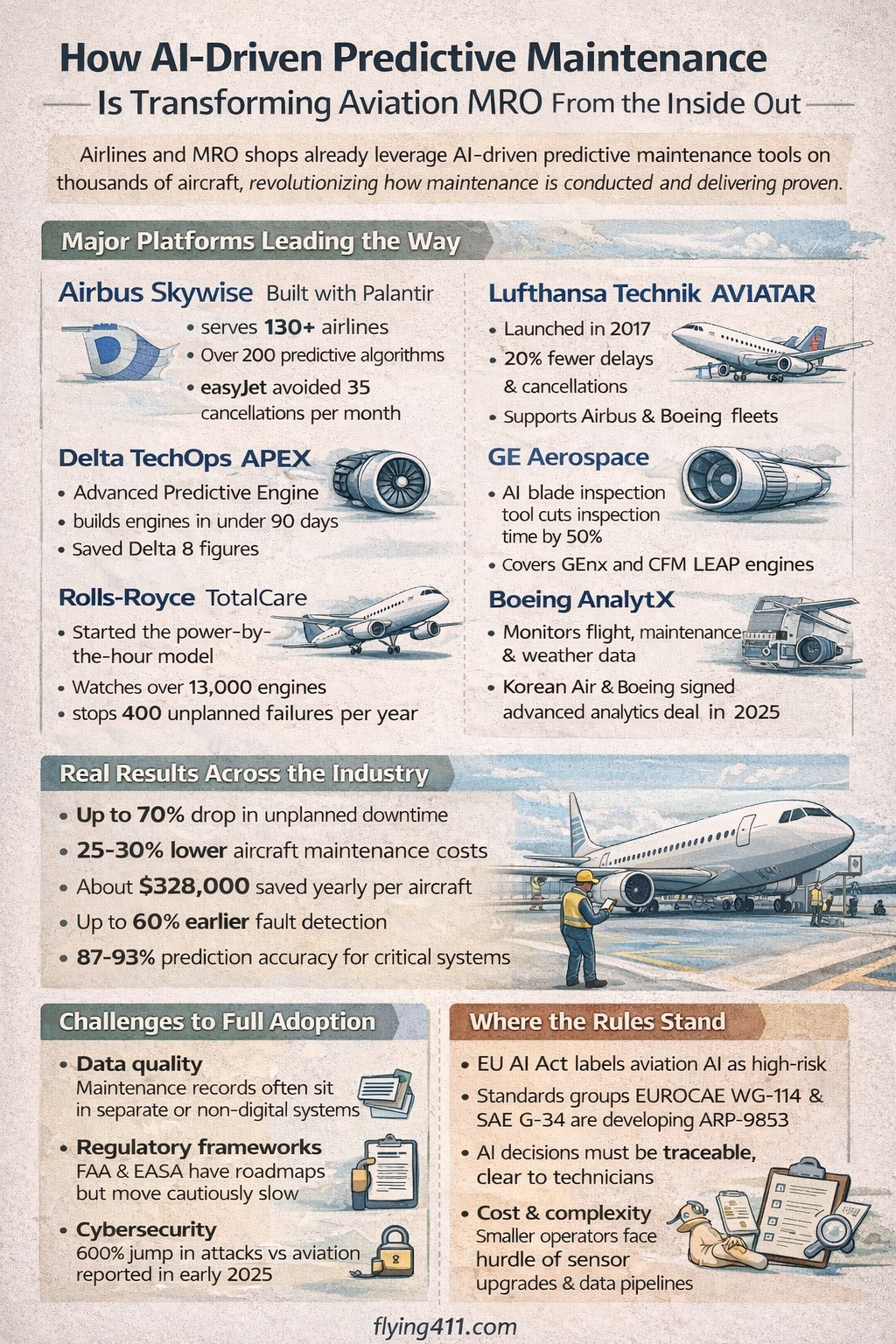
Now that we know the technology, let's look at what's happening in the real world. The shift toward AI-driven predictive maintenance isn't a theory. Airlines and MRO shops already use these tools on thousands of aircraft. The results speak for themselves.
Let's connect the dots: who's doing it, what they're getting from it, what's still hard, and where the rules stand.
The Major Platforms Leading the Way
A few key platforms now form the backbone of predictive maintenance in commercial aviation. Each one works a bit differently. But they all share the same core idea: use data to stay ahead of failures.
- Airbus Skywise is one of the biggest names in this space. Built with Palantir Technologies, Skywise is a cloud-based analytics platform. It now serves over 130 airlines worldwide. It runs more than 200 predictive algorithms that cover hundreds of parts. The Digital Alliance powers the system. This group includes Airbus, Delta TechOps, GE Digital, Liebherr, and Collins Aerospace. Airlines like easyJet, Emirates, Korean Air, and Qantas all use Skywise. easyJet avoided 35 technical cancellations in one month using Skywise alerts. Allegiant Air saves at least one aircraft from going out of service every day.
- Lufthansa Technik's AVIATAR launched in 2017. It offers Predictive Health Analytics, Condition Monitoring, and an Electronic Technical Logbook. It works on both Airbus and Boeing fleets. It's part of a bigger Digital Tech Ops Ecosystem that includes AMOS (for maintenance management) and flydocs (for digital records). LATAM Airlines rolled out AVIATAR on more than 300 aircraft. They saw 20% fewer delays and cancellations. Frontier Airlines and Air Transat also use the platform.
- Delta TechOps' APEX program (Advanced Predictive Engine) collects real-time data through an engine's full life. It helps Delta plan for parts years ahead. Delta now builds engines in under 90 days. Outside vendors take 150 to 200 days. The program saved Delta eight figures. It won the 2024 Grand Laureate Award from Aviation Week Network.
- GE Aerospace has over ten years of AI in aviation work. Its AI blade inspection tool has been used on GEnx wide-body engines for about three years. It cuts inspection time in half and improves accuracy. The tool now covers CFM LEAP narrow-body engines too. GE plans to invest over $1 billion in its MRO shops over the next five years.
- Rolls-Royce started the power-by-the-hour model with its TotalCare program. The company has collected engine data since the 1980s. Its IntelligentEngine platform builds digital twins of Trent engines. Live sensor data updates them during every flight. The system watches over 13,000 engines. It stops about 400 unplanned events per year. Their AI models spot problems 45% better and cut false alerts in half.
- Boeing's AnalytX tools use flight, weather, and maintenance data to watch aircraft health. In 2025, Korean Air and Boeing signed a new deal to build advanced predictive analytics software together.
One standout story comes from Azul, a Brazilian airline. Azul worked with AE Studio in California. They used AI to push their AOG prediction window from one to two days out to two to three weeks. At its best, the system predicted and stopped 150 events per month. The AI found failure links between totally unrelated aircraft components. No human could have spotted those connections. One Azul manager wrote a tail number on a glass board. He predicted it would go AOG in two weeks. It did. That moment helped the whole team trust the data.
Real Results Across the Industry
The numbers tell a clear story:
- Up to 70% drop in unplanned downtime
- 25 to 30% lower aircraft maintenance costs
- About $328,000 in yearly savings per aircraft
- Up to 60% earlier fault detection versus older methods
- Prediction accuracy between 87% and 93% for critical aircraft systems
These gains boost aircraft availability. More planes fly. Airlines earn more. Fewer passengers get stuck at the gate. For airlines with hundreds of aircraft, even a small gain means millions of dollars.
If you buy or own aircraft, it helps to know how these systems tie into records. For more on that, check out Aircraft Logbook and Maintenance History Verification: What Buyers Need to Know.
The Challenges That Still Remain
There's been a lot of progress. But the road to full adoption still has some bumps.
- Data quality is a big issue. Maintenance records across the industry sit in different formats. Some are in separate systems. Some are still on paper. AI needs clean, steady data to work well. Many operators are still in the early stages of going digital with their records.
- Regulatory frameworks are still catching up. The FAA released its Roadmap for AI Safety Assurance. It takes a slow, careful approach. EASA published its AI Roadmap 2.0. It plans to add AI rules for maintenance starting in 2026. For now, both agencies allow AI as a support tool. It can't be the main decision-maker.
- Cybersecurity is a growing worry. Connected platforms open new doors for attacks. Thales reported a 600% jump in ransomware and theft attacks on aviation between January 2024 and April 2025. Insurance costs for MROs have gone up because of it.
- Workforce readiness matters just as much as the tech. Technicians need training to understand and trust what AI tells them. The tools only work as well as the people using them.
- Cost and complexity can slow things down. This is true for smaller operators. Adding sensors to older aircraft, paying for platforms, and building data pipelines all cost money. Experts say it's best to start small. Try a pilot project on one aircraft type or system. Then grow from there.
Even maintenance schedules are changing. Instead of rigid, calendar-based checks, many operators now use flexible schedules based on real condition data. This cuts both over-maintenance and unscheduled maintenance. It saves time and money.
If you own an aircraft and manage your own upkeep, these changes affect your daily work. Learn more in our guide: Aircraft Owner Maintenance Guide: What You Need to Know to Stay Compliant and Safe.
Where the Rules Stand
The aviation MRO industry has some of the strictest rules in the world. AI adds a new layer to deal with.
- The FAA splits AI into two types: "learned" AI (fixed models) and "learning" AI (models that change over time). Models that adapt need ongoing monitoring.
- EASA released its first AI proposal for aviation in November 2025. It treats AI as something whose actions must be clear, trackable, and in line with human operators.
- The EU AI Act labels aviation AI as high-risk. It requires strong oversight. It also applies to non-EU companies if their AI affects EU citizens.
- Standards groups (EUROCAE WG-114 and SAE G-34) are building ARP-6983. This will be the first set of rules for using machine learning in aerospace.
Regulators and airlines agree on one thing. AI choices in maintenance must be clear. If a system flags a part, the technician needs to see why. That openness matters for trust, safety, and getting certified.
The path forward is clear. Predictive analytics tools, powered by machine learning and huge amounts of flight data, are becoming standard in the aircraft maintenance toolbox. Airlines that start early already see fewer problems, lower costs, and smarter operations. As the rules grow and data gets better, the gap between early movers and the rest will only get bigger.
Conclusion
The shift toward AI-powered predictive maintenance isn't a "someday" thing. It's here now. And it's moving fast.
Airlines and MRO shops around the world use these tools to catch problems weeks early. They cut cancellations. They save money. They make smarter calls about when and how to care for their fleets. The tech works. The results are real.
But here's what matters most. Predictive maintenance doesn't replace the skilled people who keep planes safe. It gives them better info to work with. It turns huge piles of sensor data into clear alerts. The mechanic still makes the call. The AI helps them see what's coming.
For airlines, MROs, and aviation pros, the question isn't if this tech works. It's how fast you can start using it.
The future of aircraft maintenance runs on data. It's proactive. It's smarter than ever. And the teams that get on board now will have a big edge in the years ahead.
Want to stay up to date on aviation maintenance, tech, and industry trends? Visit Flying 411 for expert insights, aircraft resources, and everything you need to stay in the know.
Frequently Asked Questions
How much does it cost to implement predictive maintenance in aviation?
Costs depend on fleet size, aircraft age, and platform choice. Adding sensors to older planes and signing up for tools like Skywise or AVIATAR takes upfront money. But most operators see a positive return within the first year from fewer AOG events and less parts waste.
Can predictive maintenance be used on older aircraft that weren't built with sensors?
Yes. Over 6,000 older aircraft were being looked at for sensor upgrades in 2025. IoT sensors can be added to key parts like engines, landing gear, and hydraulic systems. Setup can often be done in one day per group of parts.
Does predictive maintenance eliminate the need for scheduled inspections?
No. The FAA and EASA still require inspections at set times. Predictive maintenance works alongside those rules. It adds extra insight that helps teams plan better between required checks.
How accurate are AI predictions for aircraft component failures?
It depends on the system and data quality. Research shows prediction accuracy between 87% and 93% for key systems like engines and landing gear. The models get better over time as they process more flight data.
What happens if an AI predictive system gives a wrong alert?
False alerts can lead to checks that weren't needed. That costs time and money but doesn't hurt safety. The bigger worry is a missed prediction. That's why AI tools support human choices, not replace them. Regulators require human oversight at all times.