Philippine Airlines has had quite a journey. Founded on March 15, 1941, it is the oldest commercial airline in Asia still operating under its original name over 85 years of continuous service.
The flag carrier of the Philippines filed for bankruptcy in 2021, restructured fast, and came roaring back. Now, in 2025, it is making one of the biggest moves in its history, ordering new long-range aircraft and opening fresh routes across the Pacific.
If you fly between the Philippines and the United States, or if you follow aviation news, this story has your name on it. The Philippine Airlines fleet expansion 2025 is changing what travel looks like for millions of people, and the details are worth knowing.
Key Takeaways
Philippine Airlines is expanding its fleet in 2025 with nine new Airbus A350-1000 widebody jets and 13 A321neo narrowbody aircraft on the way. The first A350-1000 was delivered in December 2025 and will fly nonstop transpacific routes between Manila and major US cities. New routes to Vietnam, Seattle, and more have already launched, with Los Angeles frequency increases and a Saipan restart coming in 2026.
| Key Detail | What You Need To Know |
| New Aircraft | 9 Airbus A350-1000s ordered |
| First Delivery | December 20, 2025 |
| Seat Count | 382 seats (3-class layout) |
| Primary Routes | Manila to USA nonstop flights |
| A321neo Orders | 13 aircraft, first delivery 2026 |
| New Routes (2025) | Da Nang, Ho Chi Minh City, Seattle |
| US Market Share Drop | 65% (2022) to 47% (2023) |
| Fleet Size | ~82 aircraft as of January 2026 |
| Financial Recovery | 15 straight profitable quarters |
| PAL Holdings Investment | $660M+ in pre-delivery payments |
Philippine Airlines Is Growing Again After Bankruptcy
Not many airlines bounce back from bankruptcy this fast. Philippine Airlines filed for Chapter 11 bankruptcy protection in September 2021. This is a legal process that lets a company reorganize its debts while it keeps operating. Within just four months, PAL had completed its restructuring plan and exited bankruptcy on December 31, 2021. That kind of speed is rare in the airline industry.
The restructuring was not painless. PAL Holdings, the airline's parent company controlled by billionaire Lucio Tan, had to make tough cuts. The airline reduced its fleet by 25 percent. It cut expensive aircraft lease agreements. It trimmed its Boeing 777 fleet and gave back several Airbus A350-900s. In total, PAL removed about $2 billion in structural costs from its balance sheet. That is a lot of weight to shed, but it worked.
Here is what the recovery looks like in numbers:
- 2024 net income: PHP 10.22 billion (about $180 million USD)
- Q2 2025 net income: $60 million, up 48% from the same time in 2024
- First-half 2025 net income: $137 million, up 12% year-over-year
- Shareholders' equity: Turned positive at roughly $922 million
- Profitable quarters in a row: 15 as of mid-2025
The airline is also targeting 18 million passengers in 2025. That kind of confidence does not come from guessing. It comes from results.
PAL fleet modernization is now the top priority. A new leadership team is driving the strategy. Richard Nuttall, formerly the CEO of SriLankan Airlines, took over as PAL's president in May 2025. Carlos Luis Fernandez joined as Executive Vice President and Chief Operating Officer. Together, they are pushing the airline toward a leaner, more modern fleet built around long-haul growth.
The airline also made a meaningful hub investment. The Cebu hub is being developed into what PAL calls "a true inter-island and international hub." That means more domestic flights feeding into international connections, not just in Manila, but from Cebu too.
The big takeaway is this: PAL did not just survive bankruptcy. It came out the other side with a plan. And that plan is now in motion.
The Filipino Diaspora Is Driving Demand for More Flights
Here is a fact that explains a lot. Over 10 million Filipinos live outside the Philippines. They are spread across the United States, Canada, the Middle East, Europe, and beyond. The United States alone is home to more than 4 million Filipino Americans. That is a massive group of people who want to visit family, attend events, send money home, and stay connected to their roots. And most of them need a flight to do it.
This is the engine behind transpacific flights Philippines expansion. It is not complicated. Where people go, airlines follow. And Filipinos go back to the Philippines a lot.
Look at where the biggest Filipino communities are in the US:
- Nevada (Las Vegas area): About 170,000 Filipinos, many employed in hospitality
- Texas (Houston area): Around 200,000 Filipinos
- Illinois (Chicago area): About 160,000 Filipinos
- California: The largest concentration, especially around Los Angeles and San Francisco
PAL already flies to Los Angeles, San Francisco, New York, Seattle, Guam, and Honolulu. But cities like Chicago, Houston, and Las Vegas have significant Filipino populations with no direct service from Manila Philippines. Routes to those cities are under serious evaluation right now.
The demand for nonstop flights matters especially to diaspora travelers. When you are flying 14 to 16 hours to see your family, a layover adds real stress. Direct service is not just a convenience. It is a meaningful improvement in the travel experience. Nonstop is also more reliable and easier to manage for connecting passengers.
The long-haul flights between Manila and North America are among the most economically valuable routes in PAL's entire network. Premium travelers in business class and premium economy make up a large share of the revenue on these routes. Filipino families traveling for holidays, reunions, and funerals also fill economy cabins consistently throughout the year.
There is also cargo to consider. The Philippines receives billions of dollars in remittances every year. Cargo shipments, balikbayan boxes (care packages sent home by overseas Filipinos), and freight all move on these same transpacific routes. PAL's widebody aircraft carry that cargo in the belly of the plane alongside passengers.
The demand is real, consistent, and growing. That is exactly why PAL is investing in aircraft that can handle these long routes efficiently and profitably.
PAL Needed New Aircraft to Compete With United Airlines
For a long time, Philippine Airlines had a strong grip on the transpacific market. In 2022, PAL held about 65 percent of the US-Philippines market share. That means out of every 100 passengers flying between the two countries, 65 were on PAL. That is a dominant position.
Then United Airlines entered the market.
In 2023, United launched direct flights from the US to Manila. The results were immediate. PAL's US and Canada market share dropped from 65 percent to 47 percent in a single year. That is an 18-point swing. In airline terms, that is a serious hit.
United Airlines is a powerful competitor. It has a huge domestic network in the US, which means it can feed connecting passengers onto its Manila to USA nonstop flights from dozens of American cities. PAL does not have that same domestic US footprint on its own. To fight back, it needed two things: more seats on more flights, and better aircraft to make those flights competitive.
That is exactly what the new aircraft delivery program is designed to do. Here is what PAL is bringing to the fight:
- Nine Airbus A350-1000s on firm order, with options for three more
- Each aircraft configured with 382 seats across three cabin classes
- Range of up to 16,100 kilometers, enough to reach any major US or European city nonstop from Manila
- 25% lower fuel burn compared to the older widebody aircraft PAL used to rely on
- A premium business class product featuring private suites with sliding doors and lie-flat beds
The Airbus A350-1000 delivery of the first aircraft happened on December 20, 2025. PAL became just the 10th airline in the world to operate this variant. That is a notable milestone for a carrier that was in bankruptcy just four years earlier.
PAL also signed a codeshare agreement with American Airlines in late 2024. Under this deal, PAL connects to seven American Airlines domestic routes through Los Angeles. This gives PAL passengers access to cities across the US without PAL needing to fly there directly. It is a smart way to compete with United's built-in domestic network.
2026 deliveries will bring five more A350-1000s into service. That means more frequency, more capacity, and more route options. Los Angeles flights are being increased from 14 to 18 per week starting June 2026. The PAL A350-1000 is also scheduled to begin serving New York starting January 6, 2026.
The widebody aircraft additions are just the start. The 2025 fleet expansion also sets the stage for Philippine Airlines new routes to cities like Chicago, Houston, Las Vegas, and potentially European destinations like Paris and Brussels. The goal is clear: take back market share and grow beyond what PAL had before United showed up.
The competition is real, but so is PAL's momentum.
Philippine Airlines Fleet Expansion 2025 Brings the Airbus A350-1000 and Major New Routes
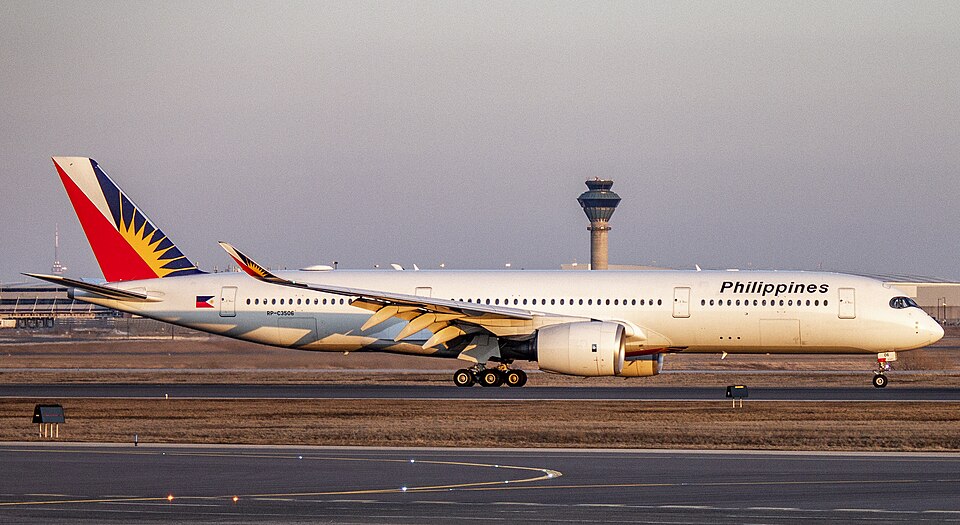
December 20, 2025 was a big day for Philippine Airlines. A brand-new Airbus A350-1000 touched down at Ninoy Aquino International Airport in Manila Philippines, fresh from its handover ceremony in Toulouse, France. PAL Holdings chairman Lucio Tan led the delegation that accepted the aircraft. PAL became the 10th airline in the world to operate this jet. For an airline that was in bankruptcy just four years earlier, that is a remarkable achievement.
This single delivery kicked off what is shaping up to be the most ambitious fleet renewal in PAL's history. And it is only the beginning.
The Aircraft at the Center of It All
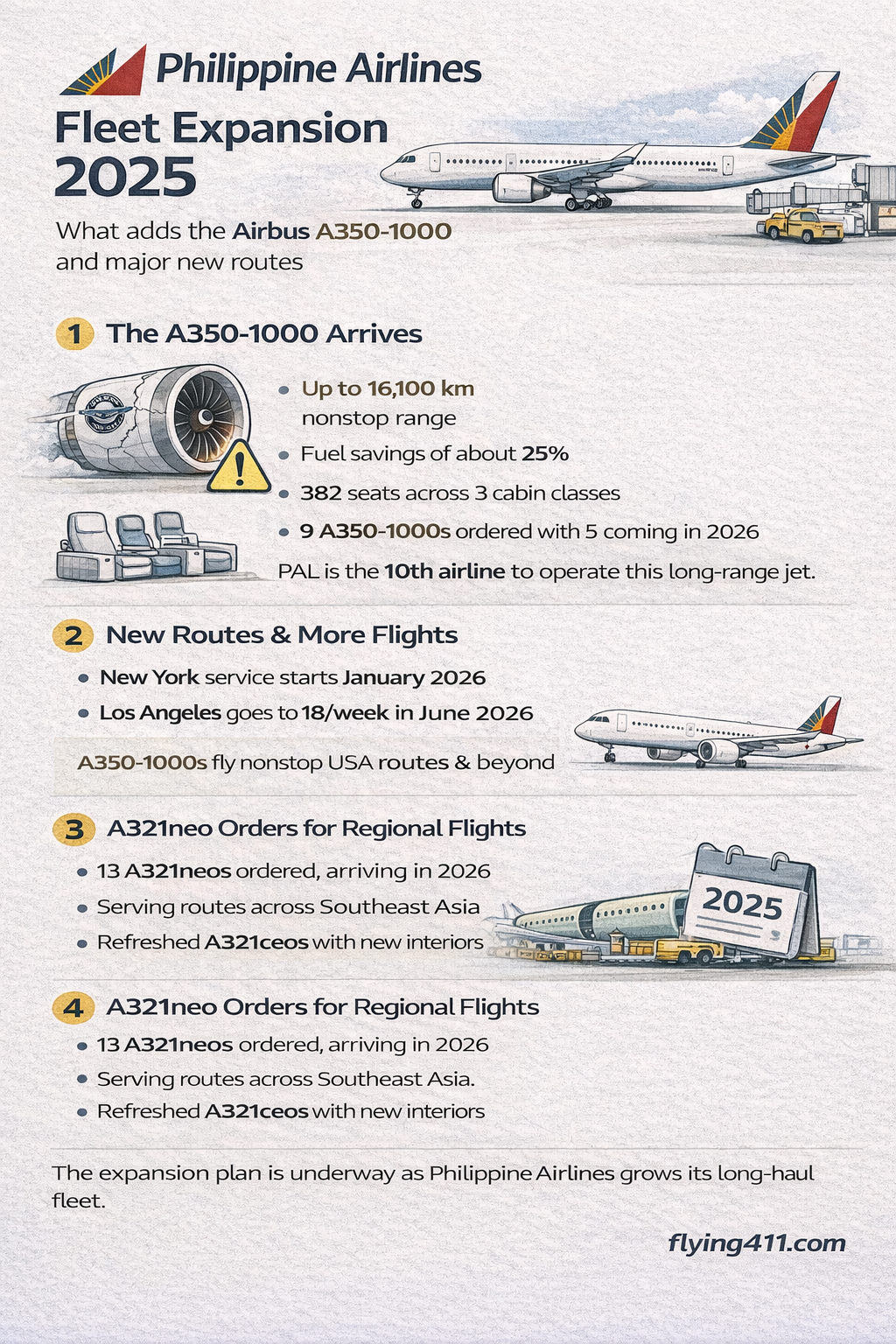
The Airbus A350-1000 is built for one job: flying very far, very efficiently. With a range of up to 16,100 kilometers, it can connect Manila to virtually any major city in the United States or Europe without stopping. That matters a lot when your core market is Filipino travelers who want to get home as fast as possible.
The Airbus A350-1000 delivery brings some impressive numbers with it:
- Range: Up to 16,100 km, enough for true nonstop transpacific service
- Engines: Two Rolls-Royce Trent XWB-97s, currently the most fuel-efficient engines in their class
- Fuel savings: About 25% lower fuel burn compared to older widebody jets
- Structure: Over 50% composite materials, which reduces weight and cuts maintenance needs
- Cabin air: Fully refreshed every 2 to 3 minutes with higher humidity levels to reduce fatigue on long flights
PAL configured its A350-1000 with 382 seats spread across three cabin classes. Business Class gets 42 private suites, each with a 46-inch privacy wall and a sliding door. Premium Economy fills 24 seats. Economy holds 316 passengers. Every seat has a 4K screen and USB-C charging. The LED mood lighting comes in 22 different settings, all inspired by the colors of the Philippines.
If you are curious how this aircraft stacks up against another popular long-haul jet, check out 787 VS A350: IS 787 BETTER THAN A350? for a detailed side-by-side breakdown.
How PAL Is Using the New Jets
The first A350-1000 went straight to work on high-demand routes. PAL began Manila to USA nonstop service to New York starting January 6, 2026, operating three times a week with the new jet. Los Angeles, San Francisco, and Seattle are also on the deployment list as more aircraft arrive.
The 2025 fleet expansion is not just about adding one aircraft. PAL has nine A350-1000s on firm order, with options for three more. Five more are scheduled to arrive across 2026, with three additional deliveries in 2027 and the final aircraft coming in 2028. Each new jet adds more seats, more frequency, and more flexibility to serve North American travelers.
The 2026 deliveries will directly support a major frequency boost on the Los Angeles route. PAL is increasing LA flights from 14 to 18 per week starting June 2026. That is a third daily flight on select days, giving travelers far more options for when they want to fly.
Here is a snapshot of the current and upcoming route picture:
- New York (JFK): A350-1000 service started January 2026, 3x weekly
- Los Angeles: Increasing to 18 flights per week from June 2026
- Seattle: Already at 5 weekly flights after a November 2025 frequency boost
- Saipan: Restarting March 29, 2026, becoming PAL's 7th US destination
- Da Nang, Vietnam: Launched July 1, 2025, operating 3x weekly
- Ho Chi Minh City from Cebu: Started May 2, 2025, first-ever nonstop from the Visayas region to southern Vietnam
The A321neo Is Coming Too
The widebody aircraft orders get most of the attention, but PAL is also refreshing its narrowbody fleet. Thirteen Airbus A321neos are on order, with the first new aircraft delivery expected in 2026. These jets will serve shorter regional routes across Southeast Asia and feed passengers into PAL's international hubs.
PAL's existing A321neo long-range variants already fly routes like Brisbane, Perth, and Port Moresby. The new batch will add more capacity to the domestic and regional network, especially as the Cebu hub continues to grow. PAL is actively expanding Cebu into a full international hub, adding both domestic frequencies and new international connections out of Cebu itself.
Older A321ceo aircraft are also getting a refresh. PAL started a refurbishment program in mid-2025, fitting updated seats and new in-flight entertainment systems. A handful of aircraft were completed in 2025. Nine more go through the program in 2026, and the final six follow in 2027.
What PAL Fleet Modernization Means for Travelers
PAL fleet modernization is not an abstract concept. It shows up in real ways for passengers. Here is what the new aircraft actually deliver:
- Quieter cabins thanks to advanced composite construction that reduces vibration
- Better sleep on overnight flights due to lower cabin altitude and higher humidity
- Faster Wi-Fi packages available across all cabin classes
- More legroom and wider seats in economy compared to older PAL jets
- Private suites in business class with full lie-flat beds and sliding privacy doors
For travelers planning a long-haul flight journey between North America and Southeast Asia, these improvements are noticeable from the moment you board. If you are thinking about booking premium cabin travel and want to understand how airline seat purchases work, the guide How to Buy Aircraft Seats: A Complete Guide for First-Time Buyers walks you through everything step by step.
The Bigger Picture
PAL's fleet renewal is connected to something larger. The Philippines is growing. Tourism is recovering strongly. The Filipino diaspora continues to expand. And Manila is being developed into a more competitive hub between Asia and North America.
The airport itself is getting upgrades. New infrastructure at NAIA means more slots, fewer delays, and better handling for large jets like the A350-1000. Turboprop operations are also being shifted to Clark International Airport from March 2026 to ease congestion at Manila.
Every piece of this puzzle connects. New aircraft enable new routes. New routes bring more passengers. More passengers justify more aircraft. Lucio Tan and the PAL Holdings team have built a clear and consistent strategy around this cycle. And with the first A350-1000 already in service and five more arriving in 2026, that strategy is now fully underway.
Conclusion
Philippine Airlines has come a long way in a short time. From bankruptcy in 2021 to delivering one of the world's most advanced long-range jets in 2025, that is a story worth paying attention to. The new A350-1000s are changing what PAL can offer to travelers flying between the Philippines and North America. More nonstop options, better cabins, and a growing route network all point to an airline that is serious about competing on the world stage. If you are planning a trip to the Philippines, or you are just passionate about aviation, the next few years from PAL are going to be interesting to watch.
Want to dig deeper into aviation news, fleet updates, and aircraft guides? Visit Flying411 for more resources, route breakdowns, and everything you need to know about the world of general and commercial aviation.
Frequently Asked Questions
What cabin classes does the Philippine Airlines A350-1000 offer?
The A350-1000 at PAL is set up in three classes. Business Class has 42 private suites with sliding doors and lie-flat beds. Premium Economy has 24 seats. Economy holds 316 passengers. Total capacity is 382 seats per flight.
Will Philippine Airlines add flights to Chicago or Houston in 2026?
PAL has publicly identified Chicago, Houston, and Las Vegas as potential future US destinations. These cities have large Filipino communities and significant unserved passenger demand. No firm launch dates have been announced yet, but they remain under active evaluation.
How does the A350-1000 differ from the A350-900 already in PAL's fleet?
The A350-1000 is the larger and longer-range version. It carries more passengers and can fly farther nonstop than the A350-900. Both share the same pilot training and spare parts systems, which saves PAL money on operations and crew certification.
Is Philippine Airlines planning to return to European routes?
PAL has mentioned Paris and Brussels as potential future destinations. The A350-1000's range makes nonstop Manila-to-Europe flights technically possible. No confirmed launch dates have been announced, but European expansion is part of the airline's long-term strategy.
What is PAL Express and how does it connect to the main airline?
PAL Express is Philippine Airlines' regional subsidiary. It operates shorter domestic routes within the Philippines, often feeding passengers into PAL's international flights at Manila and Cebu. The two airlines work together as part of the same network under PAL Holdings.