Some machines are built to impress. But the helicopters on this list go far beyond impressive — they are absolutely enormous. We are talking about aircraft the size of commercial planes, capable of lifting tanks, transporting entire military units, and hovering over disaster zones with enough cargo to save thousands of lives.
Helicopters do not always get the credit they deserve. People tend to think of them as small, noisy aircraft used for news coverage or hospital transfers. But some rotorcraft are in a completely different league. These are the heavy-lifters, the flying workhorses, the engineering masterpieces that redefine what a helicopter can be.
If you have ever looked up and wondered just how big these machines can get, you are about to find out. The top 10 biggest helicopters in the world are ranked here by maximum takeoff weight — the most accurate way to measure a helicopter's true size and capability.
Key Takeaways
The biggest helicopter in the world is the Mil Mi-26, a Russian-built heavy-lift aircraft with a maximum takeoff weight of 123,500 lbs (56,000 kg) and a payload capacity of up to 44,000 lbs (20,000 kg). It holds the world record for the greatest mass ever lifted by a helicopter. Most of the largest helicopters on this list serve military or heavy-industry roles, with a mix of American, Russian, and European designs dominating the rankings.
| Rank | Helicopter | Max Takeoff Weight | Max Payload | Country |
| 1 | Mil Mi-26 | 123,500 lbs (56,000 kg) | 44,000 lbs (20,000 kg) | Russia |
| 2 | Mil Mi-10 | 96,340 lbs (43,700 kg) | 33,070 lbs (15,000 kg) | Russia |
| 3 | Mil Mi-6 | 93,700 lbs (42,500 kg) | 26,400 lbs (12,000 kg) | Russia |
| 4 | Sikorsky CH-53K King Stallion | 88,000 lbs (39,916 kg) | 36,000 lbs (16,329 kg) | USA |
| 5 | Bell Boeing V-22 Osprey | 60,500 lbs (27,443 kg) | 20,000 lbs (9,072 kg) | USA |
| 6 | Boeing CH-47F Chinook | 50,000 lbs (22,680 kg) | 26,000 lbs (11,793 kg) | USA |
| 7 | Sikorsky CH-53E Super Stallion | 73,500 lbs (33,340 kg) | 32,000 lbs (14,515 kg) | USA |
| 8 | Sikorsky S-64 Skycrane | 42,000 lbs (19,051 kg) | 20,000 lbs (9,072 kg) | USA |
| 9 | AgustaWestland AW101 | 32,187 lbs (14,600 kg) | 13,200 lbs (5,987 kg) | UK/Italy |
| 10 | Aerospatiale SA 321 Super Frelon | 28,660 lbs (13,000 kg) | 11,023 lbs (5,000 kg) | France |
Flying411 is your go-to resource for in-depth aviation content — from helicopter specs and comparisons to buying guides and flight knowledge. Bookmark it and keep your aviation IQ sharp.
Why Size Matters in the World of Helicopters
Not all helicopters are created equal. A small Robinson R22 weighs around 1,300 lbs at takeoff. The Mil Mi-26, at the other end of the spectrum, weighs nearly 45 times that. The difference is not just impressive on paper — it has real-world consequences.
Large helicopters make operations possible that no other aircraft can handle. Think about:
- Disaster relief — delivering heavy machinery, food, and medical supplies to earthquake zones
- Military logistics — transporting armored vehicles, troops, and weapons to remote combat areas
- Construction — placing roof structures, lifting communication towers, and supporting offshore oil platforms
- Firefighting — carrying massive water tanks over active wildfires
Size also determines how far a helicopter can fly and how much fuel it burns. Bigger aircraft are generally powered by multiple turboshaft engines — some producing more combined horsepower than a fleet of sports cars. Understanding how a helicopter engine works gives you a real appreciation for the power behind these machines.
The bigger the helicopter, the more complex the engineering — and the more incredible the achievement.
How Helicopters Got So Big
The story of giant helicopters really begins with the Soviet Union. During the Cold War, both superpowers were in a race to develop the most capable military hardware — and that race extended to the skies above.
The Soviet Mil design bureau, led by Mikhail Mil, produced some of the most impressive rotorcraft ever built. Their early designs, like the Mi-6, set world records in speed and lift capacity. By the 1980s, the Mi-26 had arrived — and it remains the largest production helicopter ever built to this day.
The United States took a different approach. Rather than going purely for raw size, American manufacturers like Sikorsky and Boeing focused on versatility and deployability — helicopters that could operate from aircraft carriers, land on rough terrain, and complete complex missions in extreme conditions.
Fun fact: The Mil Mi-12, a Soviet prototype from 1968, remains the largest helicopter ever built. It set a world payload record of 88,636 lbs (40,204 kg) — but it never entered production.
The Top 10 Biggest Helicopters in the World, Ranked by Size
Here is a detailed breakdown of each helicopter, covering what makes it unique, who uses it, and what it was built to do.
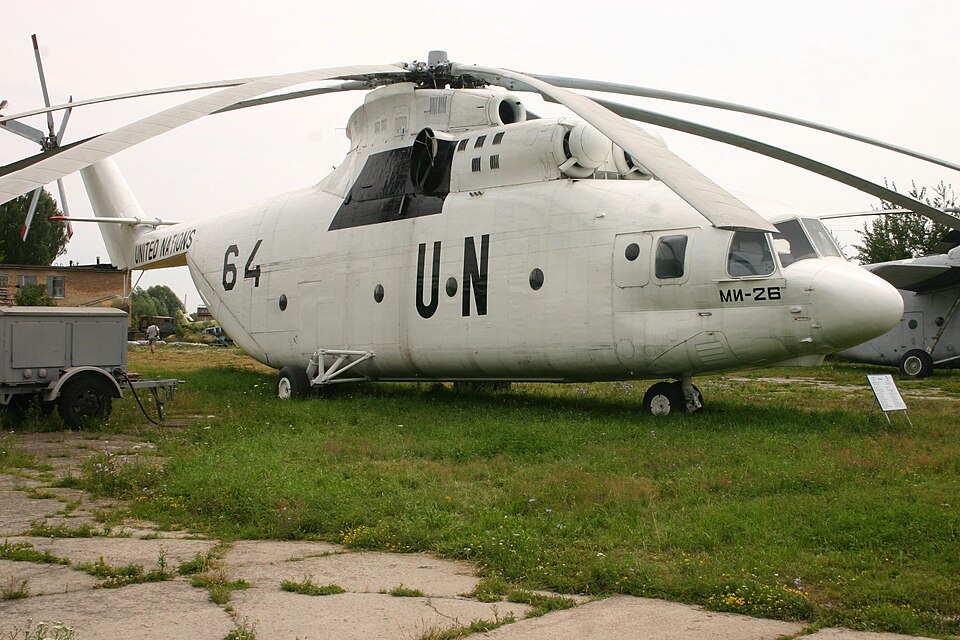
1. Mil Mi-26 — The World's Largest Production Helicopter
The Mi-26 is in a league of its own. Built by Russia's Mil helicopter design bureau and first introduced in 1983, it remains the largest and most powerful helicopter ever to reach mass production.
Key specs:
- Max takeoff weight: 123,500 lbs (56,000 kg)
- Max payload: 44,000 lbs (20,000 kg)
- Rotor diameter: 105 ft (32 m)
- Length: 131 ft 2 in (40 m)
- Engines: Two Lotarev D-136 turboshafts, 22,480 shp combined
The Mi-26 can carry up to 150 battle-ready troops or 60 medical stretchers. Its cargo hold is roughly the same size as the interior of a Lockheed C-130 military transport plane. It has been used to lift a frozen wooly mammoth out of Siberia, deliver equipment to Chernobyl, and recover U.S. military helicopters from mountain ranges in Afghanistan.
As of 2024, it still holds the FAI world record for the greatest mass lifted by a helicopter to 2,000 meters — a record set in 1982. This aircraft is truly the pinnacle of the most powerful helicopter in the world.
2. Mil Mi-10 — The Flying Crane
The Mi-10, codenamed "Harke" by NATO, was developed in 1962 as a specialized flying crane. It shares the same engines, transmission, and rotor system as the Mi-6, but its fuselage was redesigned to focus on external cargo operations.
Key specs:
- Max takeoff weight: 96,340 lbs (43,700 kg)
- Max external payload: 33,070 lbs (15,000 kg)
- Length: 107 ft (32.86 m)
Its wide-track, four-legged landing gear lets the Mi-10 straddle large cargo on the ground and lift it directly — a design feature unique to its era. It was used to install power lines, transport drilling rigs to remote oilfields, and carry prefabricated buildings. A specialized version with a shorter undercarriage could carry platform payloads of up to 33,000 lbs.
3. Mil Mi-6 — The Record-Breaker
The Mi-6, introduced in 1957, was the world's largest and fastest production helicopter when it first flew. It won the prestigious Sikorsky Trophy in 1961 after becoming the first helicopter to exceed 186 mph (300 kph) in level flight.
Key specs:
- Max takeoff weight: 93,700 lbs (42,500 kg)
- Internal cargo capacity: 26,400 lbs (12,000 kg)
- Rotor diameter: 114 ft 10 in (35 m)
- Engines: Two Soloviev D-25V turboshafts, 11,000 shp combined
The Mi-6 could carry up to 90 passengers or 70 fully equipped airborne troops. It served extensively with the Soviet military and was critical in disaster response operations, including the Chernobyl nuclear accident. The Mi-26 was specifically designed to replace it — but the Mi-6 laid the groundwork for everything that followed.
4. Sikorsky CH-53K King Stallion — America's Heaviest Helicopter
The CH-53K is the newest and most powerful helicopter in the U.S. military's fleet. Designed for the U.S. Marine Corps, it replaces the older CH-53E and delivers a massive jump in capability.
Key specs:
- Max takeoff weight: ~88,000 lbs (39,916 kg)
- Payload: 36,000 lbs (16,329 kg) external
- Length: ~99 ft (30.2 m)
- Engines: Three General Electric T408-GE-400 turboshafts
The King Stallion can carry a Joint Light Tactical Vehicle or a Light Armored Vehicle, a feat no previous U.S. helicopter could manage. Its wider cargo bay accommodates larger vehicles internally, and it can carry a 12,200-lb load over 110 nautical miles in high and hot conditions. As part of its role among top U.S. military helicopters, it is designed to operate from amphibious assault ships and deliver equipment directly to shore.
Fun fact: The CH-53K produces three times the payload of its predecessor, the CH-53E, thanks to its three upgraded GE engines.
5. Bell Boeing V-22 Osprey — The Tiltrotor Giant
The V-22 Osprey is a unique aircraft — it takes off and lands like a helicopter, but then tilts its engines to fly like a turboprop airplane. This makes it faster and longer-ranged than any traditional helicopter on this list.
Key specs:
- Max takeoff weight (self-deploy): 60,500 lbs (27,443 kg)
- Internal payload: ~20,000 lbs (9,072 kg)
- External payload: ~15,000 lbs (6,804 kg)
- Top speed: ~275 knots (316 mph)
The Osprey is used by the U.S. Marine Corps, Air Force, and Navy. It can carry 24 combat troops, refuel in the air, and land on ships or rough terrain. Its terrain-following radar makes it capable of low-altitude night missions in hostile environments.
6. Boeing CH-47F Chinook — The Tandem Rotor Workhorse
The CH-47 Chinook is one of the most recognizable helicopters in the world. Its twin rotor design — one at the front, one at the rear — gives it exceptional lift stability and range. The "F" variant is the most advanced version to date.
Key specs:
- Max takeoff weight: 50,000 lbs (22,680 kg)
- External payload: 26,000 lbs (11,793 kg)
- Length: ~99 ft (30.2 m)
- Engines: Two Lycoming T55 turboshafts
The Chinook has served in every major U.S. military conflict since Vietnam. It is also used extensively in civilian roles, especially in disaster relief, firefighting, and construction. As one of the most capable best transport helicopters in the world, it continues to operate in over 20 countries. Its ability to carry 155 mm howitzers at speeds up to 161 mph while maintaining stability is a testament to its engineering.
7. Sikorsky CH-53E Super Stallion — The Old Guard
Before the King Stallion arrived, the CH-53E Super Stallion was the heaviest helicopter in the Western world. It remains in active service today, valued for its proven reliability and heavy payload in naval and expeditionary roles.
Key specs:
- Max takeoff weight: ~73,500 lbs (33,340 kg)
- Max payload: up to 32,000 lbs (14,515 kg)
- Engines: Three General Electric T64 turboshafts
The Super Stallion played critical roles in humanitarian missions, including Hurricane Katrina relief and the 2010 Haiti earthquake response. It can carry up to 16 tons over distances of 500 nautical miles. The CH-53E also served as the benchmark for what its replacement, the CH-53K, was designed to surpass — and exceed it did, by a wide margin.
Flying411 covers the full spectrum of military aviation — from powerful rotorcraft like the Super Stallion to the latest combat systems. Check out the complete guide to top attack helicopters in the world for more deep-dive comparisons.
8. Sikorsky S-64 Skycrane — The Precision Lifter
The S-64 Skycrane, also known as the Erickson Air-Crane, is a highly specialized heavy-lift helicopter designed specifically for external cargo operations. It has no enclosed cargo bay — just a powerful airframe optimized entirely for lift.
Key specs:
- Max takeoff weight: ~42,000 lbs (19,051 kg)
- External sling load: ~20,000 lbs (9,072 kg)
- Engines: Two Pratt & Whitney JFTD12 turboshafts
The Skycrane is famous in firefighting circles for its retractable snorkel system, which lets it scoop up water directly from lakes and rivers mid-flight. Its center-spine airframe design reduces payload shift — critical for precise placement of heavy objects. It has been used to install ski gondola towers, lift HVAC systems onto skyscrapers, and remove downed aircraft from remote locations.
9. AgustaWestland AW101 — Europe's Heavy-Lift Champion
A joint venture between Westland Helicopters (UK) and Leonardo (Italy), the AW101 is one of the most capable medium-heavy helicopters in the Western world. Known in its military version as the Merlin, it is in service with over a dozen nations.
Key specs:
- Max takeoff weight: ~32,187 lbs (14,600 kg)
- Max payload: ~13,200 lbs (5,987 kg) internal
- Length: 64 ft (19.5 m)
- Top speed: 192 mph (309 kph)
The AW101 can carry 26 troops in its standard configuration, with UK variants accommodating up to 45. It has served in anti-submarine warfare, search and rescue, and VIP transport. Its three-engine design provides strong redundancy — an essential quality for over-water and night operations. Nine AW101s laid end-to-end would match the length of Russia's Typhoon-class submarine, the biggest submarine ever built.
10. Aérospatiale SA 321 Super Frelon — A French Legend
The Super Frelon ("Super Hornet" in French) was once Europe's most powerful helicopter. Built from 1962 to 1981 by Aérospatiale, it served with air forces across France, China, South Africa, Greece, and Indonesia.
Key specs:
- Max takeoff weight: ~28,660 lbs (13,000 kg)
- Payload: ~11,023 lbs (5,000 kg)
- Length: 75 ft (23 m)
- Top speed: 171 mph (275 kph)
- Engines: Three Turbomeca Turmo turboshafts
The Super Frelon was a trailblazer for European heavy helicopter design. It operated in anti-submarine warfare, maritime patrol, and heavy transport roles. China's fleet of Super Frelons, designated the Z-8, remained in active service for decades after France retired its own. Though no longer in front-line use in most countries, the Super Frelon set the foundation for European heavy helicopter development.
What Makes a Helicopter "Big"? Breaking Down the Specs
When people ask about the biggest helicopters in the world, they can mean different things. Here is how the key metrics actually break down:
| Term | What It Means |
| Maximum Takeoff Weight (MTOW) | Total weight of the aircraft at the moment it leaves the ground, including fuel, crew, and cargo |
| Payload | Weight of cargo or passengers the helicopter can carry |
| Rotor Diameter | Width of the main rotor blade sweep — bigger rotors = more lift potential |
| Sling/External Load | Weight that can be carried hanging below the aircraft on a cable |
MTOW is the fairest single number for ranking size, because it accounts for the total weight of everything — including the aircraft itself. A helicopter with a massive payload but lightweight frame might not rank as high in MTOW, even if it is a capable machine.
Military vs. Civilian Giants: Who Uses These Helicopters?
Most of the biggest helicopters in the world are military aircraft. That is no coincidence. Military requirements drive the extreme engineering needed to build aircraft this large.
Military users include:
- U.S. Marine Corps — CH-53K King Stallion, CH-53E Super Stallion
- U.S. Army — CH-47F Chinook
- Russian Military — Mi-26, Mi-6, Mi-10
- French Air Force — SA 321 Super Frelon
- NATO Allies — AW101, NH90
Civilian and commercial uses include:
- Firefighting — S-64 Skycrane, Mi-26
- Construction — S-64, Mi-10, Chinook variants
- Offshore oil and gas — S-92, Super Puma
- Disaster relief — Mi-26, Chinook, Super Stallion
If you are interested in large-rotor aircraft for non-military purposes, there is also a growing market for private and executive helicopters. From VIP transport to long-range corporate travel, modern rotorcraft deliver comfort and capability that few people realize exists. You can read more about the world's best helicopters for private use to see what the civilian market looks like at the top end.
If you are passionate about aviation and want to stay informed about aircraft performance, models, and rankings, Flying411 is the resource built for you — dive into the full library of guides and comparisons today.
How These Helicopters Are Powering Modern Aviation
The helicopters on this list are not just historical curiosities. Several of them are in active production or service right now, and they are shaping the future of both military and civilian aviation.
The CH-53K King Stallion is currently being delivered to the U.S. Marine Corps. The CH-47F Chinook Block II variant is in production with new avionics and systems. The Mi-26 is still being built and operated in updated T2 variants with modern digital autopilots and navigation systems.
These platforms continue to evolve because the need for heavy-lift capacity does not go away. Whether it is moving disaster relief into a remote island, repositioning equipment on an offshore platform, or transporting military assets in a high-threat environment, only a helicopter of this scale can do the job.
Conclusion
The top 10 biggest helicopters in the world are a remarkable lineup of human engineering at its most ambitious. From the record-smashing Mil Mi-26 to the precision-focused S-64 Skycrane, every aircraft on this list was built to do what smaller machines simply cannot. They lift the impossible, fly into the unreachable, and perform when the stakes are at their highest.
Aviation at this scale is humbling. And the more you learn about these machines, the more respect you develop for the engineers, test pilots, and military operators who made them real. If this article got your rotors spinning, there is a lot more where this came from.
Ready to go deeper into the world of aviation? Flying411 has the guides, rankings, and expert breakdowns to take your knowledge to the next level — because the sky is never really the limit.
Frequently Asked Questions
What is the biggest helicopter ever built?
The Mil V-12 (also called the Mi-12) holds the record as the largest helicopter ever constructed, with a maximum takeoff weight of 231,500 lbs (105,000 kg). However, it was only ever built as a prototype and never entered production.
Which is the largest helicopter currently in production?
The Mil Mi-26 is the largest helicopter currently in production and active service, with a maximum takeoff weight of 123,500 lbs (56,000 kg) and a payload capacity of up to 44,000 lbs.
How many people can the biggest helicopter carry?
The Mil Mi-26 can carry up to 150 battle-ready soldiers or 60 medical stretchers in its cargo configuration, making it the highest-capacity passenger rotorcraft in service.
What is the difference between payload and maximum takeoff weight?
Maximum takeoff weight (MTOW) is the total weight of the helicopter when it leaves the ground, including the aircraft itself, fuel, crew, and cargo. Payload refers only to the weight of the cargo or passengers being carried.
Are any of the world's biggest helicopters available for civilian use?
Yes — several large military helicopters have civilian variants or are available for commercial operations. The S-64 Skycrane, for example, is actively used in firefighting and construction under the Erickson Air-Crane brand. The Chinook also has civilian variants used in logging and cargo transport.