When it comes to moving people and cargo through the sky, not all helicopters are created equal. Some hover gracefully over city rooftops, ferrying executives to airports. Others haul artillery guns up mountain ridges in the middle of a combat zone. And some — the real giants of the sky — can lift entire military vehicles off the ground and carry them for miles without breaking a sweat.
Transport helicopters are the backbone of modern aviation, military logistics, disaster relief, and offshore energy operations. They are the reason supplies reach remote villages after earthquakes, why oil rig crews can switch out shifts safely, and why armies can reposition heavy equipment faster than any ground convoy could ever manage. The best transport helicopter in the world is not a single, easy answer — it depends on what you need to do and where you need to do it. But a handful of machines have earned their place at the top through raw performance, proven track records, and remarkable versatility.
This guide ranks and reviews the top 10 best transport helicopters in the world, covering their key specs, real-world roles, and what makes each one stand apart from the rest.
Key Takeaways
The best transport helicopters in the world range from heavy-lift giants like the Mil Mi-26 — which holds the FAI world record for the greatest mass lifted by a helicopter — to versatile mid-range workhorses like the Boeing CH-47 Chinook, the Sikorsky UH-60 Black Hawk, and the Airbus H225 Super Puma. Each excels in a different mission profile, from battlefield logistics and disaster relief to offshore oil transport and VIP travel. The "best" title depends entirely on what the mission demands.
| Helicopter | Country of Origin | Approx. Max Payload | Primary Role |
| Mil Mi-26 | Russia | Up to 20 tonnes | Heavy military/civil lift |
| Boeing CH-47F Chinook | USA | Up to ~11,000 kg | Military troop and cargo |
| Sikorsky CH-53K King Stallion | USA | Up to ~16,000 kg | USMC heavy assault lift |
| Sikorsky UH-60 Black Hawk | USA | Up to ~4,000 kg | Multi-role tactical utility |
| Airbus H225 Super Puma | France | Up to ~4,500 kg | Offshore and SAR |
| Sikorsky S-92 | USA | Up to ~4,500 kg | Offshore oil and gas |
| Airbus H175 | France | Up to ~2,500 kg | Offshore and EMS |
| Bell 412EPI | USA/Canada | Up to ~2,600 kg | Utility and military |
| Leonardo AW101 Merlin | UK/Italy | Up to ~5,000 kg | Naval and transport |
| Eurocopter AS332 Super Puma | France | Up to ~4,000 kg | Civil and military utility |
Note: Payload figures are approximate and vary by variant, configuration, altitude, and operating conditions.
Flying411 covers everything rotorcraft enthusiasts and aviation professionals need to stay informed — from beginner pilot guides to deep dives on the world's most powerful machines.
Why Transport Helicopters Matter More Than You Think
Transport helicopters do not get as much attention as their attack or rescue counterparts. There is something flashy about a gunship. But the transport helicopter is often the unsung hero of any operation.
Think about it this way. A military unit can have all the firepower in the world, but if supplies, fuel, and personnel cannot reach them quickly, that firepower becomes useless. A disaster zone can have thousands of volunteers on standby, but if roads are washed out and runways are flooded, nothing moves without a helicopter. Transport helicopters fill the gap between what ground vehicles can do and what the mission actually demands.
Why It Matters: Transport helicopters are the primary vehicle for humanitarian aid delivery in remote or disaster-affected areas. They can access locations that no other aircraft — and certainly no truck — can reach safely.
In the oil and gas industry, helicopters ferry crews to and from offshore platforms every single day. In construction, heavy-lift helicopters place HVAC units on skyscraper rooftops and erect antenna towers on mountaintops. The range of what transport helicopters do in the real world is far wider than most people realize.
What Separates a Great Transport Helicopter From a Good One
Before diving into the rankings, it helps to understand what actually makes one transport helicopter better than another. The answer is rarely just "it lifts more stuff."
The Four Pillars of Transport Helicopter Performance
Payload capacity is the most obvious metric. How much weight can the helicopter carry internally — troops, cargo, equipment — or externally on a sling hook? More capacity means fewer trips and faster mission completion.
Range and fuel efficiency determine how far a helicopter can fly on a full tank without stopping. In offshore operations or long-range military logistics, range can be the difference between a mission that works and one that requires risky mid-route refueling.
High-altitude performance matters more than most people expect. At elevation, air is thinner. Engines produce less power, and rotor blades generate less lift. The best transport helicopters maintain useful payload capacity even in mountainous or high-altitude environments. For a deeper look at high-altitude aviation, the article on why a helicopter cannot fly to the top of Everest explains these limits clearly.
Versatility and mission adaptability round out the picture. A helicopter that can only do one job well is a liability the moment that job changes. The best transport helicopters can switch between troop transport, MEDEVAC, disaster relief, and external lift with minimal modification.
Pro Tip: When comparing helicopters, always check real-world payload at altitude and in high-temperature conditions, not just the sea-level maximum printed in the spec sheet. Performance drops significantly as heat and elevation increase.
The 10 Best Transport Helicopters in the World
The helicopters below represent the best of what the world has to offer across every major transport category — heavy military lift, offshore crew operations, tactical utility, and everything in between.
Each one earned its spot through a combination of real-world performance, operational history, and the kind of versatility that keeps it relevant mission after mission. Some are giants that defy what you thought a helicopter could carry. Others win through reliability, range, and the trust of operators across dozens of countries.
Here is how they rank.
1. Mil Mi-26 — The World's Heaviest Production Helicopter
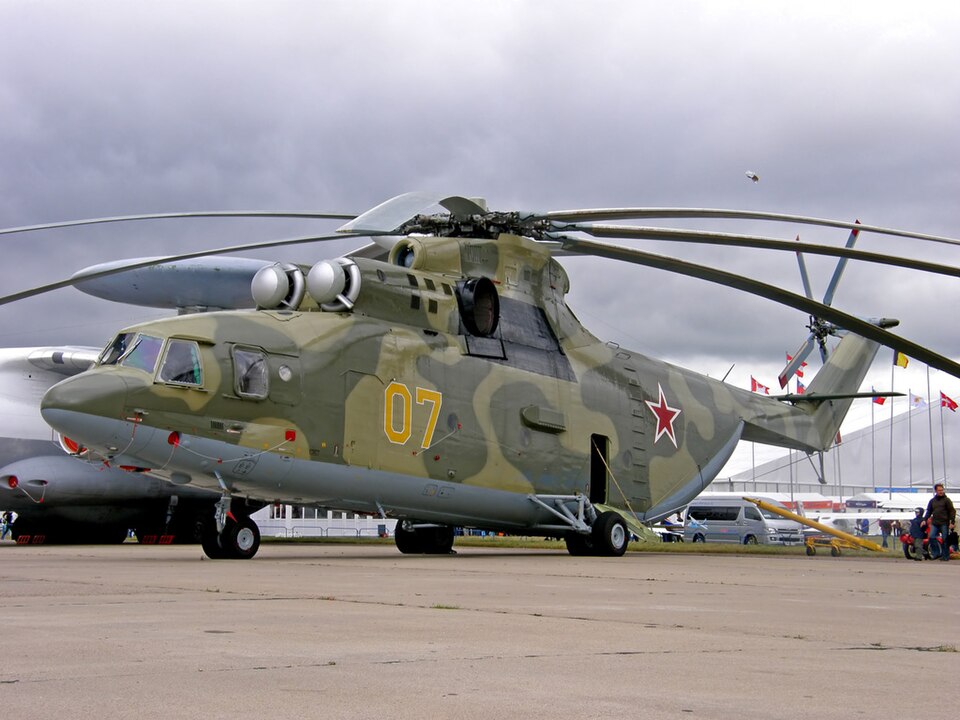
The Mil Mi-26, known by its NATO reporting name "Halo," is in a category of its own. Developed in the Soviet Union and still operated by Russia and several other nations today, it remains the largest helicopter ever to enter serial production.
Its eight-bladed main rotor spans roughly 32 meters — almost as wide as the wingspan of a regional jet. Its cargo hold is large enough to swallow a pair of infantry fighting vehicles, and its maximum external lift capacity is commonly cited at around 20 tonnes. As of 2024, the Mi-26 still holds the Fédération Aéronautique Internationale world record for the greatest mass lifted by a helicopter to 2,000 metres.
The Mi-26 has served in some of the most demanding missions imaginable — from Chernobyl disaster containment operations to airlifting a frozen woolly mammoth out of the Siberian tundra for scientific study. Its sheer capacity makes it irreplaceable for tasks that no other rotorcraft in the world can handle.
Fun Fact: The Mi-26 was once used to transport a mammoth preserved in frozen soil — believed to be tens of thousands of years old — from remote Siberia to a laboratory. The block of frozen ground encasing the mammoth is said to have weighed around 23 tonnes.
Key specs (approximate):
- Max takeoff weight: ~56,000 kg
- External lift: up to ~20,000 kg
- Crew: 5
- Role: Heavy military and civil cargo
2. Boeing CH-47F Chinook — The Most Proven Heavy-Lift Workhorse
Few helicopters in history have matched the CH-47 Chinook for longevity, global reach, and consistent battlefield performance. Originally developed by Vertol and now manufactured by Boeing Defense, Space & Security, the Chinook is a heavy-lift helicopter that is the second-heaviest lifting Western helicopter.
Its tandem-rotor design — two rotors fore and aft instead of one main and one tail rotor — gives it a practical advantage. No power is wasted on a tail rotor, meaning more engine output goes directly into lift. Powered by two Honeywell T55-GA-714A turboshaft engines, the CH-47 Chinook can reach speeds of up to 170 knots and has a maximum operational range of approximately 400 nautical miles.
The H-47 Chinook is the heavy-lift helicopter of choice for the U.S. Army and 20 international operators, excelling in cargo and troop transport, search and rescue, casualty evacuation, special operations, and disaster relief. Its rear ramp allows large vehicles and palletized cargo to be rolled on and off quickly, which is critical for time-sensitive military operations.
The modern CH-47F Block II adds structural improvements, redesigned fuel tanks, and an enhanced drivetrain that extends range while increasing lift margins. With over six decades of continuous service, the Chinook has proven itself in Vietnam, the Falklands, Afghanistan, and dozens of other operational theatres.
Good to Know: The CH-47 Chinook's tandem rotor design also means it has no tail rotor clearance limits when loading from the rear, making it easier to land and load on unprepared terrain and tight mountain plateaus.
Key specs (approximate):
- Max payload (internal): up to ~10,000 kg
- External lift: up to ~11,000 kg
- Max speed: up to ~315 km/h
- Role: Troop and cargo transport, MEDEVAC, disaster relief
3. Sikorsky CH-53K King Stallion — The U.S. Marines' Heavy Lifter
The CH-53K King Stallion is the newest and most capable member of the CH-53 family, and it sets a new benchmark for Western heavy-lift capability. With a payload of around 36,000 pounds, the CH-53K exceeds the lifting power of its predecessor, the CH-53E, by a wide margin. Built to support expeditionary and distributed operations, it can carry a substantial load over 110 nautical miles in high and hot conditions.
Powered by three General Electric T408-GE-400 engines, the King Stallion offers increased power, better fuel efficiency, and reduced emissions. Its wider cargo bay accommodates larger vehicles internally, which reduces the vulnerability that comes with external sling loads during combat operations.
The CH-53K is designed for the U.S. Marine Corps' concept of distributed maritime operations — moving heavy equipment across vast stretches of ocean and delivering it precisely where it is needed, even in contested or degraded environments.
Key specs (approximate):
- External lift: up to ~16,000 kg
- Engines: 3 x GE T408
- Role: USMC expeditionary heavy assault lift
4. Sikorsky UH-60 Black Hawk — The World's Most Versatile Utility Helicopter
If the Mi-26 is the muscle and the Chinook is the backbone, the UH-60 Black Hawk is the Swiss Army knife of transport helicopters. Introduced in the late 1970s to replace the UH-1 Huey, the Black Hawk has become one of the most widely operated military helicopters on the planet.
Its payload capacity is more modest than the heavy-lifters above — roughly 4,000 kg internally — but its combination of speed, reliability, battlefield survivability, and adaptability is unmatched in its class. It can carry around 11 fully equipped soldiers internally, operate as a MEDEVAC platform, perform search and rescue, or sling-load external cargo. Advanced variants have been adapted for special operations with enhanced avionics and terrain-following radar.
Keep in Mind: The Black Hawk's true strength is not raw lift capacity — it is operational flexibility. Its airframe has been adapted into more than 30 variants, each tailored to a specific mission set, from maritime operations to firefighting.
The UH-60 has seen service in virtually every major conflict since its introduction, and it remains in production and active service with dozens of nations. For pilots just entering the world of rotorcraft, understanding aircraft like the Black Hawk helps put the breadth of helicopter capabilities in context — the guide to the best helicopters for beginner pilots is a good starting point.
Key specs (approximate):
- Payload: up to ~4,000 kg internal
- Max speed: ~294 km/h
- Role: Tactical utility transport, MEDEVAC, SAR, special ops
5. Airbus H225 Super Puma — The Offshore Industry Standard
The Airbus H225 Super Puma has long been the helicopter of choice for offshore oil and gas operations in the North Sea and beyond. It combines twin-engine reliability, long range, and all-weather avionics in a package that oil companies and emergency services operators trust for demanding overwater missions.
With a range of around 857 km and the ability to carry up to 19 passengers in its standard configuration, the H225 bridges the gap between the medium utility class and the true heavy-lift segment. Its four-axis autopilot, advanced navigation, and icing protection systems make it well suited for the challenging weather conditions typical of offshore environments.
It is also widely used in search and rescue, serving with coast guards and naval aviation units across Europe, Asia, and the Americas.
Heads Up: The H225 faced a temporary grounding in parts of Europe following accidents in 2016 that prompted a review of its gearbox design. Airbus implemented design changes and the type returned to widespread service, but operators in safety-critical roles should always verify current airworthiness directives.
Key specs (approximate):
- Passengers: up to 19
- Range: ~857 km
- Role: Offshore crew transport, SAR, military utility
6. Sikorsky S-92 — Smooth, Safe, and Ready for Offshore
The Sikorsky S-92 is another pillar of the offshore helicopter industry. A favorite in offshore oil and gas operations, the S-92 is known for its smooth ride, modern avionics, and reliable performance. It is certified to some of the most demanding offshore operating standards in the world, including Category A performance requirements that allow it to continue safe flight and landing after an engine failure.
The S-92 is also widely used for VIP and head-of-state transport, as well as search and rescue with multiple coast guard and military operators. Its spacious cabin, low vibration levels, and advanced health and usage monitoring system make it a preferred choice when passenger comfort and mission reliability both matter.
Flying411 has in-depth resources for anyone curious about rotorcraft safety and operations — from understanding how to approach a helicopter safely to exploring advanced aviation topics.
Key specs (approximate):
- Passengers: up to 19
- Max payload: ~4,500 kg
- Role: Offshore crew transport, VIP, SAR
7. Leonardo AW101 Merlin — Europe's Multi-Role Heavyweight
The Leonardo AW101 Merlin is one of the most capable medium-heavy transport helicopters in service anywhere in the world. Jointly developed by Agusta (now Leonardo) and Westland Helicopters, it serves with the armed forces of the United Kingdom, Italy, Portugal, Denmark, Japan, and several other nations.
Its three-engine configuration provides exceptional power and redundancy. In the transport role, the Merlin can carry up to 30 troops or around 5,000 kg of internal cargo. In the maritime role, it carries sonar, torpedoes, and anti-ship missiles. In the VVIP configuration, it has served as the presidential helicopter for the United States under the designation VH-71 — a program that was later cancelled, but it speaks to the platform's pedigree.
Fun Fact: The AW101 Merlin was selected as the replacement presidential helicopter for the U.S. before the program was cancelled due to cost and requirement changes. The decision highlighted just how competitive the top tier of transport helicopter performance has become globally.
Key specs (approximate):
- Troops: up to 30
- Payload: up to ~5,000 kg
- Role: Military transport, naval ASW, VIP, SAR
8. Bell 412EPI — The Reliable Workhorse for Smaller Missions
The Bell 412EPI is a proven twin-engine utility helicopter that punches well above its weight class in terms of operational usefulness. It is a development of the iconic Bell 212, itself a descendant of the legendary UH-1 Huey. This lineage means the 412 family benefits from decades of operational refinement.
Its Pratt & Whitney Canada PT6T-9 Twin Pac engine system drives a distinctive two-blade, semi-rigid rotor system that is both mechanically simple and highly reliable. The 412EPI variant adds a Full Authority Digital Engine Control (FADEC) system and an electronic engine display that significantly reduce pilot workload.
Used by militaries, police forces, emergency medical services, and corporate operators worldwide, the Bell 412EPI fits comfortably into operations where a medium utility helicopter is needed but a heavy-lift platform would be overkill.
Quick Tip: The Bell 412 family's mechanical simplicity and global parts availability make it one of the easiest transport helicopters to support in remote or resource-limited operating environments — an important factor for operators in developing regions.
Key specs (approximate):
- Passengers: up to 13
- Payload: up to ~2,600 kg
- Role: Utility transport, EMS, military, law enforcement
9. Airbus H175 — The Modern Medium with an Eye on the Future
The Airbus H175 represents the next generation of medium-category transport helicopters. Designed with offshore crew transport as its primary market, the H175 seats up to 16 passengers in a cabin that rivals business class on a regional airline in terms of comfort and noise levels.
Its Helionix avionics suite — one of the most advanced glass cockpit systems in the civil helicopter market — integrates navigation, engine management, and health monitoring into a streamlined pilot interface. The H175 also features a full fly-by-wire flight control system, which reduces pilot workload and improves handling in demanding conditions.
Its range of around 800 km makes it competitive with the H225 Super Puma for North Sea and Gulf of Mexico offshore routes, while its lower operating costs make it attractive to operators looking to balance capability with economics.
Key specs (approximate):
- Passengers: up to 16
- Range: up to ~800 km
- Role: Offshore crew transport, SAR, EMS
10. Eurocopter AS332 Super Puma — The Classic That Refuses to Age
The AS332 Super Puma, the predecessor to the H225, remains in widespread service around the world and earns its place on this list through sheer longevity and adaptability. First introduced in the early 1980s, it has been operated by more than 40 countries in roles ranging from offshore crew transport and SAR to VIP travel and military utility.
Its twin Turbomeca Makila engines and four-blade main rotor deliver dependable performance across a wide range of conditions. While newer designs have surpassed it in some areas of technology and efficiency, the Super Puma's established maintenance network, well-understood handling characteristics, and large global fleet mean it will remain operational for many years to come.
Good to Know: The AS332 Super Puma has been operated by royalty, heads of state, and military forces across six continents. Its wide adoption in both civil and military markets speaks to a level of versatility that few helicopter types achieve in a single airframe generation.
Key specs (approximate):
- Passengers: up to 19
- Payload: up to ~4,000 kg
- Role: Offshore, VIP, military utility, SAR
How to Choose the Right Transport Helicopter for Your Mission
Picking the right transport helicopter is not simply a matter of finding the biggest or the fastest. Every mission has a different set of constraints, and the aircraft that checks all the boxes for one job may be completely wrong for another.
Key Questions to Ask Before Selecting a Transport Helicopter
Start with payload and volume requirements. A heavy external lift job in construction calls for a very different aircraft than ferrying oil workers to a platform 200 km offshore.
Consider the operating environment. High altitude, extreme heat, maritime exposure, and arctic cold all affect performance differently. A helicopter that performs well at sea level may struggle at 10,000 feet. Factors like these — and why altitude is so consequential for rotorcraft — are explored in the resource on why a helicopter cannot fly to Everest's summit.
Think about range and refueling logistics. For offshore operations, range is often the determining factor. For tactical military missions, the ability to refuel in-flight may extend effective range further than tank size alone.
Weigh operating costs and support infrastructure. A helicopter is only as good as the ability to keep it flying. Spare parts availability, trained technicians, and established maintenance programs matter enormously in remote or resource-constrained environments.
Finally, factor in weather and avionics requirements. Flying in IMC (instrument meteorological conditions) demands helicopters with certified IFR avionics, autopilots, and weather radar — capabilities not every transport helicopter offers as standard.
Thinking about dipping into helicopter aviation more broadly? The community at Flying411 has resources to help at every level of experience.
Pro Tip: Always request a mission analysis from the operator or manufacturer before committing to an aircraft type. Real-world performance at your specific altitude, temperature, and payload combination often differs from published maximum figures.
Transport Helicopters vs. Tiltrotors: Is the Future Already Here?
No discussion of the best transport helicopters in the world is complete without acknowledging the tiltrotor. The Bell V-280 Valor — winner of the U.S. Army's Future Long-Range Assault Aircraft (FLRAA) competition — blurs the line between helicopter and fixed-wing aircraft. The V-280 offers a cruising speed of 280 knots, nearly double that of conventional helicopters, along with a range of over 900 nautical miles.
The civilian AgustaWestland AW609 tiltrotor takes a similar approach to the executive and offshore market. The AgustaWestland AW609 reaches speeds of up to 275 mph, making it among the fastest civilian VTOL aircraft on the market. It combines vertical lift with fixed-wing cruise performance in a package that can carry around 9 passengers.
Tiltrotors are not yet a replacement for conventional transport helicopters across the board. Their mechanical complexity, higher acquisition cost, and different handling characteristics mean that traditional helicopters remain the dominant choice for most transport missions today. But as programs like the V-280 mature, the definition of what a "transport helicopter" is may look very different by the end of this decade.
Why It Matters: The Bell V-280 Valor program represents the first serious candidate to replace the UH-60 Black Hawk after more than four decades of dominance. Its speed and range advantages could fundamentally change how armies move troops and equipment in the 2030s and beyond.
A Quick Note on Safety and Unusual Conditions
Transport helicopters regularly operate in challenging and sometimes dangerous environments. Understanding how unusual conditions affect these aircraft is part of being an informed operator or enthusiast. Severe weather events like lightning strikes are a concern in many operating theatres — an in-depth explanation of what happens if a helicopter gets struck by lightning covers what the risks actually are and how modern aircraft are designed to handle them.
Similarly, understanding the proper way to approach a helicopter is essential for anyone who works near them on the ground — a subject that is more nuanced and safety-critical than it might first appear.
Heads Up: Even the most capable transport helicopter in the world depends on well-trained ground crews and passengers who understand basic safety protocols. Rotorwash, tail rotor hazards, and proper boarding procedures are not things to learn on the job.
Conclusion
The title of best transport helicopter in the world does not belong to a single aircraft. It belongs to a category of machines that between them represent some of the most impressive engineering achievements in aviation history. The Mil Mi-26 wins on raw lifting power. The CH-47 Chinook wins on versatility and proven longevity. The CH-53K King Stallion wins on cutting-edge military capability. The S-92 and H225 win on offshore reliability. And so on down the list — each helicopter earns its place by excelling where it is asked to.
What unites all of them is a purpose: moving things and people to places they could not reach any other way, in conditions that would stop any ground vehicle cold. These machines save lives, sustain military operations, power entire industries, and push the limits of what rotorcraft can do.
If you want to keep exploring the world of helicopters — from single-seat personal aircraft to the largest production rotorcraft ever built — Flying411 is the place to do it. Whether you are just getting started or already deep into aviation, Flying411 has the guides, insights, and practical knowledge to take your understanding to the next level.
Frequently Asked Questions
What is the largest transport helicopter in the world?
The Mil Mi-26 is widely regarded as the largest helicopter ever to enter serial production. Its cargo capacity and lifting capability have not been matched by any other production helicopter to date.
What is the most widely used military transport helicopter?
The Sikorsky UH-60 Black Hawk is among the most widely operated military transport helicopters globally, serving with armed forces in dozens of countries across a wide range of mission roles.
How fast can a transport helicopter fly?
Speed varies significantly by type. Most conventional transport helicopters cruise in the range of roughly 250 to 310 km/h. Tiltrotor aircraft like the V-22 Osprey and the AgustaWestland AW609 can fly considerably faster, approaching the speed of small turboprop aircraft.
Can civilians own or charter transport helicopters?
Yes. Many transport helicopter types, particularly medium-class aircraft like the Sikorsky S-92, Bell 412, and Airbus H175, are operated by commercial charter companies for offshore crew transport, executive travel, and emergency medical services.
What is the difference between a utility helicopter and a transport helicopter?
The terms are often used interchangeably, but utility helicopters typically refer to smaller, multi-role aircraft optimized for tactical flexibility, while transport helicopters usually emphasize payload capacity and cargo-carrying ability. In practice, many aircraft serve both roles depending on how they are configured.